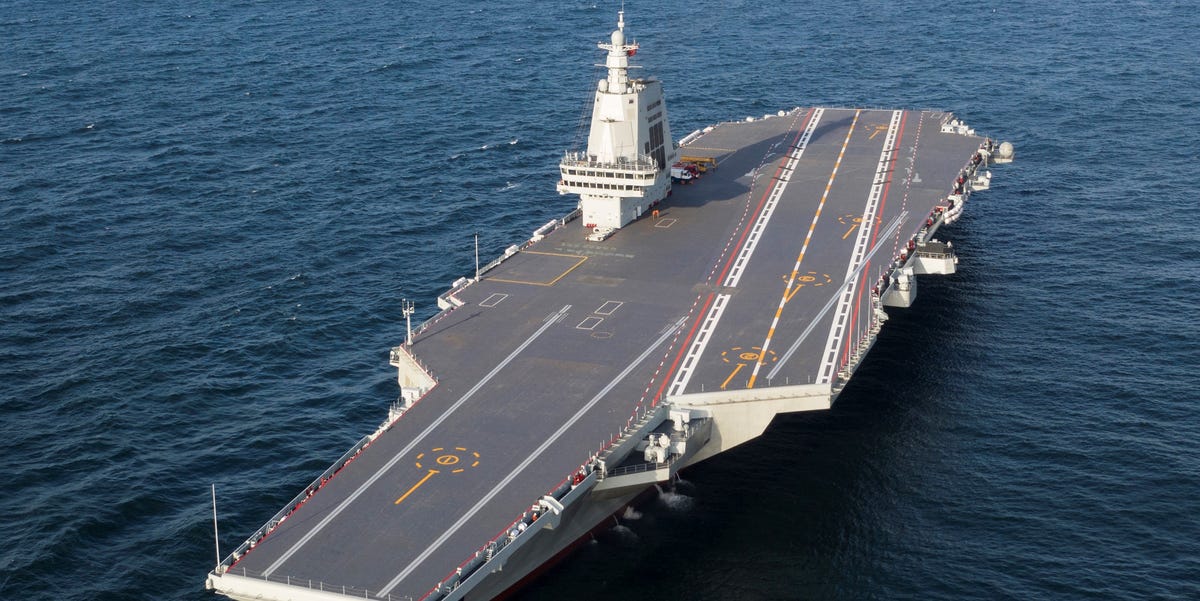
Aircraft carriers are the floating skyscrapers of naval power: part airport, part military base, part geopolitical megaphone. When one appears near a crisis zone, diplomats suddenly check their calendars, generals sharpen pencils, and news anchors discover the phrase “carrier strike group” all over again. So when China commissioned the Fujian, its third and most advanced aircraft carrier, the obvious question surfaced: can China’s aircraft carriers ever match U.S. Navy supercarriers?
The honest answer is: technologically, China is closing parts of the gap faster than many expected. Operationally, the United States still holds a massive lead. A carrier is not just a ship with airplanes on top. It is a system of systems: reactors, catapults, pilots, escorts, logistics ships, maintenance crews, doctrine, satellites, submarines, and decades of hard-earned muscle memory. Buying the piano is one thing. Playing Rachmaninoff during a thunderstorm is another.
The Current Scoreboard: Three Chinese Carriers vs. Eleven U.S. Supercarriers
China currently has three aircraft carriers: Liaoning, Shandong, and Fujian. The first two are ski-jump carriers derived from Soviet-style design concepts. They can launch fighters, but the ski-jump system limits how much fuel and weaponry those aircraft can carry. That matters because a fighter with less fuel and fewer weapons is like a delivery truck leaving the warehouse half-loaded and already low on gas.
The Fujian changes the conversation. It is China’s first domestically designed flat-deck carrier and its first to use catapult-assisted takeoff and arrested recovery, commonly called CATOBAR. More importantly, it uses electromagnetic catapults, placing it in the same launch-technology conversation as the U.S. Navy’s Ford-class carriers. This allows heavier aircraft, including early-warning planes and potentially stealth fighters, to launch with more fuel and payload.
The U.S. Navy, however, operates the world’s largest carrier force. Its Nimitz-class and Gerald R. Ford-class nuclear-powered carriers are roughly 100,000-ton supercarriers designed for long deployments, high sortie generation, and global power projection. The Ford class adds electromagnetic launch systems, advanced arresting gear, new power generation, improved weapons handling, and reduced crew requirements compared with earlier carriers.
Why U.S. Supercarriers Are Still in a Different League
Nuclear Propulsion Is a Big Deal
One of the largest differences between Chinese aircraft carriers and U.S. Navy supercarriers is propulsion. U.S. carriers are nuclear-powered. That does not mean they can ignore food, jet fuel, spare parts, or tired sailors, but it does mean the ship itself can operate for years without conventional refueling. Nuclear propulsion gives U.S. carriers speed, endurance, electrical power, and strategic flexibility.
The Fujian is conventionally powered. It is an impressive ship, but it cannot match the endurance of a nuclear-powered Ford or Nimitz-class carrier. In regional operations near China’s coast, this may not matter as much. In blue-water deployments across the Indian Ocean, Middle East, or Atlantic, it matters a lot. A carrier that needs more frequent refueling needs more support, more planning, and more protection for its logistics chain.
Air Wing Size and Maturity
The U.S. Navy has spent generations perfecting carrier aviation. American carrier air wings include F/A-18E/F Super Hornets, EA-18G Growlers, E-2D Hawkeyes, MH-60 helicopters, and increasingly F-35C stealth fighters. These aircraft are not just parked on deck for patriotic wallpaper. They are integrated into a combat system built around surveillance, electronic warfare, air defense, strike, refueling, and command-and-control.
China is developing a more serious carrier air wing. The Fujian is expected to operate aircraft such as the J-15T, J-15D electronic warfare variant, J-35 stealth fighter, KJ-600 airborne early-warning aircraft, helicopters, and unmanned systems. That is a major step forward. The KJ-600 is especially important because airborne early warning is the carrier’s long-distance eyesight. Without it, a carrier is peeking through a keyhole in a boxing match.
Still, aircraft types are only part of the story. U.S. naval aviation has deep experience launching, recovering, maintaining, and coordinating large air wings under stressful conditions. China is learning quickly, but it is still building the human and institutional experience required for sustained high-tempo carrier operations.
The Fujian: China’s Biggest Leap Yet
The Fujian is the clearest sign that China does not want a ceremonial navy. It wants a combat navy that can operate farther from home, defend sea lanes, pressure Taiwan, project power into the South China Sea, and eventually compete in wider oceans. Compared with Liaoning and Shandong, the Fujian is a generational leap.
Its electromagnetic catapults give Chinese naval aviation a tool it never had before: the ability to launch heavier and more diverse aircraft from a carrier deck. That means longer range, better payloads, and more useful support aircraft. The move from ski-jump carriers to electromagnetic catapults is not a small upgrade. It is more like going from a bicycle ramp to a professional airport runway, except the runway is moving, wet, crowded, and surrounded by ocean.
But new technology creates new headaches. The United States discovered this with the Ford class. EMALS and Advanced Arresting Gear promised major improvements, but they also faced development, reliability, and cost challenges. China will likely face its own learning curve. Launching a few aircraft successfully is different from conducting months of complex flight operations in bad weather, contested waters, and high-maintenance conditions.
Where China Could Catch Up
Shipbuilding Speed
China’s biggest advantage may be industrial capacity. Its shipbuilding sector is enormous, and the People’s Liberation Army Navy has expanded rapidly across destroyers, frigates, amphibious ships, submarines, and support vessels. If China continues building carriers, escorts, and logistics ships at scale, it could narrow the numerical and regional gap.
The Defense Department has assessed that China wants a much larger carrier fleet by the mid-2030s. Whether China reaches that goal is uncertain, but the ambition is clear. Beijing is no longer experimenting with carriers as prestige objects. It is building the foundation for carrier strike groups.
Regional Geography
China does not need to match the U.S. Navy everywhere to create serious problems in the Indo-Pacific. It needs enough carrier capability, missile coverage, submarines, land-based aircraft, satellites, and maritime militia pressure to complicate U.S. operations near Taiwan, the East China Sea, and the South China Sea.
This is where geography helps China. U.S. carriers must often cross vast distances to reach a crisis zone. China can operate closer to home, under the umbrella of land-based aircraft, anti-ship missiles, sensors, and coastal infrastructure. In a regional conflict, a Chinese carrier might not need to behave like an American carrier in the Persian Gulf. It might support blockade operations, extend air defense, protect surface groups, or complicate U.S. access.
Where China Still Trails Badly
Operational Experience
The United States has operated large-deck aircraft carriers in war, crisis, deterrence missions, humanitarian relief, and global presence operations for decades. American sailors know the brutal rhythm of carrier life: night landings, maintenance cycles, flight deck choreography, underway replenishment, and multi-carrier coordination. That experience cannot be downloaded like a software patch.
China’s carrier force is still young. Its pilots and deck crews are improving, and the PLAN has conducted more complex exercises, including dual-carrier operations with Liaoning and Shandong. Still, the difference between training and combat is enormous. Combat punishes assumptions. It also punishes people who put coffee too close to sensitive electronics, but that is another matter.
Logistics and Overseas Support
A supercarrier is only as useful as the network that sustains it. The United States has global bases, allied ports, replenishment ships, repair infrastructure, and long-practiced procedures for keeping carriers forward-deployed. China has improved its far-seas operations, including anti-piracy missions and overseas military access, but it does not yet have a comparable global logistics network.
For China to match U.S. Navy supercarriers, it would need not only nuclear carriers and advanced air wings, but also the support architecture to keep them operating far from home. That means oilers, ammunition ships, repair ships, friendly ports, overseas agreements, and crews trained to sustain operations for months under pressure.
The Carrier Strike Group Problem
A carrier rarely fights alone. A U.S. carrier strike group typically includes cruisers or destroyers, submarines, logistics ships, and an air wing. The carrier is the star of the movie, but the escorts are the stunt team, security crew, lighting department, and insurance policy.
China has built powerful escorts, especially Type 055 large destroyers and modern Type 052D destroyers. These ships give the PLAN better air defense, missile firepower, and blue-water escort capability. But integrating escorts, submarines, aircraft, satellites, cyber systems, and command networks into a smooth combat machine takes years of realistic training.
The United States has made mistakes and paid for lessons over many decades. China is trying to compress that learning curve. It may succeed in some areas, especially because it can study U.S. practices, satellite imagery, open-source reporting, and lessons from modern conflicts. But there is still no shortcut for doing hard things at sea repeatedly until they become boring. In carrier operations, boring is beautiful.
Can China Match the Ford Class?
Matching the Ford class ship-for-ship would require China to build nuclear-powered carriers with similar displacement, electrical generation, aircraft capacity, sortie generation, survivability, and integrated combat systems. It would also require matching the U.S. Navy’s training culture, pilot pipeline, maintenance depth, carrier air wing maturity, and logistics reach.
China may eventually build a nuclear-powered carrier, often discussed by analysts as a future Type 004. If that ship appears with electromagnetic catapults, advanced sensors, and a large air wing, the technical gap will narrow. But even then, one carrier does not equal a mature carrier force. The United States has multiple carriers, decades of doctrine, global infrastructure, and combat-tested procedures.
By the 2030s, China could field carriers that are highly capable in the Western Pacific and dangerous in regional scenarios. That is not the same as matching the U.S. Navy globally. A regional challenger can be extremely serious without being a worldwide equal.
What This Means for Taiwan and the Indo-Pacific
The most immediate strategic impact of China’s aircraft carrier program is not a future carrier duel in the middle of the Pacific. It is the pressure carriers can add around Taiwan and nearby seas. Chinese carriers can help extend air coverage, train for blockade-like operations, and complicate intervention by outside forces.
The Fujian gives China more options. With catapult-launched early-warning aircraft and stealth fighters, the PLAN can experiment with operations farther from shore. This could make Chinese exercises more realistic and more politically intimidating. It also gives Beijing a symbol of national power that plays well domestically. Nothing says “great power status” quite like a giant carrier, unless it is a giant carrier with a fighter jet launching dramatically at sunset.
For the United States and its allies, the lesson is not panic. It is adaptation. U.S. planners must assume that China’s carriers will become more capable, more active, and better integrated with missiles, submarines, cyber tools, and space-based sensors. The answer is not simply building more carriers. It is improving distributed operations, submarines, unmanned systems, long-range missiles, resilient logistics, and allied coordination.
Experience-Based Analysis: What Watching This Carrier Race Teaches Us
One practical experience from following aircraft carrier development is that people often focus too much on the ship and not enough on the ecosystem. A carrier’s silhouette is easy to understand. It is big, dramatic, and looks like a floating city with attitude. But the real power is hidden in routines: how quickly crews fuel aircraft, move weapons, repair engines, coordinate radar tracks, recover aircraft at night, and resupply at sea.
In that sense, the comparison between Chinese aircraft carriers and U.S. Navy supercarriers is like comparing two sports teams by looking only at stadium size. The stadium matters, but championships come from coaching, conditioning, playbooks, travel logistics, and how players perform when the scoreboard is ugly. China has built a larger and better stadium with the Fujian. The United States still has the deeper league experience.
Another lesson is that technology can change status quickly, but mastery changes slowly. The Fujian is proof that China can absorb, adapt, and leap ahead in specific technologies. Electromagnetic catapults were once treated as a club with only one member: the U.S. Navy. Now China has entered that club. That should not be dismissed. At the same time, every advanced system creates maintenance, training, and reliability demands. A catapult is not just a launch button; it is a maintenance culture wearing steel-toed boots.
There is also a psychological experience in watching this race. U.S. observers sometimes swing between two bad habits: assuming China is ten feet tall, or assuming it is still decades behind. Both views are lazy. China’s carrier program has real limitations, especially in nuclear propulsion, combat experience, logistics, and large-scale air wing integration. But its progress is real. The Fujian is not a parade float. It is a serious military platform.
The best way to understand the future is to separate “matching” into categories. Can China match U.S. carriers in regional relevance? Possibly, and sooner than many would like. Can China match specific technologies such as electromagnetic launch? It already has in broad terms. Can China match the U.S. Navy’s global carrier system, including nuclear propulsion, sortie generation, logistics, allies, maintenance, doctrine, and combat experience? Not soon.
For readers, the most useful takeaway is that aircraft carriers are not obsolete simply because missiles are dangerous, and they are not invincible simply because they are enormous. They remain valuable because they move airpower across oceans without needing permission to use a runway. They remain vulnerable because modern sensors, submarines, missiles, drones, and cyber operations make the ocean less forgiving. The future carrier contest will not be a simple “carrier versus carrier” duel. It will be a contest between networks.
If China keeps building, training, and learning, its carrier force will become a major factor in Indo-Pacific security. If the United States wants to preserve its lead, it must treat that lead as something to maintain, not something inherited from history like an old family sofa. Supercarrier dominance is not permanent. It is earned every deployment, every maintenance cycle, every training evolution, and every budget fight that somehow manages to be less graceful than a carrier landing in bad weather.
Conclusion: Can China Ever Match U.S. Navy Supercarriers?
China can narrow the aircraft carrier gap. It may eventually build nuclear-powered carriers, expand its carrier fleet, develop more advanced air wings, and train crews capable of complex operations far from home. The Fujian proves that China’s naval ambitions are serious and that its shipbuilding industry can produce world-class platforms.
But matching U.S. Navy supercarriers is not just about building big ships. It is about sustaining a global carrier ecosystem. The United States still leads in nuclear propulsion, carrier numbers, combat experience, sortie generation, logistics, allied access, and integrated strike group operations. China may become a formidable regional carrier power in the 2030s. Becoming a true global peer to the U.S. carrier force will take far longer.
So, can China’s aircraft carriers ever match U.S. Navy supercarriers? In selected technologies, yes. In regional impact, increasingly yes. In total global naval aviation power, not yetand probably not soon. The race is real, but the finish line keeps moving.