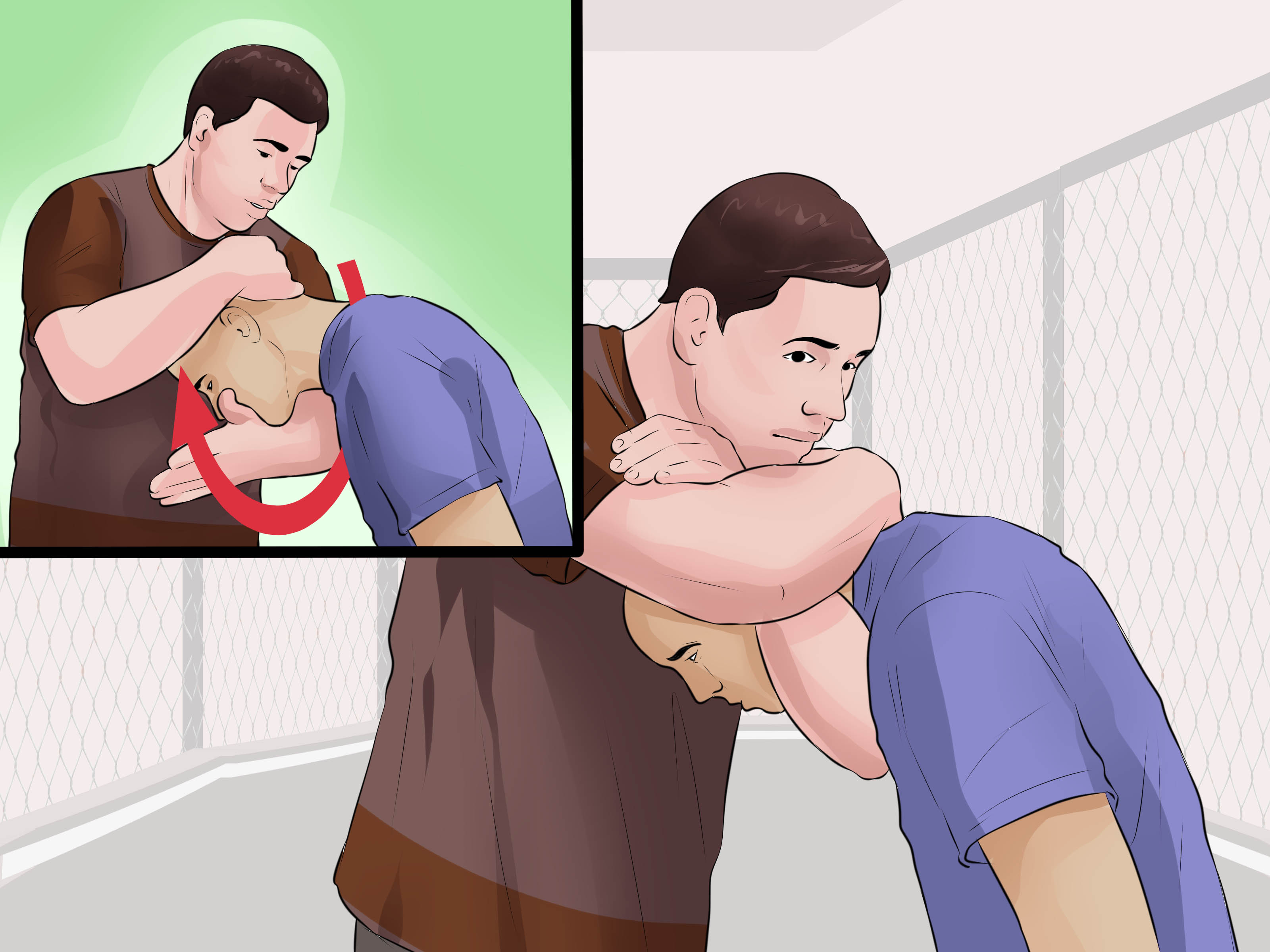
The guillotine choke is one of Brazilian Jiu-Jitsu’s most recognizable submissions. Even people who cannot tell half guard from half-and-half creamer have probably seen one during an MMA fight: a fighter changes levels, the neck becomes exposed, and suddenly everyone watching the screen starts yelling, “Watch the guillotine!”
Its popularity comes from versatility. Guillotine-style attacks appear in Brazilian Jiu-Jitsu, submission grappling, and mixed martial arts, and competitors have successfully used them from standing exchanges, scrambles, guard positions, and front-headlock situations. The technique also has numerous variations, three of the best-known being the traditional no-arm guillotine, the arm-in guillotine, and the high-elbow guillotine commonly associated with Marcelo Garcia.
Important safety note: A guillotine is a neck-compression submission capable of restricting blood flow, airflow, or both. Because incorrect or prolonged application can cause serious injury, the descriptions below explain the three variations conceptually rather than providing pressure, leverage, grip-tightening, or finishing instructions. Practical guillotine training should take place in a reputable martial-arts gym under direct supervision from a qualified coach.
What Is a Guillotine Choke?
In grappling terminology, a guillotine generally refers to a front-facing submission in which a competitor controls an opponent’s head and neck with the arms. ESPN’s MMA glossary describes the guillotine as a submission applied while facing the opponent and controlling beneath the neck, while modern BJJ instruction treats the guillotine as a family of techniques rather than one rigid move.
That distinction matters. Saying “the guillotine” is a little like saying “the sandwich.” Technically correct, but the details can vary dramatically.
Some guillotine variations isolate primarily the neck. Others incorporate one of the opponent’s arms. Some emphasize positional control, while others are associated with fast submission opportunities during transitions. Successful grapplers also use front-headlock control to create positional advances rather than stubbornly hanging onto a submission that is disappearing.
This adaptability explains why the guillotine survives at every level of grappling. It appears in beginner classes, professional BJJ tournaments, and elite MMA. UFC, ESPN, ONE Championship, and other combat-sports outlets have documented numerous high-level fights decided by guillotine submissions.
1. The Traditional No-Arm Guillotine
What Makes This Variation Different?
The traditional version is what most beginners imagine when somebody says “guillotine choke.” Conceptually, the attacker controls the opponent’s head and neck while the opponent’s arm remains outside the primary control structure.
Because the neck is comparatively isolated, this version can produce a very immediate submission threat when properly established by a trained practitioner. It can also disappear remarkably quickly when the position is poor. That creates one of the first important lessons beginners learn about guillotines: grabbing somebody’s head is not the same thing as having a good guillotine.
Technical grappling sources consistently describe the submission as highly position-dependent. A practitioner who concentrates entirely on squeezing may burn out the arms while simultaneously allowing the opponent to improve position. In other words, enthusiastic biceps are not a substitute for good jiu-jitsu.
Where Grapplers Encounter It
Students commonly encounter traditional guillotine situations during front-headlock exchanges, takedown scrambles, standing clinches, and guard transitions. Professional MMA provides plenty of visible examples because an athlete changing levels for a takedown may temporarily expose the head and neck.
Brian Ortega’s submission of Cub Swanson is a famous competitive example. ESPN reported that Ortega secured a standing guillotine during their 2017 UFC bout and forced the tap in the second round. Anthony Pettis, Nate Diaz, Jim Miller, and many other professional fighters have also recorded significant guillotine victories.
What Beginners Should Learn From It
The safest useful lesson is not “squeeze harder.” It is understanding positional awareness. Students should learn when a front-headlock position is stable, when the opponent is escaping, and when abandoning the submission is smarter than clinging to it like it owes them money.
A responsible coach will also emphasize immediate release when a training partner taps verbally or physically. There is no prize for finding out how long somebody can tolerate neck compression during Tuesday-night practice.
2. The Arm-In Guillotine
How the Arm-In Version Changes the Position
In the arm-in guillotine, one of the opponent’s arms is incorporated into the controlled space along with the head and neck. That apparently small change can substantially alter the character of the position.
Compared with the no-arm variation, the arm-in guillotine may offer additional upper-body control but generally demands different alignment and positional understanding. Experienced competitors often develop strong preferences between these variations based on body type, strategy, and the situations they frequently encounter.
BJJ instructional sources frequently contrast the arm-in variation with the high-elbow guillotine rather than declaring one universally superior. The better choice depends heavily on positioning and the athlete’s broader grappling system.
Why Control Matters
The arm-in configuration illustrates an important principle that applies throughout Brazilian Jiu-Jitsu: submissions work better when they grow naturally out of control.
Beginners sometimes see a neck and immediately launch a submission attempt. More experienced grapplers tend to evaluate the surrounding position first. Where is the opponent’s weight? Can the opponent improve position? Is the attacker maintaining balance? Is the submission actually developing, or is everybody merely participating in an aggressive group hug?
This mindset makes the arm-in guillotine valuable even when no submission occurs. Front-headlock and head-and-arm controls can influence posture, movement, and transitions. That means a practitioner can use the position as part of a larger sequence rather than treating every guillotine attempt as an all-or-nothing event.
The Big Beginner Mistake
The most common conceptual error is relying on upper-body strength instead of learning positioning.
New grapplers are understandably tempted to pull harder when something is not working. Unfortunately, failed submissions are not stubborn pickle jars. More effort does not automatically solve the problem.
Repeatedly forcing an imperfect choke also increases unnecessary stress on both training partners. In supervised drilling, the better approach is controlled repetition, feedback from an instructor, and immediate release whenever a partner taps or reports discomfort.
3. The High-Elbow Guillotine
The Variation Associated With Marcelo Garcia
The high-elbow guillotine is one of the most celebrated modern variations. It is closely associated with legendary Brazilian Jiu-Jitsu competitor Marcelo Garcia, whose success helped popularize the configuration among generations of no-gi grapplers.
BJJ Heroes lists the guillotine among Garcia’s signature techniques and notes his exceptional competitive accomplishments, including multiple ADCC and IBJJF World Championship titles. Its historical ADCC analysis also credits Garcia with numerous guillotine finishes. BJJ Fanatics and other grappling publications commonly refer to the high-elbow variation as the “Marcelotine.”
What Makes It Recognizable?
As the name suggests, the configuration is visually distinguished by a higher supporting-arm position compared with many traditional guillotines. That change affects control and defensive possibilities, which is why elite practitioners treat the variation as considerably more sophisticated than simply grabbing the head and pulling.
The high-elbow guillotine demonstrates an interesting truth about advanced grappling: the visible movement may look simple while the underlying positioning is anything but simple.
Watch a world-class athlete and everything looks effortless. Try reproducing the same movement without understanding the details and suddenly your limbs appear to have been installed by a furniture company that forgot half the instructions.
Why It Requires Proper Coaching
Because effective high-elbow positioning can create powerful neck compression, this is particularly unsuitable for unsupervised experimentation. Instruction should focus first on safe positioning, partner communication, recognition of the tap, controlled resistance, and knowing when to disengage.
Watching competition footage can help students understand when elite athletes recognize opportunities, but a highlight reel is not a substitute for hands-on coaching. Professional fighters and black belts have accumulated thousands of hours of supervised practice that are conveniently missing from the 15-second clip on social media.
Blood Chokes, Air Chokes, and Why the Difference Matters
Martial artists often casually divide neck submissions into “blood chokes” and “air chokes.” The terminology describes whether compression primarily interferes with circulation through vessels in the neck or with the airway, although real-world applications may involve a combination of forces.
From a medical perspective, external compression of the neck deserves considerably more respect than casual gym terminology sometimes suggests. NCBI’s StatPearls review explains that strangulation can interfere with cerebral oxygen delivery through compression of cervical blood vessels or obstruction of the airway.
Research specifically involving Brazilian Jiu-Jitsu has also documented uncommon but significant complications. Published medical reports describe cervical artery dissections and strokes associated with neck trauma during grappling, and a 2026 sports-medicine case report described a BJJ practitioner who sustained a thyroid-cartilage fracture requiring surgery.
These reports do not mean that every properly supervised choke causes serious injury. They do mean that deliberately treating unconsciousness as an ordinary training objective is a terrible idea.
How to Train Guillotine Variations More Safely
Train With Qualified Supervision
Learn submissions at an established BJJ, submission-grappling, or MMA academy where an experienced instructor can observe your positioning. Online information is useful for terminology and conceptual study, but it cannot see that your arm is misplaced, your partner is uncomfortable, or both of you have somehow rotated into a position resembling modern sculpture.
Tap Early During Practice
Tapping is not losing during technical training. It is the communication system that lets two people practice potentially dangerous techniques repeatedly while dramatically reducing unnecessary risk.
If a choke feels established, tap. Do not make unconsciousness the test for whether the technique “really worked.” ESPN has interviewed professional fighters who lost consciousness after attempting to resist chokes, demonstrating how quickly the situation can move beyond voluntary control.
Release Immediately
The attacking partner should release as soon as a physical or verbal tap occurs. That expectation needs to be automatic. If somebody cannot be trusted to respect a tap, that person should not be practicing submission holds on other people’s necks.
Use Progressive Resistance
Technical drilling should begin cooperatively. Resistance can gradually increase as both partners understand the position and the instructor approves progression.
Trying to “win” every repetition defeats the purpose of drilling. Practice is where athletes build recognition, timing, transitions, and judgmentnot where they collect imaginary championship belts.
Know When Symptoms Need Medical Attention
Persistent or severe neck pain following neck compression should not simply be dismissed as toughness training. Medical evaluation is especially important if symptoms include unusual headache, dizziness, weakness, numbness, difficulty speaking or swallowing, breathing difficulty, visual disturbances, or other neurological changes.
Both Cleveland Clinic and Johns Hopkins note that carotid artery dissection may follow neck injury and can lead to serious complications including stroke. Symptoms may not always appear immediately.
If someone becomes unresponsive or has difficulty breathing, treat the situation as an emergency and seek immediate medical help. MedlinePlus recommends emergency response when a person collapses, cannot breathe, or becomes unresponsive.
Common Guillotine Mistakes to Avoid
Trying to Muscle Everything
If your forearms are exhausted after every guillotine drill, there is a good chance strength is compensating for technical problems. Efficient grappling aims to make positioning do more of the work.
Ignoring the Rest of the Body
The opponent is not merely a floating neck. Their hips, arms, legs, posture, and ability to change position still matter. Tunnel vision causes grapplers to sacrifice dominant positions while chasing questionable submissions.
Refusing to Abandon a Failed Attempt
One of the biggest improvements intermediate practitioners make is learning when to let go. A submission attempt that has lost its positional foundation can quickly become an escape opportunity for the opponent.
Training Through a Tap
Never do it. A tap ends the exchange.
Experimenting on Untrained Friends
A guillotine choke is not a party trick. Do not practice neck submissions on friends, siblings, coworkers, or anybody who has not knowingly agreed to supervised martial-arts training.
Why the Guillotine Remains Important in Modern Grappling
The guillotine remains relevant because it connects naturally to positions that occur constantly in wrestling-heavy grappling. Front headlocks, takedown attempts, scrambles, seated guards, and transitions between standing and ground positions all create situations where athletes must understand guillotine threats.
Its effectiveness is not merely theoretical. UFC records include guillotine victories by competitors across numerous weight classes, while ONE Championship has historically ranked it among its most frequent submissions. Modern UFC events continue to feature the technique, confirming that it has hardly become an antique museum piece of jiu-jitsu.
But perhaps the strongest reason to study the guillotine is defensive. Even athletes who rarely attack with it need to recognize the position because opponents certainly will.
Training-Floor Experience: What Practitioners Commonly Discover About the Guillotine
Real mat experience tends to change how grapplers think about this submission. Beginners often arrive believing the guillotine is basically a strength contest. Somebody’s head appears, you grab it, squeeze like you’re carrying twelve grocery bags in one trip, and wait for applause.
Then they start rolling with experienced practitioners.
Suddenly the same guillotine that felt unstoppable against another beginner seems completely useless. The experienced partner stays calm, changes position, and escapes while the beginner’s arms turn into overcooked spaghetti.
That experience teaches lesson number one: position usually matters more than squeezing power.
After several months of training, practitioners often begin recognizing that guillotine opportunities appear during movement rather than after everybody stops. A partner changes levels, turns during a scramble, works up from the mat, or temporarily exposes the head while changing position. The experienced grappler recognizes the pattern earlier rather than reacting after the opportunity has nearly disappeared.
Lesson number two is therefore timing beats desperation.
Another common learning experience happens when students fall in love with the submission. For a few weeks they try guillotines against absolutely everybody. White belts, blue belts, the coach, perhaps the innocent grappling dummy sitting in the corner.
This phase can actually be useful because specialization builds pattern recognition. Eventually, however, partners start anticipating the attack. Now the student must learn follow-up positions, transitions, andmost painfullywhen to abandon the guillotine altogether.
That produces lesson number three: a submission is stronger when it belongs to a system.
An athlete who sees the guillotine as only a finishing move has one option. An athlete who understands the surrounding front-headlock game may have several positional choices when the submission disappears.
Students also learn quickly that different guillotine variations suit different situations. Some people naturally become comfortable with arm-in control. Others gravitate toward no-arm configurations. Students who study footage of Marcelo Garcia often become fascinated by the high-elbow variation, partly because his competitive success made something technically complicated look suspiciously easy. Historical ADCC analysis credits Garcia with repeated guillotine success against elite opposition, illustrating how deeply a specialist can develop one submission family.
Perhaps the most valuable experience, however, is learning to tap without ego. New students sometimes feel that tapping is admitting defeat. After enough training, they realize the opposite: tapping is what allows people to train tomorrow.
You tap, reset, ask what happened, and try again.
That cycleattempt, tap, analyze, repeatis how technical knowledge actually develops. Nobody needs to prove bravery by staying in a neck submission until the room starts disappearing.
The best training partners are not the people who squeeze hardest. They are the ones who provide realistic resistance while remaining controlled enough that both athletes can learn. Likewise, the best guillotine practitioners are often not visibly straining. Their advantage comes from recognition, positioning, timing, and thousands of repetitions under qualified supervision.
Ultimately, experience teaches that the guillotine is less of a single trick and more of an interconnected grappling position. The traditional no-arm guillotine, arm-in guillotine, and high-elbow variation are three branches of that larger system. Understanding their differences gives students a better vocabulary for studying BJJ while reminding them that sophisticated submissions demand sophisticated safety habits.
Conclusion
The traditional guillotine, arm-in guillotine, and high-elbow guillotine represent three of the most recognizable approaches within the broader guillotine family. Each changes the relationship between head control, arm control, positioning, and defensive options.
For beginners, however, the most important goal should not be collecting three new ways to squeeze somebody’s neck. It should be learning why the positions differ, recognizing them during supervised practice, understanding when to transition away, and respecting the risks associated with neck compression.
The guillotine has remained successful from local BJJ academies to major professional MMA events precisely because it is versatile. Treat it as a technical system instead of a strength contest, practice only with informed partners and qualified supervision, release immediately when somebody taps, and leave the “I’ll see if I can survive it” experiments to action movies.