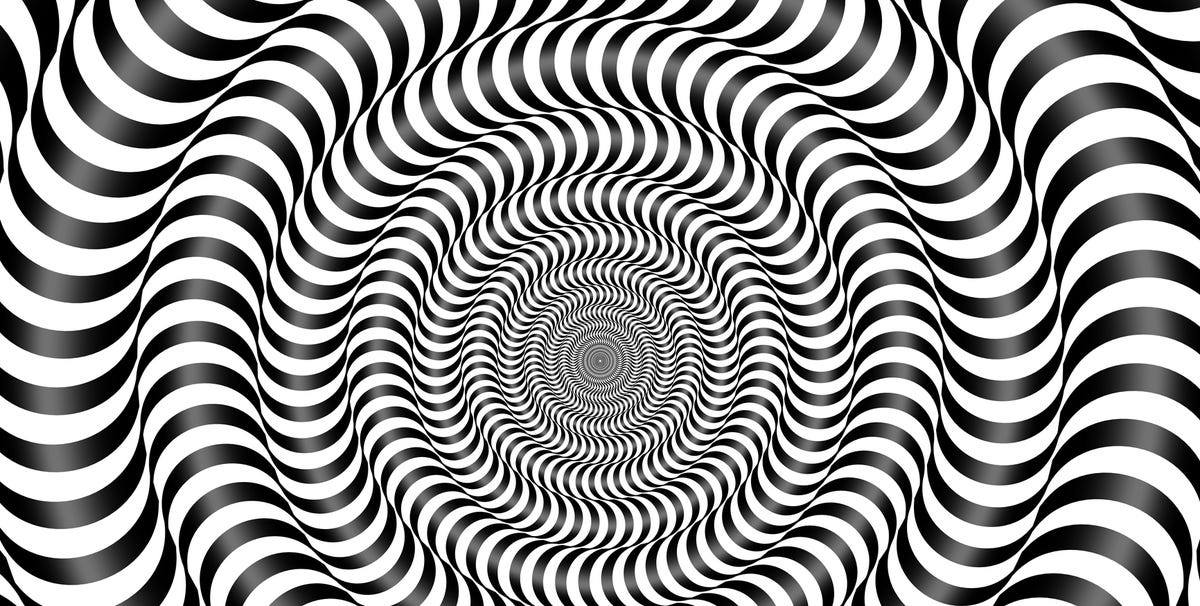
Optical illusion pictures are the internet’s favorite tiny betrayal. You look at a picture for three seconds, feel extremely confident about what you see, and then discover your brain has been confidently freelancing without supervision. A line that looks longer is not longer. A gray square is not darker. A triangle appears even though nobody drew one. Somewhere, your visual system is wearing a trench coat and whispering, “Trust me, I’ve got this.”
The best optical illusions do more than make people squint at their screens. They reveal how visual perception works. Your eyes collect light, contrast, color, edges, and motion. Your brain then turns that messy pile of information into a useful story about the world. Usually, this system is excellent. It helps you catch a ball, avoid walking into a lamp post, and locate the snack aisle with heroic efficiency. But optical illusion pictures exploit the shortcuts built into that system.
Below are ten of the trippiest and most memorable visual illusions, along with a plain-English explanation of why each one can make reality feel briefly negotiable.
Why Optical Illusion Pictures Fool the Brain
An optical illusion is not simply a bad picture or a visual prank. It is a mismatch between what is physically present and what you experience. The image sends one set of information to your eyes, but your brain interprets that information using context, expectation, perspective, contrast, and past experience.
Think of vision as a high-speed prediction engine. The retina receives a flat, two-dimensional image, yet you experience a world with depth, solid objects, lighting, motion, distance, and recognizable faces. To pull off that trick, the brain makes educated guesses. Most of the time, those guesses are incredibly useful. In illusion pictures, however, the visual system uses a familiar rule in the wrong situation. The result is a picture that seems to move, bend, flip, glow, shrink, stretch, or hide an object in plain sight.
The funniest part is that knowing an illusion is fake rarely makes it stop working. You can measure the two lines. You can inspect the pixels. You can tell your brain, “These circles are identical.” Your brain may respond with the confidence of a cat ignoring an important email: “Interesting. They still look different.”
The 10 Best, Trippiest Optical Illusions
1. The Checker Shadow Illusion
The checker shadow illusion is a masterpiece of visual sass. It usually shows a checkerboard with a shadow falling across it. Two squares that look dramatically different in brightness are actually the same shade. One seems light because it appears to sit in shadow, while the other seems dark because it appears to sit in direct light.
Your brain is not merely judging color. It is also trying to estimate lighting conditions. In everyday life, a white shirt in shade and a white shirt in sunshine can send very different light signals to your eyes, but you still recognize both as white. The illusion hijacks that useful talent. Your visual system “corrects” for the shadow, and suddenly two matching squares look like they belong in different paint cans.
2. The Müller-Lyer Illusion
Two equal-length lines can look wildly different when arrow-like fins are attached to their ends. A line with outward-pointing fins may look longer, while the same line with inward-pointing fins may look shorter. Congratulations: a couple of tiny arrowheads have just out-argued your ruler.
One reason this illusion is so powerful is that the brain pays close attention to angles and depth cues. The fins can resemble corners in a three-dimensional space, and your visual system may interpret them as clues about distance. Even on a flat screen, the brain starts building a little room around the lines. Once depth sneaks into the picture, perceived length can shift right along with it.
3. The Ponzo Illusion
The Ponzo illusion often looks like two identical horizontal lines placed between railroad tracks. Because the tracks appear to converge in the distance, the upper line seems farther away. If it is farther away but still takes up the same amount of space on your retina, your brain assumes it must be larger.
That is why the upper line can seem longer even though both lines are physically equal. The illusion is built on a practical visual rule: distant objects usually need to be bigger in the real world to look the same size as closer objects. A flat drawing of rails is enough to convince your brain that it is standing on a train platform, apparently late for a very confusing journey.
4. The Ebbinghaus Illusion
In the Ebbinghaus illusion, two center circles are the same size, but they are surrounded by circles of different sizes. The center circle ringed by smaller circles tends to look larger. The center circle surrounded by giant circles tends to look smaller. Context has entered the chat and immediately started causing trouble.
This optical illusion picture demonstrates that your sense of size is relative. Your brain does not judge an object in a vacuum; it compares it with nearby objects. That comparison is useful in everyday life, but it can be manipulated with a few carefully placed circles. It is also why the same plate of food can look generous on a small plate and suspiciously lonely on a platter the size of a satellite dish.
5. The Kanizsa Triangle
The Kanizsa triangle is proof that your brain is happy to finish other people’s drawings. A few incomplete circular shapes and angled fragments are arranged in a way that suggests a white triangle. No actual triangle outline exists, yet many viewers clearly see one floating on top of the background.
This is known as an illusory contour. The visual system is extremely good at detecting edges and completing partly hidden objects. In normal life, that ability helps you recognize a dog behind a fence or a car partly blocked by a tree. In the Kanizsa triangle, your brain sees the clues, fills in the missing edges, and presents you with a shape that is technically imaginary but visually undeniable.
6. The Hermann Grid Illusion
The Hermann grid illusion is a deceptively simple arrangement of black squares separated by white lines. When you glance around the grid, grayish dots may appear at intersections that you are not looking at directly. Try staring right at one of the ghostly spots, and it may vanish like a magician who forgot to renew the lease.
This illusion shows how peripheral vision handles contrast differently from direct vision. Your visual system processes the center of your gaze with more precision than the edges of your field of view. As a result, the high-contrast intersections can create temporary dark smudges or gray patches in your peripheral vision. The grid is not changing. Your brain is simply doing a little extra interpretation where the details are fuzzier.
7. The Café Wall Illusion
The café wall illusion uses alternating dark and light “bricks” separated by straight horizontal lines. Those lines may look as if they slope up, down, or wobble across the image. In reality, they are perfectly parallel. The wall is straight. Your confidence is not.
The effect comes from the staggered pattern, contrasting colors, and the placement of the thin dividing lines. Nearby edges influence how your visual system estimates orientation. Instead of reading the horizontal lines as stable and level, the brain gives them a slight tilt. This is one reason optical illusion pictures are so satisfying: the moment you learn the truth, you can still feel your eyes disagreeing with it.
8. Rubin’s Vase: Faces or a Vase?
Rubin’s vase is one of the most famous figure–ground illusions. At first glance, you may see a vase in the center. Look again, and the edges become two faces staring at one another. Neither interpretation is wrong. The same outline supports both.
The illusion reveals that perception involves choosing what counts as the object and what counts as the background. Your brain usually makes this decision instantly, because daily life would be exhausting if every mug, chair, and houseplant required a committee meeting. Rubin’s vase makes that decision unstable. Your perception flips between two equally possible interpretations, and the image quietly reminds you that seeing is often an act of selection.
9. The Necker Cube
The Necker cube is a wireframe cube that refuses to pick a side. One moment, it seems to point upward and outward. The next moment, the same lines make it appear to tilt in the opposite direction. Nothing in the drawing moves, but your perceived depth can reverse.
This happens because the flat drawing contains insufficient information to lock down one three-dimensional interpretation. Your visual system can organize the lines into more than one plausible cube. It may switch back and forth without warning, like someone changing their mind about where to order dinner. The Necker cube is a great reminder that depth is not directly delivered by the eye; it is constructed by the brain from clues.
10. Rotating Snakes and Other Motion Illusions
Motion illusions are the closest a still image can get to being haunted. In the famous rotating snakes style of illusion, colored patterns arranged in rings or coils appear to drift, ripple, or rotate when you move your eyes around the image. The picture is completely static, but your perception acts as though it has had three energy drinks.
These trippy optical illusion pictures rely on carefully arranged contrasts, repeated shapes, and tiny involuntary eye movements. When you hold your gaze very still, the apparent motion may weaken. When you glance around, it returns. The effect is especially dramatic in peripheral vision, where your brain is more likely to interpret the pattern as movement. It is a beautiful example of how vision depends not just on what is on the screen, but also on how your eyes scan it.
How to Enjoy Optical Illusions Without Ruining the Fun
The best way to explore optical illusion pictures is to give yourself time. Do not rush through them like a person trying to find the “Skip Intro” button on reality. Look at the image from different distances. Cover one part of the picture. Shift your gaze. Blink. Step back. Ask someone else what they see before telling them what you see.
You may notice that a favorite illusion works differently on a phone, tablet, monitor, or printed page. Screen brightness, image size, viewing angle, and room lighting can change the effect. Some illusions may also be less noticeable to certain viewers, which is completely normal. Visual perception varies from person to person, and no one’s brain is required to be impressed by the exact same trick.
What It Feels Like to Explore Trippy Optical Illusion Pictures
Looking through a collection of optical illusion pictures is a strange little adventure because the experience changes from image to image. Some illusions create an instant “Wait, what?” moment. Others are slow burners. You stare at them, decide they are ordinary, glance away, and suddenly your brain reveals the trick as if it had been saving a plot twist for the final episode.
The first experience is often confidence. You see the image and immediately assume you understand it. Two lines? Easy. A checkerboard? Nothing mysterious there. A black-and-white vase? Probably just a vase. Then the trick unfolds. The lines are the same length. The checkerboard squares match. The vase becomes two faces. That tiny collision between expectation and perception is what makes optical illusion pictures so much fun. Your brain has not failed; it has simply shown you its backstage machinery for half a second.
Motion illusions can be especially wild. You may open a static image and feel certain that it is spinning. The pattern seems to crawl around your peripheral vision, even while the rational part of your brain is yelling, “This is a JPEG. It has no motor.” That split between knowledge and perception is oddly delightful. You know the image is still, but your visual system keeps handing you a different report.
Ambiguous illusions create a different kind of experience. With Rubin’s vase, the thrill is not that one answer is correct and the other is wrong. The thrill is that both answers are available, yet you cannot fully see both at once. The image asks your brain to choose a foreground and a background. Once the picture flips, you may struggle to return to the first interpretation. It is like hearing a song lyric incorrectly and then being unable to unhear the new version.
The Necker cube can feel almost meditative. Stare at it for a while and the cube seems to turn itself inside out. The lines remain fixed, but your sense of depth changes. You start noticing how much your mind contributes to what you call “seeing.” A flat drawing becomes a three-dimensional object because your brain is constantly making intelligent guesses about space. The cube is not changing; your interpretation is.
Optical illusion pictures are also social. Show one to a friend and you may get completely different reactions. One person spots the hidden face immediately. Another sees only the background. Someone insists that the spinning circles are moving, while someone else shrugs and says, “They look pretty calm to me.” That difference can turn a simple image into a conversation about attention, perspective, and the strange ways everyone’s perception is slightly personal.
The most memorable illusion experiences often happen when the trick keeps working after you understand it. You can measure the matching lines. You can place a color picker over the checkerboard squares. You can trace the straight café wall edges with a ruler. The evidence is right there, yet your eyes continue to send a different emotional verdict. That is the magic of visual perception: facts can win the argument, but the illusion still gets the last smirk.
In the end, trippy optical illusion pictures are not really about being fooled. They are about being invited to notice how spectacularly complicated ordinary vision is. Every day, your eyes and brain transform light into a stable, meaningful world. These ten illusions briefly interrupt that smooth process and let you peek behind the curtain. It is a weird, colorful, slightly wobbly reminder that reality is not merely seen. It is interpreted.