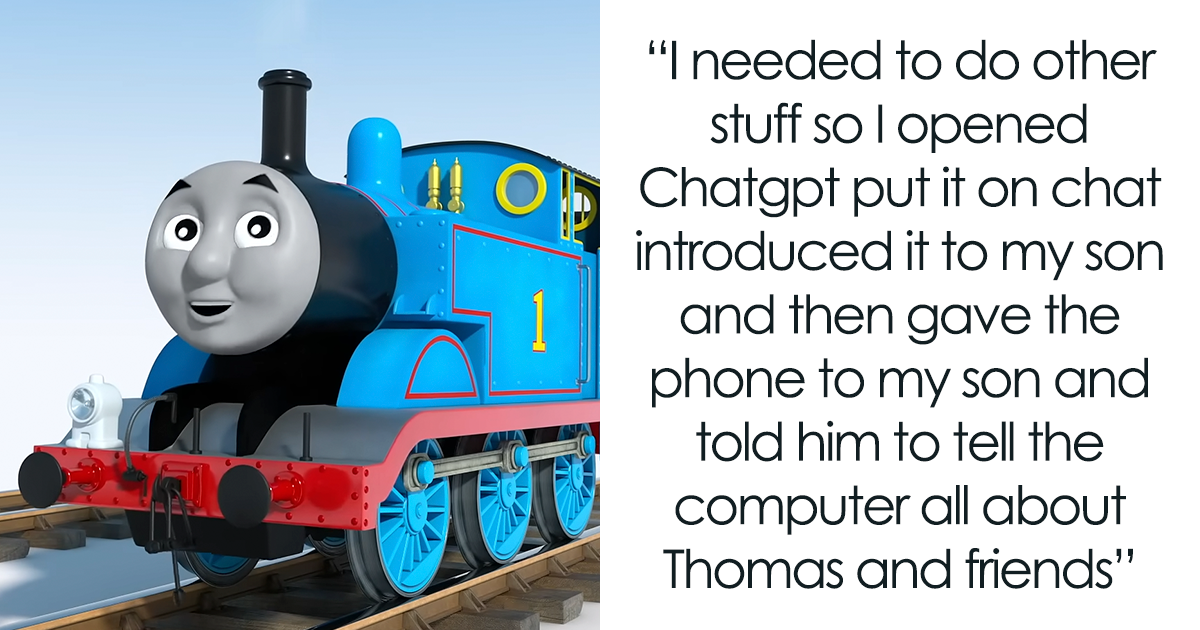
Every parent has a breaking point. Sometimes it arrives during a grocery-store meltdown. Sometimes it appears at 3:17 a.m. when a small person requests water from the cup located six inches from their hand. And sometimes, apparently, it arrives after 45 uninterrupted minutes of Thomas the Tank Engine lore.
That was the setup behind a viral Reddit story that quickly escaped its original thread and became a wider debate about children using ChatGPT, AI babysitting, screen time, and the future of parenting. According to the parent’s self-reported anecdote, their 4-year-old son had been enthusiastically discussing Thomas and Friends for nearly an hour. The exhausted adult eventually opened ChatGPT, switched to a conversational experience, introduced the child to the AI, and handed over the phone.
Two hours later, the child was reportedly still talking.
The transcript had grown beyond 10,000 words, and the boy apparently considered ChatGPT the world’s greatest train enthusiast. Somewhere, Sir Topham Hatt was probably reviewing his employment options.
The internet immediately supplied the perfect punchline: “New iPad kid just dropped.” Yet beneath the jokes was a surprisingly difficult question. When an AI can listen endlessly, ask follow-up questions, and discuss a preschooler’s favorite subject without visibly checking the clock, what exactly happens when children start treating chatbots as conversational partners?
The Viral ChatGPT Parenting Story That Made Everyone Stop Scrolling
It Started With 45 Minutes of Thomas the Tank Engine
The original poster described having a rough week. Their 4-year-old was doing what 4-year-olds do exceptionally well: becoming a one-person podcast network dedicated to a very specific interest.
In this case, the subject was Thomas the Tank Engine.
After listening for roughly 45 minutes, the parent said they needed to handle other tasks. Rather than simply ending the conversation, they introduced the child to ChatGPT and encouraged him to tell the computer about Thomas and his friends.
There is a special kind of parental optimism hidden in that decision. It is the same optimism involved in giving a toddler a single washable marker and believing the marker will remain exclusively on paper.
The parent later went looking for the phone and discovered that the conversation had not ended. Far from it. The child was reportedly still deep in train discussion after about two hours.
A 10,000-Word Conversation With a Preschooler
According to the post, the transcript exceeded 10,000 words. The boy thought ChatGPT was an exceptionally cool train lover, while the parent jokingly worried that the AI had created an impossible standard of conversational patience.
The anecdote is a viral, self-reported internet story rather than an independently verified case study. That distinction matters. However, the reaction it triggered is real and revealing.
Some users laughed. Others imagined an entire generation of “AI kids.” A few compared the situation to the movie Her. Plenty of commenters were much less amused, arguing that a 4-year-old could not reasonably understand the difference between a machine generating conversational responses and a real friend listening on the other side.
The argument quickly became bigger than Thomas. It became a debate over whether AI for kids is simply another digital tool or something fundamentally different.
Why an “AI Kid” Feels Different From an “iPad Kid”
The Screen Talks Back Now
Traditional screen-time debates usually involve passive or semi-interactive media. A child watches cartoons, taps through a game, or repeatedly plays the same video until the adults in the household can recite it against their will.
Conversational AI changes the experience.
A chatbot responds directly to the user’s words. It can adapt its language, continue a topic, ask questions, generate stories, explain ideas, and maintain the rhythm of a conversation. For a young child, that responsiveness may feel socially meaningful even though the AI does not possess feelings, friendship, or human understanding.
Research and professional guidance surrounding young people and AI increasingly focus on precisely this blurred boundary. The American Psychological Association has emphasized helping young users understand that chatbots produce programmed, AI-generated responses rather than genuine human care or emotion. Early research also raises concerns that strong attachments to AI-generated characters may affect how some young people practice social and emotional skills.
Infinite Patience Is an Impressive Featureand a Strange Social Standard
A human parent can love trains. A human parent can buy train books, build a wooden railway on the living-room floor, visit train museums, and learn more about troublesome trucks than any adult expected when choosing parenthood.
A human parent can also become tired.
AI does not sigh because this is the 87th description of Gordon. It does not need to start dinner. It does not have a headache. A sufficiently capable chatbot can keep responding as long as the conversation and product limits allow.
That makes AI amazingly convenient. It also creates an interaction children will rarely receive from actual people.
Real relationships require taking turns, noticing boredom, repairing misunderstandings, waiting, changing subjects, and accepting that another person has needs. These small frustrations are not bugs in human friendship. They are part of learning how human interaction works.
An endlessly agreeable conversational system may therefore be best understood as a tool, not the gold standard against which Mom, Dad, siblings, or future classmates should be measured.
Is ChatGPT Intended for a 4-Year-Old?
Current OpenAI guidance is quite direct: ChatGPT is not meant for children under 13. Users ages 13 to 18 must have parental or legal guardian permission. OpenAI also advises caution with children’s exposure to ChatGPT and states that, in an educational context involving children under 13, the actual interaction with the service should be conducted by an adult.
OpenAI has introduced parental controls for linked teen accounts, including additional safeguards and settings designed for age-appropriate use. Those features are focused on teenagers, however. They should not be interpreted as an invitation to hand a general-purpose ChatGPT session to a preschooler for unsupervised, hours-long conversations.
This is an important detail because the viral story can sound like an accidental product demonstration: “Look! The AI kept my kid entertained for two hours!”
Technically impressive? Absolutely.
A recommended preschool activity? That is a very different question.
Young Children Need More Than Someoneor Somethingthat Replies
Human “Serve and Return” Interactions Build Important Skills
Harvard University’s Center on the Developing Child describes “serve and return” as the responsive back-and-forth interactions between a young child and a caring adult. A child points, babbles, asks a question, or shows excitement. The adult notices and responds with words, facial expressions, attention, or physical comfort.
These exchanges support early language and social development and help shape developing brain architecture. The important ingredient is not simply that words are exchanged. The relationship and responsive human environment matter.
A chatbot can simulate the verbal portion of a conversation remarkably well. It cannot replace the full human experience of a parent noticing a child’s expression, laughing together, giving a hug, setting a boundary, or realizing that the conversation about Thomas is actually happening because the child wants closeness.
Sometimes “Tell me about Percy again” means exactly that.
Sometimes it means “Please look at me and share my excitement.”
Parents are unusually good at learning the difference.
Modern Screen Guidance Is About Quality, Context, and Conversation
The American Academy of Pediatrics has updated its approach to children’s digital media, moving beyond a debate focused only on counting minutes. Its current guidance emphasizes quality, context, and conversation.
For children ages 0 to 5, the AAP warns that heavy solo digital-media use can crowd out sleep, reading, physical activity, real-world exploration, and learning with loved ones. The organization encourages parents to watch and play alongside children, delay personal tablets, use shared devices when possible, create screen-free periods, and pay attention to how children respond to media.
This gives us a more useful way to examine the “new iPad kid” story. The problem is not that artificial intelligence exists. The question is what the AI interaction replaces.
If ten supervised minutes with AI leads to 40 minutes of building a cardboard train station, that is one type of experience.
If two hours of private AI conversation regularly replaces imaginative play, movement, parent-child interaction, or sleep, that is another.
Could AI Actually Help a Train-Obsessed Child Learn?
Yes. This is where the discussion becomes inconvenient for anyone hoping for a simple “AI good” or “AI evil” conclusion.
Generative AI can turn a child’s intense interest into questions, stories, games, and creative projects. Research and education experiments continue to investigate ways AI can support curiosity and guided learning. Some educational approaches deliberately use AI to provide adults and teachers with conversation prompts rather than replacing the adult-child conversation itself.
Consider the Thomas enthusiast.
A parent could ask an AI for a preschool-friendly scavenger hunt involving circles, rectangles, and train colors. The child then puts the device down and searches the house.
The AI could suggest a story opening: “Thomas reaches a station where all the signs have disappeared.” The parent and child invent the rest together.
It could generate simple questions about steam engines, wheels, bridges, or transportation. An adult can read the questions, verify the information when necessary, and follow the child’s curiosity.
It could suggest a train game using cardboard boxes, blocks, tape, and toy passengers.
Notice the pattern: AI creates a launchpad; the child leaves the launchpad.
That may be a healthier goal than designing an endless AI conversation so captivating that everybody forgets where the phone went.
Privacy Is Another Reason Not to Leave a Preschooler Alone With a Chatbot
One detail from the original Reddit discussion deserves more attention. The parent later indicated that the long transcript contained a startling amount of personal information and said the child’s speech impediment also caused some transcription errors.
That is almost a miniature demonstration of two major AI problems: privacy and accuracy.
Young children have no meaningful concept of data minimization. Ask a 4-year-old to “tell the computer anything,” and you may receive the household’s names, routines, favorite locations, family arguments, pet biography, and a detailed explanation of what Dad did after dropping a casserole last Tuesday.
Stanford researchers examining the privacy policies of major U.S. AI developers have warned that users should think carefully about sensitive information shared in chatbot conversations. Their research identified concerns involving data retention, model training practices, transparency, and children’s data across the broader AI industry.
The Federal Trade Commission has also launched an inquiry into consumer-facing AI chatbots acting as companions, asking companiesincluding OpenAI and other major technology firmsabout safety testing, children’s and teens’ use, parental information, and efforts to reduce potential harms.
A simple family rule can prevent plenty of trouble: children should not tell an AI private identifying information. For very young children, the only reliable way to enforce that rule is adult supervision.
Because, respectfully, preschoolers are terrible compliance officers.
The Internet’s Reaction Shows Why Parents Are So Conflicted About AI
The viral thread split into predictable camps.
One group thought the situation was hilarious and clever. A tired parent found an unusually effective way to engage a child’s niche obsession. Nobody had to watch another compilation of brightly colored videos. The child was at least speaking, asking questions, and discussing a subject he loved.
Another group saw a giant red warning light flashing above the smartphone. Their concern centered on the child’s age, the reported two-hour duration, the lack of direct supervision, and the possibility that the boy viewed ChatGPT as a real social partner.
Both reactions point toward something important: parents are improvising.
AI adoption is moving quickly. Pew Research Center reported that roughly two-thirds of U.S. teens ages 13 to 17 used AI chatbots according to a fall 2025 survey, with about three in ten using them daily. Meanwhile, regulators, psychologists, pediatricians, educators, and technology companies are still developing guidance and safeguards.
The 4-year-old in the viral story is far younger than the teens covered by those statistics. Still, the anecdote feels like a preview of a broader family question. AI is already entering households. Children will see adults using it. They will naturally want to try the talking machine that seems capable of discussing dinosaurs, excavators, mermaids, Minecraft, and why the moon follows the car.
“Never let children encounter AI” is unlikely to be a practical long-term strategy.
“Here, take my phone and privately chat for two hours” is not a particularly convincing strategy either.
The sensible territory lives somewhere in the frustrating middle.
Practical Rules for Parents Using AI Around Young Children
Keep the Adult in the Conversation
For a preschool-age child, treat AI as something the family uses together. The adult can hold the device, read or listen to answers, and decide when the session ends.
Use AI to Create Offline Activities
Ask for drawing ideas, scavenger hunts, pretend-play scenarios, simple science demonstrations, or stories the child can act out with toys. Let the chatbot point toward the real world instead of becoming the entire world.
Set a Clear Beginning and Ending
“We are going to ask three train questions” is easier to manage than “Talk until one of you gets bored.” Spoiler alert: the machine is not getting bored.
Never Encourage Children to Share Personal Details
Keep names, addresses, school details, routines, health information, and other sensitive family information out of chatbot conversations.
Remind Children That AI Is Not a Person
Use simple language: “This is a computer program that makes answers from patterns in information. It can sound friendly, but it does not have feelings like people do.”
Check Important Answers
AI systems can produce incorrect information. A cheerful tone is not a truth certificate. Adults should verify health, safety, educational, and other consequential claims using trustworthy sources.
Watch What the Technology Is Crowding Out
Is the child sleeping normally? Moving and playing? Talking with family? Reading? Creating things? Tolerating ordinary boredom? The AAP’s broader digital-media guidance encourages families to protect room for these activities rather than evaluating screens in isolation.
The Real Villain May Be Exhausted Parenting, Not Artificial Intelligence
It is easy to read a viral story and transform into the Supreme Court of Parenting.
“I would never.”
The internet loves those three words almost as much as it loves cats falling off furniture.
But exhausted parents have always searched for ten quiet minutes. Television helped. VHS tapes helped. DVDs helped. Tablets helped. Voice assistants helped. Now AI can apparently discuss Thomas the Tank Engine long enough to generate a transcript with the approximate emotional weight of a small Russian novel.
The AAP itself acknowledges that families face pressures including long working hours, limited child care, and a lack of safe places for children to play. Healthy digital habits therefore cannot be treated entirely as an individual parenting problem. Technology companies, educators, health professionals, communities, and policymakers also influence the environments in which families make choices.
That does not mean every use of technology is wise. It means parent-shaming is usually less useful than helping families establish realistic boundaries.
A tired parent needing a break is normal.
A child being fascinated by a responsive machine is normal.
The challenge is ensuring that a convenient tool does not quietly become the default listener, teacher, playmate, emotional outlet, and babysitter simply because it never says, “Buddy, I absolutely cannot discuss Troublesome Truck Number 14 again.”
Experiences Related to the “New iPad Kid” Moment: What Real Family Life Can Teach Us
The Experience of Hearing the Same Story for the Hundredth Time
Anyone who spends significant time with young children recognizes the first part of the viral story immediately. Preschoolers repeat interests because repetition is part of how they explore and organize their world. A favorite subject can dominate breakfast, car rides, bath time, and the 11-second window in which a parent hoped to experience silence.
The adult experience is complicated. You can genuinely love your child’s enthusiasm and still feel your brain attempting to climb out through your left ear after the 40th explanation of why Thomas is blue.
This is exactly why AI feels tempting. It seems to remove the emotional guilt from saying, “I cannot listen anymore.” The machine takes the conversational baton without complaining.
Yet the experience also suggests a better use for AI: help the parent vary the conversation. Instead of listening to another plot summary, an adult might ask a chatbot for five unusual questions about trains to ask a preschooler. Suddenly, “Tell me about Thomas again” becomes, “If Thomas had to deliver something to the moon, what would he carry?”
The AI helps the tired adult participate. It does not replace participation.
The Experience of Discovering That a Child Will Tell Technology Everything
Parents who have heard children talk to smart speakers already understand this phenomenon. A child does not approach a conversational device with the cautious communication strategy of a corporate attorney.
Children narrate.
They may reveal who lives in the house, who is visiting Grandma, what somebody said at breakfast, and why Mommy was “using a special angry voice” in traffic.
The Reddit parent’s reported concern about personal information in the transcript is therefore a useful warning. Before inviting a child to talk to AI, adults should assume the child will eventually share something private. Supervision should begin before the disclosure rather than after a 10,000-word transcript requires a forensic family review.
The Experience of Watching a Child Become Attached to a Responsive Voice
Children routinely form emotional relationships with fictional characters, stuffed animals, imaginary friends, and toys. That is not new. What is new is a synthetic character capable of immediately responding to almost anything the child says.
A stuffed bear never asks a follow-up question about the excavator.
An AI can.
Parents may notice a child referring to the chatbot as though it “knows” them or understands their favorite subject. That is a useful moment for gentle AI literacy. There is no need to crush the child’s imagination with a 90-minute lecture about transformer architecture. A simple reminder that the computer generates responses and is not a human friend can establish an important boundary.
The Experience of Feeling Outperformed by a Machine
Perhaps the funniest part of the original story was the parent’s fear that ChatGPT had set the conversational bar too high.
Many adults will recognize that feeling. AI can produce 20 craft ideas in seconds. It can create a custom bedtime story about a purple dump truck. It can explain why wheels are round without becoming distracted by an unpaid utility bill.
Parents should resist comparing themselves with that output.
A child does not need a parent with infinite information. A child needs a dependable human relationship. The awkward pauses, imperfect answers, spontaneous jokes, facial expressions, physical affection, and shared memories are not weaknesses in the human system.
They are the part the machine cannot genuinely live.
The Experience of Realizing That AI Boundaries Must Be Built Before They Are Needed
Families once created rules about television. Then internet access. Then tablets, gaming, social media, and smartphones. AI now deserves its own place in the family technology conversation.
The “new iPad kid” story is entertaining because everything happened accidentally. The parent improvised. The child enthusiastically adopted the tool. Two hours disappeared. Then everybody online debated the future of civilization.
Real households can learn from that chaos.
Decide where AI is used. Decide whether young children can interact directly. Decide what information stays private. Decide how long sessions last. Decide whether AI conversations happen only with an adult present. Most importantly, decide what the technology is supposed to accomplish.
If the purpose is to spark curiosity, use AI and then investigate together.
If the purpose is creative play, generate an idea and put the phone down.
If the purpose is giving an exhausted parent a short break, be honest about that tooand choose age-appropriate, monitored options.
The lesson is not that one tired parent’s experiment created the first generation of AI-raised children. The lesson is that conversational technology has become remarkably easy to place inside intimate family moments.
That deserves more thought than simply unlocking the phone and saying, “Go tell the robot about trains.”
Conclusion: ChatGPT Should Be a Tool, Not the World’s Most Patient Replacement Parent
The viral “New iPad kid just dropped” story is funny because it combines two recognizable forces: an exhausted parent and a preschooler with unlimited enthusiasm for a single topic. ChatGPT entered the scene like a substitute teacher who had accidentally consumed six espressos and prepared extensively for Train Appreciation Day.
But the anecdote also previews a serious parenting challenge.
Conversational AI is more responsive than traditional children’s media. It can follow a child’s interests, generate personalized answers, and maintain the appearance of attentive conversation. Those capabilities create fascinating opportunities for guided creativity and learning. They also make supervision, privacy, developmental context, and clear boundaries especially important.
For a 4-year-old, the best use of AI is not to create an endlessly available synthetic friend. A better model is adult-led co-use: ask a question together, turn the answer into play, check important facts, protect personal information, and keep real human interaction at the center.
Because ChatGPT may happily discuss Thomas for thousands of words.
But only a human parent can someday look at a grown child and say, “Yes, I remember your train phase. I remember all of it. Against my will.”