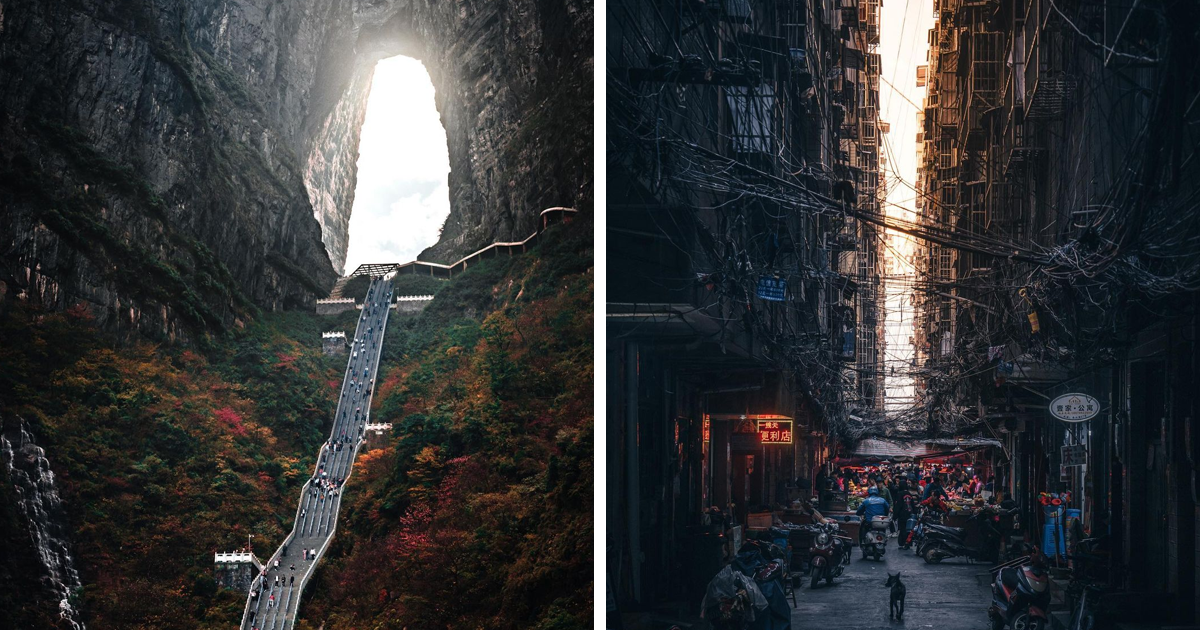
Some photographers chase sunsets. Others chase celebrities, mountain peaks, or that one pigeon that looks suspiciously like it pays rent. Ryosuke Kosuge, better known online as RK, seems to chase something quieter and harder to fake: the hidden rhythm of everyday life in Asia. His 30 stunning photos do not simply show streets, temples, markets, stairways, rooftops, and faces. They reveal how ordinary places can become visual fireworks when a patient photographer notices the geometry, humor, labor, color, and human pulse already waiting there.
This is the kind of photography that makes you look twice at your own neighborhood. A row of hanging lanterns? Suddenly a galaxy. A narrow shop packed with tools? A portrait of memory and skill. A busy street tangled with wires? Not chaos, but choreography with a slight electrical problem. Kosuge’s images travel through Japan, Taiwan, China, Vietnam, Hong Kong, and other parts of Asia, but the real destination is not a pin on a map. It is the feeling that daily life, when framed with care, is much more cinematic than we usually admit.
Who Is Ryosuke Kosuge, Also Known As RK?
Ryosuke Kosuge is a Tokyo-based photographer and director of photography whose work spans portrait, nature, architectural, cityscape, still life, running culture, video, and iPhone photography. That range matters because his best-known Asia images do not fit neatly into one box. They are part travel photography, part street photography, part architectural study, part visual diary, and part “wait, how did he even see that?” magic trick.
RK began his creative journey using an iPhone before later moving into DSLR work and professional freelance photography. That origin story is important because it helps explain the liveliness of his images. They do not feel like stiff postcards made by someone standing ten feet behind a tripod whispering, “Behold, culture.” Instead, many of his frames feel quick, curious, and alert. They carry the instincts of someone trained to notice with whatever camera happens to be in hand.
His signature style is often described as dense, and the word fits beautifully. Dense does not mean messy. It means layered. His photos often fill the frame with stairs, wires, shelves, signs, crowds, patterns, rooftops, textiles, smoke, mountains, or human movement. The viewer’s eye has somewhere to travel. In a single image, you may enter through a person, drift into the architecture, follow a repeating pattern, and end up wondering how many stories are hiding in the corners.
Why These 30 Photos Feel So Alive
The charm of Ryosuke Kosuge’s 30 stunning photos lies in their ability to make everyday life feel both familiar and astonishing. These are not images that rely only on famous landmarks. Yes, temples, mountains, city skylines, and dramatic stairways may appear, but the emotional weight often comes from smaller things: a worker surrounded by tools, a craft preserved by hand, a cyclist passing through an unusual pattern, a face half-lost in the activity of a market, or a street scene where buildings and people seem to breathe together.
1. He Finds Patterns Where Others See Background Noise
Kosuge has a remarkable eye for repetition. In his work, birdcages, incense bundles, stairways, roof tiles, windows, cables, and bamboo traps become more than objects. They become rhythm. This is one reason his photographs are so shareable: the brain loves order, especially when it appears in a place that still feels real and lived-in.
A good example is his attention to traditional crafts. In places such as Vietnam and China, his images often highlight handmade objects arranged in mesmerizing repetition. These compositions are visually satisfying, but they also carry cultural meaning. A repeated shape can represent skill passed through generations. A craft object can become a quiet monument. Suddenly, a basket, a cage, or a bundle of incense is not “stuff.” It is evidence of time, labor, and community.
2. He Treats Architecture As A Character
In many travel photos, buildings are just scenery. In Kosuge’s images, architecture behaves like a cast member with excellent posture. Stairways pull the eye upward. Narrow alleys compress the frame. Dense city blocks stack human life vertically. Temples, bridges, towers, and shopfronts do not merely decorate the image; they shape the emotional temperature of the scene.
This is especially clear in his cityscapes. Asian cities often combine old and new in the same breath: neon signs near traditional roofs, scooters beneath glass towers, quiet shrines tucked behind roaring streets. Kosuge understands this contrast. He does not flatten Asia into a single aesthetic. Instead, he lets the viewer see the layers: the sacred and the commercial, the handmade and the high-tech, the ancient and the freshly painted.
3. He Makes People Feel Essential, Not Decorative
The human figures in RK’s photos rarely feel like random extras wandering into the frame. They give scale, warmth, and story. A vendor in a compact shop, a craftsperson surrounded by materials, a person moving through a corridor of color, or a lone figure against a massive landscape can turn a beautiful composition into a memorable narrative.
This is where Kosuge’s work becomes more than “pretty Asia photography.” The people in these images remind us that places are not museum exhibits. They are lived in. Someone opens the shop before sunrise. Someone arranges the goods. Someone repairs the machine, carries the basket, lights the incense, crosses the bridge, waits for the train, feeds the birds, sweeps the temple steps, or rides home through traffic with the calm face of a person who has done this route a thousand times.
Everyday Life In Asia Through RK’s Lens
Asia is vast, complex, and impossible to summarize in a single photo essay, let alone a single sentence. Kosuge’s 30 photos do not attempt to define the continent. That would be like trying to fit a thunderstorm into a teacup. Instead, his images offer glimpses: Japan’s dense urban textures, Taiwan’s coastal and city scenes, China’s monumental landscapes and craft traditions, Vietnam’s vivid colors and handmade industries, and Hong Kong’s vertical energy.
What connects these places is not sameness. It is attention. RK’s work suggests that everyday beauty appears differently in every location. In one place, it may be a mountain staircase disappearing into mist. In another, it may be a market stall glowing under artificial light. Somewhere else, it may be the soft repetition of handmade materials drying in the open air. The common thread is the photographer’s willingness to look long enough for the ordinary to become specific.
Japan: Density, Neon, Memory, And Motion
Kosuge’s Tokyo images often carry a sense of energetic compression. Shops are full. Streets are layered. Lights reflect. Wires cross. People move with purpose. Instead of treating visual clutter as a problem, he often turns it into structure. That is a very urban skill. Anyone can photograph a clean skyline on a perfect day. It takes a sharper eye to photograph a tight street full of signs, shelves, cables, and people without making the viewer feel trapped in a drawer full of phone chargers.
The famous mood behind his “DENSE” style grew from moments like the portrait of an elderly man in an Akihabara camera shop, surrounded by equipment and personality. That kind of image works because it respects the small kingdom of a working space. The shop is not just a background; it is biography in object form.
Vietnam: Color, Craft, And Daily Labor
Vietnam appears in RK’s photography as a place of intense color and living tradition. Incense-making villages, bamboo craft scenes, narrow streets, riverside activity, and warm human moments all fit naturally into his visual language. His images often show how craft and beauty overlap. Materials arranged for work become patterns. Patterns become art. Art becomes a doorway into culture.
This matters because travel photography can sometimes reduce places to scenery. Kosuge’s stronger images resist that. When he photographs a handmade craft, the point is not simply “look how colorful this is.” The deeper message is: people made this, people use this, people learned this, and people continue this. That is a much richer story than color alone.
China, Taiwan, And Hong Kong: Scale Meets Detail
In China, Kosuge’s photos often play with grand scale: mountain formations, steep stairways, massive structures, and vast urban scenes. But he also zooms mentally into detail, noticing birdcages, wires, shops, and small human gestures. Taiwan and Hong Kong bring their own textures: coastal light, compact streets, vertical architecture, markets, and the layered visual density of cities where life seems to happen in every available square inch.
The result is a body of work that does not choose between big and small. It understands that both are necessary. A mountain tells one story. A hand making an object tells another. A street corner at dusk may tell both at once, especially if a scooter passes through at the exact right second, because scooters are apparently born with dramatic timing.
What Makes RK’s Photos SEO-Worthy And Human-Worthy?
From a digital publishing perspective, Ryosuke Kosuge’s photography succeeds because it offers several layers of interest. Search engines may recognize terms such as “Ryosuke Kosuge photos,” “everyday life in Asia,” “Asian street photography,” “travel photography,” “Tokyo photographer,” and “RK photographer.” Human readers, thankfully, are less robotic. They respond to story, emotion, surprise, and the tiny joy of seeing a familiar world made strange again.
His 30 stunning photos work well for online audiences because they are instantly visual, but they also reward deeper viewing. At first glance, a reader might notice color or symmetry. On a second look, they may notice a face, a tool, a sign, a shadow, or a small contradiction inside the frame. That second look is where good photography lives. It is also where readers stay longer, scroll more slowly, and actually remember what they saw.
The Power Of Visual Storytelling
Strong street and travel photography does not merely document what was in front of the lens. It suggests what it felt like to be there. National Geographic’s classic advice on travel photography emphasizes research, sensitivity to local customs, early and late exploration, and openness to the rhythm of a place. RK’s images reflect many of those principles. He does not appear to be parachuting into a location, grabbing a souvenir shot, and sprinting away like a raccoon with a croissant. His best photographs feel observed, not extracted.
That distinction is important. Everyday-life photography depends on trust, patience, and respect. The photographer must be curious without being careless. The viewer should feel invited into a scene, not forced to stare at someone who has been visually ambushed. Kosuge’s strongest frames tend to balance artistry with admiration. They show the beauty of public life while still allowing people and places to keep their dignity.
Composition Lessons From Ryosuke Kosuge’s 30 Photos
You do not need to own expensive gear to learn from RK’s work. Remember, his path began with mobile photography. What matters most is the eye: where it looks, how long it stays, and whether it notices the relationship between objects before the moment disappears.
Look For Repetition
Repetition gives a photo rhythm. Rows of windows, bundles of incense, market umbrellas, train seats, temple steps, hanging lanterns, or tiled rooftops can all create visual music. The trick is to find one interruption: a person, a shadow, a splash of color, or a small imperfection. Perfect repetition is satisfying, but interrupted repetition is memorable.
Use People For Scale And Story
A huge staircase becomes more dramatic when a person stands on it. A narrow street becomes more intimate when someone walks through it. A craft scene becomes meaningful when the maker is present. People help the viewer understand size, purpose, and emotion. Without them, even a beautiful location can feel like a very expensive screensaver.
Embrace Visual Density
Beginners are often told to simplify everything. That advice is useful, but RK’s work shows another path: organized complexity. A dense image can succeed when the photographer controls lines, layers, colors, and subject placement. The goal is not to cram everything into the frame like a suitcase before a budget flight. The goal is to make every busy element contribute to the scene.
Follow Light, But Also Follow Life
Golden hour is beautiful, but daily life does not always wait for perfect light. Markets open early. Workers move at midday. Neon blooms at night. Rain changes the street. Fog softens mountains. Reflections appear in puddles. RK’s photographs remind us that timing is not only about the sun; it is about human activity.
Why Everyday Life In Asia Resonates With Global Viewers
Many viewers are drawn to these photos because they feel both specific and universal. A street in Tokyo is not a street in Hanoi. A craft village in Vietnam is not a mountain site in China. A market in Taiwan is not a dense corner of Hong Kong. Yet the emotional themes travel well: work, movement, tradition, pride, community, solitude, beauty, and the comic persistence of daily errands.
This is why street photography remains powerful. It records public life as it changes. It preserves gestures that might otherwise vanish: the way someone arranges goods, the way commuters lean into rain, the way a craftsperson stands inside a workshop, the way old buildings and new technology share the same block. These moments are small, but history is mostly made of small moments stacked very high.
Experiences Inspired By Ryosuke Kosuge’s Everyday Asia Photography
Spending time with Ryosuke Kosuge’s 30 stunning photos can change the way a person moves through a city. After viewing his work, even a regular walk to buy coffee starts to feel like a low-budget photo expedition, minus the dramatic music and sponsorship deal. You begin to notice how a delivery bike leans against a wall at the same angle as a shadow. You see how plastic stools outside a food stall create a pattern. You realize that the old man fixing something in a doorway may be surrounded by more story than an entire shopping mall.
One useful experience connected to this topic is practicing “slow looking.” Choose a street, market, station, park, or neighborhood corner and spend ten minutes observing before taking a photo. At first, this feels awkward. Your brain complains. Your hand reaches for the camera. A pigeon judges you. But after a few minutes, patterns appear. The same vendor repeats the same gesture. Light hits one sign more beautifully than the others. People avoid one puddle in exactly the same curved path. A boring place becomes a small theater.
Another experience is photographing a familiar place as if you were visiting it for the first time. This is one of the best lessons from RK’s Asia images. He makes viewers feel that ordinary spaces deserve attention. Try this at a bus stop, a local market, a school hallway, a side street, or a family kitchen. Do not hunt for the most spectacular thing. Hunt for relationships: color against color, person against architecture, old object beside new object, movement against stillness. The photograph improves when the frame has tension and connection.
A third experience is learning to respect the people inside everyday scenes. If someone is clearly uncomfortable, lower the camera. If a craftsperson allows a photo, take the moment seriously. If you photograph public life, remember that the people in the frame are not props. They are the reason the scene matters. RK’s best photos feel compelling because they celebrate life rather than collecting strangers like decorative souvenirs.
Finally, his work encourages travelers and casual photographers to stop treating Asia as a checklist of famous sights. Temples, towers, beaches, and mountain views are wonderful, but everyday life often holds the better story. The steam rising from a food stall, the glow of a shop at night, the patience of someone repairing a tool, the geometry of laundry above an alley, the quiet pride in handmade workthese moments are not secondary. They are the heartbeat. Kosuge’s photography reminds us that beauty is rarely hiding. Most of the time, it is standing in plain sight, waiting for us to stop scrolling long enough to notice.
Conclusion
Ryosuke Kosuge’s 30 stunning photos give a glimpse of everyday life in Asia by turning streets, crafts, landscapes, shops, and public spaces into layered visual stories. His work is not just beautiful because Asia is beautiful, although that certainly helps and deserves a polite round of applause. His photography stands out because he notices how beauty operates: through repetition, density, contrast, patience, humor, and human presence.
For readers, RK’s images offer more than travel inspiration. They offer a way of seeing. They suggest that the world does not need to be polished into perfection before it becomes worth photographing. The ordinary is already full of pattern. The street is already full of theater. The workshop is already full of history. The city is already writing its own visual poem, even if half the lines are tangled in power cables.
That is the lasting gift of Kosuge’s everyday Asia photography: it invites us to look again. Not faster, not louder, not with a checklist, but with curiosity. And in a world overflowing with images, curiosity may be the rarest lens of all.