The Marvel Cinematic Universe looks effortless when the portals open, the capes flutter, and somebody says something heroic while a city politely explodes in the background. But behind every clean superhero moment is a small army of directors, stunt teams, costume designers, editors, visual effects artists, dialect coaches, prop makers, composers, and actors trying not to laugh in foam armor.
That is what makes behind-the-scenes MCU facts so addictive. They remind us that the world’s biggest superhero franchise was built from risky casting choices, last-minute script changes, improvised jokes, technical wizardry, practical problem-solving, and a shocking amount of tape, wire, green screen, and human patience. The Marvel movies may feel like machine-built blockbusters, but many of their most memorable moments came from surprisingly human accidents.
Below are 21 real behind-the-scenes MCU facts from the Infinity Saga and beyond. Some are funny, some are technically impressive, and some prove that Hollywood magic often begins with someone saying, “Okay, this sounds impossible, but let’s try it anyway.”
21 Behind-The-Scenes MCU Facts Every Marvel Fan Should Know
1. Robert Downey Jr. helped reshape Iron Man with improvisation
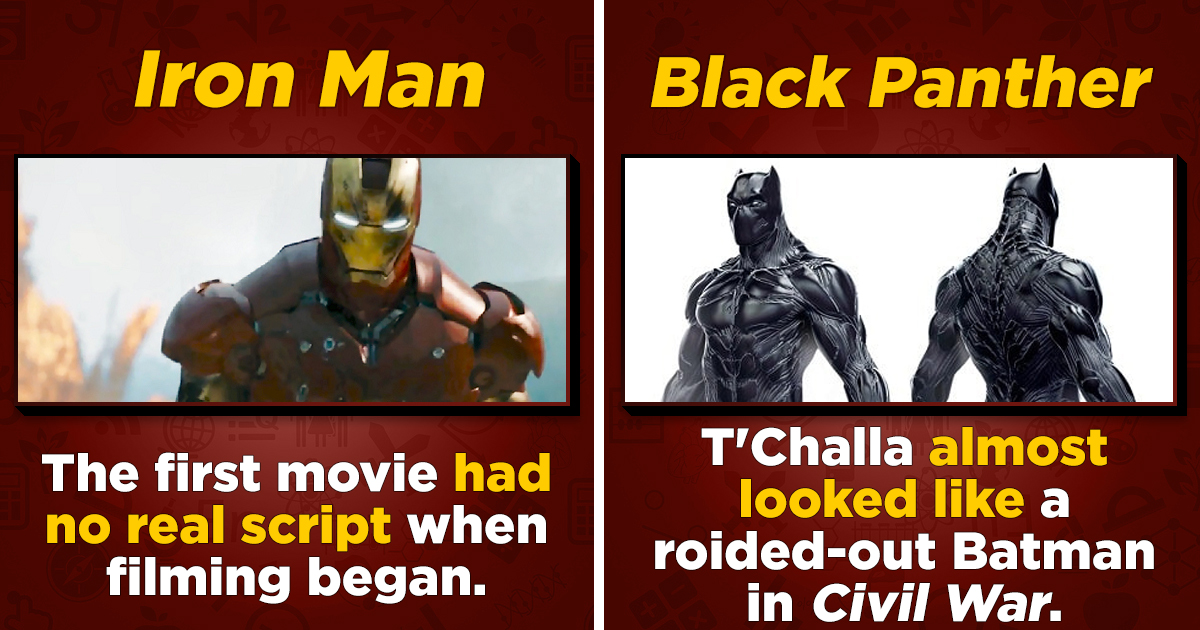
Iron Man did not become the MCU’s launchpad because it followed a perfectly sealed blueprint. The production was famously flexible, and Robert Downey Jr.’s natural rhythm as Tony Stark helped define the character. His quick wit, clipped delivery, and slightly chaotic charm gave Tony the feeling of a genius who was always three thoughts ahead and one espresso too deep.
The biggest example is the ending, where Tony publicly admits he is Iron Man. In traditional superhero storytelling, secret identities are treated like sacred treasure. The MCU kicked that door open, tossed the secret identity out, and said, “We’re doing this differently.” That one choice made Tony Stark feel modern, reckless, and strangely honest.
2. Nick Fury’s post-credits scene turned one movie into a universe
The first Iron Man post-credits scene was a small moment with massive consequences. Samuel L. Jackson’s Nick Fury appears in Tony Stark’s home and talks about the “Avengers Initiative.” At the time, many casual moviegoers did not expect extra scenes after the credits, so the reveal felt like a secret handshake for comic book fans.
Today, post-credits scenes are practically part of the MCU’s furniture. Back then, that scene was a gamble. It suggested Marvel was not just making a superhero movie; it was building a connected cinematic world. That tiny scene became the seed for one of the biggest franchises in film history.
3. “Skinny Steve” in Captain America required serious visual effects
Before Steve Rogers became Captain America, Captain America: The First Avenger had to convince viewers that Chris Evans was a much smaller, physically fragile version of himself. This was not done with one simple trick. The effect involved a combination of body doubles, digital shrinking, careful camera work, and visual effects refinement.
The result matters because it makes Steve’s transformation emotional, not just cosmetic. We believe in the underdog before we believe in the super soldier. That is why the serum scene works: the audience is not simply watching muscles arrive; they are watching courage finally get the body it deserves.
4. Chris Evans considered the elevator fight one of his favorite Captain America moments
The elevator fight in Captain America: The Winter Soldier is one of the cleanest action scenes in the MCU. It is tight, tense, and almost painfully efficient. Steve Rogers is trapped in a small metal box with enemies pretending not to be enemies, which is basically the worst office meeting ever.
What makes the scene special is how grounded it feels. There are no cosmic beams or giant monsters. It is choreography, timing, physical performance, and character clarity. Steve’s famous “Before we get started, does anyone want to get out?” line works because he already knows what is happening, and he is still polite enough to offer an exit. Peak Captain America.
5. Thor’s “friend from work” line came from a Make-A-Wish child
One of the funniest lines in Thor: Ragnarok did not come from a traditional writer’s room. When Thor sees Hulk in the arena and joyfully shouts that he is “a friend from work,” the line was suggested by a child visiting the set through Make-A-Wish.
It is a perfect example of why Ragnarok feels so alive. The movie has the energy of a superhero story that discovered improv comedy, neon paint, and emotional damage all in the same weekend. The line works because Thor says it like a golden retriever who just spotted another golden retriever wearing gladiator armor.
6. Taika Waititi performed Korg using motion capture
Director Taika Waititi did not just guide Thor: Ragnarok from behind the camera. He also played Korg, the soft-spoken rock warrior who somehow made revolution sound like a casual group project. Korg was created through motion capture, allowing Waititi’s facial expressions and comic timing to influence the digital character.
The magic of Korg is contrast. He looks like he could headbutt a spaceship, but he speaks with gentle awkwardness. That mismatch helped push the MCU toward a looser, stranger, more character-driven style of humor.
7. Vin Diesel recorded Groot in multiple languages
Groot may have a famously limited vocabulary, but Vin Diesel’s performance was not lazy voice work. He recorded variations of “I am Groot” with emotional intention, and Marvel released versions of the phrase in many languages. The joke is that Groot says only one sentence. The craft is that every version has to mean something different.
In Guardians of the Galaxy, Groot can be sweet, confused, protective, curious, or heroic with only three words. That is voice acting on hard mode. It is like being asked to perform Shakespeare using a refrigerator magnet that only says “tree.”
8. The Guardians soundtrack was part of the storytelling from the beginning
The music in Guardians of the Galaxy is not just decoration. James Gunn used classic pop songs to connect Peter Quill to his mother, his childhood, and the Earth he lost. The Awesome Mix gives the movie a beating human heart beneath all the space weirdness.
That is why the soundtrack feels so memorable. The songs are not randomly dropped in because they sound cool. They are part of Peter’s emotional survival kit. A cassette tape becomes a character, which is impressive considering most cassette tapes in real life mainly specialize in getting tangled at the worst possible moment.
9. Doctor Strange’s magic needed hand choreography
The spellcasting in Doctor Strange did not come from actors simply waving their hands at invisible orange circles. The production leaned into detailed hand movements inspired partly by finger tutting, giving the magic a physical language. That made Strange’s sorcery feel practiced rather than random.
This is a smart visual choice. Magic in film can easily become vague glowing air. By connecting spells to disciplined hand movement, the movie gives mysticism rules, rhythm, and personality. Doctor Strange does not just cast spells; he performs them like a surgeon learning cosmic calligraphy.
10. The astral form in Doctor Strange had to look spiritual without looking silly
Visual effects teams faced a tricky challenge with Doctor Strange’s astral projection. The effect had to look supernatural but not like a Halloween bedsheet ghost. It needed to feel weightless, human, and readable without turning into something unintentionally goofy.
The final effect works because it avoids being too opaque or too invisible. The astral body looks like Strange, but slightly removed from ordinary reality. That balance is harder than it sounds. One wrong move and the Sorcerer Supreme becomes the Sorcerer Screensaver.
11. Black Panther’s costumes were built from deep cultural research
Ruth E. Carter’s costume design for Black Panther helped make Wakanda feel like a real nation with history, regions, rituals, and social structure. The costumes drew from African cultural references while also pushing into Afrofuturism, blending tradition with advanced technology.
The result was not just “cool superhero clothing.” It was world-building through fabric, beadwork, armor, color, and silhouette. Wakanda became believable because every outfit seemed to say something about identity, rank, community, and pride.
12. Black Panther made Oscar history for Marvel
Black Panther became a milestone not only at the box office but also during awards season. Its wins for costume design, production design, and original score marked major recognition for Marvel Studios at the Academy Awards.
That matters because it showed superhero films could be judged not only as crowd-pleasing spectacles but also as achievements in craft. The movie did not succeed by apologizing for being a comic book film. It succeeded by being a comic book film with artistic confidence.
13. Tom Holland’s Spider-Man secrecy became its own MCU comedy subplot
Tom Holland developed a reputation for accidentally revealing Marvel secrets, which turned MCU press tours into a kind of spoiler obstacle course. The studio and his co-stars often joked about keeping him away from sensitive information.
This became especially funny because Spider-Man stories depend heavily on secrets: secret identities, secret villains, secret multiverse visitors, secret everything. Holland’s real-life enthusiasm made him lovable, but also slightly dangerous to marketing departments. He was basically a walking post-credits scene with a microphone.
14. No Way Home kept major returning actors under intense secrecy
Spider-Man: No Way Home became one of the MCU’s biggest secrecy operations. The returns of Tobey Maguire and Andrew Garfield were heavily protected, and the production had to balance fan expectations, leaks, rumors, and pandemic-era filmmaking challenges.
The secrecy paid off because the reveal worked as both nostalgia and story. The returning Spider-Men were not treated as empty cameos. They helped Peter Parker understand grief, responsibility, and the cost of being Spider-Man. Fan service is easy; emotional fan service is the hard part.
15. Andrew Garfield had to deny the obvious for months
Andrew Garfield’s No Way Home press run became legendary because fans kept asking whether he was in the movie, and he kept dodging the question. His denials became part of the entertainment before the film even opened.
The funniest part is that fans were analyzing every facial twitch like he was testifying before a multiverse court. Garfield turned secrecy into performance art. By the time he actually appeared on screen, the audience reaction was not just joy; it was collective relief after months of detective work.
16. Endgame’s “Avengers assemble” line was saved for maximum impact
Marvel waited years before letting Captain America say the full “Avengers assemble” line. By the time it finally arrived in Avengers: Endgame, the phrase carried the weight of the entire Infinity Saga.
The quiet delivery makes the moment stronger. Instead of shouting over the music like a gym coach with a shield, Steve Rogers says it with calm certainty. The army is already there. The audience is already screaming. Cap does not need volume. He has earned silence.
17. The Endgame portals scene was a massive puzzle
The portals sequence in Avengers: Endgame looks like one smooth wave of returning heroes, but behind the scenes it required careful planning, visual effects coordination, scheduling, and musical timing. Different characters had to enter from different locations, and the scene needed to build emotion without becoming visual traffic.
That is the hidden genius of the scene. It gives fans the giant comic book splash page they wanted, but it also guides the eye. Wakanda, sorcerers, Guardians, Spider-Man, armies, alliesthe movie organizes chaos into catharsis.
18. Howard the Duck sneaked into the Endgame battle
One of the strangest tiny details in Endgame is the brief appearance of Howard the Duck during the final battle. It is easy to miss because, to be fair, audiences were busy processing the emotional equivalent of being hit with 14 nostalgia trucks.
The cameo is pure Marvel mischief. It rewards fans who pause, zoom, and investigate frames like cinematic raccoons. Not every Easter egg needs to reshape the universe. Sometimes it just needs to be a duck in the apocalypse.
19. Josh Brolin’s Thanos performance was more human than people think
Thanos may be a giant purple alien, but his performance was grounded in Josh Brolin’s motion capture acting. The facial expressions, pauses, and emotional intensity helped make the character more than a digital boss fight.
This is why Thanos worked as a villain. The visual effects made him huge, but Brolin’s performance made him unsettlingly calm. He was not just roaring at heroes. He believed he was being reasonable, which is often the scariest villain setting.
20. MCU suits often mix practical costumes with digital enhancement
Many MCU superhero suits are not simply one thing. They may begin as practical costumes, partial armor, tracking suits, or motion capture references, then receive digital polish in post-production. Iron Man, Spider-Man, Black Panther, and other characters often rely on this hybrid approach.
This helps explain why the suits can look sleek while still allowing actors to move, emote, and survive long shooting days. A comic-accurate costume may look amazing in art, but real humans need to sit down, breathe, and occasionally eat a sandwich without requiring a pit crew.
21. The MCU’s biggest secret weapon is collaboration
The best behind-the-scenes MCU facts all point to the same conclusion: these movies are collaborative machines. A child can inspire a Thor joke. A costume designer can define an entire civilization. A composer can make portals feel like resurrection. A visual effects team can turn a human actor into a cosmic villain or a pre-serum Steve Rogers.
The MCU is often discussed as a franchise, a brand, or a timeline. But behind the scenes, it is also a workplace full of problem-solvers. That is the real superpower. Not vibranium. Not arc reactors. Not magic rings. Just thousands of artists making impossible things look easy.
Why These Behind-The-Scenes MCU Facts Still Matter
Behind-the-scenes stories matter because they make the MCU feel handmade again. When a franchise becomes this large, it is easy to assume everything was calculated in a secret studio laboratory guarded by lawyers and a suspiciously serious raccoon. But many of the best Marvel movie moments came from creative flexibility.
Consider Tony Stark revealing he is Iron Man. That choice did more than end a movie. It announced the MCU’s attitude. These heroes would not always follow old formulas. They would be public, messy, funny, flawed, emotional, and sometimes reckless. In a way, Tony’s confession gave the entire franchise permission to be less traditional.
Or look at Thor: Ragnarok. Before that film, Thor was powerful but often trapped in very formal fantasy language. The “friend from work” line helped signal a new version of the character: still mighty, but far more relaxed and ridiculous. That single joke opened the door to a Thor who could be heroic and hilarious at the same time.
The technical facts are just as important. Skinny Steve, Doctor Strange’s astral form, Thanos’ motion capture, and the Endgame portals scene all show how much invisible labor goes into blockbuster storytelling. Visual effects are not just computer buttons labeled “make epic.” They require taste, restraint, anatomy, physics, lighting, acting sensitivity, and constant revision.
Costume design also plays a major role. Black Panther proved that superhero world-building can happen through clothing as powerfully as through dialogue. Wakanda’s costumes told audiences who these people were before anyone explained it. That is efficient storytelling, and it is also beautiful cinema.
For fans, these facts add another layer of appreciation. The next time you watch Cap in the elevator, Groot saying his three-word masterpiece, or the portals opening in Endgame, you can see the craft behind the spectacle. The magic does not disappear when you understand how it was made. If anything, it gets better. Knowing how many people worked to create those moments makes them feel even more impressive.
Experience Notes: Watching the MCU Like a Behind-The-Scenes Detective
One of the most enjoyable ways to rewatch the MCU is to stop watching only for plot and start watching for decisions. Every scene is packed with creative choices. Why does Tony interrupt people so often? Why does Steve Rogers stand so still when everyone else is panicking? Why does Peter Quill’s music make a space prison feel weirdly personal? Once you start asking those questions, the movies become more than superhero adventures. They become case studies in tone, performance, and production design.
For example, rewatch Iron Man with Tony’s improvisational energy in mind. Notice how Downey makes technical dialogue feel conversational. He can talk about engineering like he is ordering lunch, which helps the audience believe Tony is both brilliant and exhausting. That performance style became a foundation for later MCU humor, especially the fast banter between heroes who probably should be focusing on not falling out of the sky.
Then rewatch Captain America: The Winter Soldier for physical storytelling. The elevator scene works because it builds suspicion through body language. Steve sees the trap forming before the first punch. The cramped space turns every elbow, shoulder, and glance into a signal. It is a reminder that good action is not only about impact. It is about geography, tension, and character.
Guardians of the Galaxy is perfect for studying music as emotional architecture. The songs are fun, yes, but they also protect Peter Quill from loneliness. His mixtape is not a gimmick; it is a portable memory. That is why the soundtrack never feels like a playlist slapped over explosions. It feels like the emotional language of a man who jokes because the alternative is feeling everything at once.
Black Panther rewards attention to design. Pause on the costumes, throne room, armor, and cityscapes. Wakanda feels rich because its details are consistent. The movie understands that fantasy worlds become believable when they look lived-in, not merely expensive. The design tells you that Wakanda has politics, traditions, ceremonies, and disagreements long before the plot spells them out.
Finally, rewatch Avengers: Endgame with the knowledge that the portals scene is a giant coordination miracle. It is not just a parade of famous faces. It is pacing, music, memory, and emotional payoff arranged with surgical precision. Every entrance is designed to make viewers feel the return of hope. That is why people still talk about it years later. It is not just big. It is earned.
That is the real pleasure of behind-the-scenes MCU facts. They turn passive viewing into active appreciation. You start noticing the hands behind the magic: the actor who finds a better line, the designer who invents a culture, the VFX team that solves an impossible image, the composer who gives a scene goosebumps, and the director who knows when to let silence do the shouting.
Note: This original article was researched and synthesized from official Marvel and Disney materials, Academy information, and reputable U.S. entertainment reporting, then rewritten in a fresh editorial style for web publication.