May Day sounds simple enough: it happens on May 1, it involves spring, and somewhere in the background there may be flowers, ribbons, workers, protest signs, or possibly a neighbor secretly leaving a tiny basket on your porch like a very cheerful garden goblin. But the real story of May Day is richer, older, and more fascinating than many people realize.
So, what is May Day? May Day is a holiday celebrated on May 1 with two major traditions woven together. The first is an ancient spring festival that welcomes warmth, growth, flowers, and the return of outdoor life. The second is International Workers’ Day, a global labor holiday honoring workers’ rights, especially the historic fight for the eight-hour workday. In other words, May Day is both a celebration of blooming lilacs and a reminder that nobody should have to work sixteen hours a day just to afford bread and rent. That is range.
In the United States, May Day is not a federal holiday, which sometimes confuses people because its modern labor meaning is deeply connected to American history. The Haymarket Affair in Chicago in 1886 became one of the key events behind International Workers’ Day. Yet the U.S. officially celebrates Labor Day in September, while many other countries observe labor-focused May Day on May 1.
This guide explains the meaning of May Day, why people celebrate it, how ancient customs turned into modern traditions, and why this holiday still matters today.
What Is May Day?
May Day is observed every year on May 1. Traditionally, it marks the arrival of spring in the Northern Hemisphere. Historically, people celebrated the season with flowers, dances, bonfires, Maypoles, music, feasts, and community gatherings. In many places, May Day was a joyful “winter is finally leaving, please put away the heavy coat” kind of celebration.
Over time, May Day also became associated with labor rights. In the late 19th century, workers in the United States and Europe pushed for safer workplaces, fairer wages, and shorter workdays. The demand for an eight-hour workday became central. After the Haymarket Affair in Chicago, May 1 grew into an international day of labor solidarity, marches, and remembrance.
Today, the answer to “What is May Day?” depends partly on where you are. In some communities, it is a spring festival. In many countries, it is Labor Day or International Workers’ Day. In some families, it means making May Day baskets. In others, it means attending a rally or learning about labor history. And for many people, it is simply a lovely excuse to notice that the trees have remembered how to be green.
The Ancient Roots of May Day
Long before May Day became connected to workers’ rights, it was tied to the rhythms of the agricultural year. Ancient communities paid close attention to seasonal changes because their survival depended on planting, livestock, weather, and harvests. May 1 arrived near the midpoint between the spring equinox and the summer solstice, making it a natural time to celebrate fertility, growth, and renewal.
Beltane and the Fire of Spring
One important influence on May Day was Beltane, a Celtic festival associated with fire, fertility, protection, and the beginning of the warmer season. Beltane was traditionally celebrated around May 1. Bonfires played a major role, symbolizing purification and protection. People believed fire could help guard livestock, homes, and communities as the growing season began.
Some traditions included decorating homes with greenery, gathering flowers, feasting, and celebrating the return of light. While modern May Day celebrations are usually less likely to involve driving cattle between ceremonial fires, the basic message remains recognizable: winter is over, life is waking up, and everyone is invited to act excited about it.
Floralia and Flower Traditions
Another ancient influence often connected to May Day is Floralia, a Roman festival honoring Flora, the goddess of flowers, fertility, and spring. Floralia was known for games, performances, flowers, and seasonal celebration. While May Day did not come from one single source, traditions like Floralia helped shape the broader idea of spring as a time for public joy, color, and renewal.
That explains why flowers remain such a strong symbol of May Day. Flower crowns, bouquets, May baskets, and decorated Maypoles all carry the same basic message: nature is showing off, and honestly, she has earned the applause.
The Maypole: May Day’s Most Famous Symbol
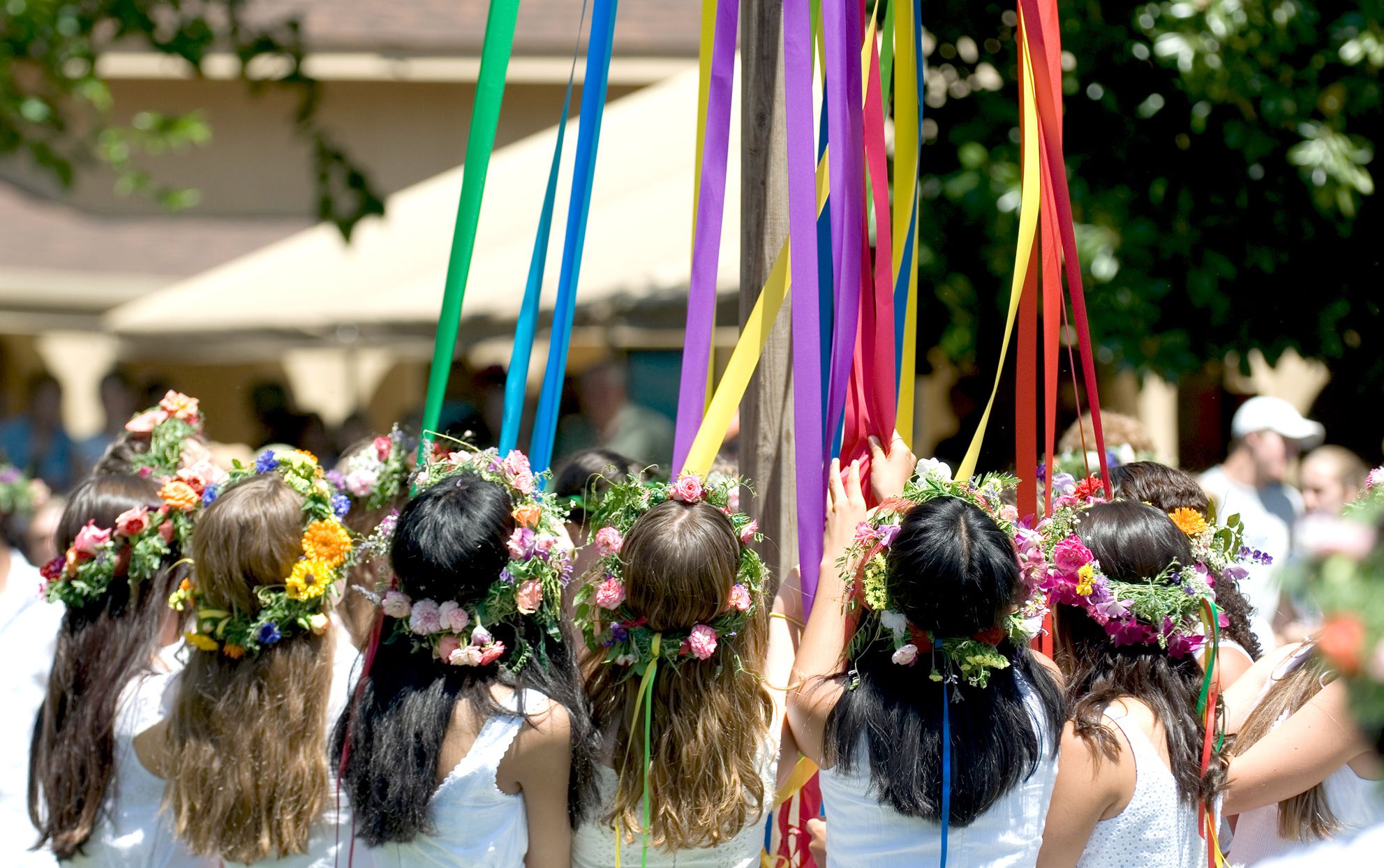
If May Day has a visual mascot, it is probably the Maypole. A Maypole is a tall wooden pole decorated with greenery, flowers, and long ribbons. In many traditional celebrations, dancers circle the pole while holding ribbons, weaving colorful patterns as they move. It is part dance, part community ritual, and part “let’s hope nobody gets tangled and becomes the human knot portion of the festival.”
Maypole customs became especially popular in parts of Europe and later appeared in American communities, schools, and spring festivals. The Maypole symbolized growth, fertility, and the joy of the season. In the Victorian era, Maypole dances became more polished and family-friendly, often performed by children in public celebrations.
In colonial America, however, May Day did not always receive a warm welcome. Some Puritan communities saw Maypoles as too rowdy, too pagan, or too much fun before breakfast. Over time, though, May Day traditions softened into community customs, especially flower giving, school celebrations, and neighborhood surprises.
What Are May Day Baskets?
May Day baskets are one of the sweetest American May Day traditions. The idea is simple: fill a small basket or paper cone with flowers, candy, homemade treats, or cheerful notes, then leave it at someone’s door on May 1. Traditionally, the giver might ring the bell and run away before being seen. It is like ding-dong ditch, but with flowers and significantly better manners.
May baskets became popular in parts of the United States during the 19th and early 20th centuries. Children often made them for neighbors, friends, teachers, or family members. In some communities, the tradition had a playful romantic angle: if the recipient caught the giver, a kiss might be expected. Modern versions usually skip that part, which is probably wise unless your homeowners association has unusually festive bylaws.
Today, May Day baskets are not as common as they once were, but many people are rediscovering them as a simple way to spread kindness. A small bouquet, a cookie, a packet of seeds, or a handwritten note can turn May 1 into a tiny neighborhood celebration.
How May Day Became International Workers’ Day
The labor meaning of May Day emerged during the industrial age, when many workers faced exhausting schedules, dangerous conditions, low wages, and little legal protection. In the 1800s, it was common for laborers to work ten, twelve, or even more hours a day. The eight-hour workday became a rallying cry: eight hours for work, eight hours for rest, and eight hours for what workers chose to do with their own lives.
In the United States, labor organizations pushed for May 1, 1886, as a major date for strikes and demonstrations demanding the eight-hour day. Workers across the country participated. Chicago became one of the movement’s most important centers.
The Haymarket Affair
On May 4, 1886, a labor rally took place at Haymarket Square in Chicago. The gathering followed days of strikes and unrest connected to the eight-hour workday movement. During the rally, someone threw a bomb as police moved to disperse the crowd. The explosion and the violence that followed killed police officers and civilians and wounded many others.
The Haymarket Affair became one of the most important and controversial events in American labor history. Several labor activists and anarchists were prosecuted, and the legal proceedings remain widely debated by historians. The event became a symbol of both labor struggle and the risks faced by activists demanding workplace reform.
In 1889, an international labor congress in Paris chose May 1 as a day to honor workers and support the demand for an eight-hour workday. The first international observances took place in 1890. Since then, May 1 has been recognized in many countries as International Workers’ Day, Labour Day, or Workers’ Day.
Why Doesn’t the United States Celebrate Labor Day on May 1?
This is one of the most common questions about May Day. If the labor side of May Day is connected to events in Chicago, why does the United States celebrate Labor Day in September instead?
The short answer is politics, timing, and public image. Labor Day in the United States developed in the early 1880s, especially through labor parades and union organizing in New York. The first Monday in September became popular as a day to honor workers with parades, picnics, and public recognition.
After the Haymarket Affair, May 1 became more strongly associated with radical labor movements, socialism, anarchism, and international protest. U.S. leaders were cautious about making May 1 the official national labor holiday. In 1894, Labor Day became a federal holiday in the United States, celebrated on the first Monday in September.
That is why Americans often associate Labor Day with barbecues, back-to-school sales, and the unofficial end of summer, while much of the world connects May 1 with worker solidarity, labor marches, and political demonstrations.
How May Day Is Celebrated Around the World
May Day celebrations vary widely. In some countries, May 1 is a national public holiday. Many workers get the day off, and cities host parades, speeches, concerts, and demonstrations. In other places, May Day is more cultural than political, centered on spring festivals and local customs.
Labor Marches and Public Demonstrations
In many countries, unions, labor organizations, and civic groups use May Day to call attention to workplace issues. Common themes include fair wages, safe working conditions, paid leave, immigrant worker protections, collective bargaining rights, and economic justice. These events can be celebratory, serious, or both. A May Day march may include music and banners, but it may also carry urgent demands for change.
Spring Festivals and Folk Customs
In some communities, May Day still looks like a seasonal festival. People dance around Maypoles, gather flowers, host fairs, crown a May Queen, sing traditional songs, or welcome the beginning of warmer weather. These customs are especially tied to older European traditions, but versions of them appear in schools, heritage festivals, and small-town celebrations elsewhere.
Community Kindness Traditions
May baskets, flower deliveries, and neighborly surprises are quieter May Day traditions, but they may be the easiest to revive. You do not need a parade permit, a large budget, or a historically accurate Maypole. You need a few flowers, a note, and the willingness to make someone smile before lunch.
Why Do We Celebrate May Day Today?
We celebrate May Day because it speaks to two human needs that never really go out of style: the need to welcome renewal and the need to protect dignity.
As a spring holiday, May Day reminds people to pause and notice the natural world. After months of cold, bare branches, and gray skies, May brings color back into daily life. Celebrating that change is not silly. It is deeply human. People have always marked seasonal turning points with food, music, flowers, fire, and ritual because the calendar is more meaningful when we do not sleepwalk through it.
As International Workers’ Day, May Day reminds us that many rights people now consider normal were not simply handed down by generous bosses wearing nice hats. The eight-hour workday, safer workplaces, weekends, overtime standards, and child labor protections all came through long struggles, organizing, sacrifice, and public pressure. May Day keeps that history visible.
In modern life, May Day can also spark conversations about current workplace challenges. Gig work, remote work, automation, wage inequality, burnout, and work-life balance are all part of today’s labor landscape. The holiday invites people to ask: What does fair work look like now? Who benefits from the current system? Who is still being left out?
Is May Day Political?
May Day can be political, but it does not have to be only political. Its labor history is undeniably tied to activism, protest, and workplace reform. In many countries, May 1 remains a day for marches, union events, and social movements. Avoiding the political side entirely would be like discussing Thanksgiving without mentioning food; technically possible, but suspicious.
At the same time, May Day is also cultural, seasonal, and communal. A child making a paper flower basket is participating in May Day. A union member marching for safer conditions is participating in May Day. A town hosting a spring festival is participating in May Day. The holiday contains all of these meanings because history is rarely tidy enough to fit into one decorative basket.
Easy Ways to Celebrate May Day
If you want to celebrate May Day, you do not need to choose between flowers and labor history. You can honor both sides of the holiday in simple, meaningful ways.
Make a May Day Basket
Create a small basket, jar, paper cone, or reusable container filled with flowers, herbs, candy, seed packets, or a handwritten note. Leave it for a neighbor, teacher, friend, coworker, or family member. Keep it simple. May Day is not asking you to become a luxury florist overnight.
Learn Local Labor History
Read about labor movements in your city or state. Many communities have stories connected to factories, farms, railroads, teachers, nurses, miners, service workers, or immigrant labor. Learning those stories can make May Day feel more personal and less like a page from a dusty textbook.
Support Workers in Everyday Life
Tip fairly when appropriate, buy from businesses that treat employees well, respect service workers, and pay attention to workplace policies. May Day is a reminder that dignity at work is not abstract. It shows up in schedules, wages, safety rules, benefits, and the way people are treated during a long shift.
Welcome Spring Intentionally
Plant flowers, clean your porch, take a walk, visit a farmers market, or bring greenery indoors. Seasonal rituals do not have to be elaborate. Sometimes the most powerful celebration is stepping outside and noticing that the air smells like soil, grass, and possibility.
Common Questions About May Day
When is May Day celebrated?
May Day is celebrated on May 1 every year. In 2026, May Day falls on Friday, May 1.
Is May Day the same as Labor Day?
May Day is recognized as International Workers’ Day or Labour Day in many countries. In the United States, however, Labor Day is a separate federal holiday celebrated on the first Monday in September.
Why are flowers associated with May Day?
Flowers are connected to May Day because the holiday grew from ancient spring festivals celebrating fertility, growth, and renewal. Flowers remain a simple symbol of the season’s return.
What is the meaning of the Maypole?
The Maypole is a traditional spring symbol often decorated with ribbons, flowers, and greenery. Dancing around it represents community celebration, seasonal renewal, and old folk customs connected to spring.
Why is May Day important for workers?
May Day is important for workers because it honors the global history of labor organizing, especially the movement for the eight-hour workday and safer, fairer working conditions.
Personal Experiences and Modern Reflections on May Day
One of the most interesting things about May Day is how differently people experience it. Ask ten people what May Day means, and you may get ten completely different answers. One person might remember making paper baskets in elementary school. Another might think of labor marches downtown. Someone else may picture Maypole dances from old movies, while another person may shrug and say, “Isn’t that when you shout mayday into a radio?” Close, but no. That is the distress call, and unless your flower basket has caught fire, it is a separate matter.
For many Americans, the spring side of May Day feels nostalgic. It belongs to a slower kind of neighborhood life, when children could leave flowers on porches and run away giggling. The tradition has a charming simplicity that feels especially refreshing today. In a world full of digital reminders, delivery notifications, and group chats with forty-seven unread messages, a small handmade basket can feel almost revolutionary. It says, “I thought of you,” without needing a password reset.
May Day can also be a meaningful family tradition. Parents can help children make paper cones, pick safe garden flowers, draw cards, or deliver small gifts to neighbors. It teaches kindness without turning generosity into a grand performance. The basket does not have to be perfect. In fact, a slightly crooked paper basket filled with dandelions may be more May Day-spirited than an expensive bouquet arranged with military precision. Spring is not about perfection. It is about life returning in all its messy, muddy, pollen-covered glory.
The labor side of May Day can feel equally personal. Almost everyone has a work story. Maybe you have had a job where the schedule was exhausting, a manager who treated breaks like mythical creatures, or a workplace where people quietly looked out for one another. May Day gives people a chance to connect those everyday experiences to a much larger history. The eight-hour workday did not appear because everyone in power suddenly had a relaxing dream about work-life balance. It came from pressure, organizing, and ordinary workers deciding that their time mattered.
In modern offices, restaurants, hospitals, warehouses, schools, farms, and delivery routes, May Day still has relevance. People continue to ask hard questions about fair pay, safe conditions, burnout, caregiving, job security, and dignity at work. Even remote workers, who may answer emails from the kitchen table while wearing slippers, are part of this conversation. Technology changed where work happens for many people, but it did not erase the need for boundaries, respect, and reasonable expectations.
A thoughtful May Day experience might combine both traditions. In the morning, you could leave flowers for a neighbor. In the afternoon, you could read about local labor history or thank someone whose work often goes unnoticed. You might support a small business with strong employee values, talk with your kids about fairness at work, or simply reflect on your own relationship with labor and rest. The best holidays are not only about decorations; they help us see ordinary life more clearly.
May Day also invites us to celebrate community. Flowers remind us that beauty is shared. Labor history reminds us that progress is shared. A Maypole dance only works if people move together. A labor movement only works if people stand together. Even a May basket works best when it travels from one person to another. At its heart, May Day is not really about one flower, one worker, one custom, or one country. It is about connection.
That may be why May Day continues to survive, even when some of its traditions fade. It offers something people still need: a way to welcome change, honor effort, and brighten someone’s doorstep. Whether you celebrate with flowers, history, activism, or a quiet walk under newly green trees, May Day remains a reminder that renewal is worth noticing and dignity is worth defending.
Conclusion: May Day Is More Than a Date on the Calendar
May Day is a holiday with deep roots and many meanings. It began as a celebration of spring, fertility, flowers, and seasonal renewal. Over time, it became a global symbol of labor rights and worker solidarity. That combination may seem unusual at first, but it makes sense. Both meanings are about life: the life that returns to the fields and gardens, and the lives of people whose work keeps communities running.
Whether you celebrate May Day by dancing around a Maypole, leaving a May basket, joining a workers’ rights event, planting flowers, or simply learning the history behind the holiday, May 1 offers a chance to pause. It asks us to notice what is growing, remember what was fought for, and imagine what could still become better.