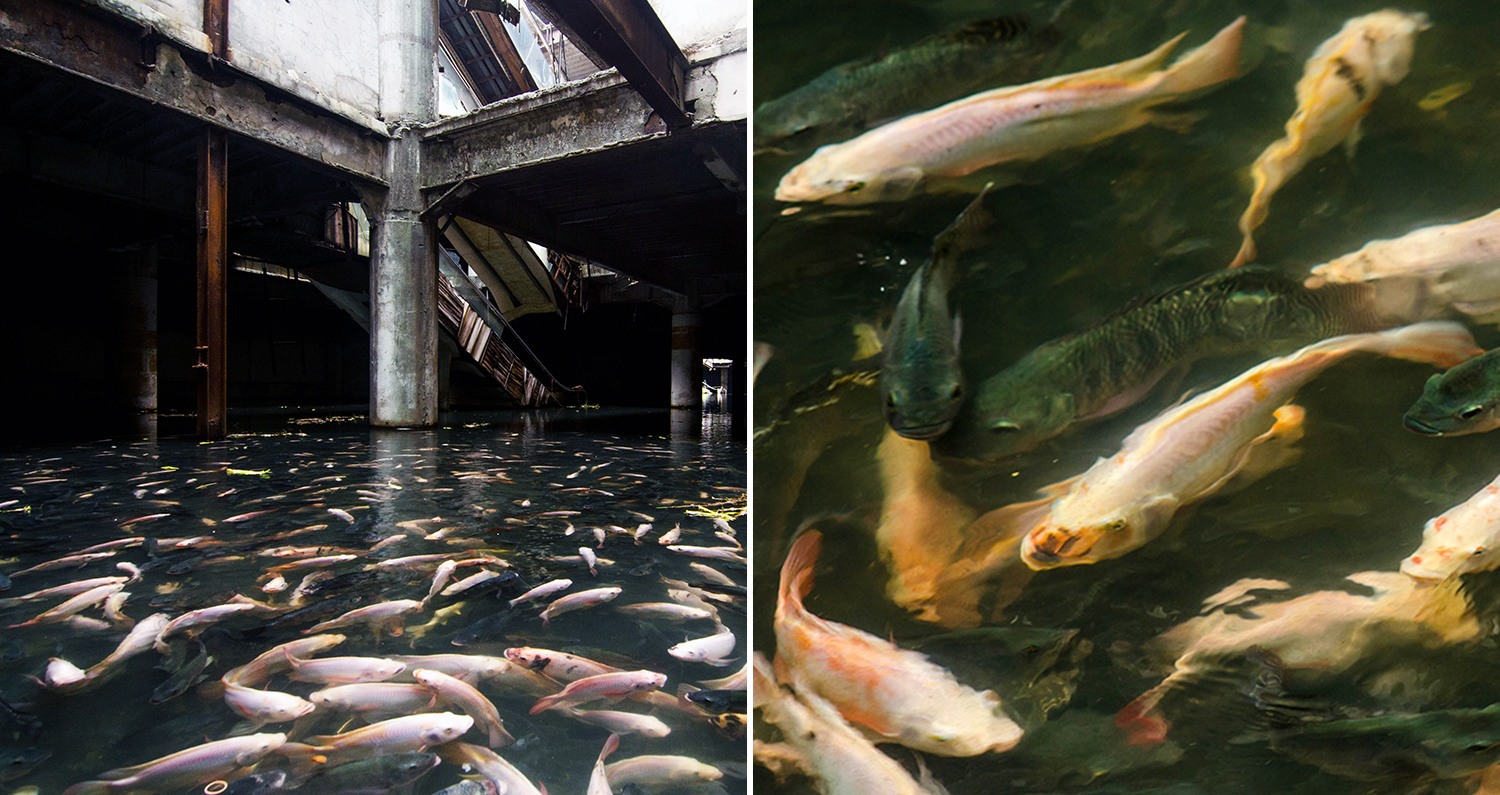
Bangkok is famous for golden temples, sizzling street food, rooftop bars, river ferries, and traffic jams that can make a scooter feel like a superhero. But hidden in the city’s older Bang Lamphu district is a story so strange it sounds like someone spilled a bowl of fish food into a disaster movie: an abandoned shopping mall became an accidental indoor pond filled with thousands of fish.
The place is known as New World Mall, or New World Department Store, and for years it was one of Bangkok’s most surreal urban legends. Once a lively retail center, the building eventually became roofless, flooded by rainwater, and quietly colonized by fish introduced by local residents to control mosquitoes. The result was not exactly a normal aquarium. There were no cheerful ticket booths, no educational signs, no smiling mascot in a fish costume. Instead, fish swam through the gloomy remains of a shopping mall, under broken escalators, beneath concrete columns, and around the ghostly outline of a consumer paradise that had lost its shoppers.
The story of Bangkok’s abandoned fish mall is more than a viral oddity. It is a tale about urban planning, local problem-solving, public safety, environmental improvisation, and the strange way cities keep writing new chapters even after a building is supposed to be finished. In other words, it is not just “fish in a mall.” It is Bangkok doing what Bangkok often does best: turning chaos into something unforgettable.
The New World Mall: From Retail Dream To Urban Ruin
New World Mall stood in Bang Lamphu, one of Bangkok’s historic neighborhoods near Khao San Road, Phra Sumen Fort, and the old city’s maze of markets, canals, temples, and family-run shops. In its prime, the mall represented modern retail ambition. It was part of a wave of Bangkok commercial development that promised air conditioning, convenience, and the glamour of a “new world” of shopping.
But the building’s future became tangled in legal and structural problems. Reports describe a mall that rose higher than it was permitted to, with several upper floors later ordered to be removed. The demolition process left behind a much lower, exposed structure. After years of legal disputes, partial demolition, and deterioration, the mall was permanently closed following a deadly collapse in 2004. From that point forward, New World was no longer a place for weekend shopping trips. It became a concrete shell waiting for rain, rumors, and eventually, fins.
For anyone who loves abandoned places, the name “New World” carries a heavy dose of irony. It was supposed to suggest progress and modern life. Instead, the building became a monument to what happens when progress gets ahead of regulation, maintenance, and long-term urban responsibility.
How Did Fish Take Over An Abandoned Shopping Mall?
The fish did not appear because Bangkok had discovered an ancient aquatic curse, although that would make an excellent movie trailer. The real explanation is more practical and, in its own way, more fascinating.
After the upper floors were removed and the roof was gone, rainwater collected in the lower levels of the abandoned building. Over time, the ground floor and basement-like areas became a stagnant pool. In tropical Bangkok, standing water is basically a handwritten invitation to mosquitoes. Local residents, facing a genuine nuisance and health concern, reportedly introduced fish into the water as a form of biological mosquito control.
The idea was simple: fish eat mosquito larvae. Instead of letting the flooded mall become a buzzing nightmare, locals turned the problem into a living ecosystem. Fish such as catfish, tilapia, and ornamental carp were reported in the water. With rainwater, shade, algae, and people occasionally feeding them, the fish population grew. Eventually, the abandoned mall was said to hold thousands of fish.
It was not an official conservation project. It was not a polished urban design experiment. It was an improvised neighborhood solution that worked so well it accidentally became world-famous. Bangkok residents did not set out to create one of the planet’s strangest aquariums. They were just trying to stop mosquitoes from treating the neighborhood like an all-you-can-bite buffet.
Why The Fish Mall Went Viral
For years, the flooded mall existed as a local curiosity. Then photos began circulating online, and the internet did what the internet does: it stared, gasped, clicked, shared, and turned the place into a global spectacle.
The visuals were irresistible. Imagine a dark shopping mall with sunlight pouring through missing sections above. Below, greenish water reflects concrete columns and old railings. Fish move through the shadows where shoppers once walked. The scene feels like a level from a post-apocalyptic video game, except the final boss is probably a very confused catfish.
Travel writers, photographers, urban explorers, and international media picked up the story. Headlines described an abandoned Bangkok mall “taken over by fish,” and the phrase stuck because it was both accurate and delightfully absurd. The story had all the ingredients of viral success: a familiar place transformed into something impossible, a little danger, a little mystery, and enough fish to make the building look as if nature had filed a hostile takeover notice.
The Surreal Beauty Of Urban Decay
Part of the fascination with New World Mall comes from the contrast between what shopping malls are supposed to represent and what this one became. Malls are designed for control. Lighting is planned. Music is selected. Escalators guide movement. Storefronts compete for attention. Security guards keep order. Food courts smell like fried chicken and sugar.
New World Mall inverted all of that. The lights were gone. The stores were empty. The roof was open to the weather. The floor was underwater. The “customers” had gills. It looked like consumer culture had walked away and nature had quietly taken over the lease.
That contrast is why abandoned malls are so powerful in modern imagination. They remind us that buildings are not permanent just because they are made of concrete. A shopping mall can be busy one decade and eerie the next. A department store can become a pond. An escalator can become a sculpture. A place built for buying things can turn into a lesson about impermanence.
Was The Bangkok Fish Mall Safe To Visit?
No, and this is where the story needs a firm splash of reality. New World Mall became famous partly because people wanted to sneak inside and photograph it, but authorities restricted access due to safety concerns. Abandoned buildings can be dangerous even when they look cinematic. Unstable floors, exposed metal, hidden holes, contaminated water, weak staircases, and falling debris are not charming travel accessories.
The Bangkok Metropolitan Administration eventually declared the site off-limits. In 2015, officials removed thousands of fish and relocated them. The water was drained, and the mall’s future became part of a broader conversation about public safety, heritage, redevelopment, and community memory.
That means travelers should not treat New World Mall as a casual attraction to explore illegally. The story is fascinating, but trespassing into unsafe buildings is not “adventure”; it is a quick way to star in a cautionary tale your travel insurance may not enjoy reading.
What Happened To The Fish?
When the flooded mall became too famous, officials had to respond. Reports from the time describe workers using nets to remove thousands of fish from the building. Many were transferred to other water bodies, including reservoirs, canals, and rivers. The operation marked the end of the mall’s most famous era as a giant accidental fish pond.
For people who loved the strange beauty of the site, the removal felt like the end of a legend. But from a safety and animal welfare perspective, the situation was complicated. A roofless, abandoned, unstable mall is not exactly a luxury fish habitat. It may have looked magical in photographs, but it was also unmanaged, unsafe, and vulnerable to pollution, crowding, and neglect.
The fish became symbols of urban resilience, but they were also living animals in an accidental ecosystem. Their removal was not just about stopping tourists from entering; it was also about addressing an unusual situation that had outgrown its origins as mosquito control.
Bangkok’s Relationship With Water Made The Story Possible
To understand why the fish mall captured imaginations, it helps to understand Bangkok’s deep relationship with water. The city grew around the Chao Phraya River and a network of canals. It is sometimes called the “Venice of the East,” a nickname that may sound romantic until you remember that Venice also has flooding problems and very damp basements.
Bangkok’s climate brings heavy seasonal rains, and water is part of daily urban life. Street vendors adjust to storms. Motorcyclists zip through puddles. Canal boats keep moving. Buildings, markets, temples, and neighborhoods all live with water in some form. New World Mall became an extreme example of this relationship: a building failed, rain entered, residents adapted, and fish moved in.
The story feels uniquely Bangkok because it combines informality, practicality, humor, and survival. The city is full of places where old and new overlap: spirit houses outside skyscrapers, ancient temples near shopping centers, street food stalls beside luxury hotels. An abandoned mall full of fish fits into that larger pattern. It is bizarre, but not random. It is Bangkok’s urban personality turned up to maximum volume.
Lessons From The Abandoned Fish Mall
1. Cities Never Stop Changing
New World Mall proves that a building’s official purpose is only one chapter of its life. A department store can become a ruin. A ruin can become a pond. A pond can become a viral landmark. A viral landmark can become an art and memory site. Cities are not static; they are living systems that rewrite themselves constantly.
2. Local Knowledge Matters
The fish were reportedly introduced because nearby residents needed relief from mosquitoes. That local response may not have been formal or perfect, but it reflected a community solving an immediate problem with available tools. Urban planning often works best when it listens to people who live next to the problem every day.
3. Viral Fame Can Be A Double-Edged Sword
Online attention made the fish mall famous, but it also increased foot traffic to an unsafe site. Many abandoned places become more vulnerable once the internet discovers them. The more mysterious they look, the more people want to enter, photograph, and post. That attention can force authorities to act, but it can also damage fragile sites.
4. Nature Is Opportunistic
The fish mall is a reminder that nature does not wait politely outside city limits. Give water a place to collect, add heat, nutrients, and a few fish, and an ecosystem can emerge in the least expected place. Nature is not sentimental. It will move into a mall if the conditions are right.
New World Mall Today: Memory, Art, And Urban Reuse
Although the fish are no longer the main attraction, New World Mall has not disappeared from Bangkok’s cultural imagination. In recent years, the building has been connected to exhibitions and public discussions about urban memory, neighborhood identity, and the future of unused spaces. Rather than simply being a forbidden ruin, it has become a site where artists, residents, and planners can ask what abandoned buildings should become.
This shift matters. Cities around the world are full of dead malls, empty offices, unfinished towers, and neglected commercial spaces. Some are demolished. Some are redeveloped. Some become art venues, community spaces, markets, or parks. New World Mall’s strange history gives Bangkok a dramatic case study in how a failed building can still hold value as memory, warning, and creative opportunity.
The mall’s future may never be as weird as its fish-filled past, and honestly, that is a high bar. But its next life could be more useful, safer, and more connected to the neighborhood that lived with it long before the world’s cameras arrived.
Why This Story Still Fascinates People
The abandoned shopping mall in Bangkok taken over by fish remains fascinating because it scrambles expectations. A mall is supposed to be dry, bright, commercial, and human-centered. New World became wet, shadowy, organic, and fish-centered. It turned a symbol of consumption into a symbol of adaptation.
It also gives people a safe way to think about bigger issues. What happens when buildings outlive their purpose? Who is responsible for abandoned spaces? How do local communities cope when official solutions move slowly? Can decay become beauty? Can a problem become a story worth preserving?
Those questions are why the fish mall is more than a quirky headline. It is funny, yes. It is visually amazing, absolutely. But it also points to serious issues in urban life: regulation, safety, climate, community, and memory. The fish are the hook. The city is the story.
A 500-Word Experience Guide: What It Feels Like To Encounter The Legend Of Bangkok’s Fish Mall
Even if you never step inside New World Mall, the experience of discovering its story can shape how you see Bangkok. Start in Bang Lamphu, and the neighborhood already feels like a layered scrapbook. Walk past old shop houses, food carts, monks in saffron robes, backpackers with oversized luggage, and aunties selling snacks with the calm authority of people who know exactly how hungry you are. The streets have texture. They do not feel designed by a committee trying to make everything beige.
Then you learn that somewhere in this living neighborhood stood a mall that once promised modern shopping comfort, only to become an accidental fish pond. Suddenly, the city feels even stranger and richer. You begin noticing water everywhere: puddles after rain, canals behind buildings, the river moving with ferries and long-tail boats, plastic buckets outside shops, fish sauce bottles on food stalls, and ornamental ponds tucked beside temples. Water is not background scenery in Bangkok. It is part of the plot.
The fish mall experience is best understood as a story rather than a checklist attraction. It is not about forcing your way into an unsafe building for a blurry photo. It is about standing in the old city and imagining how quickly a place can change. One day, a department store sells clothes and household goods. Years later, fish glide through its flooded floor. Later still, artists and residents discuss memory inside the same structure. That kind of transformation makes the city feel alive, unpredictable, and slightly mischievous.
For travelers, the lesson is to slow down. Bangkok rewards curiosity more than speed. The most memorable moments often happen between famous landmarks: a vendor joking while flipping roti, a cat sleeping under a spirit house, a canal boat spraying water like it has a personal grudge, or a local resident explaining that yes, the abandoned mall really did have fish inside. These small encounters make the fish mall legend feel less like internet trivia and more like part of a neighborhood’s personality.
There is also a respectful way to engage with the story. Do not trespass. Do not romanticize danger. Do not treat local problems as tourist props. Instead, use the legend as a doorway into deeper questions. Ask how cities reuse abandoned buildings. Visit legal exhibitions when available. Support nearby local businesses. Read about Bang Lamphu’s history. Notice how communities adapt when official systems fail or move slowly. The fish were funny, but the neighborhood’s resilience is the real headline.
In that sense, New World Mall offers one of Bangkok’s most memorable travel experiences without needing to be entered at all. It changes the way you look at the city. Every empty building becomes a possible future story. Every rainstorm becomes an author. Every fish pond becomes suspiciously ambitious. And Bangkok, already overflowing with life, seems to wink and say, “You thought you had seen everything? Cute.”
Conclusion
The abandoned shopping mall in Bangkok taken over by fish is one of those rare stories that sounds unbelievable until the facts make it even better. New World Mall was built as a symbol of modern retail, fell into legal and structural trouble, became roofless and flooded, and was transformed by local residents into an accidental fish habitat to fight mosquitoes. For a time, thousands of fish swam through a space once designed for shoppers.
Today, the fish era has ended, but the legend continues. New World Mall remains a powerful reminder that cities are never finished. They flood, fail, adapt, decay, inspire, and sometimes grow fins. Bangkok’s fish mall is funny, eerie, beautiful, and cautionary all at oncea perfect urban fable for anyone who has ever wondered what happens when humans abandon a building and nature decides to redecorate.