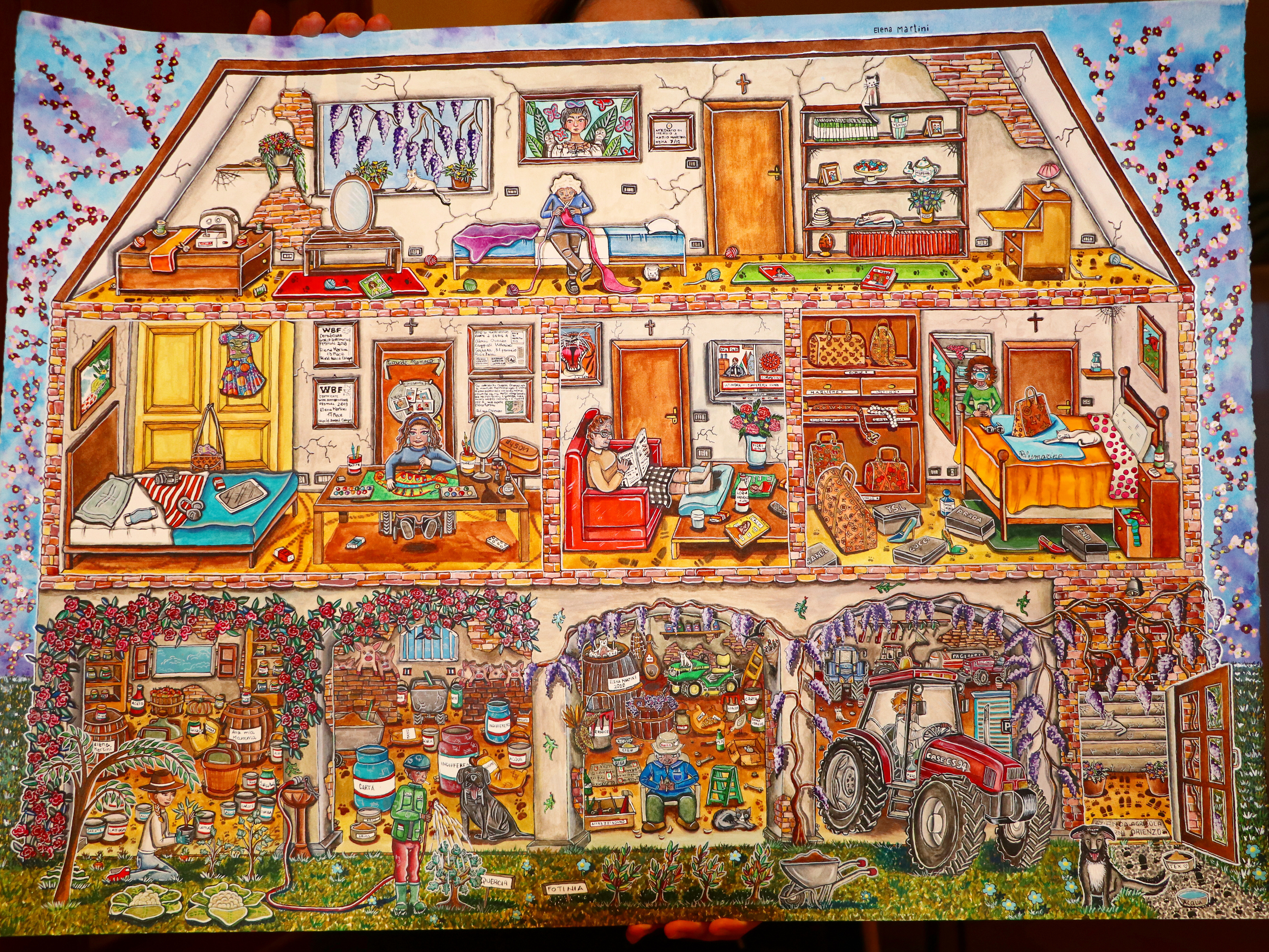
Lockdown turned ordinary rooms into offices, classrooms, gyms, bakeries, and, in several unfortunate cases, salons operated by people holding kitchen scissors. For one young disabled artist, however, the walls of home became the boundary of a much more ambitious studio. She worked across a large painting one tiny section at a time, building the image through patient marks that demanded control, concentration, and the sort of persistence most of us lose while waiting for a microwave to beep.
The widely shared image of a disabled girl leaning into a broad canvas captured something audiences immediately understood: the scale was huge, but the progress happened in inches. That contrast made the scene memorable. Yet the real significance is not that disability somehow made the painting miraculous. The significance is that the artist found a working method, stayed with it during an isolating period, and produced detailed visual work on her own terms.
A Large Painting Built From Very Small Decisions
Every detailed painting is a collection of decisions disguised as a single image. The artist must choose where an edge begins, how a shadow changes, which color belongs beside another, and whether one more highlight will complete the form or make it look as though it has been laminated. On a large canvas, those choices multiply quickly.
The lockdown painting became compelling because its tiny details could not be separated from its size. Up close, the artist was dealing with dots, lines, textures, and narrow color transitions. From a distance, those fragments had to cooperate like a very disciplined crowd. A small mistake might disappear into the whole composition, but an accumulation of careless marks could flatten the scene. Detail work therefore requires both tunnel vision and a reliable habit of stepping back.
Scale Changes the Physical Problem
A bigger painting is not merely a small painting that ate all its vegetables. It may require the artist to reposition the canvas, change working height, rotate the surface, use longer-handled tools, stabilize an arm or foot, or divide the composition into reachable zones. For a disabled artist, these choices are not afterthoughts. They are part of the artistic method.
Professional disabled painters have long adapted tools and environments to match how their bodies work. Mouth painter Mariam Paré, for example, has described relearning brush control after paralysis and later using disability-centered imagery in collaborative art. Rosie Jon paints with her feet, while Alana Tillman developed mouth-painting techniques and selected materials that worked with her grip and movement. Their methods differ, but the shared lesson is simple: technique belongs to the artist, not to one supposedly “correct” body.
Research basis:
Why Lockdown Made the Project More Meaningful
During the COVID-19 lockdowns, millions of people turned to creative projects because normal schedules collapsed. The Getty Museum’s at-home art challenge invited people to recreate famous works using household objects, and responses ranged from elegant to delightfully ridiculous. Across the internet, living rooms became galleries and laundry baskets received the dramatic roles they had always deserved.
Research basis:
For disabled people, however, lockdown was not simply an extended craft weekend. Disrupted services, reduced access to care, isolation, and inaccessible digital systems intensified existing barriers. A CDC report found that surveyed U.S. adults with disabilities experienced substantially higher rates of anxiety or depression during the pandemic and more difficulty accessing mental health care and medication than adults without disabilities. Those findings concern adults rather than the unidentified young artist in the viral image, but they help explain the broader environment in which disability and lockdown intersected.
Research basis:
Against that background, a large painting could provide structure. A blank area offered a specific task. A completed patch provided visible progress. The project did not erase fear, uncertainty, fatigue, or practical barriers, and art should never be advertised as a sparkly substitute for health care. It could, however, organize time and create a place where the artist made decisions instead of merely reacting to bad news.
The Psychology of Working Detail by Detail
Art-making can focus attention on immediate sensory questions: Is the paint too thick? Does this line need to curve? Is that blue actually blue, or is it secretly gray wearing a blue name tag? Such questions narrow a chaotic world into manageable choices.
Research on visual art-making has found associations with reduced stress, including a small study in which participants’ cortisol levels decreased after a 45-minute art-making session. Reviews of creative arts interventions have also reported promising stress-reduction effects, although outcomes vary by study design, population, and activity. The sensible conclusion is not “painting cures everything.” It is that making art can be a useful coping practice for some people.
Research basis:
The American Art Therapy Association emphasized during the pandemic that art therapy is a clinical mental health profession, not merely coloring while feeling thoughtful. Its survey respondents described creative work as particularly useful for processing isolation, grief, uncertainty, and experiences that may be difficult to put into words. Personal art-making and professional art therapy are not interchangeable, but both demonstrate how images can hold emotions that refuse to sit politely inside a sentence.
Research basis:
Adaptive Art Is Still Art, Not a Side Category
Stories about disabled artists are often framed as demonstrations of willpower. That framing can sound complimentary while quietly reducing the artwork to a motivational prop. Viewers praise the artist for “overcoming” a body, then forget to ask about composition, color, symbolism, training, ambition, or payment.
A better response begins with the work. What does the painting show? How does the eye move across it? Which details reward a closer look? How does the artist control scale? What choices create mood? Disability may shape the process and meaning, but it does not cancel artistic criticism. In fact, taking the work seriously is more respectful than applauding before anyone has looked at the canvas.
The Smithsonian American Art Museum has highlighted Creative Growth, an Oakland studio founded on the idea that people with developmental disabilities should be supported as artists rather than treated as patients completing therapeutic exercises. The studio exhibits and sells the artists’ work as contemporary art. That distinction matters: access is not charity, and creative authorship does not need a medical permission slip.
Research basis:
Language Matters When Sharing the Story
The original title uses “disabled girl,” an identity-first construction preferred by some disabled people, while others prefer “girl with a disability.” There is no universal rule that overrides an individual’s stated preference. The National Center on Disability and Journalism advises communicators to treat disability language carefully because terminology and preferences vary.
Research basis:
What should be avoided is language that turns disability into tragedy, punishment, or a surprise twist. Phrases such as “confined to a wheelchair” ignore that wheelchairs often provide freedom. Calling someone “brave” merely for appearing in public can become exhausting. And describing an artist as “suffering from” a condition without knowing how she describes herself is guesswork wearing a concerned expression.
Attribution matters too. Viral images frequently detach from their original captions as they are reposted. When the artist’s identity, diagnosis, or exact account cannot be verified, publishers should not fill the empty spaces with imaginative biography. A compelling story does not become more respectful when facts are decorated.
What the Tiniest Details Reveal
Patience Is a Technical Skill
Patience in painting is not passive waiting. It is repeated observation followed by controlled action. The artist must notice tiny differences and respond without rushing the surface. On a large painting, this rhythm may continue for days or weeks. Progress can look almost invisible from one session to the next, which is mildly rude of the canvas, but the accumulated result eventually becomes undeniable.
Access Can Improve the Creative Process
An accessible studio may include adjustable tables, lightweight tools, brush extenders, grips, supportive seating, scheduled rest, digital enlargement, voice controls, or assistance that follows the artist’s instructions. None of these adaptations makes the work less authentic. Painters have always used devices, from mahl sticks to projectors. The difference is that tools associated with disability are too often treated as exceptions rather than normal parts of craft.
Details Invite Viewers to Slow Down
A highly detailed painting changes the speed of looking. The viewer cannot absorb it with one glance and one enthusiastic “Wow!” before moving along. Small features create discovery: a repeated shape, a tiny expression, a hidden object, a delicate shift in texture. The painting asks for the same attention that produced it.
How Schools, Families, and Galleries Can Support Disabled Young Artists
Support starts by asking what the artist needs rather than announcing what should be helpful. A young painter may need a different table height, extra drying time, fewer sensory distractions, digital reference images, assistance opening paint containers, or simply permission to work in shorter sessions. The goal is not to make everyone use the same process. The goal is to make meaningful participation possible.
Museums increasingly recognize that accessibility involves more than installing a ramp. MoMA has argued for disability equality that addresses attitudes and programs as well as architecture, while The Met offers multisensory and adapted art experiences for visitors with disabilities. Smithsonian guidance similarly treats accessible exhibition design as part of serving a diverse public. These approaches offer a useful model for classrooms and community studios: build access into the plan, not onto the edge after everything else is finished.
Research basis:
Recognition should also include practical respect. Credit the artist by name when confirmed. Ask permission before sharing images. Provide alt text and captions. Pay artists for published work or commissioned projects. Do not assume a parent, teacher, or assistant created the piece. Most importantly, allow the young person to speak about the work in her own way, whether through speech, writing, an augmentative communication device, gesture, or the artwork itself.
Related Experience: What a Detail-Heavy Lockdown Project Can Feel Like
The following is a composite reflection based on commonly reported experiences of disabled artists and people who used art-making to structure time during lockdown. It is not presented as a quotation or biography of the unidentified artist in the viral image.
At the beginning, the canvas feels less like an invitation and more like a large white appliance that has been delivered to the wrong house. It occupies space. It waits. Every untouched area seems to ask whether the artist has made an administrative error.
The first session is mostly negotiation. Where can the canvas sit? Which section is reachable? How should the tools be arranged so that painting does not require a tiny expedition every three minutes? A cup is moved. A cushion is added. The reference image is enlarged. Someone suggests a helpful shortcut and is politely ignored because it would change the look of the work.
Then the painting begins. Not the entire painting, of course. One leaf. Half a face. A narrow strip of patterned fabric. The world outside may be counting infections, canceled plans, and days indoors; the artist counts brushstrokes, color mixtures, and completed shapes. The task is small enough to begin but connected to something large enough to matter.
Some days are productive. A section that seemed impossible suddenly works, and the artist keeps going past the planned stopping point because momentum has finally shown up, late and without apologizing. Other days, the body sets the schedule. Fatigue arrives. Pain interrupts. Fine control becomes less reliable. Paint dries on the palette while nothing useful happens on the canvas.
Those slower days are not evidence of failure. They are part of the project’s actual timeline. The painting grows through work and rest, correction and adaptation. A tool may be modified. The canvas may be turned. A complicated area may be postponed until energy returns. The method evolves because the artist is paying attention to both the image and the body making it.
As weeks pass, the unfinished sections become islands surrounded by color. From close range, the work still looks fragmented: dots, edges, tiny highlights, stubborn transitions. From across the room, the fragments begin to organize themselves. Depth appears. Shapes connect. The painting starts to look back.
Sharing the work online introduces a second experience. Encouragement can feel wonderful, especially during isolation, but comments may focus more on disability than art. Strangers may call the artist heroic without mentioning a single visual detail. The kindest viewers are often those who ask about the palette, the subject, the hardest section, or what the artist wants to make next. Those questions recognize a future, not merely a viral moment.
Finishing does not arrive with orchestral music. It may come as a quiet realization that another mark would not improve the image. The artist looks across the full surface and sees time made visible: lockdown hours converted into texture, uncertainty converted into choices, and hundreds of tiny decisions converted into one large painting.
Conclusion: The Big Picture Is Made of Small Acts
The story of a disabled girl painting the tiniest details in a big artwork during lockdown resonates because it contains two scales at once. There is the scale of the canvas, bold enough to command a room, and the scale of the brushstroke, modest enough to disappear unless someone pays attention.
Her work should not be reduced to a lesson about “overcoming” disability. It is a lesson about artistic process: adapt the workspace, divide the impossible into reachable sections, return after difficult days, and let careful decisions accumulate. The pandemic restricted movement and separated people, but creative work gave many artists a way to build structure, expression, and connection inside those limits.
The most respectful response is not pity and not automatic applause. It is to look closely. Notice the technique. Ask about the choices. Credit the creator. Support accessible studios and galleries. Then step back and see what all those tiny details have become.