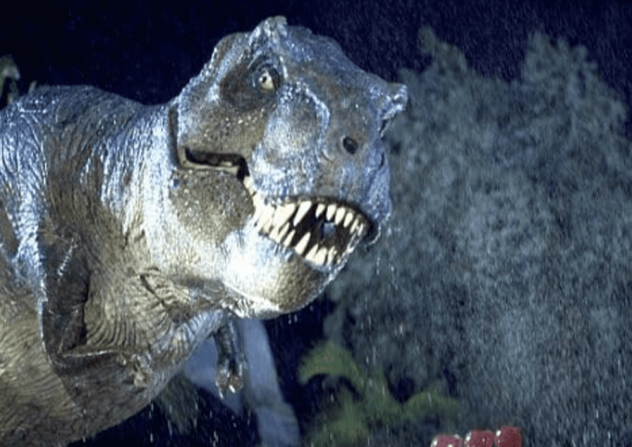
The 1990s were an awkwardly glorious time for monster movies. Practical creature effects still ruled the workshop, computer-generated imagery was beginning to flex its shiny new muscles, and filmmakers apparently believed every scientific breakthrough would end with something enormous eating a supporting actor.
While slashers and supernatural thrillers often dominate discussions of 1990s horror movies, the decade also produced a wonderfully varied collection of creature features. These films unleashed underground worms, mutant insects, genetically enhanced sharks, prehistoric reptiles, alien predators, and at least one ancient Egyptian with serious relationship issues.
The following ten movies were selected for their influence, entertainment value, creature design, atmosphere, and continuing appeal. Some are recognized classics. Others are gloriously messy cult favorites. All deserve a place on any horror fan’s watchlist.
The Best Monster Movies of the 1990s
1. Tremors (1990)
Tremors begins in the tiny desert settlement of Perfection, Nevada, where handymen Valentine McKee and Earl Bassett are planning to escape their dead-end jobs. Unfortunately, their career change is interrupted by giant subterranean predators that detect movement through vibrations.
These creatures, eventually nicknamed Graboids, transform the ground itself into hostile territory. Walking, driving, and even dropping a tool can attract something large enough to swallow a station wagon. That simple rule gives the movie a beautifully clear suspense engine: the characters must survive without touching the floor for too long.
Kevin Bacon and Fred Ward make an immensely likable team, while Michael Gross and Reba McEntire nearly steal the movie as survivalists Burt and Heather Gummer. The practical monsters are convincing, the action is easy to follow, and the comedy never turns the creatures into harmless jokes.
Tremors is a model of efficient creature-feature storytelling. Every escape teaches the survivors something new, and every solution creates another problem. It is funny, clever, and endlessly rewatchablethe rare horror movie that can make an underground worm feel like both a terrifying predator and an unusually aggressive piece of plumbing.
2. Arachnophobia (1990)
Frank Marshall’s Arachnophobia turns an ordinary American town into an eight-legged nightmare. After a deadly South American spider reaches California, it breeds with a local species and produces an army of highly venomous offspring.
The film understands that spiders do not need to be the size of trucks to frighten people. They only need to appear inside slippers, lampshades, cereal boxes, showers, and any other place where a person would prefer not to discover a surprise with multiple knees.
Jeff Daniels provides a grounded center as a doctor who happens to fear spiders, while John Goodman delivers comic relief as an exterminator with the confidence of an action hero and the equipment of a hardware-store employee. Marshall carefully balances suburban comedy with escalating suspense, earning the film its often-used description as a “thrill-omedy.” Contemporary critics also recognized its ability to make audiences squirm while maintaining an accessible, playful tone.
The use of real spiders and practical techniques gives the attacks a tactile quality that many digital creature movies struggle to reproduce. Arachnophobia remains essential because it proves that an effective monster does not need to roar. Sometimes it just needs to crawl behind the toilet.
3. Jurassic Park (1993)
Jurassic Park is usually categorized as science-fiction adventure, but its most memorable sequences are pure monster horror. A tropical island loses power, engineered predators escape, and a group of vulnerable humans realizes that the food chain has been aggressively reorganized.
Steven Spielberg builds anticipation before revealing the dinosaurs in full. Water trembles in a cup. Heavy footsteps approach in the rain. A goat disappears. Then the Tyrannosaurus rex steps through a broken fence and creates one of the most famous creature attacks in cinema.
The kitchen sequence with the velociraptors is equally effective. It uses reflections, clicking claws, narrow hiding spaces, and frightened children to create suspense without relying on excessive gore. The dinosaurs feel like animals rather than generic villains, which makes them more believable and, when hungry, much less open to negotiation.
The movie’s combination of Stan Winston’s practical creations and Industrial Light & Magic’s computer-generated dinosaurs changed visual-effects filmmaking. The Academy recognized it with Oscars for visual effects, sound, and sound-effects editing, while later technical accounts have continued to describe it as a benchmark in the transition from stop-motion methods to digital animation.
More than three decades later, the effects remain persuasive because Spielberg uses them selectively. The audience never becomes numb to the dinosaurs. Every appearance feels important, dangerous, and worthy of a very large insurance claim.
4. Species (1995)
In Species, scientists combine human DNA with genetic instructions received from space. Their experiment produces Sil, an alien-human hybrid who rapidly grows into an adult and escapes from confinement. A team of specialists is assembled to track her before she reproduces.
The plot blends pursuit thriller, body horror, science fiction, and unapologetic exploitation. Natasha Henstridge gives Sil an unusual combination of innocence, calculation, and predatory instinct. She understands human behavior just well enough to manipulate people, but not well enough to stop treating them like temporary biological equipment.
The movie’s greatest asset is the creature design by H.R. Giger, whose biomechanical artwork had previously defined the visual identity of Alien. Sil’s transformed body combines transparent surfaces, skeletal structures, tentacles, and sharp organic shapes. Even reviewers who found the story familiar acknowledged the connection between Giger’s design and his earlier alien imagery.
Species is not subtle, and it does not pretend otherwise. It is a polished, pulpy monster movie about scientific arrogance, reproduction, identity, and the terrible consequences of opening interstellar email attachments.
5. Anaconda (1997)
A documentary crew traveling through the Amazon encounters Paul Serone, a mysterious snake hunter played by Jon Voight. Serone gradually takes control of their boat and leads them toward an enormous anaconda that he intends to capture alive.
Anaconda works because it approaches ridiculous material with surprising commitment. Jennifer Lopez, Ice Cube, Eric Stoltz, Kari Wuhrer, and Owen Wilson play the increasingly unlucky expedition members, while Voight delivers every line as though he learned human communication by observing it through binoculars.
The snake is created through a mixture of animatronics and digital effects. Some shots have aged better than others, but the movie wisely surrounds its monster with steaming jungle scenery, murky water, damaged boats, and enough suspicious rustling to keep viewers alert.
Roger Ebert praised the film as a slick and funny creature feature, highlighting its adventure atmosphere and satisfying monster action. That description captures why it remains popular: Anaconda delivers exactly the movie promised by its title, plus a villain who may be even more dangerous than the snake.
6. The Relic (1997)
The Relic traps its characters inside a Chicago natural-history museum during a major fundraising event. Something has arrived with a shipment from South America, and it is collecting human brains for reasons that become increasingly complicated and unpleasant.
Penelope Ann Miller plays evolutionary biologist Margo Green, while Tom Sizemore portrays Lieutenant Vincent D’Agosta. Together they investigate a series of gruesome deaths before confronting the Kothoga, a massive hybrid creature connected to plants, hormones, ritual, and scientific interference.
The museum setting gives the film personality. Shadowy exhibition halls, storage rooms, tunnels, laboratories, and ceremonial displays create a gothic atmosphere inside a modern institution. Director Peter Hyams, who also served as cinematographer, frequently leaves portions of the frame in darkness, allowing viewers to imagine the creature before seeing it clearly.
The Kothoga was designed with significant practical-effects involvement from Stan Winston’s team. Its eventual rampage delivers the kind of violent physical confrontation expected from a 1990s studio monster movie. Contemporary reviews noted that the film pushed its gore and creature violence beyond the usual mainstream level.
7. Mimic (1997)
Guillermo del Toro’s English-language debut begins with a public-health emergency. Entomologist Susan Tyler creates a genetically engineered insect called the Judas breed to eliminate disease-carrying cockroaches. The new insects are supposed to die after one generation. Nature, having apparently skipped the terms-and-conditions page, chooses another option.
Years later, the Judas insects have evolved into towering predators capable of imitating the silhouette of a person. Their folded wings resemble a long coat, their limbs suggest arms and legs, and their clicking movements echo human footsteps. From a distance they look almost normal, which is exactly the problem.
Del Toro fills the movie with rain, rust, amber light, underground architecture, religious imagery, and elaborate insect anatomy. The theatrical production was troubled by studio interference, but even the compromised version contains the visual obsessions that would define his later work. A subsequent director’s cut restored some of his preferred material.
Mimic is worth seeing for its atmosphere alone. It transforms abandoned subway tunnels into a decaying insect kingdom and makes every distant figure on a train platform seem deserving of a cautious second look.
8. Deep Rising (1998)
Before directing The Mummy, Stephen Sommers made this loud, fast, and proudly excessive aquatic monster movie. A group of mercenaries boards a luxury cruise ship intending to rob it, only to discover that most of the passengers have already been consumed by tentacled creatures.
Treat Williams plays boat captain John Finnegan, Famke Janssen plays a jewel thief, and Kevin J. O’Connor supplies nervous comic energy as mechanic Joey Pantucci. Their survival strategy involves guns, explosions, jet skis, improvised plans, and the repeated discovery that the monster has more tentacles than anyone budgeted for.
The creature, designed with the involvement of effects artist Rob Bottin, is essentially a giant deep-sea organism whose feeding appendages move independently through the ship. The result resembles Alien, a disaster movie, and a pirate adventure being forced to share one very wet hallway. Even negative contemporary assessments emphasized the film’s enormous squid-like head and tooth-filled tentacles.
Deep Rising initially struggled to find an audience, but its energetic pacing, practical gore, ensemble chemistry, and cheerful lack of restraint have helped it develop cult status. It is cinematic junk food served on expensive chinaand sometimes that is exactly what movie night needs.
9. The Mummy (1999)
Stephen Sommers returned one year later with a much larger production that reinvented Universal’s classic monster as the center of a romantic adventure. Brendan Fraser plays Rick O’Connell, a former soldier who accompanies librarian Evelyn Carnahan, played by Rachel Weisz, to the lost city of Hamunaptra.
They accidentally resurrect Imhotep, an ancient priest who was cursed and buried alive after an affair with the pharaoh’s mistress. Imhotep begins regenerating by harvesting organs from those who opened his tomb, while also unleashing plagues, sandstorms, scarab beetles, and an impressive amount of shouting.
The film balances horror imagery with comedy, romance, and old-fashioned adventure. Arnold Vosloo gives Imhotep dignity and menace, while Fraser and Weisz create enough charm to prevent the effects from overwhelming the human story.
Contemporary commentary recognized the movie as a major departure from the restrained 1932 version. Instead of relying on a slowly moving bandaged figure, Sommers created a swashbuckling spectacle filled with digitally reconstructed bodies and supernatural destruction. The film became a worldwide hit and revitalized the Universal monster property for a new generation.
10. Deep Blue Sea (1999)
Scientists working at an isolated underwater laboratory genetically enlarge shark brains while researching a treatment for Alzheimer’s disease. The sharks become smarter, more coordinated, and understandably annoyed about the entire arrangement.
Director Renny Harlin treats the facility like a sinking maze. Corridors flood, doors malfunction, escape routes disappear, and the sharks demonstrate an alarming ability to plan ahead. The movie repeatedly establishes what viewers expect to happen and then bites through those expectations with industrial efficiency.
The cast includes Thomas Jane, Saffron Burrows, LL Cool J, Michael Rapaport, Stellan Skarsgård, and Samuel L. Jackson. Jackson participates in one of the decade’s most memorable monster-movie shocks, a scene best experienced without advance explanation and preferably without holding a drink.
The production mixes animatronic sharks with digital effects, using each technique according to the needs of the scene. Critics who enjoyed the film praised its professionalism, suspense construction, and willingness to honor the conventions of the shark thriller without merely repeating Jaws.
Deep Blue Sea closes the decade with an ideal summary of 1990s creature cinema: ambitious science, isolated victims, practical effects, emerging CGI, outrageous deaths, and a firm reminder that making predators more intelligent is rarely an excellent workplace initiative.
Why These 1990s Creature Features Still Matter
The strongest monster movies reveal their creatures gradually. Tremors begins with unexplained deaths and vibrations. Jurassic Park announces the Tyrannosaurus through sound and movement before showing its full body. Mimic hides its insects inside human silhouettes. Suspense comes from learning the monster’s rules alongside the characters.
These films also document an important transition in special effects. Practical puppets, animatronics, makeup, miniatures, and full-scale mechanical creatures were still common, while digital effects offered movements and camera angles that physical models could not achieve. The best productions combined both approaches rather than treating one as a complete replacement for the other.
The decade’s monster movies were also unusually comfortable mixing tones. Horror could coexist with comedy, romance, action, or adventure. A film might deliver a gruesome death, a clever joke, and a spectacular explosion within five minutes. That flexibility made the movies accessible without removing their teeth.
Most importantly, each creature reflects a recognizable human mistake. Scientists ignore safeguards. Business owners value profits over survival. Explorers open sealed tombs. Researchers alter shark intelligence. Documentary crews trust Jon Voight. The monsters may be fictional, but the poor decision-making is painfully authentic.
A Personal Monster-Movie Marathon Experience
Watching these ten movies as a marathon creates an unexpectedly revealing tour through 1990s filmmaking. The ideal setup is simple: dim lights, generous snacks, a television large enough to appreciate a charging Tyrannosaurus, and no loose objects on the floor during Arachnophobia. Every stray thread will look like a spider leg by the second act.
Starting with Tremors immediately establishes the decade’s affection for practical effects. The Graboids have weight. Dirt explodes around them, buildings shake, and actors physically interact with their remains. Even when viewers understand how the illusion works, the physical presence makes the danger feel immediate. It also demonstrates how much personality a monster can have without speaking or displaying a recognizable face.
Arachnophobia changes the experience by shrinking the threat. After giant worms, tiny spiders should feel less impressive, yet they are often more uncomfortable because they can occupy familiar spaces. During a group screening, people begin checking their sleeves, shoes, and drinks. Nobody does this during Jurassic Park, because most living rooms have reasonably effective defenses against velociraptors.
The transition to Jurassic Park feels like moving from a clever genre production into cinematic history. Its major sequences remain remarkably disciplined. The film does not bury the audience beneath constant dinosaur action. It creates anticipation, provides a powerful encounter, and then allows time for the experience to register. Modern blockbusters sometimes seem frightened that viewers will escape if the screen remains quiet for twelve seconds. Spielberg understands that silence is part of the attack.
The middle of the marathonSpecies, Anaconda, The Relic, and Mimiccaptures the wonderfully strange identity of mid-1990s horror. These movies have serious production values but often operate with the logic of late-night cable. Scientists explain impossible biology with complete confidence. Monsters develop extremely convenient abilities. Authorities make decisions that suggest the creatures have already eaten the competent employees.
This is not a weakness when the movies commit to their premises. Species offers unsettling design and body horror. Anaconda provides campy adventure. The Relic delivers a shadowy museum maze. Mimic creates a rain-soaked urban nightmare. Watching them together reveals how many distinct environments a traditional hunt-and-survive structure can support.
Deep Rising works best late in the evening, when critical resistance has weakened and the sight of armed mercenaries fighting digestive tentacles seems perfectly reasonable. Its enthusiasm is infectious. The movie does not ask whether a scene is plausible; it asks whether the scene could contain another explosion.
The Mummy then provides a refreshing burst of charm. It is less frightening than several earlier selections, but its monsters, scarabs, decomposing bodies, and supernatural plagues preserve a horror foundation beneath the adventure. Fraser and Weisz remind viewers that charismatic characters can make even the wildest effects-driven story emotionally engaging.
Ending with Deep Blue Sea is especially satisfying. It combines scientific arrogance, enclosed spaces, creature intelligence, and elaborate practical destruction into a final concentrated dose of 1990s excess. By this point, the marathon’s primary lesson is obvious: when a researcher says an experimental predator is completely secure, begin locating the nearest emergency exit.
A marathon also makes the imperfections more enjoyable. Some digital shots have aged. Certain scientific explanations sound as though they were assembled from refrigerator magnets. A few characters exist primarily to become lunch. Yet the movies remain entertaining because they offer clear visual identities, memorable monsters, and filmmakers willing to embrace genre pleasures without embarrassment.
For the full experience, avoid watching everything alone on a phone. Monster movies benefit from shared reactions. Gasps, laughter, shouted warnings, and arguments over who made the worst decision become part of the entertainment. Add Lake Placid, Godzilla, or The Faculty as bonus features when ten movies somehow feel insufficient. Just remember to check the bathtub for spiders, the basement for insects, the lake for crocodiles, and the kitchen for genetically engineered sharks. The last one is unlikely, but after this marathon, optimism seems irresponsible.
Conclusion
The best monster movies from the 90s combined old-school creature craftsmanship with rapidly advancing digital technology. They could be frightening, funny, romantic, absurd, or all four before the closing credits.
Tremors demonstrated the power of a simple monster rule. Arachnophobia weaponized everyday spaces. Jurassic Park changed visual effects. Species delivered unforgettable biomechanical design. Anaconda, The Relic, and Mimic turned jungles, museums, and subway tunnels into hunting grounds. Deep Rising celebrated aquatic chaos, while The Mummy and Deep Blue Sea ended the decade with blockbuster-sized creature entertainment.
Not every effect is timeless and not every plot survives close scientific inspection. That hardly matters. These movies understand the central promise of a creature feature: introduce an unforgettable monster, trap interesting people near it, and make survival difficult enough to keep the popcorn suspended halfway to the viewer’s mouth.
Note: The term “monster movie” is used broadly here to include giant-animal horror, mutant-creature films, prehistoric predators, extraterrestrial hybrids, and supernatural beings.