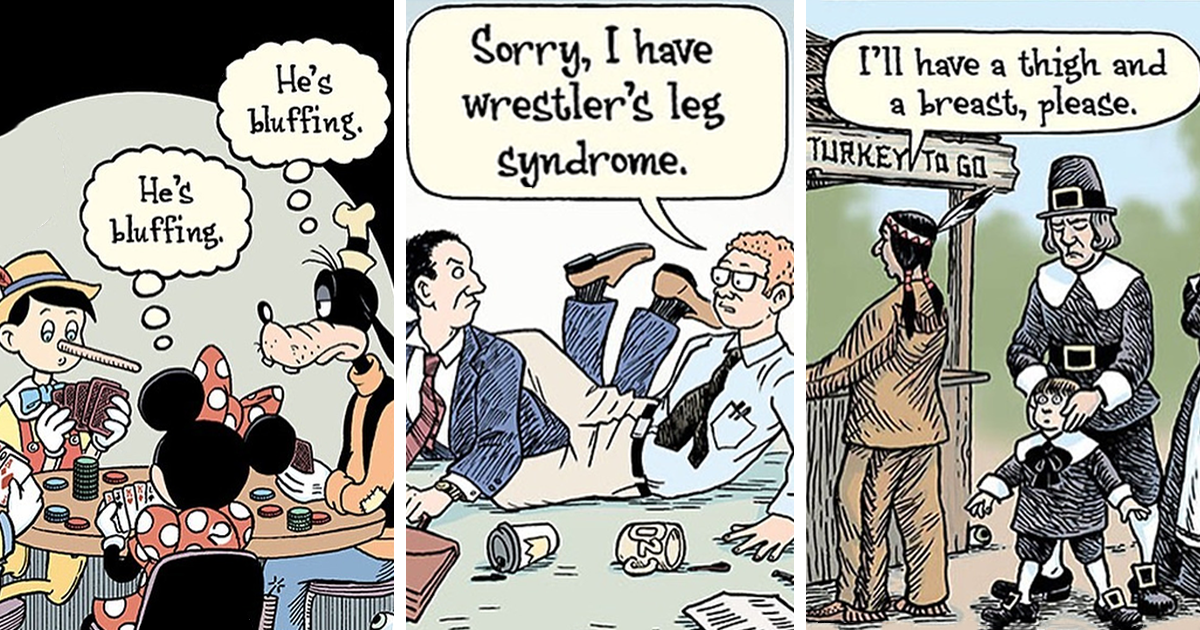
A dog visits a therapist. A skeleton develops social anxiety. A pirate discovers that office paperwork is more terrifying than the open sea. Welcome to the delightfully crooked universe of Dan Piraro, where ordinary life steps on a banana peel, falls through a philosophical trapdoor, and somehow lands in a perfectly composed single-panel comic.
Piraro is best known as the creator of Bizarro, the long-running surreal comic panel that began appearing in newspapers in the 1980s. The feature is built around compact visual jokes, deadpan dialogue, strange background details, and a world in which animals, monsters, historical figures, household objects, and exhausted humans all seem to share the same mildly inconvenient reality. Today, Bizarro is presented by Comics Kingdom as the work of Piraro and his longtime creative partner Wayno.
This article draws on official creator pages, syndication material, professional cartooning archives, historical profiles, interviews with Piraro and Wayno, and published collections discussing the appeal of his surreal newspaper cartoons.
Why Dan Piraro’s Single-Panel Comics Work So Well
A single-panel comic has no warm-up lap. There is no previous scene explaining why the cow is attending a business meeting or why Death is arguing with a parking attendant. The artist must establish the setting, introduce the conflict, and deliver the joke almost instantly.
Piraro’s strongest cartoons accomplish this by presenting nonsense as if it were completely routine. The characters rarely scream, “Good heavens, this is absurd!” Instead, they respond with the tired expressions of people who have already filled out three forms and are now being told they used the wrong color ink.
The comedy usually begins with recognition. We see a doctor’s office, restaurant, living room, therapy session, classroom, or customer-service counter. Then one familiar detail is replaced with something impossible. That small violation of reality is enough to turn the entire scene sideways.
A Guided Tour Through 30 Unexpectedly Absurd Comic Situations
The 30 comic situations below illustrate the recurring ingredients that make Piraro’s silly single-panel comics so memorable. Some rely on role reversal, others on visual puns, and several appear to have been conceived after reality was left unattended near an open container of glue.
Everyday Life With One Important Screw Missing
- The therapist who needs therapy: A supposedly calm professional becomes more emotionally overwhelmed than the patient. The reversal pokes fun at the idea that experts always have their own lives neatly organized.
- The doctor who takes language literally: A familiar medical expression becomes a physical object or impossible diagnosis. The joke works because the wording is technically correct and medically useless.
- The dentist facing organized resistance: Teeth, tools, or nervous patients appear to have formed their own negotiating committee. Suddenly, a routine cleaning feels like an international summit.
- The restaurant with alarmingly honest service: Rather than hiding the kitchen’s chaos, the staff casually admits what customers have always feared. The waiter remains professional, which makes the disaster even funnier.
- The customer-service desk in the afterlife: Heaven or hell is treated like a giant bureaucracy where souls need tickets, identification, and possibly proof of address.
- The relationship explained as machinery: Emotional problems are converted into gears, broken switches, faulty wiring, or missing instruction manuals. Romance has rarely looked so much like an appliance warranty.
- The job interview for an impossible occupation: A monster, mythical figure, or household object attempts to explain its professional qualifications to an unimpressed manager.
- The real-estate tour with a dangerous feature: A cheerful agent describes a haunted castle, volcano-adjacent property, or villainous laboratory as though it merely needs fresh paint.
Animals Acting More Human Than Humans
- The dog analyzing its owner: Instead of being the confused pet, the dog clearly understands the household and quietly judges the human who keeps throwing away perfectly good food.
- The cat with a private business strategy: Cats in absurd comics often behave like executives who tolerate people only because the humans control the can opener.
- The farm animal challenging the menu: A cow, pig, chicken, or fish notices something troubling about a restaurant’s featured dish and requests a word with management.
- The wildlife support group: Animals discuss their encounters with humans as if recovering from a shared traumatic experience involving leaf blowers, selfie sticks, and suburban landscaping.
- The pet interpreting human behavior: Activities that seem normal to peopleworking late, staring at phones, buying exercise equipmentlook completely irrational from an animal’s perspective.
- The predator with inconvenient ethics: A carnivorous animal struggles with guilt, dietary restrictions, or a prey animal who has read too many negotiation books.
- The animal pursuing a human career: A creature applies for work that perfectly matches one of its natural abilities, only to become trapped in meetings and performance reviews.
History, Mythology, and Monsters With Modern Problems
- The pirate dealing with office bureaucracy: Sword fighting and sea monsters were manageable. Expense reports, password resets, and mandatory training finally break the captain’s spirit.
- The cowboy facing contemporary anxiety: A rugged figure from the frontier worries about branding, online reviews, or whether his horse has better health insurance.
- The snowman confronting the forecast: A character made of frozen water listens to a meteorologist announce warmer temperatures with the expression of someone reading a very personal threat.
- The angel with an unglamorous problem: Heavenly beings may have wings and halos, but they still encounter uncomfortable shoes, crowded elevators, or confusing workplace policies.
- The monster attending counseling: A vampire, zombie, or creature from beneath the bed explains that frightening people no longer provides the same sense of fulfillment.
- Death suffering a scheduling conflict: The Grim Reaper becomes less terrifying when forced to manage appointments, transportation delays, and clients who refuse to follow instructions.
- The mythological hero after retirement: A once-mighty legend adjusts to domestic life, where defeating monsters is easier than assembling furniture without leftover screws.
- The historical figure encountering modern technology: A famous person from the past discovers smartphones, automated menus, or social media and immediately regrets returning.
Visual Puns, Hidden Jokes, and Reality in Pieces
- The figure of speech made physical: Expressions such as “carrying emotional baggage” or “being tied to a desk” become literal scenes. The image explains the joke before the caption finishes it.
- The sign that contradicts the scene: A polite notice promises safety, peace, or professionalism while absolute chaos unfolds two inches away.
- The artwork observing the museum visitors: Paintings and statues quietly reverse the gaze, making the humans look like the strange exhibits.
- The household object developing an attitude: Furniture, appliances, and office equipment respond to mistreatment after years of being kicked, overloaded, or blamed for user error.
- The background detail delivering a second punch line: The main caption earns the first laugh, but a sign, book title, tiny character, or distant disaster rewards closer inspection.
- The hidden-symbol treasure hunt: Recurring objects are tucked into the artwork, giving readers another reason to scan every corner after understanding the central gag.
- The delayed-reaction comic: The panel seems merely strange at first. Several seconds later, the visual connection clicks, and the reader laughs while wondering why a talking fish suddenly feels intellectually superior.
The Secret Ingredient: Serious Artwork Serving Silly Ideas
Part of Bizarro’s charm comes from the contrast between polished illustration and ridiculous subject matter. The rooms have recognizable furniture. Clothing, facial expressions, and architecture receive enough attention to make the environment believable. That visual credibility allows the impossible element to stand out.
Piraro has discussed his interest in design, painting, retro furnishings, and unusual character styling. His carefully drawn settings do more than decorate the joke; they establish a convincing reality that can then be punctured by one surreal idea. A poorly developed setting might produce a quick gag. A detailed setting produces a tiny alternate universe.
That is why background objects matter. A strangely shaped lamp, oversized hairstyle, crooked picture frame, or suspiciously alert chicken may not be essential to the punch line, but it contributes to the feeling that this universe has existed long before the reader arrived.
The Hidden Symbols Turn Reading Into a Game
Another signature feature is the collection of recurring secret symbols hidden inside many panels. Piraro’s official FAQ explains that a number near the artist’s signature indicates how many symbols readers can search for in that cartoon. What began as a private visual joke developed into a beloved ritual for fans.
The tradition continued as Wayno became increasingly involved in the feature. According to Comics Kingdom, their collaboration developed from gag writing and coloring into Wayno creating the Monday-through-Saturday panels, while Piraro continued with the Sunday comic and contributed feedback and ideas. Wayno has also described maintaining the secret-symbol tradition as part of preserving the strip’s distinctive identity.
The symbols create two reading speeds. First, readers absorb the main joke. Then they return as detectives, inspecting wallpaper, shelves, clothing, and suspiciously crowded corners. It is comedy followed by a scavenger hunt, which is a generous amount of entertainment for one rectangle.
Absurd Humor With Something Real Underneath
Piraro’s comics are silly, but they are not empty. Beneath the talking animals and supernatural office workers, many panels examine consumer behavior, workplace frustration, environmental carelessness, vanity, technology, relationships, and the peculiar ways people justify their habits.
The satire rarely arrives as a lecture. Instead, the reader is allowed to recognize the foolishness independently. A human may appear less logical than a dog. A monster may demonstrate greater emotional awareness than its therapist. An ancient civilization may seem better prepared for modern life than the people currently running it.
Piraro’s animal-related and environmental themes have also been recognized beyond the comics pages, while his professional honors include major awards from the National Cartoonists Society. The organization’s records list multiple newspaper-panel awards connected with Bizarro, and Piraro received its highest annual honor for outstanding cartooning.
How One Panel Can Produce a Bigger Laugh Than a Long Story
Long-form comedy can build characters and gradually increase tension. A single-panel comic uses a different weapon: compression. The audience receives only the most useful moment, usually the instant when a perfectly normal situation becomes unrecoverably ridiculous.
There is also no room for unnecessary explanation. The best panels trust readers to complete the joke. We recognize the setting, identify the broken rule, and connect the visual information with the caption. That tiny burst of participation makes the punch line feel discovered rather than delivered.
Producing this kind of work consistently is far less effortless than it appears. Interviews with Piraro describe the relentless demand of daily deadlines and the pressure of generating fresh gags year after year. Wayno has similarly described a disciplined process involving sketchbooks, batches of rough ideas, feedback, revision, hand-drawn elements, and digital assembly. The finished joke may take seconds to read, but simplicity is often the final result of complicated labor.
Why These 30 Silly Comics Remain So Shareable
Single-panel cartoons fit naturally into modern reading habits. They require little background knowledge, load quickly in the brain, and can be enjoyed during a coffee break without remembering what happened in episode 473.
More importantly, Piraro’s absurd situations are recognizable across generations. Technology changes, newspapers shrink, and hairstyles become fashionable for reasons nobody can defend, but people still endure awkward appointments, confusing relationships, strange workplaces, and animals who appear disappointed in them.
The cartoons also improve when shared. One reader notices the main pun. Another spots the secret symbol. A third discovers a tiny sign in the background. A fourth declares that the joke is not funny, then spends six minutes explaining it in detail, accidentally proving that the panel has already won.
Conclusion
Dan Piraro’s funniest single-panel comics succeed because they make absurdity feel strangely reasonable. Every scene begins with a recognizable piece of life and introduces one impossible adjustment: the animal understands more than the owner, the monster needs emotional support, the professional has no idea what is happening, or the background quietly rebels against the foreground.
These 30 silly situations demonstrate that a comic does not need a lengthy story to create a complete world. A few characters, one carefully chosen line, and a small visual contradiction can produce surprise, social commentary, and a laugh that arrives several seconds late but stays much longer.
The Reader Experience: What Happens After 30 Bizarro Panels
Reading one absurd single-panel comic is a quick diversion. Reading 30 of them in a row changes the experience. After several panels, the reader begins adapting to the internal logic of the Bizarro universe. A talking dog no longer seems especially unusual. An anxious skeleton feels understandable. A pirate holding a performance review appears almost inevitable.
The first stage is simple recognition. You look at the setting and identify the ordinary situation: a waiting room, a restaurant, a classroom, a couple talking in bed, or an employee standing before a supervisor. Your brain begins predicting the familiar outcome. Then the comic replaces one expected element with something impossible. The reward comes from feeling your prediction collapse without causing any actual damage to the furniture.
After ten or twelve panels, you start looking beyond the caption. The artwork trains you to distrust innocent background details. A small sign may contain a second joke. A book title may change the meaning of the conversation. Something on a shelf may be watching the characters. Even a chair can look suspicious when it has been drawn with enough personality.
This slower inspection produces a pleasant contrast with the way most online content is consumed. Instead of scrolling immediately, you pause. You scan the corners. You count hidden objects. You return to the facial expressions and notice that the character who says nothing may be the funniest person in the panel. The comic becomes less like a disposable meme and more like a compact room you can briefly explore.
The experience is also cumulative. Similar themes begin to emerge across unrelated scenes. Humans repeatedly create systems that confuse everyone. Animals frequently appear more emotionally intelligent than their owners. Experts are trapped by their own specialties. Monsters struggle with ordinary insecurity. The afterlife has terrible administration. Together, the panels suggest that civilization is a massive group project in which nobody read the instructions.
Not every joke lands in exactly the same way. One may produce an immediate laugh, another a quiet smile, and another a delayed realization several moments later. That variation is part of the appeal. A collection of 30 panels is not a rapid-fire sequence of identical punch lines; it is a tour through puns, visual reversals, cultural observations, philosophical silliness, and drawings that occasionally seem proud of how much nonsense they can fit into a newspaper-sized box.
There is also a reassuring quality to this kind of absurd humor. Real life often feels irrational without offering a punch line. Piraro’s cartoons reorganize confusion into a form that can be understood. The world inside the panel may be ridiculous, but its ridiculousness is carefully composed. There is a border around it. Someone has chosen the wording, positioned the characters, hidden the symbols, and provided an exit.
By the thirtieth comic, ordinary surroundings can begin to look temporarily different. The dog across the street may appear to be preparing a legal argument. The office printer seems capable of revenge. A restaurant menu feels like it might contain a moral dilemma. This aftereffect is one of the best compliments surreal comedy can receive: it does not merely show readers a strange worldit makes the familiar world look wonderfully strange for a little while.