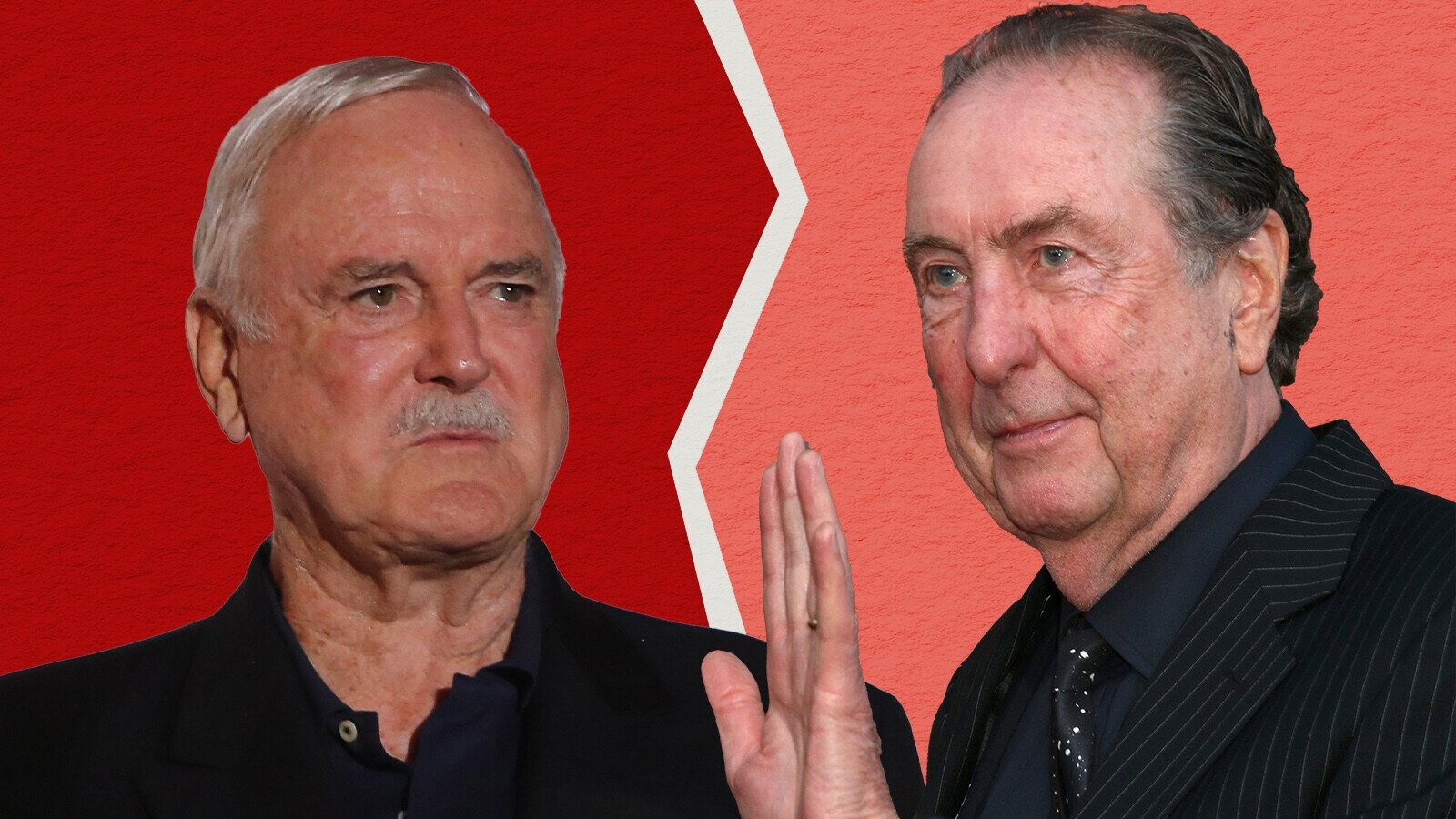
Monty Python reunions have always arrived with a wink, a dead parrot, and at least one joke about everyone being too old to continue. The latest gatherings, however, have carried a less cheerful punchline: Eric Idle has been conspicuously absent while John Cleese, Michael Palin, and Terry Gilliam have continued to meet and discuss new appearances.
The headline practically writes itself. Idle skips a Monty Python reunion after a spat with Cleese. Yet the real story is more complicated than a simple celebrity feud. It involves money, management, decades of creative history, geographical distance, differing memories, and the awkward reality that legendary collaborators do not always remain close friends forever.
There is also an important factual caution. Reports confirmed Idle was missing from the gatherings, but they did not establish that he deliberately rejected a formal invitation because of Cleese. In other words, the empty chair is real; the precise reason for it remains partly inferred.
What Happened at the Monty Python Reunion?
The most widely discussed mini-reunion occurred in May 2024, when John Cleese and Terry Gilliam joined Michael Palin for his 81st birthday. Photos of the three surviving Pythons smiling together quickly delighted fans. They also produced an unavoidable question: Where was Eric Idle?
Idle, who has long lived in the Los Angeles area, was not pictured at the celebration. His absence came only months after a public argument over the management and finances of the Monty Python business. That timing made the reunion feel less like an innocent dinner among old colleagues and more like a visual summary of a strained relationship.
The situation became even more notable in June 2026, when Cleese said he, Palin, and Gilliam were discussing an entertainment event for later in the year. Cleese joked that the occasion would allow them to insult one another and discuss their faults. Idle was not mentioned as a participant, while Holly Gilliam, Terry Gilliam’s daughter and a central figure in the earlier dispute, was reportedly exploring venues and dates.
That does not amount to a full Monty Python reunion. Graham Chapman died in 1989, and Terry Jones died in 2020. It is better described as a gathering of three surviving members, possibly built around conversation, a screening, or a special appearance. Still, for admirers who think of the Pythons as one gloriously argumentative organism, Idle’s absence is impossible to ignore.
Why Did Eric Idle and John Cleese Fall Out?
The Eric Idle and John Cleese feud did not begin with a disagreement over comedy. By Idle’s account, the dispute centered on business, money, and the management of Monty Python’s shared assets.
Idle Raised Concerns About Python Income
In early 2024, Idle challenged the popular assumption that every member of Monty Python remained fabulously wealthy from reruns, movies, recordings, merchandise, and stage adaptations. He said the group’s income streams had declined sharply and that he still needed to work.
Idle then criticized the decision to have Holly Gilliam manage Python-related business. His comments were pointed, personal, and delivered publicly on social media, which is rarely the ideal conference room for settling a decades-old partnership. Social media can turn a bookkeeping disagreement into a medieval siege before anyone has finished breakfast.
Cleese Defended Holly Gilliam
Cleese responded by strongly defending Holly Gilliam’s work, describing her as efficient, clear-minded, hardworking, and pleasant to deal with. He added that Michael Palin and Terry Gilliam shared his favorable opinion.
Cleese also pushed back against Idle’s version of how management changes occurred. When Idle suggested that Cleese had removed longtime manager Jim Beach and installed Holly Gilliam, Cleese described that account as an invention. The dispute therefore became not only a disagreement about performance but also a battle over the historical record.
The “Loathed and Despised” Joke Added Fuel
During the online exchange, Cleese joked that the Pythons had always loathed and despised one another. Several reports interpreted the remark as a direct attack on Idle. Cleese later clarified that it was a joke about the entire troupe and criticized the failure to recognize the irony.
That clarification was plausible because mock hostility has always been part of the Monty Python style. The group’s public image was built on arguments, interruptions, pompous authority figures, and people being struck with fish. Unfortunately, when a real financial dispute is happening at the same time, even an obvious joke can arrive wearing steel-toed boots.
Idle Says the Conflict Is About Business, Not Comedy
Idle later explained that he and Cleese did not fundamentally disagree about what was funny. Instead, their “very bad argument” concerned business and money. He suggested that distance and infrequent face-to-face contact left more room for misunderstanding.
That distinction matters. Creative partnerships can survive fierce artistic disagreements because the conflict remains connected to the work. Financial disagreements are often harder. They involve trust, ownership, control, responsibility, and competing recollections of decisions made over many years.
Idle has also continued to acknowledge Cleese’s comic brilliance. His criticism has not erased their shared achievements or his recognition that Cleese was an extraordinary performer and writer. Admiration and anger can coexist, especially after more than half a century of professional entanglement.
By March 2026, Idle said he had not seen Cleese in 10 years. That suggests the rupture is not merely a fresh social-media flare-up. It reflects a long physical and personal separation, even if the most public phase of the dispute began much later.
A Partnership Built on Creative Friction
Monty Python’s Flying Circus debuted in Britain in October 1969. The troupe brought together Graham Chapman, John Cleese, Terry Gilliam, Eric Idle, Terry Jones, and Michael Palin, combining university revue traditions, television writing experience, surreal animation, intellectual satire, and a cheerful disregard for conventional sketch endings.
Their work reached American viewers through public television in the 1970s and helped reshape English-language comedy. Instead of moving neatly from setup to punchline, Python sketches could collapse, mutate, interrupt themselves, or be invaded by a knight carrying a rubber chicken. The format influenced generations of television writers, comedians, filmmakers, and people who still cannot hear the word “spam” without humming.
The group was never presented as six permanently harmonious best friends. Their strength came from different writing partnerships and conflicting instincts. Cleese and Chapman often favored tightly constructed verbal escalation. Palin and Jones developed richly performed character pieces. Gilliam supplied the instantly recognizable animation. Idle, who frequently wrote alone, contributed songs, wordplay, television-host parodies, and characters who could weaponize a raised eyebrow.
Creative friction was therefore part of the machinery. The problem is that productive friction can become personal friction when rights, money, and management replace scripts on the table.
Eric Idle’s Importance to the Monty Python Legacy
Idle’s absence matters because he was not a peripheral participant. He helped create some of the group’s best-known musical material and later became one of its most active custodians.
His song “Always Look on the Bright Side of Life,” introduced in Monty Python’s Life of Brian, grew far beyond the film. Its jaunty whistle and cheerfully inappropriate optimism became a cultural anthem. The joke is that everything is terrible; the comfort is that singing remains available.
Idle also adapted Monty Python and the Holy Grail into Spamalot, writing the musical’s book and lyrics and co-writing its music with John Du Prez. The original Broadway production won the 2005 Tony Award for Best Musical, proving that Python’s coconuts, knights, and aggressively silly medieval logic could thrive in a new commercial form.
He played a major role in staging the 2014 reunion shows at London’s O2 Arena. The initial performance sold out in less than a minute, additional dates followed, and the final show was broadcast internationally. The surviving five members ended with “Always Look on the Bright Side of Life,” apparently closing the book on live Python performance with the sort of farewell that contained both sentiment and a giant foot hovering nearby.
Because Idle helped engineer that farewell, seeing later Python events proceed without him has extra emotional weight. He is not simply absent from the photograph; one of the principal architects of the previous reunion is absent from the room.
Was Eric Idle Actually Invited?
No reliable public account has established whether Idle received and declined a formal invitation to the 2024 birthday gathering or the potential 2026 event. Reports generally described him as absent and connected that absence to the feud, but they did not document a direct refusal.
That distinction protects the story from becoming more dramatic than the evidence allows. Idle lives thousands of miles from Britain, maintains his own touring and publishing schedule, and may have practical reasons for missing a private celebration. At the same time, his public criticism of the group’s management and his decade without seeing Cleese make it reasonable to view the absence within the larger conflict.
The responsible conclusion is therefore modest: the feud provides meaningful context, but it does not prove motive. Sometimes an empty chair is a statement. Sometimes it is an airline itinerary. Occasionally it is both.
Could a Complete Reunion Still Happen?
A complete reunion in the original sense is impossible after the deaths of Chapman and Jones. Palin has also argued that Python depended on all six members as writers and performers, and that the 2014 shows served as a satisfying farewell.
A smaller gathering remains possible, as the discussions involving Cleese, Palin, and Gilliam demonstrate. Such an event could include a film screening, live conversation, archival material, or a loosely structured evening of memories and insults. It would celebrate Python without pretending the original troupe can simply be reconstructed.
Could Idle rejoin them? Publicly available evidence offers little reason for immediate optimism. The management dispute remains unresolved in the public record, and Idle’s statement that he had not seen Cleese for a decade suggests that reconciliation would require more than a cheerful group text.
Yet Python history has repeatedly shown that commercial opportunity, nostalgia, and mortality can bring strong personalities back into the same room. The 2014 shows arrived after years of skepticism about a reunion. A future appearance with Idle is not impossible, but it would likely require private conversation before public comedy.
What the Spat Reveals About Famous Creative Groups
Audiences often imagine a beloved ensemble as a family frozen at the moment of its greatest success. Fans see the chemistry on-screen and assume it continues unchanged backstage for the next 50 years. Real creative partnerships are less tidy.
A comedy group can share intellectual trust without sharing financial priorities. Its members can respect one another’s talent while disliking one another’s decisions. They can produce timeless work together and later become unable to agree on who should answer an email about licensing.
Monty Python’s catalog also has unusual complexity. It spans television episodes, films, books, records, live shows, stage adaptations, merchandise, streaming agreements, and individual projects derived from group material. Managing those rights across decades would challenge even a troupe composed entirely of calm accountants, which Monty Python very much was not.
The Idle-Cleese dispute is therefore both specific and universal. It is about famous comedians, but it is also about aging collaborators, shared ownership, communication failures, and the emotional cost of turning youthful invention into a permanent business.
The Fan Experience: Nostalgia, Disappointment, and Perspective
For longtime fans, news of any Monty Python reunion produces an immediate emotional reflex. There is excitement at seeing familiar faces together, followed by a quick mental roll call. Cleese? Present. Palin? Present. Gilliam? Present. Idle? Ah. The mood shifts from celebration to concern before the tea has arrived.
That experience is especially strong because Python was an ensemble whose identity depended on combination. Watching one performer alone is enjoyable, but watching the members collide creates the special electricity. Palin’s patient shopkeeper becomes funnier opposite Cleese’s furious customer. Idle’s smug television host works because the surrounding universe is already unstable. Gilliam’s animation appears to rescue a sketch, only to make it more dangerous. Remove one element and the audience notices the altered chemistry.
Fans may also feel tempted to choose sides. Idle’s concerns about declining income and management can sound understandable, particularly when expressed by a performer who helped create and preserve the material. Cleese’s defense of Holly Gilliam can sound equally understandable if his professional experience with her has been positive. From outside the partnership, there is no complete set of contracts, accounts, meeting minutes, or private conversations. The public receives fragments, jokes, accusations, and rebuttalsexcellent ingredients for a sketch, poor ingredients for an audit.
A healthier fan experience allows two ideas to coexist. First, it is disappointing that men who created so much communal joy appear unable to enjoy one another’s company. Second, their private relationship does not have to remain perfect for the work to retain value. Monty Python and the Holy Grail does not become less funny because its creators later disagreed about management. The Black Knight continues insisting that his injuries are minor, blissfully unaware of corporate governance.
There is also something deeply human in the situation. Many people have experienced a friendship that once felt permanent but changed because of distance, money, work, family, or a disagreement that became larger every year it went unaddressed. The famous version arrives with headlines and photographers, but the emotional structure is familiar: two people remember the past differently and communicate mostly through third parties or public statements.
The reunion photographs can therefore be enjoyed without pretending they show the whole story. They capture genuine affection among Cleese, Palin, and Gilliam. They also capture an absence. Viewers are free to feel happy, sad, curious, and mildly irritated at the same time. That combination is almost appropriately Python-esque: warm nostalgia interrupted by administrative absurdity.
Ultimately, the best fan response may be to resist demanding a sentimental ending from people whose art spent decades mocking sentimental endings. Reconciliation would be welcome. A final appearance by all four surviving Pythons would be historic. But no audience is entitled to force friendship upon collaborators simply because their old work still makes strangers laugh.
Conclusion
Eric Idle’s absence from recent Monty Python gatherings has become a symbol of his broken relationship with John Cleese and his disagreement with the group’s management. The dispute appears rooted primarily in business and money rather than comic taste, and it has been intensified by distance, public social-media exchanges, and conflicting accounts of past decisions.
The requested headline captures the drama, but the evidence calls for nuance: Idle was absent, the feud is real, and a direct cause-and-effect refusal has not been publicly proved. Whether the surviving Pythons reunite again with or without him, their shared legacy remains securebrilliant, argumentative, commercially complicated, and still capable of turning an awkward dinner photo into international news.