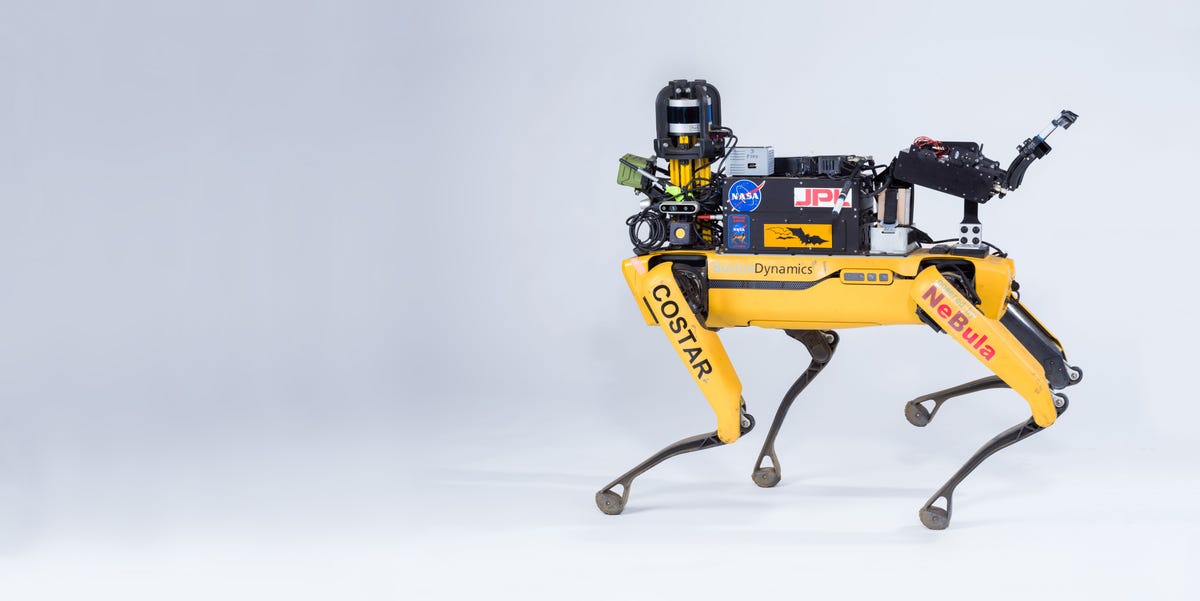
For more than half a century, the phrase “planetary rover” has usually meant one thing: a tough little vehicle on wheels, rolling bravely across alien dirt while Earthlings hold their breath. Wheeled rovers have done extraordinary work on the Moon and Mars, and nobody should take away their space-exploration trophies. But the next great leap in planetary robotics may not roll at all. It may walk, climb, crouch, hop, scramble, brace, rappel, and occasionally look like a very expensive metal dog having the best camping trip of its life.
Legged robots could revolutionize space exploration because they are built for the places wheels hate: steep crater walls, loose regolith, fractured lava tubes, icy cliffs, boulder fields, shadowed pits, and terrain so uneven that even a mountain goat might ask for a better route. As NASA, JPL, MIT, Caltech-linked teams, and robotics researchers continue testing walking and climbing machines, the idea is becoming clearer: future explorers may need legs not because legs are cool, although they absolutely are, but because the most scientifically valuable places in the solar system are often the hardest to reach.
Why Space Exploration Needs a New Kind of Robot
Traditional rovers are masters of careful travel. They conserve energy, carry sophisticated instruments, and survive environments that would make a laptop faint dramatically. Yet wheels have limits. They can struggle on steep slopes, sink in soft soil, get damaged by sharp rocks, and avoid hazards that may hide the best science. Mars cliffs may expose ancient layers of rock. Lunar polar craters may contain water ice. Lava tubes may preserve signs of past life or offer natural shelters for future astronauts. Unfortunately, many of these destinations are not exactly wheelchair accessible.
This is where legged robots for space exploration enter the story. A walking robot can place each foot deliberately, test the ground, adjust its posture, and step over obstacles instead of trying to bulldoze through them. A climbing robot can grip rock faces. A modular lunar robot can be rebuilt for different jobs. A quadruped scout can enter caves where GPS does not exist and radio signals behave like moody teenagers. Instead of treating rough terrain as a reason to turn around, legged robots can treat it as the main event.
What Makes Legged Robots Different From Wheeled Rovers?
The difference is not simply “legs versus wheels.” It is a whole new mobility philosophy. Wheeled rovers are efficient on relatively manageable terrain, but legged robots trade some mechanical simplicity for adaptability. A leg can lift, probe, push, brace, and reposition. Feet can be designed with spikes, pads, claws, drills, grippers, or soft contact surfaces depending on the destination. On a rocky slope, a robot can distribute its weight across several contact points. In a cave, it can duck under low ceilings and step across collapsed rock. On icy surfaces, it may anchor itself before taking measurements.
Legged planetary robots also make autonomy more valuable. A robot walking into a lunar pit or Martian cave cannot wait for a human driver to approve every toe placement. It must sense the environment, build a map, evaluate risk, and decide where to move next. That is why many prototypes combine legged mobility with artificial intelligence, lidar, stereo cameras, onboard planning, and scientific instruments. In plain English: the robot needs to be part explorer, part geologist, part mountaineer, and part “please do not fall into that hole” specialist.
Real Examples Already Pointing Toward the Future
LEMUR: The Climbing Robot That Thinks Like a Space Gecko
NASA’s Jet Propulsion Laboratory developed LEMUR, short for Limbed Excursion Mechanical Utility Robot, as a four-limbed climbing robot capable of scaling rock walls. It used many tiny hooks in its fingers to grip rough surfaces and artificial intelligence to help choose routes around obstacles. In field tests, LEMUR climbed cliffs in California’s Death Valley while scanning rock for fossils, showing how similar technologies could someday help explore steep planetary terrain.
LEMUR is important not only as a robot, but as a family tree. Its technology helped inspire related concepts for crawling, climbing, gripping, and sampling in extreme environments. JPL has explored ideas such as Ice Worm, which uses anchoring techniques for icy surfaces, and other machines that borrow from LEMUR’s ability to interact physically with difficult terrain. The takeaway is simple: if the next discovery is halfway up a cliff, a robot with legs and grippers has a much better chance than a rover politely waiting at the bottom.
NeBula-SPOT: Robot Dogs in Martian-Like Caves
Another major example is NeBula-SPOT, a four-legged explorer prototype that combines JPL autonomy software with Boston Dynamics’ Spot platform. This robot has been used in underground and cave-like environments to test autonomous navigation where GPS is unavailable and direct communication is unreliable. In NASA-linked field work, Spot-style legged robots explored lava tubes and Martian-analog caves, building 3D maps and helping teams evaluate how robots could search for biosignatures in places humans cannot easily or safely enter.
The cave angle matters. Lava tubes on Mars and the Moon could protect delicate evidence from radiation, micrometeorites, and extreme temperature swings. They could also become future astronaut shelters. But caves are dark, uneven, dusty, and full of navigation surprises. A wheeled robot may see a jumble of rocks; a legged robot sees a staircase with bad manners.
MIT’s WORMS: Build-a-Bot for the Moon
MIT’s Walking Oligomeric Robotic Mobility System, better known as WORMS, takes a different approach. Instead of designing one robot for one job, WORMS imagines a kit of universal robotic parts that astronauts could assemble into different “species” for lunar missions. Need a pack robot to carry solar panels? Build one. Need a spider-like robot to descend into a lava tube? Reconfigure the parts. Need a digger, mapper, or cargo mover? Snap together a new body plan.
This modular approach could be extremely useful for Artemis-era lunar exploration. Shipping everything from Earth is expensive, and a Moon base cannot afford a “robot zoo” where every machine has unique parts, tools, and repair procedures. A field-reconfigurable legged robot system could simplify logistics, extend hardware life, and let astronauts adapt to problems nobody predicted in the mission brochure.
DuAxel and Tethered Mobility: When Wheels and Legs Learn From Each Other
Not every revolutionary robot needs animal-style legs. JPL’s DuAxel is a two-part rover concept that travels as a pair, then separates so one tethered unit can rappel down steep slopes while the other anchors above. Although DuAxel is wheeled, its tethered descent strategy overlaps with the same goal driving legged robotics: access terrain that conventional rovers cannot safely reach. Future planetary exploration will likely use hybrid teams, with wheeled robots covering easier ground, legged robots tackling rough zones, drones scouting overhead, and tethered systems descending into pits or cliffs.
How Legged Robots Could Transform Lunar Exploration
The Moon is not a smooth gray parking lot. It is a harsh, dusty, cratered world with dramatic lighting, intense temperature swings, and regions that have not seen sunlight for billions of years. Near the lunar South Pole, permanently shadowed regions may contain water ice, a critical resource for future missions. Water can support astronauts, produce oxygen, and potentially contribute to rocket propellant. The problem is that these areas are cold, dark, rugged, and difficult to reach.
Legged robots could scout these regions before astronauts arrive. They could descend crater rims, map safe paths, test soil strength, identify ice-bearing areas, deploy sensors, and carry small payloads. Because a legged robot can step carefully and use onboard sensing to judge terrain, it may be better suited for unstable slopes than a traditional rover. In a lunar base scenario, walking robots could also help deploy cables, inspect habitats, move tools, set up communications towers, and serve as mobile assistants. Basically, they could become the lunar version of a helpful intern, except they do not need coffee and can survive vacuum.
How Legged Robots Could Change Mars Exploration
Mars has given wheeled rovers a legendary career, but the Red Planet still keeps many secrets out of reach. Some of the most interesting targets are layered cliffs, crater walls, canyon edges, caves, and ancient hydrothermal environments. These places may preserve clues about water, habitability, and past life. Unfortunately, they are also hazardous. A rover that gets stuck on Mars is not getting a tow truck.
Legged robots could make Mars missions more ambitious. A quadruped scout could walk ahead of a rover to evaluate routes. A climbing robot could inspect sedimentary layers exposed in steep terrain. A cave explorer could map lava tubes and search for mineral or biological signatures protected from surface radiation. A robot with a Raman spectrometer, microscope, drill, or sampling arm could analyze several targets in one traverse instead of waiting for slow, step-by-step commands from Earth.
This matters because Mars communication delays make real-time driving impossible. Depending on orbital positions, signals can take many minutes one way. A robot that can make safe local decisions, prioritize targets, and conduct semi-autonomous science would dramatically increase mission efficiency. Instead of asking Earth, “May I take one step?” every few minutes, it could say, “I mapped the area, checked three rocks, avoided the scary crack, and found something interesting. You are welcome.”
Why Caves and Lava Tubes Are Such a Big Deal
Caves and lava tubes are among the most exciting destinations for future space exploration. On Mars, they may preserve traces of past microbial life by shielding rocks from radiation and extreme surface conditions. On the Moon, pits and caves may offer stable temperatures compared with the brutal day-night swings on the surface. Some lunar pits have been found to maintain comparatively comfortable temperatures in shaded areas, making them intriguing candidates for future exploration and possible shelter concepts.
Getting into those caves is the hard part. Entrances may be steep, blocked by rubble, or hidden in shadow. Inside, robots must deal with dust, rough floors, poor lighting, and communication dropouts. A legged robot has several advantages here. It can step over debris, stabilize itself on irregular surfaces, carry lights and sensors, and build maps as it goes. If one robot carries a camera, another carries a sampling arm, and a third acts as a communication relay, the team becomes far more capable than a single machine trying to do everything at once.
Autonomy: The Brain Behind the Legs
Legs are only useful if the robot knows what to do with them. Planetary robots need autonomy because space is too far away for joystick-style control. Autonomous systems help robots detect hazards, plan paths, build 3D maps, identify science targets, and continue operating when communication is limited. JPL’s work with NeBula and Team CoSTAR demonstrates how multi-robot autonomy developed for underground Earth environments can support future missions to caves, lava tubes, and other extreme planetary sites.
Recent research also shows the promise of semi-autonomous scientific workflows. In analog tests with legged robots carrying instruments such as microscopic imagers and Raman spectrometers, robots have demonstrated the ability to approach multiple targets and return useful science data more quickly than traditional single-target operations. This does not mean robots replace scientists. It means robots can gather better options faster, allowing scientists to focus on interpretation and high-value decisions.
The Science Payoff: More Data From More Dangerous Places
The main reason legged robots could revolutionize space exploration is not that they look futuristic. It is that they could increase scientific return. More mobility means access to more geological diversity. A robot that can climb down a crater wall can inspect layers that reveal a planet’s history. A cave robot can search for minerals, ice, or preserved organics in protected environments. A walking lunar scout can examine permanently shadowed regions that may hold water ice. A robot with a manipulator arm can place instruments precisely against rock surfaces instead of hoping a target is conveniently located on flat ground.
This could also improve mission planning. Before astronauts enter an area, legged robots can map hazards, check slopes, test regolith stability, and identify safe paths. Before a sample-return mission commits to drilling, a robot can survey multiple candidate rocks. Before a lunar base is built, walking machines can inspect the terrain and help place infrastructure. Space exploration becomes less like sending one brave rover into the unknown and more like deploying a smart field team.
The Big Challenges: Power, Dust, Reliability, and Cost
Of course, legged robots are not magic. They introduce serious engineering challenges. Legs require many actuators, joints, sensors, and control systems. More moving parts can mean more failure points. Walking can consume more energy than rolling on smooth ground. Dust can invade mechanisms. Extreme temperatures can damage electronics and batteries. Low gravity changes how robots balance, push against surfaces, and recover from slips. A robot that walks beautifully in a lab may behave very differently on powdery lunar regolith or jagged Martian rock.
Then there is reliability. A planetary robot cannot stroll into a repair shop. Every joint, footpad, cable, seal, and processor must survive launch vibration, radiation, thermal cycles, and long mission timelines. Designers must decide when legs are worth the added complexity. For many routes, wheels will remain better. For truly nasty terrain, legs may justify their cost. The future is not “wheels are dead.” The future is “use the right mobility tool for the terrain.” Space robots are finally becoming less like one-size-fits-all vehicles and more like a toolkit.
Human-Robot Teams on the Moon and Mars
The most exciting future may involve astronauts working alongside legged robots. On the Moon, a walking robot could carry tools, inspect spacesuits, follow astronauts across rough terrain, or act as a mobile sensor platform. It could enter risky areas first, then send back maps and images. On Mars, where astronaut time and safety will be precious, robots could scout caves, set up scientific stations, and prepare work sites before humans arrive.
This partnership changes the role of robots from distant machines to field teammates. A rover waits for commands. A capable legged robot can collaborate. It can carry, inspect, map, sample, and warn. It can go first when the terrain looks suspicious. It can keep working while humans return to the habitat. It can take on repetitive or hazardous tasks. In other words, it becomes the space-exploration equivalent of a very loyal trail buddy with lidar.
Experience-Based Insights: What Field Testing Legged Robots Teaches Us
Field tests on Earth offer a practical preview of how legged robots could behave on the Moon and Mars. The first lesson is humility. Natural terrain is never as polite as a lab floor. Lava tubes contain loose fragments, sharp textures, sudden ledges, low ceilings, darkness, and surfaces that confuse simple assumptions about traction. A robot that performs perfectly on a test track may need new behaviors when the ground changes every few inches. Engineers quickly learn that “rough terrain” is not one problem; it is a thousand tiny problems wearing the same dusty jacket.
The second lesson is that legs create opportunities for science teams. When a legged robot enters a cave or crosses a broken field of rock, it can position sensors in places that a wheeled platform may never reach. In reported cave and analog tests, researchers have used walking robots to build maps, approach targets, and support investigations of rock surfaces and potential biosignatures. For scientists, this is thrilling because the robot is not merely traveling; it is opening new questions. What is behind that collapse pile? What minerals are on that wall? Does the cave preserve a record of water, heat, or microbial activity? With better mobility, the science menu gets much larger.
The third lesson is that autonomy is not optional. Human operators cannot micromanage every move in a cave, a crater, or a Martian traverse. Communication can drop out. Lighting can change. The robot may need to decide whether a step is safe, whether a slope is too risky, or whether a target is worth closer inspection. This does not eliminate human judgment. Instead, it shifts humans toward mission goals and scientific interpretation while the robot handles local execution. The best experience is not “robot replaces scientist.” It is “robot gives scientist more useful choices.”
The fourth lesson is that teamwork beats heroics. A single robot carrying every instrument becomes heavy, expensive, and vulnerable. A team of smaller robots can divide tasks: one maps, one samples, one relays communication, one scouts ahead. If one unit has trouble, the mission may continue. This is especially important for caves and polar regions, where a communication relay can be just as valuable as a drill. In future missions, legged robots may work with wheeled rovers, drones, landers, and astronauts as part of a mixed exploration network.
The final lesson is patience. Legged robots are promising, but space is unforgiving. Engineers must improve energy efficiency, thermal control, dust tolerance, fault recovery, and planetary protection procedures before these machines become routine explorers. Still, the direction is clear. Every cave test, lunar analog campaign, autonomy challenge, and modular robot demonstration adds another brick to the bridge between today’s prototypes and tomorrow’s planetary field assistants. The experience so far suggests that legged robots will not replace classic rovers everywhere. Instead, they will expand the map of where robotic exploration can go.
Conclusion: The Next Giant Leap May Have Four, Six, or Many Legs
Legged robots could revolutionize space exploration by turning impossible terrain into reachable science. They can climb, step, brace, crawl, and adapt in ways that traditional rovers cannot. From JPL’s LEMUR and NeBula-SPOT to MIT’s WORMS and new semi-autonomous science demonstrations, the field is moving toward robots that do more than survive alien landscapes. They actively investigate them.
The future of planetary exploration will likely be mixed: wheels for efficient travel, drones for aerial scouting, tethered robots for steep descents, and legged robots for the roughest, darkest, most scientifically tempting places. That combination could help humanity explore lunar ice deposits, Martian caves, crater walls, lava tubes, and eventually the icy worlds beyond Mars. The solar system is full of places that look impossible from a rover’s point of view. Give the robot legs, a brain, and a good set of sensors, and suddenly the impossible starts looking like a trailhead.