Note: This article discusses historical animal deaths in a factual, non-graphic way. Many of these stories are strange, sad, and revealingnot because elephants are villains, but because humans have often treated intelligent wild animals as entertainment, trophies, curiosities, or walking publicity stunts.
Why Famous Elephant Deaths Still Fascinate Us
Elephants have always occupied a strange place in human imagination. They are powerful enough to move logs, gentle enough to touch a calf with surgical tenderness, and smart enough to make people wonder whether the phrase “an elephant never forgets” is less a proverb and more a warning label. Across history, famous elephants became royal gifts, circus headliners, zoo celebrities, wartime symbols, and living advertisements for human ambition.
Then came the bizarre endings. Some died in train yards. Some were executed as if they had stood trial. Some were turned into museum specimens, restaurant dishes, or moral lessons. Others became symbols in debates about animal welfare, captivity, and the limits of spectacle. The deaths of these famous elephants are not just odd historical trivia. They show how quickly public wonder can become public cruelty when a wild animal is forced into a human script.
Below are ten famous elephants and the unusual circumstances surrounding their deaths. Think of it as elephant history with a raised eyebrow, a heavy heart, and absolutely no peanuts thrown from the cheap seats.
1. Hanno: The Pope’s Elephant With the Golden Medical Bill
Hanno was a white elephant given to Pope Leo X by King Manuel I of Portugal in the early 1500s. In Renaissance Rome, this was not exactly a casual housewarming gift. Hanno became a sensation, parading through the city and charming the pope so thoroughly that he earned a place in Vatican lore. Imagine the modern equivalent of giving someone a luxury car, except the car eats hay, causes traffic jams, and can accidentally rearrange architecture.
His death was bizarre because of the medicine. Accounts vary in the details, but the commonly repeated story says Hanno became ill and was treated with a gold-laced remedy, possibly for digestive trouble. The treatment did not save him. He died in 1516, and Pope Leo X reportedly mourned him deeply, even commissioning a memorial. Hanno’s story feels absurd until you remember that Renaissance medicine often mixed faith, status, and guesswork. If gold could decorate churches, palaces, and noble wardrobes, why not try it on an elephant? Hanno, unfortunately, was not impressed by luxury healthcare.
2. Hansken: The Touring Elephant Who Became a Scientific Relic
Hansken was one of the most famous performing elephants of 17th-century Europe. Born in Sri Lanka, she traveled widely and became known for tricks that impressed crowds across the continent. Artists studied her, including Rembrandt, who sketched her from life. In an era before wildlife documentaries, seeing an elephant up close was like meeting a myth with a trunk.
Hansken died in Florence in 1655 after years of touring. Her death itself was sad, but her afterlife made the story stranger. Her skeleton was preserved and eventually became important to scientific study. In other words, Hansken went from celebrity performer to anatomical reference point. That may sound like an unexpected career pivot, but early modern Europe loved turning rare animals into objects of display, study, and status. Hansken’s life reminds us that fame did not protect elephants from exhaustion, transportation stress, or the human habit of collecting everything, including bones.
3. Old Bet: America’s Early Circus Elephant and a Fatal Argument Over Admission
Old Bet is often remembered as one of the first named circus elephants in the United States. She was associated with Hachaliah Bailey, a showman whose traveling exhibitions helped shape early American circus culture. To people in small towns in the early 1800s, Old Bet was astonishing. Many had never seen an elephant, and the chance to view her was worth paying forunless, apparently, you had a very intense opinion about ticket prices.
In 1816, Old Bet was shot and killed while on tour near Alfred, Maine. One widely reported explanation is that a local farmer objected to poor people being charged money to see her. Other accounts suggest jealousy or resentment may have played a role. Either way, the death was bizarre because Old Bet became the victim of a human dispute about morality, money, and spectacle. She was not just an animal; she was a business model on four legs. When people fought over that business model, she paid the price.
4. Chunee: The Menagerie Star Killed in a London Building
Chunee was a famous Asian elephant displayed at the Exeter Change menagerie in London. He performed for crowds and became a popular attraction, but his living conditions were cramped and unnatural. Over time, Chunee became increasingly difficult to manage. Reports suggest pain, confinement, and poor welfare may have contributed to his distress.
In 1826, Chunee was killed after authorities decided he was too dangerous to keep. What makes the death so strange is the setting: an elephant was destroyed inside a city menagerie, in a building not designed for anything close to such a crisis. Soldiers were called, and the event became a public controversy. Chunee’s skeleton later entered museum collections, turning another tragic captive elephant into an educational object. His story helped fuel criticism of menageries and pushed the public to question whether exotic animals belonged in cramped urban displays. The short answer, delivered by history with a sigh: no, probably not.
5. Castor and Pollux: The Paris Zoo Elephants Eaten During a Siege
Castor and Pollux were elephants at the Jardin des Plantes in Paris during the Franco-Prussian War. When Paris was besieged in 1870, food shortages became desperate. The city’s zoo animals, once symbols of education and wonder, suddenly became potential meals. This is where history leaves the charming lane and turns down Nightmare Boulevard.
Castor and Pollux were killed and their meat was reportedly served in Paris restaurants. Their deaths were bizarre not because they were violent in an unusual technical sense, but because of the social reversal. One month, an elephant is a beloved attraction. The next, it is listed on a menu for people trying to survive a starving city. The story shows how quickly civilization’s polished manners can wobble when hunger walks in wearing muddy boots. Castor and Pollux remain unforgettable examples of how war can reduce even the most magnificent animals to emergency resources.
6. Jumbo: The Superstar Elephant Killed by a Train
Jumbo may be the most famous elephant in modern history. He lived at the London Zoo before P.T. Barnum bought him and turned him into a sensation in North America. Jumbo’s name became so associated with size that “jumbo” entered everyday language. That is branding so powerful it outlived the elephant, the circus posters, and probably several generations of oversized popcorn buckets.
In 1885, Jumbo died in St. Thomas, Ontario, after being struck by a train. Barnum promoted a dramatic version of the event in which Jumbo heroically protected a smaller elephant named Tom Thumb. Some historians treat that version with caution, since Barnum was not allergic to publicity. The basic fact remains: a world-famous elephant died in a rail yard while traveling with a circus. His body was then preserved and exhibited, because Barnum rarely saw a tragedy he could not convert into a ticketed attraction. Jumbo’s death is bizarre because it combines celebrity culture, industrial travel, mythmaking, and posthumous marketing into one very Victorian package.
7. Topsy: The Coney Island Elephant Killed by Electricity
Topsy was an Asian elephant associated with the American circus world and later Luna Park at Coney Island. By the early 1900s, she had become notorious after incidents involving humans, though sensational newspapers likely inflated parts of her reputation. In 1903, she was killed at Coney Island using poison and electricity, and the event was filmed by Edison’s company.
The death is often misrepresented as a direct stunt by Thomas Edison in the “War of the Currents.” The reality is more complicated. Edison was not personally present, and the timing does not neatly match the famous electrical rivalry. Still, Topsy’s death became linked in popular memory to electricity, spectacle, and early film. It is bizarre because a captive elephant’s final moments became a technological artifact. She was not only killed; she was turned into footage. In today’s language, Topsy became viral before the internet existed, which is perhaps the saddest possible use of innovation.
8. Mary: The Circus Elephant Hanged in Tennessee
Mary, also called “Murderous Mary” in sensational accounts, was a circus elephant with Sparks World Famous Shows. In 1916, after a handler died during a parade in Tennessee, public anger grew quickly. The details of the incident are tangled in rumor, newspaper exaggeration, and folklore, but the aftermath is clear enough: Mary was taken to Erwin, Tennessee, and killed by hanging from a railroad derrick.
Her death remains one of the most infamous examples of animal execution in American history. It was bizarre because the event resembled a public punishment, as if a frightened, captive elephant could be processed through the same moral logic as a human criminal. Mary’s story has haunted Erwin for more than a century, and modern retellings often frame it as a tragedy of poor training, public panic, and circus economics. She became a symbol of what happens when crowds demand simple justice from a situation that was never simple in the first place.
9. Black Diamond: The “Killer Elephant” Turned Texas Legend
Black Diamond was a large Indian elephant with the Al G. Barnes Circus. He was famous, feared, and heavily controlled. In 1929, after a deadly incident in Corsicana, Texas, he was deemed too dangerous. Newspapers amplified the story, and the circus faced the same problem that had appeared in other elephant tragedies: how to protect business, satisfy public fear, and deal with an animal too large to manage easily.
Black Diamond was eventually killed in Kenedy, Texas. The circumstances were widely reported and became part of Texas circus lore. What makes the death bizarre is the combination of public spectacle, local legend, and commercial calculation. The event was not just about safety; it also became publicity. Even Black Diamond’s remains entered the realm of display and rumor. His story is a reminder that the circus often sold wonder and danger from the same wagon. When wonder went wrong, danger got the headline.
10. Tyke: The Elephant Whose Death Changed the Circus Conversation
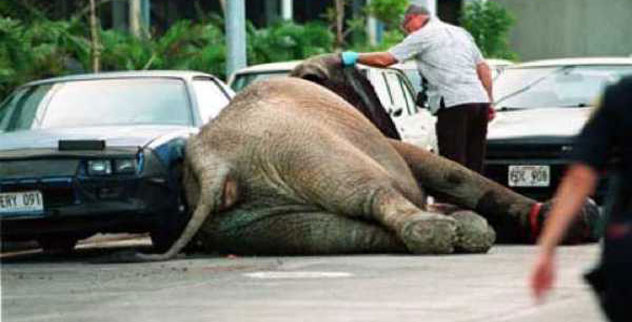
Tyke was an African elephant performing in Honolulu in 1994 when she escaped from a circus arena after a deadly incident involving her trainer. She ran through city streets before police killed her. Unlike older elephant deaths, Tyke’s final hours were captured on modern video and broadcast widely. That changed everything. The public could no longer rely on dramatic newspaper prose or folklore. People could see the chaos, fear, and tragedy unfold.
Tyke’s death became a turning point in discussions about performing elephants. Animal advocates pointed to her history, earlier incidents, and the pressures of captivity. The question shifted from “Why did this elephant become dangerous?” to “Why was a wild animal in that situation at all?” Tyke’s story is bizarre in a modern way: a circus tragedy collided with television, legal action, animal welfare activism, and changing public attitudes. She became not only a famous elephant, but a symbol of the end of an era.
What These Bizarre Elephant Deaths Have in Common
At first glance, these stories seem wildly different. A pope’s pet, a London menagerie star, a Paris zoo elephant, a Barnum celebrity, a Coney Island attraction, and a Honolulu circus performer do not appear to belong in the same paragraph. Yet the pattern is obvious: humans repeatedly placed elephants in unnatural roles and then acted shocked when reality refused to follow the program.
Elephants are social, intelligent, wide-ranging animals. They are not props with pulse rates. In the wild, they form complex family groups, communicate in subtle ways, travel long distances, and rely on memory to survive. In captivity, especially in historical circuses and menageries, they were often isolated, chained, transported, displayed, or trained through harsh methods. When stress, pain, fear, or confusion surfaced, people frequently interpreted the behavior as evil, madness, or rebellion.
The phrase “bizarre deaths” is useful for SEO, but it also points to a deeper truth. The deaths were bizarre because the situations were bizarre. A train yard is a bizarre place for a beloved elephant to die. A railroad crane is a bizarre tool for public justice. A city menagerie is a bizarre home for a massive, sensitive animal. A restaurant menu is a bizarre ending for zoo celebrities. The more we study these stories, the less strange the elephants seemand the stranger the humans look.
Experience Notes: Visiting Elephant History With Better Eyes
Reading about famous elephants and their bizarre deaths changes the way you experience elephant exhibits, documentaries, sanctuaries, and even old circus posters. At first, the stories sound like oddball historythe kind of thing someone brings up at dinner when the conversation needs either rescuing or ruining. But after a while, the mood shifts. You begin to notice how often elephants were made famous for reasons that had very little to do with their own lives. They were famous because they were rare, huge, profitable, photogenic, or useful to someone else’s story.
That realization matters when visiting zoos, wildlife parks, museums, or historic towns connected to these animals. A better experience starts with asking better questions. Is the elephant being allowed to behave like an elephant? Does the facility explain conservation, habitat loss, poaching, social needs, and welfare? Are visitors encouraged to respect distance, intelligence, and natural behavior? Or is the animal presented as a novelty with ears? The difference is not small. It is the difference between education and entertainment wearing a fake mustache.
These stories also make old photographs feel different. A vintage circus poster may look colorful and charming, with bold fonts and cheerful promises, but behind the design was a demanding system of travel, confinement, and control. That does not mean we must throw history into a bonfire and pretend the past never happened. It means we can look at it honestly. We can admire the artistry of old posters while refusing to romanticize the suffering that often stood behind them.
For writers, teachers, travelers, and curious readers, the best approach is balance. Do not reduce these elephants to spooky trivia. Hanno was not merely “the elephant with the gold treatment.” Jumbo was not only “the one hit by a train.” Mary was not a monster in a circus tent. Tyke was not a headline with tusks. Each was a living animal caught inside a human system that rewarded attention, money, and control. Their deaths feel bizarre because they expose the machinery around them.
Modern elephant experiences should leave people with humility, not just selfies. If you visit a sanctuary, support organizations that prioritize elephant welfare over close-contact thrills. If you watch a documentary, pay attention to the experts discussing behavior and habitat, not just the dramatic narration. If you write about elephants, avoid turning tragedy into cheap shock. Humor can make history readable, but empathy keeps it responsible.
The lasting lesson is simple: elephants are not oversized characters in human drama. They are complex animals with their own needs, memories, relationships, and boundaries. The more we understand that, the less likely we are to repeat the mistakes that made these deaths famous in the first place.
Conclusion
The deaths of these famous elephants are strange, unforgettable, and often uncomfortable. Hanno’s golden remedy, Jumbo’s train-yard tragedy, Topsy’s filmed electrocution, Mary’s public hanging, Black Diamond’s Texas legend, and Tyke’s televised end all show the same uncomfortable pattern: humans made elephants into spectacles, then struggled when spectacle collided with reality.
These stories still matter because they help us see elephants more clearly. They are not circus machines, royal decorations, war rations, or museum props. They are intelligent wild animals whose lives should not depend on ticket sales, public panic, or someone’s appetite for novelty. If history has a trunk, it is tapping us politely on the shoulder and asking us to do better.