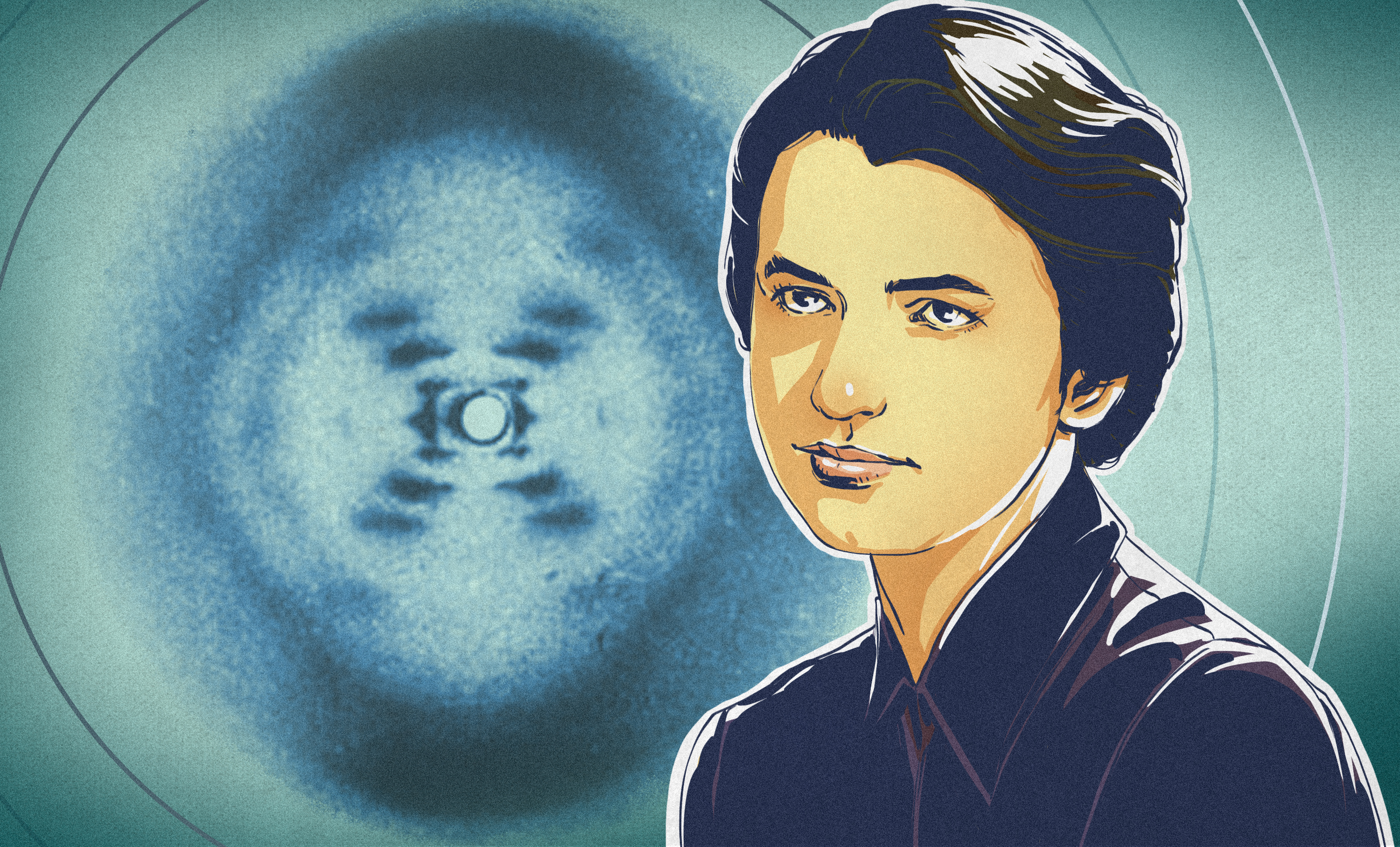
There are moments in science when a discovery does not arrive with fireworks, applause, or a dramatic movie soundtrack. Sometimes it appears as a smudgy black-and-white pattern on photographic film, looking less like the secret of life and more like something your printer coughed up after a paper jam. But in 1952, Rosalind Franklin and her graduate student Raymond Gosling produced one of the most important scientific images of the twentieth century: Photograph 51. That image helped reveal the double-helix structure of DNA, the molecule that carries genetic information in living things.
The title “Rosalind Franklin Saw DNA First” is more than a catchy phrase. It points to a deeper truth about science, credit, evidence, and the people whose work changes history even when history takes its sweet time saying thank you. Franklin did not merely “help” in a vague background way. She produced precise X-ray diffraction data, interpreted DNA’s physical properties, and understood that the molecule had a helical structure with crucial architectural features. In other words, before DNA became the world-famous twisted ladder in textbooks, Franklin had already seen the clues written in shadows.
This story is not just about one photograph. It is about the way knowledge is built: by patience, measurement, skepticism, and sometimes by arguing with colleagues who really should have listened better. It is also about how the popular version of discovery can flatten a complex scientific collaboration into a simple hero story. The truth is richer, messier, and far more interesting.
Who Was Rosalind Franklin?
Rosalind Elsie Franklin was born in London on July 25, 1920. From an early age, she showed the kind of sharp intelligence that makes lazy assumptions run for cover. She studied physical chemistry at Newnham College, Cambridge, and during World War II she worked on coal and carbon research for the British Coal Utilisation Research Association. That may sound less glamorous than decoding life itself, but her coal research was serious science with practical wartime importance. It also helped her earn a doctorate from Cambridge in 1945.
After the war, Franklin moved to Paris, where she trained in X-ray crystallography, a technique used to study the structures of materials by examining how X-rays scatter when they pass through them. Paris was important for her scientifically and personally. She found a research culture that valued her technical skill, and she became exceptionally good at turning difficult experimental problems into reliable data. In plain English: she learned how to make invisible structures confess.
By the time Franklin joined King’s College London in 1951, she was not a beginner wandering into DNA research with a notebook and a hopeful smile. She was already an accomplished physical chemist and crystallographer. At King’s, she was assigned to study DNA fibers using X-ray diffraction. This assignment placed her near the center of one of the biggest scientific races of the century: figuring out the structure of DNA.
Why DNA’s Structure Mattered So Much
Today, most people know DNA as the molecule behind heredity, ancestry tests, crime-scene forensics, medical genetics, and every science documentary that uses glowing blue spirals. But in the early 1950s, scientists were still trying to understand exactly how DNA could store and transmit biological information. They knew DNA mattered, but its structure remained a puzzle.
That structure was not a minor detail. In biology, shape is often function wearing a lab coat. If scientists could determine the shape of DNA, they might understand how genetic information was copied and passed from one generation to the next. The problem was that DNA was tiny, slippery, and not available for inspection under a normal microscope. Nobody could just hold it up to the light and say, “Ah yes, double helix, very elegant, please pass the coffee.”
Researchers needed indirect evidence. X-ray diffraction was one of the best tools available. When X-rays pass through an ordered material, they scatter in patterns that can reveal the arrangement of atoms and molecules. The resulting images are not straightforward pictures. They are more like mathematical fingerprints. To read them, you need technical skill, discipline, and the patience of someone willing to stare at dots until the universe blinks first.
Photograph 51: The Image That Spoke in Shadows
Photograph 51 was an X-ray diffraction image of the B-form of DNA, taken under high-humidity conditions. The “B-form” matters because DNA can take different physical forms depending on moisture levels. Franklin distinguished between the wetter B-form and the drier A-form, and this distinction was one of her major contributions. Without separating those forms, the data could look confusing, like trying to solve two jigsaw puzzles after someone dumped both boxes onto the same table.
The photograph showed a striking cross-shaped pattern. To an expert, that pattern strongly suggested a helix. It also contained measurements that pointed to key features of DNA’s structure, including the spacing of the bases and the repeating pattern of the molecule. Franklin’s experimental work indicated that the phosphate groups were on the outside of the structure, while the bases were positioned inside. That detail was enormously important because it helped rule out incorrect models.
Franklin was cautious. She did not rush to publish a grand model before she believed the data fully supported it. This caution has sometimes been misread as hesitation or failure to understand her own evidence. That is unfair. Good scientists are not slow because they lack imagination; they are careful because nature does not care about your deadline. Franklin wanted a structure derived from rigorous analysis, especially from her more complex A-form images.
Did Rosalind Franklin Really “See DNA First”?
The phrase “Rosalind Franklin saw DNA first” needs careful handling. She did not see DNA the way we see a chair, a cat, or the suspicious leftovers in the fridge. She saw DNA through X-ray diffraction, through patterns created by invisible molecular order. But yes, in a meaningful scientific sense, Franklin saw key evidence of DNA’s helical structure before the double helix became famous.
Her work produced some of the clearest experimental evidence available. Photograph 51, taken by Gosling under Franklin’s supervision, was not just a pretty scientific artifact. It was a data-rich image that helped James Watson and Francis Crick build their model of DNA at Cambridge. When Watson saw the photograph, shown to him by Maurice Wilkins without Franklin’s direct permission, he immediately recognized its importance. The image pushed Watson and Crick toward the correct helical model.
But Franklin’s contribution was broader than one photograph. Her measurements, notes, and unpublished data also mattered. A report containing her crystallographic findings reached Cambridge and gave Crick important information about DNA’s symmetry and dimensions. This helped Watson and Crick refine their model. Their famous 1953 Nature paper proposed the double helix, but it rested partly on evidence Franklin had worked hard to produce.
The Watson, Crick, Wilkins, and Franklin Puzzle
The discovery of DNA’s structure is often told as the story of James Watson and Francis Crick having a brilliant breakthrough. They did have a brilliant breakthrough. Their model connected structure to function with stunning clarity, especially through complementary base pairing: adenine pairs with thymine, and cytosine pairs with guanine. This pairing suggested how DNA could copy itself, which was the biological jackpot.
However, the breakthrough was not made in a vacuum. Maurice Wilkins and Rosalind Franklin at King’s College London produced key X-ray evidence. Franklin’s work was especially precise. The final model depended on experimental data from multiple scientists, including Franklin, Wilkins, Gosling, and others whose contributions are often reduced to footnotes while the double helix gets the parade float.
Watson, Crick, and Wilkins received the Nobel Prize in Physiology or Medicine in 1962. Franklin did not. She had died of ovarian cancer in 1958 at only 37 years old, and Nobel Prizes are not awarded posthumously under normal rules. Still, the Nobel story has become a symbol of how recognition in science can lag behind contribution, especially for women working in male-dominated institutions.
Was Rosalind Franklin Robbed?
This question is tempting because it has drama, villains, and the emotional simplicity of a courtroom scene. But history is more complicated. Franklin was not a helpless assistant whose work was casually decorative. She was an independent scientist, a demanding thinker, and an expert in her field. Recent scholarship has emphasized that she should be understood as an equal player in the discovery of DNA’s structure, not merely as a victim standing outside the lab window while men took all the credit.
At the same time, it is impossible to ignore the unfairness. Franklin’s data were shared and used in ways that did not fully respect her agency. Her role was minimized for years in popular accounts. Watson’s later portrayal of her in “The Double Helix” helped create a distorted public image, often focusing on personality conflict rather than scientific achievement. The result was a historical fog machine: plenty of drama, not enough accuracy.
So, was she robbed? She was certainly undercredited. She was not given the recognition she deserved during her lifetime. Her scientific judgment was undervalued, her evidence was used without proper acknowledgment, and the public story of DNA long favored the model builders over the experimentalist whose data made the model possible.
Franklin’s Scientific Style: No Guessing, No Glitter
One of the most fascinating things about Franklin is her scientific personality. She was exacting. She preferred evidence over speculation. She did not want to build a model just because it looked clever. In today’s language, she was not interested in “vibes-based molecular biology.”
This approach made her powerful. Her work on DNA was not a lucky snapshot. It required carefully prepared fibers, controlled humidity, long X-ray exposures, and expert interpretation. Photograph 51 was the result of method, not magic. Franklin’s ability to distinguish A-form from B-form DNA showed her experimental sophistication. She understood that conditions changed the molecule’s appearance, and that accurate conclusions required careful separation of those conditions.
Her caution also reveals a larger lesson about science. Some discoveries come from bold model building; others come from refusing to accept a model until the evidence is strong enough. Science needs both kinds of minds. Watson and Crick were daring synthesizers. Franklin was a rigorous experimentalist. The double helix emerged because evidence and imagination eventually met, though not under ideal ethical conditions.
Beyond DNA: Franklin’s Work on Viruses
Franklin’s career did not end with DNA. After leaving King’s College, she moved to Birkbeck College, where she studied viruses, especially tobacco mosaic virus. Her research helped lay the groundwork for structural virology. She investigated how RNA was arranged inside viral particles and collaborated with scientists including Aaron Klug, who later won the Nobel Prize in Chemistry.
This part of Franklin’s life matters because it prevents us from reducing her to one photograph. Photograph 51 was historic, but Franklin was not a one-image scientist. She made important contributions to carbon chemistry, DNA research, and virus structure. If she had lived longer, it is entirely plausible that her later work would have become even more influential. Her early death cut short a career that was still accelerating.
Why Rosalind Franklin’s Story Still Matters
Franklin’s story remains powerful because it touches several modern concerns at once: women in science, research ethics, data sharing, collaboration, credit, and the way popular history chooses its heroes. It reminds us that discovery is often collective, even when awards are individual. It also reminds us that evidence can be revolutionary even before the world knows how to applaud it.
For students, Franklin’s story is a warning against accepting simplified textbook narratives. For scientists, it is a reminder to credit colleagues clearly and generously. For institutions, it is a case study in how workplace culture can shape whose ideas are heard. And for everyone else, it is proof that the person quietly doing the careful work may be the person who sees the future first.
Common Myths About Rosalind Franklin and DNA
Myth 1: Franklin did not understand her own data
This is one of the most persistent and unfair myths. Franklin understood a great deal about DNA’s structure. She identified helical features, recognized important differences between DNA forms, and produced measurements that were essential to the final model. Her caution was not ignorance; it was scientific discipline.
Myth 2: Photograph 51 alone solved DNA
Photograph 51 was crucial, but it was not the entire story. The double helix model also relied on chemical knowledge, Chargaff’s rules about base ratios, model building, other X-ray data, and theoretical insight. Still, Photograph 51 was one of the clearest pieces of evidence pointing toward the helix.
Myth 3: Watson and Crick did everything by themselves
Watson and Crick built the famous model, but their success depended on data from King’s College and the broader scientific community. DNA’s structure was a shared scientific achievement, even if recognition was not shared equally.
Myth 4: Franklin was only important because of sexism
Sexism affected how Franklin was treated and remembered, but her importance is scientific first. She deserves recognition because her work was excellent. The injustice is not that people later cared about gender; it is that her technical contributions were not fully honored from the beginning.
What “Rosalind Franklin Saw DNA First” Teaches Us
The phrase works because it captures something emotionally and scientifically true. Franklin saw the evidence clearly. She saw the helical pattern. She saw that DNA had a structure waiting to be decoded. She saw enough to push biology toward one of its greatest breakthroughs.
But the phrase also asks us to see Franklin clearly. Not as a tragic footnote. Not as a supporting character. Not as “the woman behind the men.” She was a scientist of formidable skill whose work helped transform biology. When we say Rosalind Franklin saw DNA first, we are also saying that we are finally learning to see Rosalind Franklin properly.
Experiences and Reflections: Seeing the Lesson in Franklin’s Story
It is easy to think of Rosalind Franklin’s story as something sealed in a museum case: old lab benches, glass plates, formal letters, and serious people in serious coats. But the experience of learning about her feels surprisingly modern. Anyone who has ever done careful work behind the scenes can recognize part of the story. Maybe you were the person who built the spreadsheet, checked the numbers, fixed the draft, tested the design, or quietly made the project possible while someone else gave the presentation. Congratulations, you have met the tiny office version of the Franklin problem.
One experience related to this topic is the feeling of realizing that evidence does not always speak loudly enough on its own. Photograph 51 was powerful, but it still needed interpretation, communication, and fair recognition. In classrooms, this is a useful lesson for students who think being right is enough. Being right matters, but so does explaining your work, protecting your contribution, and making sure your name stays attached to your results. Franklin’s story teaches that good work deserves good documentation. A lab notebook is not just a notebook; it is a shield with graph paper.
Another experience comes from seeing how collaboration can be both brilliant and uncomfortable. The discovery of DNA’s structure required many minds, but the sharing of Franklin’s data raises hard questions. In modern workplaces and research teams, this remains relevant. Who owns a dataset? When is it acceptable to share results? How do collaborators acknowledge each other? These questions are not dusty academic issues. They show up in software teams, medical research, journalism, design studios, and group projects where one person somehow does 80 percent of the work while another person “circles back” with confidence.
Franklin’s story also changes how we experience scientific images. At first glance, Photograph 51 does not look dramatic. It is not colorful. It does not scream, “I am about to launch modern genetics.” But once you understand what the cross pattern means, the image becomes thrilling. It is like learning a new language and suddenly realizing the wall has been talking the whole time. That experience can make science feel less like memorizing facts and more like detective work.
There is also a personal lesson in Franklin’s refusal to rush. In a culture that loves instant answers, quick takes, and dramatic announcements, Franklin’s carefulness feels almost rebellious. She wanted the data to be strong. She wanted the conclusion to be earned. That is an experience worth carrying into everyday life. Whether you are writing, researching, investing, studying, or making a decision that matters, there is value in pausing long enough to ask, “Do I actually know this, or do I just like the sound of it?” Franklin’s answer would probably involve more measurements.
Finally, learning about Rosalind Franklin can be motivating because it proves that recognition can change, even if it arrives late. For years, many people knew Watson and Crick but not Franklin. Today, her name is central to the story. Schools, universities, books, plays, documentaries, and scientific institutions now discuss her role more honestly. That does not undo the unfairness, but it does show that history is not frozen. We can revise public memory when better evidence and better judgment demand it. In that sense, Franklin’s legacy is still doing scientific work: correcting the record, sharpening the truth, and reminding us to look again.
Conclusion
Rosalind Franklin saw DNA first in the disciplined, demanding way a crystallographer sees: through patterns, measurements, and evidence. Photograph 51 was not a decorative image in the background of someone else’s discovery. It was a key that helped unlock the double helix. Franklin’s work showed that DNA had a helical structure, clarified its physical properties, and supplied essential data for the model that transformed biology.
Her story is not simply about being overlooked. It is about excellence, caution, collaboration, and the ethics of credit. It asks us to honor the people who produce the evidence, not only the people who announce the model. It also reminds us that science is not a straight line from genius to glory. It is a human process, full of brilliance, friction, ambition, mistakes, and delayed recognition.
Today, Rosalind Franklin is rightly remembered as one of the essential figures in the discovery of DNA’s structure. She did not just stand near the double helix. She helped reveal it. And in the shadowy cross of Photograph 51, she gave the world a first clear glimpse of the molecule that helps make life life.
Note: This article is written for web publication and is based on established historical and scientific information from reputable educational, scientific, and biographical sources. The HTML below intentionally avoids unnecessary source-code artifacts and citation placeholders.