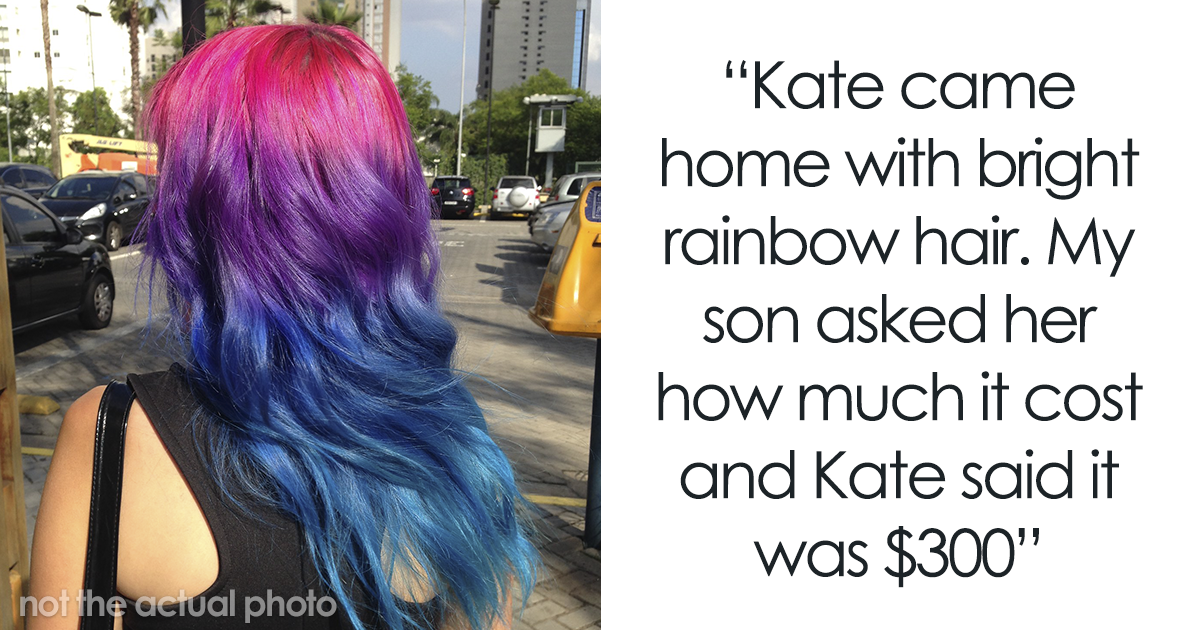
A 19-year-old spending $300 on rainbow hair sounds, at first, like the kind of family argument that belongs somewhere between a group chat meltdown and a sitcom dinner scene. One person sees a vivid, confidence-boosting transformation. Another sees three hundred very real dollars flying out the window with glitter on its shoes. Add in a rent-free living arrangement, a parent already worried about responsibility, and the magic phrase “it’s important for my mental health,” and suddenly we have the internet’s favorite activity: judging strangers with the intensity of a Supreme Court hearing.
The story centers on a young woman living at home without paying rent. According to the parent’s account, she earns money but struggles to save it. Then she comes home with bright rainbow hair and explains that the salon visit cost $300. When questioned, she says the color makes her feel good and matters to her mental health. The parent responds that if she can afford a $300 hair appointment, she can afford to contribute rent from now on.
It is easy to pick a side in five seconds. Some readers will say, “She is an adult. Pay rent.” Others will say, “She is 19, hair grows out, and parents should not turn self-expression into a bill.” The more useful answer is less dramatic and more uncomfortable: both sides may have a point, but both sides may also be communicating in the least productive way possible.
Why This Rainbow Hair Debate Hit A Nerve
The reason this story travels so well online is not really the hair. It is about money, control, identity, adulthood, and the strange emotional weather inside a family home when a child is technically grown but not fully independent. That stage can be awkward. One day your parents are telling you to clean your room; the next day they are explaining utility bills like you are joining a tiny domestic corporation.
Young adulthood has changed. Many people ages 18 to 29 still rely on parents while they work, study, save, or figure out their next step. Housing costs, tuition, wages, healthcare, and transportation all make independence harder than it looked in older coming-of-age movies where one summer job somehow paid for an apartment, a car, and several diner dates. Living at home is no longer rare or automatically shameful. For many families, it is practical.
But practical does not mean tension-free. When an adult child lives rent-free, money choices become visible. A parent may not care about a $6 coffee, but a $300 salon visit can feel like a neon sign blinking, “I have disposable income.” The adult child, meanwhile, may feel that any criticism of spending is an attack on autonomy. So the argument becomes less about rent and more about respect.
Was $300 For Rainbow Hair Actually Ridiculous?
Before treating the price like a national emergency, it helps to understand salon math. Vivid rainbow hair is not the same as grabbing a box dye from a drugstore and hoping for the best under bathroom lighting. Bright fantasy colors often require bleaching, toning, sectioning, applying multiple colors, processing time, rinsing, styling, and sometimes corrective work if the hair has previous dye history.
Professional color can cost well over $100, and vivid or multi-step color services can climb much higher depending on hair length, location, stylist skill, and the amount of lightening required. A $300 bill for rainbow hair may sound extravagant, but in the salon world it is not automatically outrageous. In some cities, it is practically the “welcome to vivid color” cover charge.
That does not mean the parent is wrong to notice the price. A purchase can be fairly priced and still financially unwise for someone who has no savings, no contribution plan, and no clear budget. The question is not simply, “Was the hair worth $300?” The better question is, “Can this person afford $300 hair while meeting adult responsibilities?” That answer depends on income, savings, family expectations, and whether the household had already discussed financial contribution.
Self-Expression Can Support Mental Well-Being
Hair is not just hair. It sits on your head, announces itself before you speak, and follows you into every mirror, selfie, classroom, workplace, and awkward elevator ride. For many people, changing hair color is a way to claim identity, mark a new chapter, recover confidence, or feel more like themselves. Rainbow hair can be playful, rebellious, artistic, comforting, or all of the above.
So when the daughter says the hair matters to her mental health, that should not be dismissed with an eye roll. Self-care can include small actions that help people manage stress, feel energized, and reconnect with themselves. Appearance choices can absolutely influence mood and confidence. Anyone who has ever left a salon walking like they are in a shampoo commercial knows this is not imaginary.
However, there is a difference between saying “this helps me feel better” and saying “this expense is automatically beyond discussion because mental health.” Mental health is important, but it should not become a magic shield that blocks every conversation about budgeting. A salon appointment can be meaningful without being financially untouchable. A purchase can be emotionally valid and still require planning.
The Parent’s Rent Demand: Fair Boundary Or Punishment?
The parent’s strongest argument is simple: an adult who earns money and lives at home should contribute something, especially if the family has other children and household expenses. Food, electricity, water, internet, and space all cost money. Parents are not free hotels with emotional baggage and better snacks.
Adult children paying rent can teach budgeting, make household costs feel more realistic, and reduce resentment. Many families set a modest monthly amount, ask for help with groceries, or require regular chores instead of formal rent. Some parents even save the rent secretly and return it later as moving-out money, which is both financially useful and very parental in a “surprise, I was teaching you all along” way.
But timing matters. If rent is introduced only after a parent disapproves of hair color, it can feel less like a boundary and more like a punishment. The daughter may hear, “You made a choice I dislike, so now I am charging you.” That framing invites defensiveness. A healthier version would be: “You are an adult earning money, and we need to set a household contribution plan. This is not about controlling your hair. It is about shared responsibility.”
Where The Daughter Has A Point
The daughter is right that her money is her money. Adults should be allowed to make style choices, even loud ones. Rainbow hair is not immoral, dangerous, or proof of failure. It is color. Very committed color, yes, but still color.
She is also right that parents can become controlling under the banner of “concern.” If every purchase becomes a lecture, adult children may feel trapped in a childhood role. A 19-year-old who lives at home still deserves privacy, dignity, and the ability to enjoy some of what she earns.
But adulthood is a package deal. The same independence that protects her right to choose rainbow hair also comes with the expectation that she participates in real-life costs. “I can spend my money however I want” is stronger when the person saying it is also paying bills, saving for goals, or contributing to the home that makes that spending possible.
Where The Parent Has A Point
The parent is not wrong to worry about spending habits. If a young adult consistently burns through money while living rent-free, parents may feel they are subsidizing impulse purchases. That can create resentment fast. Nobody wants to feel like they are covering groceries so someone else can afford luxury self-care with a receipt long enough to knit into a scarf.
The parent also has other children to support, which changes the equation. Family money is not infinite. Parents who help one adult child may have less time, money, and emotional energy for younger siblings, retirement, emergencies, or basic peace.
Still, the parent weakens the case by tying rent directly to the hair. Criticizing the purchase as “ridiculous” shifts the conversation from budgeting to judgment. Once a young adult feels mocked, the practical lesson gets buried under hurt feelings. If the goal is responsibility, the message needs to be about structure, not shame.
The Real Issue: No Clear Financial Agreement
The family’s biggest mistake appears to be the absence of a clear agreement. Rent-free living can work beautifully when everyone understands the purpose. Is the adult child saving for school? Paying down debt? Building an emergency fund? Working part-time while studying? Helping with siblings? Recovering from a difficult season?
Without a plan, “living at home” becomes a vague arrangement powered by assumptions. The parent assumes the daughter should be saving. The daughter assumes she can enjoy her earnings. Both may feel betrayed because neither agreed on the rules.
A better household agreement would include a monthly contribution, savings goal, chores, privacy boundaries, and a timeline for reassessing. For example: “Starting next month, you contribute $200 toward household expenses, save 20% of each paycheck, and help with dinner twice a week. We will revisit this in three months.” That is less dramatic than yelling about rainbow hair, but it also works better than door-slamming diplomacy.
How Mental Health Should Fit Into The Conversation
If the daughter is using hair color as a form of self-expression, that is understandable. If she is struggling emotionally and relying on shopping or salon changes as her main coping tool, that deserves a gentler and more serious conversation. Spending can provide a short-term mood boost, but it is not a full mental health plan.
Healthy coping usually includes a mix of habits: sleep, movement, supportive relationships, creative outlets, therapy when needed, time outdoors, journaling, medication if prescribed, and routines that make life feel manageable. Hair can be part of self-care, but it should not be the entire emotional toolbox. A toolbox with only hair dye in it is colorful, but it may not fix the leak.
The parent could ask, “What has been going on that made this feel so important?” instead of opening with “That is ridiculous.” The daughter could respond, “I know it was expensive. I planned for it, and I am willing to talk about contributing at home.” Both responses require maturity. Conveniently, maturity is exactly what this family is arguing about.
What A Fair Rent Plan Might Look Like
A fair rent plan for a 19-year-old should be realistic, not crushing. Charging full market rent may defeat the purpose of living at home, especially if the goal is to help the young adult launch successfully. But charging nothing while complaining about every purchase is also a recipe for family tension.
Families can consider several options:
1. A Modest Monthly Contribution
The adult child pays a manageable amount toward utilities, groceries, or general household costs. This teaches consistency without making independence impossible.
2. Rent Saved For Future Move-Out Costs
The parent collects rent and puts it into a savings account for the child’s deposit, furniture, emergency fund, or first month’s rent. This approach teaches budgeting while still supporting launch.
3. A Chore-And-Bill Hybrid
If income is low, the adult child contributes through chores, cooking, errands, or sibling help, plus a smaller financial amount. Contribution does not always have to be purely cash.
4. A Timeline Agreement
The family sets a review date. After three or six months, they discuss income, savings, school, job plans, and whether the arrangement still makes sense.
What Young Adults Can Learn From This
For young adults, the lesson is not “never buy fun things.” Life is not meant to be one long spreadsheet wearing beige pants. Joy matters. Style matters. Feeling like yourself matters. But if you want people to respect your freedom, show that you understand responsibility.
Before making a major nonessential purchase, ask: Do I have savings? Do I owe anyone money? Am I contributing fairly where I live? Will this purchase make next week harder? If the answer is “I have no plan, but I do have vibes,” pause. Vibes are wonderful. Landlords, dentists, and car insurance companies do not accept them as payment.
Budgeting does not mean killing personality. It means making room for personality without letting it eat rent money. A rainbow hair fund is perfectly reasonable. Put aside money over time, price the service honestly, include tip and maintenance products, and enjoy the appointment without guilt.
What Parents Can Learn From This
For parents, the lesson is not “ignore irresponsible spending.” It is “separate money boundaries from personal criticism.” If your adult child’s choices worry you, talk about the financial pattern, not the hairstyle, clothes, hobbies, or harmless forms of self-expression.
Instead of saying, “That hair was a ridiculous waste,” try, “I am concerned that you are spending large amounts while not contributing to the household. We need to agree on what adult responsibility looks like while you live here.” Same boundary. Less emotional shrapnel.
Parents also need to be honest about their own motives. Are you charging rent because the household needs help, because you want to teach responsibility, or because you are angry about a choice? The first two can be healthy. The third usually becomes a fight wearing a budget costume.
Experiences Related To The Topic: When Hair, Money, And Family Rules Collide
Many families have some version of this story, even if rainbow hair is replaced by concert tickets, sneakers, tattoos, gaming equipment, a weekend trip, or a phone upgrade. The object changes; the conflict stays the same. A young adult wants to spend money on something that feels meaningful. A parent sees the purchase and thinks, “Interesting. So you do understand how money works when it is fun.”
One common experience is the first “adult purchase” after getting a job. A teenager or young adult earns a paycheck and suddenly feels rich, even if the paycheck is actually doing the financial equivalent of wearing a paper hat in a hurricane. They buy something expressive: a new hair color, a piercing, clothes, makeup, car accessories, collectibles, or a trip with friends. The purchase feels like proof of independence. To the parent, it may look like proof that the young adult has no idea what independence costs.
Another common experience is the emotional value of appearance changes. People often change their hair after a breakup, a difficult semester, a new job, a loss, or a period of low confidence. The mirror becomes a place to say, “I am still here, and I get to choose what I look like.” That can be powerful. A parent who dismisses it as vanity may miss the deeper meaning. At the same time, the young adult may need to recognize that emotional meaning does not erase financial consequences.
Some families solve this well by creating “freedom within structure.” The adult child pays a small rent, covers personal expenses, and keeps a savings goal. After that, the remaining money is theirs to enjoy without commentary. This can actually reduce conflict because parents no longer feel used, and the adult child no longer feels watched. Everyone knows the deal. The rainbow hair becomes just hair, not Exhibit A in the Trial of Financial Responsibility.
Other families make the mistake of turning every expense into a moral referendum. A parent sees takeout and lectures about retirement. A young adult buys shoes and gets a speech about mortgage rates. Soon the young adult hides purchases, the parent snoops or comments, and trust leaks out of the house like air from a sad balloon. Money conversations become ambushes instead of planning sessions.
The healthiest experiences usually involve calm timing. Nobody has a brilliant financial conversation while angry in the kitchen. A better approach is to wait, sit down, and talk numbers. How much does the adult child earn monthly? What are their fixed costs? What can they contribute? What are they saving for? What household tasks are expected? When will the arrangement be reviewed? Specifics lower the temperature.
There is also a valuable lesson about mental health language. Younger generations are often more comfortable naming anxiety, stress, burnout, identity, and self-care. That is a good thing. But families can clash when mental health language is used in a way that older parents experience as avoidance. The bridge is curiosity. Parents can take the emotional claim seriously while still asking for responsibility. Young adults can explain what supports their well-being while still accepting that shared homes require shared effort.
In the rainbow hair case, the best ending would not be the daughter giving up colorful hair or the parent silently paying for everything forever. The best ending would be a new agreement: her body, her style, her money after responsibilities; their home, their costs, their right to request contribution. That balance is not as entertaining as an internet fight, but it is much more useful in real life.
Conclusion
The $300 rainbow hair argument is not really about whether colorful hair is good or bad. It is about the messy transition from being cared for to contributing, from asking permission to making choices, from parental control to adult accountability. The daughter deserves respect for her self-expression and emotional needs. The parent deserves respect for household costs and financial boundaries.
Asking an adult child to pay rent can be fair. Using rent as a reaction to a disliked purchase can feel punitive. Spending money on self-care can be valid. Calling every desired purchase “mental health” can avoid responsibility. The answer lives in the middle: clear expectations, respectful communication, realistic budgeting, and enough compassion to remember that becoming an adult is not a switch. It is a process, sometimes with rainbow highlights.