Note: This article is based on a synthesis of real aviation, automotive, auction, museum, and regulatory information. Source links are intentionally not embedded in the publishable body.
For more than a century, the flying car has been the unofficial mascot of tomorrow. It has appeared in cartoons, science fiction movies, trade-show stages, and optimistic press releases that practically arrive wearing chrome sunglasses. The promise is always the same: one day, instead of sitting in traffic behind a landscaping truck, you will press a button, rise into the sky, and glide over the freeway like a commuter with main-character energy.
Then reality clears its throat.
The headline “Nobody Wants To Buy the Original Flying Car” sounds like a joke, but it captures something surprisingly deep about transportation technology. The dream of the flying car is wildly popular. Actual flying cars, however, are hard to sell. The Moller M400 Skycar, one of the most famous “original flying car” prototypes in modern popular culture, became a perfect example. It looked futuristic. It had a thrilling backstory. It promised vertical takeoff and landing. It had been promoted for decades. And when a prototype appeared for sale online, the public mostly responded with the auction equivalent of quietly backing away.
Why? Because buying a flying car is not like buying a classic Mustang, a private plane, or even a slightly suspicious boat from a guy named Dale. It is buying a bundle of dreams, regulations, engineering compromises, maintenance questions, safety concerns, and museum logistics. The Moller Skycar was not merely an odd vehicle. It was a rolling, hovering symbol of why the future often looks simpler in posters than it does in paperwork.
What People Mean by “The Original Flying Car”
The phrase “original flying car” can mean different things depending on who is doing the bragging. Historically, the Taylor Aerocar deserves serious attention. Designed by Moulton “Molt” Taylor, the Aerocar first emerged in the late 1940s and became one of the most practical early roadable aircraft. It could drive on roads, tow its wings and tail behind it, and convert into an airplane. It even received certification from U.S. aviation authorities in the 1950s. Only a handful were built, but unlike many fantasy machines, the Aerocar actually did the thing. It drove. It flew. It made the family sedan look deeply underqualified.
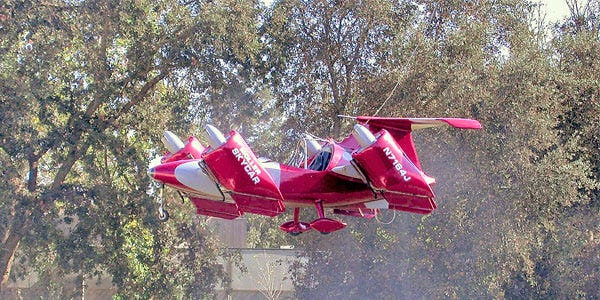
The Moller M400 Skycar belongs to a different chapter. It became famous not because it was the first flying car ever built, but because it embodied the modern pop-culture version of the dream: a compact, futuristic, vertical-takeoff machine that looked like it had escaped from a sci-fi movie set. Developed by engineer Paul Moller and Moller International, the M400 was promoted as a personal vertical takeoff and landing vehicle, often described as a VTOL flying car. Its red body, ducted fans, and bold performance claims made it irresistible to journalists, futurists, and anyone who had ever looked at rush-hour traffic and thought, “What if I simply left the road?”
That fame is why the Moller Skycar often gets called the “original flying car” in popular articles, even though aviation historians will immediately reach for a red pen. The better way to put it is this: the Taylor Aerocar was one of the original practical roadable aircraft, while the Moller Skycar became one of the original internet-age symbols of the flying-car promise. One was charmingly mechanical. The other was aggressively futuristic. Both show why the market has never been as easy as the dream.
The Moller M400 Skycar: A Future That Looked Ready for a Movie Poster
The Moller M400 Skycar was not shy. It was designed as a four-seat vehicle with vertical takeoff and landing capability. Instead of requiring a runway like a normal airplane, it was supposed to rise upward using ducted fans powered by multiple rotary engines. Promotional materials described a machine that could travel at highway speeds on the ground and achieve aircraft-like performance in the air. The vision was seductive: drive from your garage, take off vertically, cross long distances quickly, and land near your destination. Basically, a helicopter, sports car, and science project all sharing one very intense résumé.
Reports around the 2017 auction described the prototype as powered by eight Rotapower engines producing more than 700 horsepower. The vehicle had been associated with enormous development costs, often reported at more than $150 million over several decades. To be fair, that kind of persistence deserves some respect. Many people give up on New Year’s resolutions by January 12. Moller spent decades chasing the same sky-road machine.
But the Skycar’s most important problem was not whether it looked exciting. It absolutely did. The problem was whether a buyer could actually use it as advertised. The M400 prototype had demonstrated tethered hovering, but it did not become a certified, everyday flying car. That distinction matters. A flying car that cannot legally fly is still fascinating, but it starts to resemble the world’s most dramatic lawn ornament.
The Auction Problem: A Flying Car With a Giant Asterisk
When the Moller M400 prototype appeared on eBay in 2017, the listing had the ingredients of viral attention. It was bright red. It was rare. It was tied to decades of flying-car hype. The asking structure was dramatic too: reports described bidding starting at $1 million with a Buy It Now price of $5 million. That is a lot of money for any vehicle, but especially for one whose best use might be making every visitor to your private museum say, “Wait, is that thing real?”
The catch was enormous: in its auctioned form, the Skycar did not have FAA approval to fly. Buyers were told that it could not simply be purchased and taken into the sky. A potential owner could display it, preserve it, or perhaps work with the company toward approval, but that is a very different proposition from “congratulations, here are the keys, please avoid geese.”
The first listing reportedly attracted no bidders, and the vehicle was relisted with a much lower opening bid. That lack of buyer enthusiasm was not necessarily a rejection of the dream. It was a rejection of the deal. People love the idea of a flying car. They are less eager to spend museum-grade money on a prototype that comes with legal limitations, uncertain operating costs, no clear path to everyday use, and the terrifying possibility of explaining it to their insurance agent.
Why Nobody Wants To Buy the Original Flying Car
1. It Is a Vehicle, a Prototype, and a Problem Set
Classic cars are already expensive to own. Vintage aircraft are even more demanding. Combine the two and you do not get convenience; you get a maintenance puzzle wearing aviation goggles. A flying car has to satisfy two worlds that rarely agree on priorities. Cars need crash structures, lights, bumpers, tires, emissions compliance, and road manners. Aircraft need lightness, aerodynamic efficiency, airworthiness, inspection records, and systems that behave reliably when gravity becomes less of a suggestion and more of a legal department.
A prototype like the Moller Skycar adds another layer. It is not a mass-produced vehicle with a dealer network, parts catalog, and friendly neighborhood mechanic who can say, “Yep, your ducted fan is making that noise again.” It is a one-off or near-one-off experimental machine. Even moving it, storing it, insuring it, or restoring it can become a project large enough to need its own project manager.
2. FAA Approval Is Not Decorative
In aviation, certification is not a polite suggestion. It is the difference between an aircraft and an object that looks like an aircraft. The Moller Skycar’s auction appeal was limited because the buyer could not simply fly it in its listed condition. Without the proper approvals, it was essentially a display piece or a development gamble.
That matters because the value of a flying car depends heavily on whether it can perform both halves of its name. If it drives but does not fly, it is a strange car. If it flies but cannot drive legally, it is a strange airplane. If it cannot legally do either in practical daily use, it becomes a collector object. Collector objects can be valuable, but buyers are selective. A million-dollar conversation starter must be a spectacular conversation starter.
3. The Market for Flying-Car Museums Is Not Huge
A vehicle like the Moller M400 makes sense for a museum, technology collection, aviation exhibit, or eccentric billionaire who already owns the world’s largest indoor waterfall and now needs something for the lobby. But that is a small audience. Most collectors want provenance, beauty, usability, racing history, celebrity ownership, or a proven investment curve. The Skycar has historical significance, but it also carries the awkward aura of unfinished promise.
That does not make it worthless. In some ways, it makes it more interesting. The Skycar is a physical artifact of technological optimism. It belongs beside early electric cars, jet packs, personal helicopters, and other machines that said, “The future is almost here,” then got stuck in the hallway. But the number of buyers who can pay seven figures for that kind of artifact is limited.
4. Practicality Is the Dream Killer
The average driver wants a vehicle that starts every morning, fits in a parking space, survives potholes, and does not require a preflight checklist before visiting the grocery store. The average pilot wants an aircraft with predictable handling, documented maintenance, regulatory clarity, and a support ecosystem. A flying car asks one machine to satisfy both personalities. That is like asking a golden retriever to do your taxes: charming idea, questionable execution.
Even if a flying car works, the owner still needs places to take off and land, weather that cooperates, training, maintenance, inspections, noise acceptance, and airspace permissions. In dense cities, vertical takeoff may sound ideal, but urban aviation introduces questions about safety, noise, emergency landing zones, battery or fuel reserves, and what happens when hundreds of people decide the sky is the new express lane.
The Taylor Aerocar Proves the Dream Was Never New
The Taylor Aerocar is important because it shows that the flying-car idea did not fail from lack of imagination. Molt Taylor created a clever, functional design decades ago. The Aerocar could convert between road and flight modes, and its roadable-aircraft concept was far more grounded than many later fantasies. Yet even with certification and real-world operation, it never became a mass-market product.
That is the uncomfortable lesson. If a working, certified flying car struggled commercially in the 1950s and 1960s, then newer designs must overcome not only engineering challenges but also old market truths. Buyers do not purchase dreams alone. They purchase usefulness, reliability, support, and confidence. The Aerocar had charm, but it could not create a new transportation category by itself. The Moller Skycar had futuristic spectacle, but it could not turn spectacle into buyer trust.
Modern Flying Cars Still Face the Same Gravity
Today’s flying-car and eVTOL companies are more sophisticated than the tinkerers of earlier decades. Modern composites, electric propulsion, software controls, batteries, sensors, and flight computers make some old ideas more plausible. Companies such as Alef Aeronautics, Terrafugia, PAL-V, Joby Aviation, Archer, and others have pushed public interest back into the sky. Some are pursuing private flying cars; others focus on air taxis, where professional operators may make more sense than individual owners.
Still, the same questions return wearing newer shoes. Who certifies it? Who insures it? Where can it take off? How loud is it? What happens in bad weather? How much training does the operator need? Can the business model survive after the launch video stops trending? These questions are not boring details. They are the bridge between “cool prototype” and “real transportation.”
Terrafugia’s Transition, for example, achieved important milestones as a roadable aircraft, but turning that into broad U.S. commercial success proved difficult. Alef has attracted attention with an electric flying-car concept and experimental approval for testing, but experimental approval is not the same as mass-market permission for everyday commuters. PAL-V has pursued a road-and-air gyroplane-style approach and has worked through European certification milestones. Each effort is impressive. None has yet made flying cars as common as SUVs with too many cup holders.
Why the Flying Car Still Refuses To Die
The flying car survives because it solves a problem emotionally before it solves it practically. Traffic feels like stolen life. Roads are crowded. Airports are inconvenient. Helicopters are expensive and noisy. A personal aircraft that can also drive promises freedom in its purest consumer form: no schedule, no runway, no traffic, no waiting behind someone who forgot how turn signals work.
That emotional power is why people keep clicking on flying-car headlines. It is why prototypes attract crowds. It is why investors periodically return to the idea, convinced that this time batteries, autonomy, lightweight materials, or software will finally make the fantasy behave. The dream is durable because the problem is durable. As long as people are stuck in traffic, someone will imagine rising above it.
But dreams need infrastructure. The automobile did not succeed by existing alone; it needed roads, fuel stations, repair shops, rules, factories, financing, and cultural acceptance. Aviation needed airports, air traffic systems, pilot training, maintenance standards, and regulation. A flying car needs pieces of both ecosystems, then must add new ones of its own. That is not impossible, but it is much harder than building one dazzling prototype.
The Real Value of the Moller Skycar
The Moller Skycar may not be valuable as a practical commuting machine, but it is valuable as a lesson. It shows how big technological ideas can become trapped between hype and certification. It shows that engineering ambition alone does not create a market. It shows that “almost” can be both inspiring and expensive.
In a museum, the Skycar would make perfect sense. Visitors would stop, stare, and ask questions. Children would imagine piloting it over skyscrapers. Adults would remember old promises about the future. Engineers would inspect the design and debate whether the concept was ahead of its time, fundamentally flawed, or simply underfunded at the wrong moments. That is exactly what good artifacts do. They do not just show what happened; they show what people hoped would happen.
As a consumer purchase, though, the story changes. A buyer must ask what they are actually buying. A car? Not really. An airplane? Not in the ordinary certified sense. A museum object? Yes. A speculative development platform? Perhaps. A guaranteed ticket to the Jetsons lifestyle? Absolutely not. The Skycar’s awkward market position explains why attention did not translate into eager bidding.
Experience Section: What the Flying-Car Dream Feels Like Up Close
The experience of encountering a flying car, even through photos, auction listings, museum exhibits, or old newsreels, is different from reading about a normal vehicle. A classic car usually triggers nostalgia. A vintage airplane triggers admiration. A flying car triggers a tiny argument inside the brain. One side says, “This is brilliant.” The other side says, “Please explain where the wings go when I need to parallel park.”
That tension is part of the magic. Machines like the Moller Skycar and Taylor Aerocar invite people to imagine transportation without boundaries. The road ends, but the journey does not. The driveway becomes a runway. The garage becomes a hangar. Even people who know nothing about aviation understand the emotional appeal. Nobody enjoys traffic. Nobody wakes up hoping to spend forty minutes staring at the same bumper sticker. A flying car seems to offer a clean escape from the dullest part of modern life.
But the closer you look, the more complicated the fantasy becomes. Imagine owning a prototype flying car. At first, it sounds incredible. Every neighborhood barbecue becomes your personal press conference. Your garage instantly outranks everyone else’s garage. But then come the questions. Can it be legally operated? Who can maintain it? Where are the spare parts? Does the city allow this thing to run? Does the airport welcome it? Does your insurance company laugh, hang up, or both?
That is why flying cars often feel more satisfying as exhibits than as possessions. In a museum, the dream remains clean. The vehicle can sit under bright lights while visitors enjoy the possibility of it. No one has to file paperwork, check fuel systems, schedule inspections, or explain to a homeowners association why a vertical-takeoff machine is technically “seasonal outdoor equipment.” The flying car becomes a story, and stories are easier to maintain than engines.
There is also a strange emotional honesty in failed or unfinished machines. A perfectly successful product hides the struggle behind polished marketing. A prototype reveals the struggle. You can see the ambition, the compromises, the courage, and sometimes the overconfidence. The Moller Skycar is compelling because it tried to leap over ordinary transportation. Whether it succeeded is almost less interesting than the fact that people kept trying for so long.
For enthusiasts, the best experience may be learning from these machines rather than owning them. The Aerocar teaches that practicality matters. The Skycar teaches that futuristic design needs regulatory reality. Modern eVTOL projects teach that software and batteries help, but they do not erase physics. Every generation thinks it has finally found the missing piece. Sometimes it has. Sometimes it has simply invented a more expensive way to rediscover the old problems.
Still, it is hard not to root for the idea. The flying car is ridiculous in the way many great inventions looked ridiculous before they became normal. The challenge is separating the useful future from the shiny fantasy. Maybe the first widely adopted flying cars will not look like sports cars. Maybe they will be air taxis, emergency vehicles, rural mobility tools, or specialized aircraft that drive only short distances. Maybe personal sky-commuting will remain a luxury niche. Whatever happens, the experience of chasing the flying-car dream reminds us that technology is not just about what works. It is also about what people desperately want to be possible.
Conclusion: The Future Was for Sale, But the Fine Print Was Too Heavy
The story of “Nobody Wants To Buy the Original Flying Car” is not really about a lack of imagination. People have plenty of imagination. The Moller Skycar attracted attention because it looked like a future many people wanted. The problem was that attention is not the same as trust, and curiosity is not the same as a purchase order.
The original flying-car dream remains powerful because it promises escape from the ordinary. Yet the Moller M400 shows that the market demands more than a thrilling shape and a legendary backstory. Buyers need certification, usability, support, safety, legal clarity, and a reason to believe the machine is more than an expensive symbol. Until flying cars can offer those things at scale, many will remain exactly where the Skycar landed: admired, debated, photographed, and difficult to sell.
That does not make the dream foolish. It makes it unfinished. The Moller Skycar, the Taylor Aerocar, and today’s eVTOL startups all belong to the same long conversation about mobility, freedom, and the human refusal to accept traffic as destiny. The original flying car may not have found a buyer, but it still bought itself a permanent place in the history of ambitious machines.