When the world first saw the reports from Bucha, a quiet suburb northwest of Kyiv, the reaction was shock, grief, and a demand for answers. Ukrainian officials said nearly 300 residents had been found dead after Russian forces withdrew from the area in spring 2022. Later investigations and local accounting placed the toll even higher. But while international journalists, human rights investigators, and Ukrainian authorities were documenting what happened on the ground, Russian state television was telling viewers a very different story.
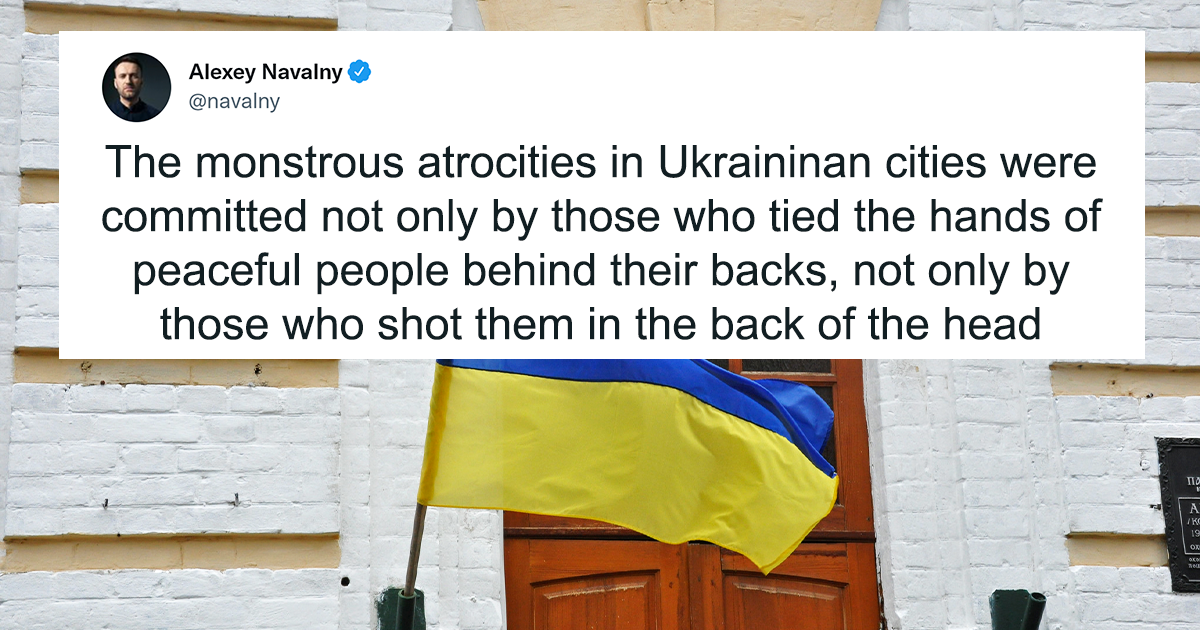
That contrast is what Alexei Navalny, Russia’s most famous opposition figure, tried to expose from prison. In a widely shared thread posted through his team in April 2022, Navalny described how an ordinary viewer of Russian federal TV would hear about Bucha. According to him, the story was not presented as evidence of civilian suffering or possible war crimes. Instead, viewers were told that Bucha was a Western provocation, a staged event, and even a psychological trick involving the similarity between the English word “butcher” and the Ukrainian town’s name.
It was a moment that revealed more than one outrageous television segment. It showed how modern propaganda works when a government needs to protect its audience from reality. The result is not simply misinformation. It is an alternate weather system: a fog machine with studio lighting, confident anchors, and enough emotional thunder to make facts feel optional.
What Happened in Bucha?
Bucha became one of the most recognized names of the early months of Russia’s full-scale invasion of Ukraine. Russian forces occupied the town in March 2022 as they attempted to advance toward Kyiv. After Ukrainian forces regained control, residents, journalists, and investigators found evidence of widespread civilian deaths. Ukrainian officials initially reported nearly 300 residents dead. Later, more detailed counts by local authorities and reporting from major international outlets showed a larger number of victims.
Human rights organizations documented patterns consistent with unlawful killings, enforced disappearances, and other serious abuses during the occupation. Journalists on the ground reported destroyed homes, abandoned military positions, and residents searching for relatives. International investigators later treated Bucha as a major case study in possible war crimes committed during the invasion.
The world’s attention focused not only on the scale of the deaths but also on the attempt to deny them. Russia rejected responsibility and claimed the evidence was staged. Those claims were challenged by satellite imagery, witness accounts, forensic work, videos, and reporting from independent news organizations. The timeline mattered: evidence showed that bodies and signs of violence were present while Russian forces controlled the town, contradicting claims that the scene had been created after they left.
Navalny’s View From Inside the Russian Information Bubble
Alexei Navalny was in prison when he commented on Bucha. That detail matters. He was not watching events unfold from a foreign newsroom or a comfortable office. He was inside the very system he criticized, with limited access to information and Russian federal television as one of the main available windows to the outside world.
In his thread, Navalny explained that he learned about the “monstrous events in Bucha” through Russian news coverage that framed the incident as a massacre committed by “Ukrainian Nazis.” Later, he said, a Channel One anchor offered what he described as an unbelievable explanation: NATO had supposedly prepared the Bucha “provocation” in advance, and U.S. President Joe Biden’s earlier use of the word “butcher” to describe Vladimir Putin was presented as proof that Western audiences had been subconsciously prepared for the story.
As propaganda logic goes, this was a triple backflip into a swimming pool with no water. The claim relied not on evidence but on word association. “Bucha” sounded vaguely like “butcher,” therefore the West must have planned the entire narrative. It was the kind of argument that might collapse under the weight of a raised eyebrow, yet on state television it was delivered with the seriousness of a national security briefing.
Navalny’s larger point was more important than the absurdity of one claim. He argued that Russian propaganda had stopped being just a tool of the Kremlin and had become an active political force. In his view, TV hosts and commentators were not merely defending the war; they were escalating it, demanding harsher action, and punishing even mild suggestions that peace talks could be useful.
How Russian TV Reframed Bucha
Russian state media did not settle on one simple explanation for Bucha. Instead, it used a familiar propaganda method: throw many claims into the air and make the audience too tired to catch the truth. Some broadcasts suggested the images were fake. Others claimed Ukrainian forces were responsible. Some argued that Western media had coordinated the outrage. The goal was not always to prove one version. The goal was to make every version feel uncertain.
This strategy is powerful because doubt can be easier to create than belief. A viewer does not have to be fully convinced that Bucha was staged. They only have to wonder, “How do we really know?” Once that doubt appears, the moral urgency fades. The question shifts from “Who killed civilians?” to “Who benefits from this story?” That shift is the propagandist’s favorite magic trick: now you see the victims, now you see a conspiracy theory.
Navalny recognized the danger in this approach. He warned that propaganda creates a public mood in which war crimes are not only excused but demanded. That is a chilling argument because it treats television not as background noise but as political machinery. The studio becomes part of the battlefield, and the anchor’s desk becomes a command post for emotional mobilization.
Why the Bucha Narrative Was So Important
Bucha was a turning point in international perception of the war. Before the reports from the town, many outside observers already viewed Russia’s invasion as illegal and destructive. After Bucha, the debate became even sharper. Western governments increased pressure on Moscow, discussed more sanctions, and called for accountability. The images and reports from Bucha made the war’s civilian cost impossible to treat as an abstract geopolitical dispute.
That is exactly why the Russian state-media response was so aggressive. If Bucha were accepted by Russian viewers as a real atrocity committed during Russian occupation, it would challenge the official story that Russia was conducting a noble or defensive operation. It would raise painful questions: What are our soldiers doing? Why are we being told this is liberation? What else has been hidden from us?
For an authoritarian media system, those questions are dangerous. They open doors. Propaganda’s job is to slam those doors shut, then hang a sign on them reading, “Western Fake News Department.”
The Evidence Against the “Staged” Claim
The staged-hoax narrative did not hold up under independent scrutiny. Satellite imagery showed that some bodies were visible on streets during the period when Russian troops controlled Bucha. Journalists documented conditions in the town soon after Russian forces withdrew. Human rights groups gathered testimony and physical evidence. The United Nations later reported unlawful killings of civilians in areas of northern Ukraine that had been under Russian control.
No single piece of evidence tells the whole story. But together, the evidence formed a consistent picture: civilians were killed during the Russian occupation, and the denial campaign began after the world saw the consequences. That is why Bucha remains central to discussions about war crimes, accountability, and the role of documentation in modern conflict.
The lesson is not that every first report in a war is perfect. War reporting is difficult, chaotic, and often incomplete. The lesson is that serious investigation looks for timelines, corroboration, witnesses, imagery, documents, and patterns. Propaganda, by contrast, often looks for a slogan. When the slogan arrives before the evidence, readers should check their pockets; someone may be trying to steal their judgment.
Navalny’s Attack on the Propaganda Machine
Navalny did not limit his criticism to one television host. He called for sanctions against the people who build and broadcast Russian war propaganda, from editors-in-chief to talk-show personalities. He compared the role of propagandists to those who incite violence and argued that they should eventually face legal consequences.
His message was blunt: the people who encourage aggression from television studios are not innocent spectators. They help create the emotional permission structure for violence. A soldier may carry out an order, but propaganda helps prepare the public to cheer, deny, or ignore what follows.
This is why Navalny’s comments still matter. They were not only about Bucha. They were about the architecture of denial. A modern government does not need every citizen to know nothing. It needs enough citizens to feel that truth is impossible, that everyone lies, and that loyalty is safer than curiosity.
Russian State Media and the Art of Manufactured Confusion
Russian state television has long relied on a mix of nationalism, grievance, fear, and spectacle. The format often looks like debate, but the range of acceptable conclusions is carefully controlled. Guests may shout. Hosts may interrupt. Graphics may flash. But the destination is usually the same: Russia is under attack, the West is deceitful, Ukraine is controlled by extremists, and any evidence against Moscow is part of an information war.
The Bucha coverage fit that pattern. Instead of asking what happened to civilians, the coverage asked who was trying to frame Russia. Instead of treating witness accounts and satellite images as evidence, it treated them as hostile weapons. The result was a media environment where reality had to pass through a political metal detector before it could enter the room.
For viewers with access to independent reporting, the contradictions were obvious. For viewers who depended mainly on federal television, the story was different. Navalny understood this from inside prison. He warned that the lies were not only monstrous but persuasive to people without alternative information. That is perhaps the most unsettling part: propaganda does not need to be elegant. It only needs to be repeated, emotional, and protected from competition.
Why Bucha Still Matters for Media Literacy
Bucha is not only a Ukrainian tragedy. It is also a warning about how information systems can be weaponized. In the digital age, atrocities are documented faster than ever, but denial also travels quickly. Satellite images, phone videos, local testimony, and open-source investigations can reveal facts. At the same time, state media, bots, influencers, and partisan channels can flood the public space with doubt.
That means media literacy is no longer a nice extra skill, like knowing how to fold a fitted sheet or unsubscribe from five newsletters you never meant to join. It is a civic survival tool. Readers need to ask: Who is making this claim? What evidence supports it? Are multiple independent sources saying the same thing? Does the argument rely on documents and timelines, or on emotional suspicion?
In the Bucha case, the difference between evidence and narrative was stark. Independent investigations worked backward from facts on the ground. Russian state media worked backward from the conclusion that Russia could not be guilty. One method investigates. The other protects power.
Experiences and Reflections: What This Story Feels Like From the Reader’s Side
For many people following the Bucha story from outside Ukraine, the experience was emotionally disorienting. First came the shock of the reports. Then came the denial. Then came the realization that the denial was not a fringe internet rumor but a polished message broadcast to millions. It felt like watching two realities compete in real time: one built from witnesses and evidence, the other built from accusation and performance.
Readers often describe moments like this as the point when news stops feeling distant. A town most people had never heard of became a symbol of civilian suffering. A prison thread from Navalny became a guide to understanding how a closed media system processes inconvenient facts. And the absurd “Bucha/butcher” argument became a reminder that propaganda does not always arrive wearing a villain costume. Sometimes it arrives in a suit, behind a desk, speaking with complete confidence.
The experience also shows why people should be careful with their own information habits. During crises, many readers scroll quickly, react quickly, and share quickly. That is human. But propaganda is designed for exactly that speed. It wants outrage before verification, loyalty before evidence, and exhaustion before understanding. The antidote is slower than the disease: read carefully, compare sources, and resist the temptation to treat every claim as equally plausible just because it is loud.
Another lesson is that denial can be emotionally comforting. If a viewer believes Bucha was staged, they do not have to confront the possibility that their country’s army committed crimes. They do not have to feel responsibility, grief, or shame. Propaganda offers emotional shelter, but the rent is moral blindness. Navalny’s thread mattered because it tried to tear a hole in that shelter and let reality in.
For publishers, educators, and everyday readers, Bucha remains a case study in how to write and think about contested events. Avoid sensationalism. Avoid graphic excess. Focus on evidence, chronology, accountability, and the human cost. The point is not to turn tragedy into content. The point is to preserve truth against those who would bury it under noise.
Finally, there is the experience of remembering Navalny himself. His comments on Bucha came from a man already punished for challenging the Russian state. He later died in prison in 2024, making his warnings feel even heavier. Whether readers agreed with every part of his politics or not, his Bucha thread captured a central truth about authoritarian systems: controlling the story is part of controlling the country. When a government can make citizens doubt what happened in a town full of evidence, it can make them doubt almost anything.
Conclusion
Navalny’s response to Russian TV coverage of Bucha was more than a reaction to one outrageous broadcast. It was an anatomy lesson in propaganda. He showed how a tragedy could be inverted, how victims could be erased, how evidence could be recast as conspiracy, and how television could help transform denial into public loyalty.
The Bucha killings remain one of the defining atrocities associated with Russia’s full-scale invasion of Ukraine. The attempts to dismiss them as staged did not withstand serious investigation, but they did reveal something deeply important: in modern war, the fight over truth begins almost as soon as the violence itself.
For readers, the story is a reminder to treat confident claims with careful attention, especially when they come from systems that punish dissent. Facts need evidence. Accountability needs memory. And when propaganda tries to turn tragedy into a trick of language, the responsible answer is not confusion. It is investigation, clarity, and a refusal to look away.