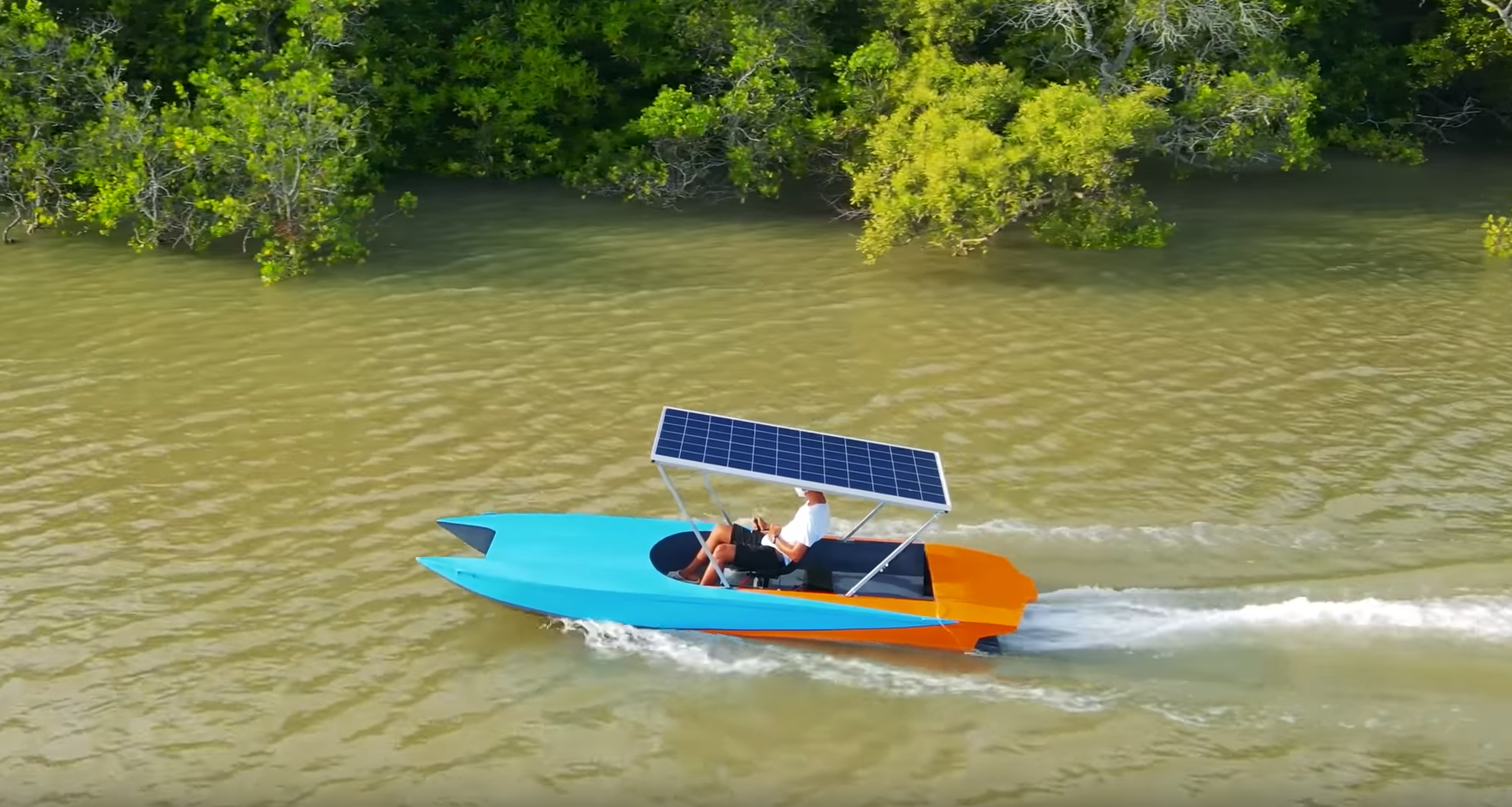
A scratch-built electric boat has a special kind of charm. It is not polished like a showroom cruiser, not wrapped in marketing slogans, and definitely not delivered with a complimentary branded cooler. It is the kind of machine that says, “Someone stared at plywood, fiberglass, motors, batteries, and a body of water, then decided all of those things should meet.”
The result, in this case, is a small single-seat electric boat that looks simple at first glance but reveals a lot about where small watercraft may be heading. Built around a custom fiberglass hull, shaped with a plywood mold, and pushed by a pair of electric motors producing roughly 4 kW in total, the boat is surprisingly lively on the water. Add a belt-driven drivetrain, a standard-style propeller, a large battery, and a 300 W solar panel that doubles as shade, and you have a backyard engineering project that feels less like a toy and more like a tiny preview of boating’s electric future.
What makes it interesting is not just that it moves. Plenty of floating objects can be persuaded to move, including pool noodles and bad decisions. What stands out is how quickly the boat gets going, how cleanly it appears to plane, and how naturally electric propulsion fits a small craft when weight, hull shape, and power delivery are balanced well.
Why This Electric Boat Feels Faster Than Expected
The magic begins with the hull. The boat uses a catamaran-like form rather than a simple flat-bottomed box. That matters because hull design is one of the biggest factors in whether a small craft feels sluggish or snappy. A displacement hull pushes through the water, moving a volume of water equal to the boat’s weight. That can be efficient at low speeds, but it also creates a practical speed ceiling based on waterline length. A planing hull, by contrast, rises and skims over the surface once it reaches enough speed.
This scratch-built boat appears to benefit from that planing behavior. Once it lifts and reduces the amount of hull dragging through the water, the same amount of power can produce a much more exciting ride. That is why a relatively modest 4 kW setup can look impressive. In car language, 4 kW sounds tiny. In small-boat language, especially with a light hull and a single rider, it can be plenty of shove.
The twin-hull layout also helps with stability. A narrow monohull can be quick, but it may feel twitchy when weight shifts. A catamaran-style platform spreads buoyancy across two hulls, making the boat feel more planted. For a DIY electric boat, that stability is valuable because batteries, motors, and the driver all need to sit in the right relationship to the center of gravity. Nobody wants a boat that accelerates like a rocket and handles like a shopping cart with three angry wheels.
The Powertrain: Simple, Clever, and Very Electric
The propulsion system uses two electric motors with a combined output of about 4 kW. Instead of a gas engine turning a propeller through a traditional marine gearbox, the setup uses a belt-driven drivetrain. That approach can be compact, relatively easy to package, and flexible when matching motor speed to propeller speed.
Electric motors are excellent for small boats because they deliver torque immediately. A gasoline engine often needs to climb into its preferred rpm range before it feels strong. An electric motor responds right away, which makes the boat feel quick off the line. On water, where drag rises brutally with speed, that instant response is not just fun; it helps the craft break through the awkward transition between pushing water and getting on plane.
There is also less noise. Electric boats are not silent, because water, wind, propellers, belts, and hull slap still exist. But they remove the familiar drone, vibration, fumes, and hot mechanical clutter of a small combustion engine. The experience becomes more like gliding with a soundtrack of water instead of arguing with a lawn mower that learned to swim.
The Solar Roof Is Not a Superpower, But It Is Smart
The boat’s 300 W solar panel is a neat touch because it serves two jobs. First, it provides shade for the operator, which is not a luxury when sitting on open water under direct sun. Second, it can recharge the battery when the motors are not being used.
It is important to keep expectations realistic. A 300 W panel cannot continuously feed two motors running at a combined 4 kW. At full power, the motors would demand far more energy than the panel can produce in real time. But solar charging is still useful between runs, during slow cruising, or while the boat sits at rest. Think of it as a range extender for patient people, not a magic portal to unlimited speed.
That said, solar makes more sense on boats than many people realize. Boats often sit outdoors, exposed to sun, with flat or semi-flat surfaces available for panels. For small electric craft used on lakes, rivers, ponds, and calm coastal areas, even modest solar support can reduce plug-in charging needs and stretch a casual day on the water.
Why Small Electric Boats Are Having a Moment
Electric boating is not new. Electric launches were popular more than a century ago before gasoline outboards became dominant. What has changed is the technology. Modern lithium batteries store more energy in less weight than older lead-acid packs. Brushless motors are compact and efficient. Controllers are smoother. Solar panels are cheaper. And people are increasingly interested in quiet, low-maintenance machines that do not smell like a fuel dock.
Commercial products show the same trend. Mercury’s Avator electric outboards target small-boat users who want clean, quiet propulsion with digital range monitoring. Torqeedo offers electric outboards, inboards, and hybrid systems, with higher-power options aimed at larger recreational and commercial uses. At the bigger end, U.S. marine research and transportation projects are exploring hybrid and battery-electric vessels for ferries, workboats, and research platforms.
The DIY boat sits at the fun, experimental end of that spectrum. It is not trying to replace a ferry or cross an ocean. It is showing that electric propulsion can make a small personal craft feel quick, simple, and enjoyable without requiring a huge engine or a complicated fuel system.
Speed Comes From the Whole System, Not Just the Motors
One of the best lessons from this project is that speed is a system result. Many beginners focus only on motor wattage, as though adding power automatically creates a fast boat. It does not. A heavy, poorly balanced hull can waste impressive power. A bad propeller match can turn watts into bubbles. A weak battery system can sag under load. A sloppy drivetrain can turn acceleration into heat.
This scratch-built electric boat works because several pieces line up: a lightweight body, a hull that can get on plane, enough motor output for the size, and a drivetrain that appears to put power into the prop effectively. The result is not just motion, but usable motion. That distinction matters.
It also explains why electric boats can feel surprisingly strong even when their rated power seems low compared with gasoline engines. Electric motors deliver smooth torque, and small boats do not need enormous horsepower when the hull is light and efficient. The trick is avoiding the common DIY trap of building a beautiful hull, then stuffing it with batteries until it handles like a refrigerator.
Where DIY Electric Boats Shine
Small electric boats make the most sense in places where range needs are predictable. Lakes, ponds, canals, marinas, slow rivers, and protected bays are ideal. These are environments where quiet operation, easy launching, and low maintenance matter more than long-distance cruising.
For fishing, electric propulsion can be a major advantage because it reduces noise and vibration. For recreational cruising, it makes conversation easier. For environmentally sensitive waterways, zero direct exhaust emissions are attractive. For tinkerers, the modular nature of batteries, motors, controllers, and solar panels makes experimentation irresistible.
The scratch-built boat also highlights how personal electric watercraft can be more approachable than many people assume. A custom hull does not need to look like a luxury yacht. It needs to float correctly, track predictably, distribute weight safely, and match the power system to the intended use. When those pieces are right, even a compact one-person boat can look delightfully quick.
The Big Limitation: Batteries Still Rule Everything
Every electric boat conversation eventually returns to batteries. Batteries decide range, weight, charging time, cost, and layout. Water is a demanding environment because drag rises quickly as speed increases. The faster a boat goes, the more energy it consumes, often at a rate that surprises people used to road vehicles.
That is why a small electric boat may run happily for a long time at low speed but drain its battery quickly at full throttle. The same principle applies to commercial electric boats. Ferries and workboats are promising candidates when routes are predictable and charging infrastructure can be planned. Random long-distance boating is harder because marinas do not yet offer the same charging convenience that drivers increasingly expect on land.
For a DIY builder or buyer, the best approach is to define the mission first. Is the boat for short joyrides? Quiet fishing? A 30-minute lake loop? A full afternoon of slow cruising? Performance bursts? Once the mission is clear, battery size and motor power can be chosen realistically. Without that planning, electric boating becomes a guessing game, and water is not famous for rewarding guesses.
Safety Is the Part That Should Never Be Improvised
Electric propulsion around water deserves respect. High-current systems, lithium batteries, wet environments, vibration, corrosion, and homemade structures are not a casual mix. A scratch-built project can be inspiring without being a free pass to improvise electrical safety.
Any serious electric-boat project should be designed around marine-rated components, proper battery management, overcurrent protection, secure mounting, waterproofing, ventilation where required, emergency shutoff planning, and compliance with applicable boating rules. The U.S. Coast Guard has warned about lithium-ion battery installation hazards, and ABYC standards exist because boats are harsh electrical environments. The fun part is the test ride; the important part is making sure the test ride does not become a rescue story with a soundtrack of regret.
Personal flotation devices, legal lighting, sound signaling, fire safety equipment, and local registration requirements still matter, even for a small homemade craft. Electric propulsion changes the drivetrain, not the responsibility of operating safely.
What This Project Says About the Future of Personal Boating
The most exciting thing about this scratch-built electric boat is not that it will replace every gasoline-powered skiff tomorrow. It will not. Gas engines still dominate for long range, high power, remote operation, and heavy loads. But small electric boats are becoming more convincing because they offer a different kind of pleasure.
They are clean at the point of use. They are quiet. They start without drama. They can be charged at home. They have fewer routine maintenance headaches. And when properly designed, they can be genuinely quick.
That last point matters. For years, electric boats were often associated with slow trolling motors and gentle pond cruising. Projects like this one push against that stereotype. They show that electric propulsion can be playful. Not just responsible. Not just eco-conscious. Playful. The boat jumps forward, planes across the water, and makes the viewer think, “Wait, that little thing is moving.”
Lessons Builders and Boating Fans Can Take Away
1. Hull efficiency beats brute force
A well-shaped lightweight hull can make modest power feel impressive. In small electric boats, reducing drag is often smarter than adding more battery and motor weight.
2. Electric torque changes the feel
Instant torque gives electric boats a responsive character. Even when top speed is moderate, acceleration can feel lively and satisfying.
3. Solar helps, but it does not replace planning
A solar panel can extend usefulness and recharge during downtime, but it cannot erase the energy demands of high-speed boating. Range planning still matters.
4. Stability matters as much as speed
The catamaran-like form appears to give the boat a planted stance. For small personal craft, confidence on the water is just as important as the speed number.
5. Safety should be engineered, not wished into existence
Electric boats can be simple to operate, but the systems behind them need careful design. Batteries and water require serious attention.
Experience Notes: What a Scratch-built Electric Boat Teaches in the Real World
Spending time around small electric boats teaches a lesson that spec sheets rarely capture: smoothness changes everything. A gasoline skiff can be fun, but it often announces itself with vibration, fumes, pull-start rituals, and the classic small-engine personality disorder known as “I ran fine yesterday.” An electric boat feels different from the first push of the throttle. The response is immediate, clean, and almost too easy. There is no warm-up ceremony. No cloud of exhaust. No shouting over the motor unless the wind is doing something dramatic.
The second lesson is that water exposes design mistakes quickly. On land, a slightly inefficient vehicle may still roll along acceptably. On water, drag is ruthless. A small change in weight, trim, propeller choice, or hull angle can make the difference between lively performance and a boat that just squats in the water looking embarrassed. That is why the scratch-built electric boat is impressive: it appears to have crossed the invisible line from “floating experiment” to “actually enjoyable machine.” Getting a homemade boat to plane cleanly is not just about power. It is about balance, hull shape, and reducing wasted energy.
The third lesson is that range is emotional. A battery display at 80 percent feels wonderful. A battery display at 18 percent feels like a philosophical crisis, especially when the dock is farther away than your confidence. Electric boating rewards calm planning. Short high-speed bursts are fun, but slow cruising is where batteries feel generous. Many first-time electric boaters learn to treat full throttle like dessert: delightful, but not the whole meal.
Another experience worth noting is how quiet propulsion changes the social side of boating. People talk more. Wildlife is easier to notice. Passengers relax because the boat is not growling beneath them. Even mechanical-minded people, the ones who usually enjoy engine noise, often appreciate how much detail returns when the motor quiets down. You hear water peeling away from the hull. You hear the belt, the prop wash, the wind, and sometimes the tiny voice in your head saying, “This is cooler than I expected.”
Finally, projects like this remind us that innovation does not always arrive wearing a corporate badge. Sometimes it shows up as a handmade hull, a pair of motors, a solar panel roof, and a builder willing to test an idea in public. That spirit is valuable. It helps people see electric boating not as distant future technology, but as something already splashing around in small, clever, surprisingly fast forms.
Conclusion
The scratch-built electric boat shows that speed on the water does not require a roaring engine or a massive fuel tank. With a lightweight custom hull, a smart catamaran-like shape, twin electric motors, and solar-assisted charging, it delivers a ride that looks quick, clean, and genuinely fun. More importantly, it demonstrates the design logic behind successful small electric boats: reduce drag, manage weight, match the drivetrain carefully, and respect the battery system.
Electric boating still has limits, especially around range, charging infrastructure, and battery safety. But for small personal craft, lake cruisers, quiet fishing platforms, and experimental builds, the technology is already compelling. This project is not just a cool one-off. It is a glimpse of a boating future where the fastest thing on the water might not be the loudest.