Note: This article is written as original, publication-ready educational content based on real historical information from NASA, NASA History, the Smithsonian National Air and Space Museum, The Planetary Society, university space-science resources, and engineering-history coverage of the Pioneer program.
The Little Spacecraft That Could, Did, and Kept Going
If the early space age had a motto, it might have been: “Launch it, learn from it, and please do not let it explode on live television.” The 1950s and 1960s were full of bold ideas, expensive lessons, and machines that sometimes behaved like caffeinated toasters. Rockets failed. Instruments malfunctioned. Satellites went silent. Yet every failure taught engineers something important about building hardware for a place where there is no repair shop, no spare wrench, and absolutely no “turn it off and back on again” button.
That is why the Pioneer missions matter. NASA’s Pioneer 10 and Pioneer 11 were not glamorous luxury cruisers of the solar system. They were lean, spin-stabilized, nuclear-powered robotic scouts designed to answer terrifyingly practical questions: Could a spacecraft survive the asteroid belt? What would Jupiter’s radiation do to electronics? Could a probe use Jupiter’s gravity to reach Saturn? And could a machine designed for a short mission somehow keep talking to Earth for decades?
The answer, in classic engineering style, was: mostly yes, but only because a lot of very smart people were willing to improvise. That is the heart of “hacking when it counts.” Not hacking as in breaking into computers, but hacking as in solving real problems with limited tools, brutal constraints, and a deadline that does not care about your feelings.
Why NASA Needed Pioneers Before the Grand Tour
By the late 1960s, scientists were dreaming about a rare planetary alignment that would allow spacecraft to use gravity assists to visit multiple outer planets. This so-called Grand Tour opportunity would not come around often. In fact, the alignment was the kind of celestial coupon deal that shows up roughly once every 175 years. Miss it, and humanity would have to wait a long time for the next bargain.
But before NASA could confidently send ambitious spacecraft toward Jupiter, Saturn, Uranus, and Neptune, it needed reconnaissance. The outer solar system was still mysterious. Jupiter was not just a giant striped marble; it was a massive radiation machine wrapped in clouds, magnetism, and mystery. The asteroid belt, meanwhile, sounded like a cosmic shooting gallery. Popular imagination pictured it as a chaotic rock storm where spacecraft would dodge boulders like a hero in an arcade game. Engineers needed facts, not movie trailers.
Pioneer 10 and Pioneer 11 were built to gather those facts. Their missions were relatively simple compared with later spacecraft, but simple does not mean easy. These probes had to cross deep space, survive harsh radiation, collect useful science, and communicate over distances that made ordinary radio engineering look like shouting across a parking lot during a thunderstorm.
Pioneer 10: First Through the Asteroid Belt, First Past Jupiter
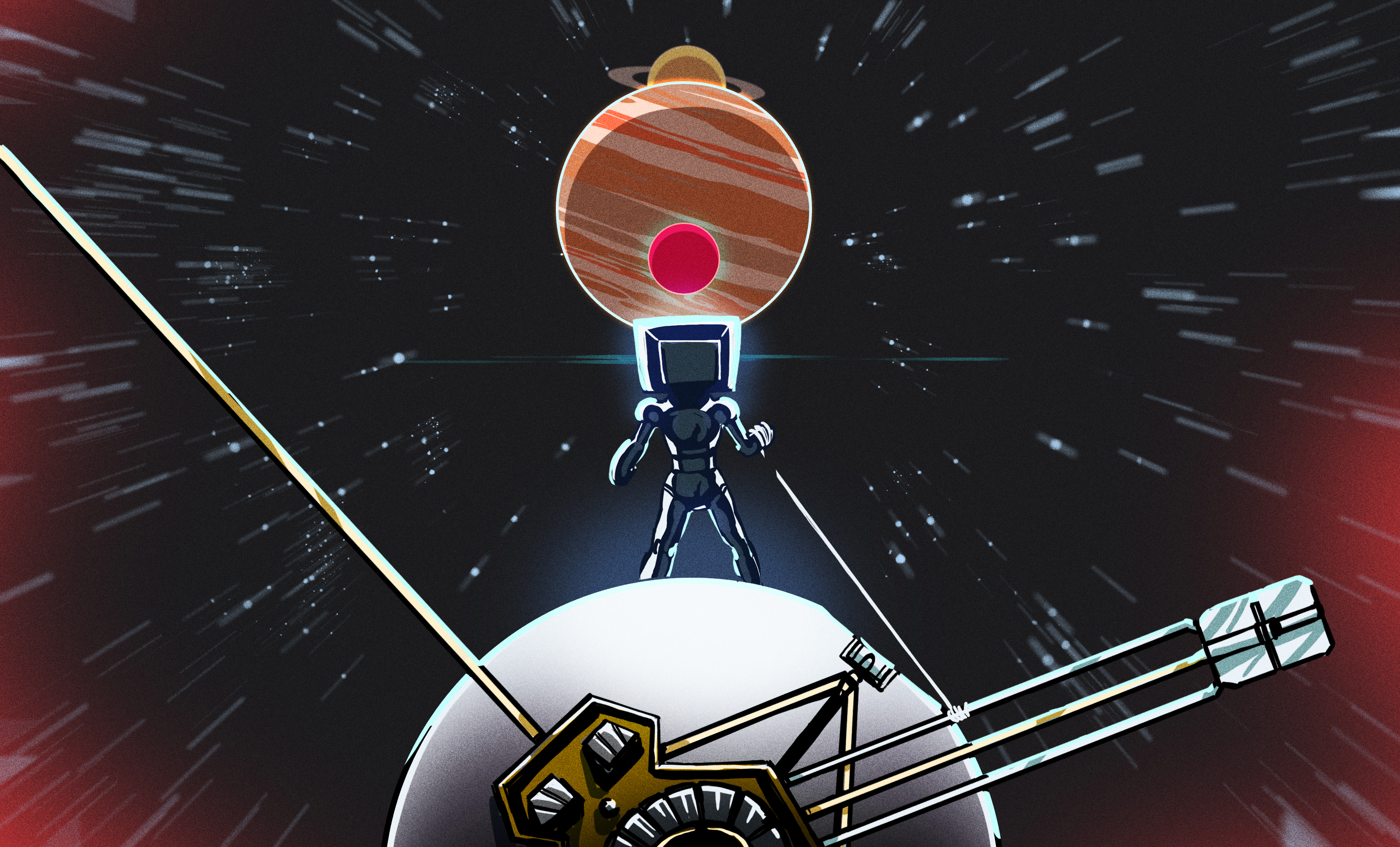
Pioneer 10 launched on March 2, 1972, from Cape Canaveral aboard an Atlas-Centaur rocket. NASA designed it as the first mission to the outer planets, and it quickly began collecting records like a kid grabbing stickers at a science fair. It became the first spacecraft to fly beyond Mars, the first to pass through the main asteroid belt, the first to fly by Jupiter, and the first spacecraft placed on a trajectory to escape the solar system.
The asteroid belt crossing was a major test. If dust and rocks were dense enough to shred a spacecraft, the dream of outer planet exploration would need a serious rethink. Instead, Pioneer 10 found that the belt was far more navigable than feared. It encountered dust and small particles, but not the Hollywood-style wall of doom. That one result alone helped open the door for Voyager and later deep-space missions.
Then came Jupiter. In December 1973, Pioneer 10 made its closest approach to the giant planet at roughly 81,000 miles from the cloud tops. By then, command-and-response time between Earth and spacecraft was around 92 minutes. That meant controllers could not joystick the probe like a remote-control car. Every command had to be planned, tested, timed, and sent with discipline. Spacecraft operations were less like gaming and more like mailing instructions to a submarine on another planet, except the submarine is moving at tens of thousands of miles per hour and the planet can fry electronics.
The Engineering Hack: Simplicity as Survival Strategy
Pioneer 10 and Pioneer 11 were marvels of deliberate restraint. Each spacecraft weighed about 570 pounds, used a large high-gain antenna, and relied on radioisotope thermoelectric generators, or RTGs, for electrical power. At launch, the RTGs produced about 155 watts. That is less than many modern gaming PCs use while deciding whether to install another update. Yet the Pioneers used that modest power supply to run instruments, maintain communications, and keep essential systems alive millions and eventually billions of miles from Earth.
The spacecraft were spin-stabilized. Instead of using complex systems to constantly point in all directions, they rotated like carefully controlled tops. This helped maintain orientation and simplified the design. Their large dish antennas were aimed back toward Earth, and many operations were controlled from the ground through NASA’s Deep Space Network.
This was one of the great “hacks” of the Pioneer missions: put as much complexity as possible on Earth, where engineers could think, calculate, and troubleshoot, and keep the spacecraft as rugged as possible. The onboard computer capability was extremely limited by modern standards. Your smartwatch would look at Pioneer’s computing power and politely ask, “Is this a museum exhibit?” Yet the design worked because the mission architecture matched the technology of the time.
Jupiter: Beautiful, Huge, and Very Rude to Electronics
Jupiter was the biggest test. Pioneer 10 measured the planet’s magnetosphere, radiation belts, atmosphere, moons, and solar-wind environment. It returned about 500 images of Jupiter and its surroundings, including views far better than Earth-based telescopes could provide at the time. The mission showed the Great Red Spot in new detail and gathered data that helped scientists understand Jupiter as a dynamic, powerful world rather than simply a bright object in the night sky.
But Jupiter did not roll out a welcome mat. Its radiation damaged Pioneer 10’s imaging photopolarimeter before all planned observations could be completed. The spacecraft still achieved its main goals, but the encounter proved exactly why a pathfinder was needed. Engineers learned that future spacecraft would need better radiation planning, careful trajectories, and realistic expectations about what Jupiter could do to instruments.
In other words, Pioneer 10 was the brave friend who tries the suspiciously spicy sauce first so everyone else can decide how much water to order.
Pioneer 11: The Follow-Up That Went Even Farther
Pioneer 11 launched on April 6, 1973, as Pioneer 10’s sister spacecraft. It followed the same basic design but had a different destiny. After traveling through the asteroid belt, it flew by Jupiter in December 1974. Its Jupiter encounter was closer than Pioneer 10’s, passing about 26,400 miles from the cloud tops. That close approach was not just for sightseeing. Pioneer 11 used Jupiter’s gravity to change course and head toward Saturn.
This was another elegant hack: use a planet as a free engine. Gravity assist does not violate physics; it simply borrows a tiny bit of orbital energy from a massive planet. Jupiter did not notice. Pioneer 11 absolutely did.
During its Jupiter flyby, Pioneer 11 returned the first images of Jupiter’s polar regions and gathered valuable data about the magnetosphere and moons. Then it spent years crossing the solar system toward Saturn, sharpening its course with midcourse corrections along the way.
Saturn Gets Its First Visitor
On September 1, 1979, Pioneer 11 became the first spacecraft to fly by Saturn. It passed within about 13,000 miles of the planet and crossed Saturn’s ring plane beyond the outer visible rings. The mission confirmed important details about Saturn’s magnetic field, measured temperatures, studied Titan, photographed the ring system, and discovered Saturn’s narrow F ring along with a small moon.
For later missions, this was priceless. Voyager 1 and Voyager 2 were already on their way, and Pioneer 11 helped reduce uncertainty. It acted like a scout walking ahead on a trail and yelling back, “There are rings here, the terrain is weird, and you should definitely watch your step.”
Pioneer 11’s Saturn flyby also demonstrated how a relatively small spacecraft could deliver civilization-changing science. The images may look modest compared with modern spacecraft photography, but in 1979 they were historic. Humanity had finally seen Saturn up close through a machine built on Earth, launched by a chemical rocket, and guided across billions of miles with math, patience, and radio waves.
The Pioneer Plaque: A Message in a Cosmic Bottle
Both Pioneer 10 and Pioneer 11 carried plaques designed as messages for any intelligent life that might someday encounter them. The idea was associated with Carl Sagan, Frank Drake, and Linda Salzman Sagan. The plaques showed human figures, the spacecraft for scale, a diagram of hydrogen, the solar system, and a pulsar map intended to locate Earth in the galaxy.
Realistically, the chance of either spacecraft being found is extremely small. Space is not merely big; it is aggressively, comically, insultingly big. If the solar system were a neighborhood, the Pioneers are not drifting down the next street. They are wandering into a dark continent with a postcard taped to their jackets.
Still, the plaque mattered. It transformed a scientific spacecraft into a cultural artifact. Pioneer was not only measuring radiation and magnetic fields. It was carrying a statement: “We were here. We wondered. We built things. We had questionable haircuts in the 1970s, but we meant well.”
Power, Distance, and the Slow Fade
Pioneer 10 was originally designed for a 21-month mission, but it continued operating far beyond expectations. NASA maintained routine contact until 1997, and the spacecraft sent its last telemetry in 2002. Its final faint signal reached Earth in January 2003, when it was about 7.6 billion miles away. That signal took more than 11 hours to arrive.
Pioneer 11 also outlived its original mission goals. NASA Ames made last contact with Pioneer 11 in 1995, and the spacecraft is now silent, coasting outward. Pioneer 10 is headed generally toward Aldebaran in Taurus, though it will take more than two million years to get there. Pioneer 11 is traveling in a different direction and will pass near a star in Aquila in about four million years.
The end of communication was not dramatic. No explosion. No heroic final speech. Just power slowly declining as the RTGs aged, until the transmitters could no longer speak loudly enough for Earth to hear. It was less “farewell, brave explorer” and more “the battery icon finally hit zero after three decades.”
The Pioneer Anomaly: When the Data Looked Weird
Even after their planetary encounters, the Pioneer spacecraft kept contributing to science. One of the most famous later puzzles was the Pioneer anomaly. Scientists noticed that the spacecraft seemed to be slowing slightly more than expected. For a while, this raised fascinating questions. Was there unknown physics? A problem in the models? Tiny forces engineers had underestimated?
The eventual explanation was beautifully practical: uneven heat radiation from the spacecraft produced a tiny force. Heat leaving the vehicle in one direction nudged it in the other. The effect was small, but over long distances and long times, small things matter. Deep-space navigation is the art of caring about numbers so tiny that normal people would use them only to avoid splitting a restaurant bill.
What the Pioneer Missions Taught Future Explorers
The Pioneers helped prove that the asteroid belt could be crossed, Jupiter could be survived, gravity assists could be used for ambitious outer-planet trajectories, and small spacecraft could return enormous scientific value. They influenced the planning of Voyager and helped build confidence in deep-space mission design.
They also taught a broader engineering lesson: reliability is not magic. It is architecture, discipline, testing, and humility. The Pioneer teams knew they were sending machines into environments they did not fully understand. So they built conservatively, planned carefully, and left room for adaptation. When problems appeared, mission controllers worked around them. When power declined, they prioritized. When instruments failed, they squeezed science from what remained.
Experiences and Lessons from “Hacking When It Counts”
The phrase “hacking when it counts” applies far beyond space exploration. The Pioneer missions are a masterclass in how to solve hard problems when resources are limited and consequences are real. In everyday life, most people do not need to guide a spacecraft past Jupiter. But many people do face Pioneer-like situations: a project deadline, a broken system, a limited budget, a tool that is not ideal, or a plan that suddenly meets reality and loses a few bolts.
The first lesson is to reduce complexity before complexity reduces you. Pioneer did not succeed because it had unlimited computing power. It succeeded because its design was understandable, rugged, and matched to the mission. That is a useful mindset for engineers, writers, business owners, students, and anyone trying to build something that must work under pressure. Fancy features are fun until they become failure points. A simple system that works is better than a brilliant system that needs constant emotional support.
The second lesson is to prepare for delayed feedback. Pioneer controllers could not instantly correct a mistake near Jupiter because radio signals took more than an hour to complete a round trip. That forced careful thinking before action. In modern work, we often expect instant responses, instant analytics, instant results, and instant coffee strong enough to see through time. But important decisions still benefit from Pioneer-style planning: simulate the outcome, check the assumptions, and remember that some errors cannot be fixed quickly once launched.
The third lesson is to treat constraints as design partners. The Pioneers had limited power, limited memory, limited computing, and limited bandwidth. Instead of pretending those limits did not exist, engineers designed around them. That mindset is powerful. A small team can outperform a large one if it understands its constraints. A modest website can beat a bloated one if it loads quickly and serves readers well. A student with limited time can still do excellent work by focusing on the highest-value tasks first.
The fourth lesson is to keep collecting value after the “main mission” ends. Pioneer 10’s primary mission was Jupiter, but it kept sending useful information for decades. That is a beautiful reminder that good work can have a long tail. A research project can become a teaching resource. A prototype can become a platform. A failed plan can become the data that makes the next plan succeed. The Pioneers were not disposable fireworks; they were durable learning machines.
The fifth lesson is cultural: send a message with your work. The Pioneer plaque did not help the spacecraft navigate, measure radiation, or survive the cold. Yet it gave the mission human meaning. The best technical projects often carry a message beyond their specifications. They say something about curiosity, courage, cooperation, and imagination. Whether you are building a spacecraft, writing software, designing a classroom lesson, or repairing a machine in your garage, the work can say: “Someone cared enough to make this better.”
Finally, the Pioneer missions remind us that exploration is not always sleek. Sometimes it is awkward, underpowered, patched together, and held together by careful math and stubborn hope. That does not make it less heroic. It makes it more human. Pioneer 10 and Pioneer 11 were not perfect machines. They were practical machines sent into impossible distances by people who knew they did not have all the answers. And when the answers mattered, they hacked wisely.
Conclusion: Why the Pioneer Missions Still Matter
The Pioneer missions changed space exploration by proving that humanity could send machines beyond Mars, through the asteroid belt, past Jupiter, and onward toward the stars. Pioneer 10 and Pioneer 11 were scouts, test pilots, science labs, engineering experiments, and cosmic messengers all at once. They helped prepare the way for Voyager and every ambitious deep-space mission that followed.
Their legacy is not only in the data they returned, but in the attitude they represent. Build lean. Think clearly. Expect trouble. Use physics creatively. Keep communicating as long as the power holds out. And when you send something into the unknown, make it good enough that even after it falls silent, it still tells a story.