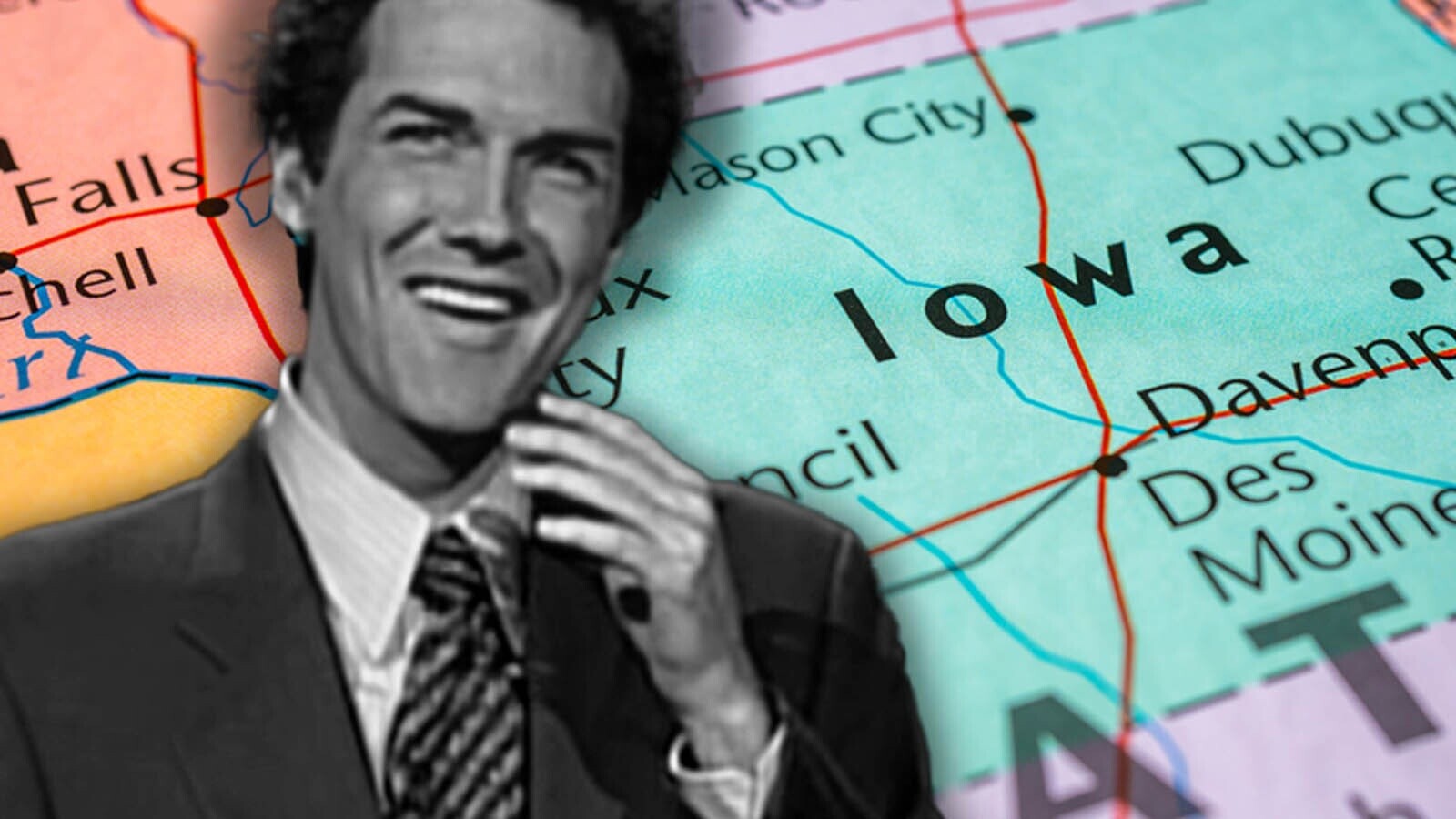
There are comedy legends, and then there are comedy legends so absurd they sound like they were invented by a half-drunk road comic at 1:12 a.m. in the back booth of a club bar. Norm Macdonald getting “kicked out of the state of Iowa” belongs firmly in that second category. It has all the right ingredients: a charity event, a crowd expecting something fairly safe, a headliner who treated the assignment like a dare, and an aftermath so dramatic it has been retold for decades with the energy of a campfire story that keeps finding new campers.
But here’s the funny thing about this funny disaster: the title makes it sound like one nuclear-grade punchline detonated over corn country and sent Norm flying across the border. Real life was messier, funnier, and somehow even more Norm. The Iowa meltdown was not about a single dirty joke. It was about an entire set that ignored the room, ignored the brief, ignored common sense, and then practically winked while the audience headed for the exits.
If you want the clean version, this is not that article. If you want the real version, welcome. Because the story of Norm Macdonald in Iowa says almost everything you need to know about him: he was brilliant, stubborn, reckless, impossible to manage, and often funniest precisely when everyone around him wished he would please, for the love of all that is decent, stop talking.
What Actually Happened in Iowa?
On June 22, 1997, Norm Macdonald performed at Hancher Auditorium at the University of Iowa as part of entertainment tied to the AEGON Advantage Golf Tournament, a fundraising event connected to the university’s athletic department. This was not some midnight comedy cellar packed with people who had already agreed to be spiritually punched in the face. It was a public-facing charity event with families in attendance, teenage kids in the room, corporate guests, and a general expectation that the night would land somewhere between Saturday Night Live mischievous and country-club safe.
Also on the bill were fellow SNL names Jim Breuer and Darrell Hammond, along with Comedy Sportz. That lineup likely helped create the fatal misunderstanding. To many ticket buyers and organizers, these were television comedians. Familiar comedians. NBC comedians. The kind of comedians who, in theory, would show up, do voices, do some broad material, maybe a few weird observations, collect applause, and then politely wake up for golf.
Norm Macdonald, of course, interpreted the evening in his own dialect. And Norm’s dialect was not family programming. It was deadpan misbehavior with a passport stamp from the land of “let’s see how long I can keep this going.”
The Set That Blew Up the Room
Contemporaneous coverage from Iowa made clear that the controversy was not vague or exaggerated. Macdonald’s set reportedly included repeated profanity, material about masturbation, jokes about gay sex, and jokes involving women having sex with pigs. That last category is important because it helps explain why the legend of “the raunchy joke” stuck around. Later retellings, including comics swapping road stories, often boiled the whole scandal down to bestiality material. That was the radioactive center of the incident, even if the explosion came from the entire routine.
According to reporting at the time, about 80 percent of the roughly 1,300-person audience left during Macdonald’s set. Think about that for a second. Eighty percent. Not mild discomfort. Not a few offended donors gathering their wraps in a huff. A crowd evacuation. Parents led teenagers out of the auditorium. Athletic department officials reportedly considered pulling him off the stage. And yet, in a detail that feels exquisitely Norm, many of the people who stayed laughed and applauded. Even on the night he turned a fundraiser into a public relations tire fire, he still had his people.
Macdonald did not exactly try to calm the room. As audience members walked out, he reportedly cracked wise about whether they expected him to talk about losing his luggage at the airport. That line matters because it reveals the whole operating system. Norm was not misunderstanding the discomfort. He was enjoying it. Or at the very least, he was refusing to rescue anybody from it.
Was He Literally “Kicked Out of Iowa”?
Not in the formal, border-patrol, “sir, hand over your state privileges” sense. Iowa did not build a giant corn-powered catapult and launch Norm Macdonald back to Canada. But the phrase survives because something close enough happened to make the legend stick.
After the performance, University of Iowa athletics officials publicly apologized. Athletic director Bob Bowlsby blasted the act as profane, vulgar, and off-color. Organizers also withdrew Macdonald’s invitation to participate in the golf outing the next day. In other words, he was not literally exiled from Iowa, but he was absolutely told, in institutional language, “Thank you for your interest in this event. Please do not come to the golf course.”
That bureaucratic rebuke later became comedy folklore. Jim Breuer would go on to tell the story as Norm getting “kicked out of the state.” That phrasing is too funny and too perfectly oversized not to survive. It transforms a university embarrassment into a myth. And Norm, more than most comedians, seemed built for myth. He was a man who could turn a bad booking into a folk tale.
The Real Problem Was the Booking
Part of what makes the Iowa incident so enduring is that both sides look a little ridiculous. Macdonald clearly ignored the tone of the event. But the people who booked him also seem to have mistaken “famous from television” for “appropriate for a mixed crowd at a fundraiser.” Those are not the same thing, and they were especially not the same thing in the 1990s, when stand-up could be significantly bluer, stranger, and meaner than network sketch comedy.
Later Iowa retrospectives noted that the contract expectations reportedly called for a more family-friendly performance without sexual material or profanity. Whether Macdonald blew past those terms out of boredom, contempt, or sheer comic perversity is impossible to prove. But the available reporting points in the same direction: the event wanted mainstream; Norm delivered grenade.
Why This Story Feels So Incredibly Norm
Because Norm Macdonald spent much of his career acting like career advice was a rumor started by cowards.
He was one of the great deadpan comics of his era, a performer whose genius came partly from making the wrong choice at exactly the right moment. He could tell a joke too long, too dark, too old-fashioned, or too dumb-looking on paper, then somehow make it land because he understood tension better than almost anyone. Watching Norm was often less like hearing a comedian deliver material and more like watching a man test the structural integrity of a room.
That quality made him beloved by comics and unpredictable to institutions. On Weekend Update, he brought a stripped-down, punky bluntness that helped define the segment in the 1990s. Offstage, he developed a reputation for saying the thing a manager, network executive, or sensible adult would beg him not to say. He seemed uninterested in smoothing the edges that made him singular. In fact, he often looked suspicious of success whenever it arrived in a conventional package.
The Iowa story fits neatly into that pattern. He was invited to perform at an event built on comfort, decorum, and donor friendliness. Instead of adapting, he became more himself. Too much himself, depending on your perspective. But that is exactly why the story lasted. If he had shown up and done a nice, harmless 25 minutes, nobody would remember a thing except maybe the chicken dinner.
The Joke Was Dirty, But the Bigger Punchline Was the Mismatch
Headlines love to frame the episode as “the raunchy joke” that got him booted from Iowa. But the more accurate punchline is this: Norm Macdonald got in trouble because he performed like Norm Macdonald in a venue that had accidentally booked an idea of Norm Macdonald.
That difference matters. The TV version was recognizable and odd. The stand-up version could be harsher, more profane, and more willing to linger in taboo territory just to see what kind of electricity it created. This was a comedian who could build an entire bit out of discomfort and then stand there with the face of a substitute teacher explaining long division. He had the innocence of a choirboy and the instincts of a pyromaniac.
In that sense, Iowa became a perfect collision between image and reality. The university and donors likely expected a celebrity comedian. What they got was a comic’s comic, which is sometimes another way of saying, “the exact wrong man for a polite event, and therefore strangely the most memorable possible choice.”
How the Iowa Incident Became Comedy Lore
Most entertainment scandals fade. This one aged into legend because it had replay value. Local Iowa writers revisited it. Fans shared the old reporting like contraband treasure. Comics told the story onstage and in interviews. Later profiles even noted that Macdonald kept a letter in his office withdrawing his invitation to the University of Iowa golf event, as if the whole thing had graduated from embarrassment to souvenir.
That detail feels almost too on-brand to be real, which is precisely why it sticks. Norm collected absurdity the way some people collect stamps. A formal letter disinviting him from a golf outing after he detonated a fundraiser? That is not just fallout. That is décor.
And over time, the Iowa story started to represent something bigger than one ugly, hilarious booking mistake. It became a summary of Macdonald’s comic DNA. He was not a smooth operator. He was not a crowd-pleaser in the ordinary sense. He could absolutely destroy, but sometimes he also seemed delighted by the possibility of destroying the wrong way.
What It Must Have Felt Like in the Room
This is where the story gets especially vivid. Later recollections from people who were there describe the feeling not simply as offense, but as disbelief. One attendee remembered people streaming out in waves while others stayed behind because they could sense they were witnessing something unforgettable, even if they were not sure whether it was genius, sabotage, or a man making the wildest professional decision of his week.
That is the unique live-wire experience of Norm Macdonald. A lot of comedians want your approval. Norm often seemed more interested in your attention, and those are not the same thing. Approval is neat. Attention is electric. Approval gets applause. Attention gets a story you tell for 25 years.
The people who walked out probably experienced the set as a disaster. The people who stayed experienced it as something rarer: an authentic comic event, messy and badly matched and maybe wildly inappropriate, but undeniably alive. And live comedy, at its most memorable, is not always pleasant. Sometimes it feels like watching a high-wire act where the performer keeps looking down just to make you panic.
Five Hundred More Words on the Experience of Watching Norm Be Norm
To understand why the Iowa story refuses to die, you have to think less like a scandal archivist and more like someone who has ever sat in a room while a comedian decides, in real time, that the safe path is for other people. That is what people were really seeing that night. Not just dirty material. Not just a booking error. They were seeing a performer pick danger over approval.
Accounts from people who were there suggest the room kept dividing itself into tribes by the minute. One tribe believed the show had become an offense against civilization. Another believed they were watching one of the funniest disasters in Iowa history. That split is almost the essence of Norm Macdonald’s appeal. He could make one side of a room furious and the other side feel lucky, sometimes with the exact same sentence.
There is also something deeply theatrical about the way the event unfolded. The earlier acts had warmed up the audience. The crowd was primed. The night had structure. Then Norm arrived and treated the structure like an inconvenience. You can almost feel the temperature shift: first the uneasy laughter, then the scattered groans, then the parent-body language of “we are leaving now,” then the mass migration. It is part stand-up show, part social experiment, part accidental performance art.
And yet the most revealing detail may be that plenty of people who remained were still laughing. That matters because it keeps the story from becoming too tidy. This was not a simple morality play where the wicked comic offended the innocent crowd. It was a collision between incompatible expectations. For some people, the set was beyond the pale. For others, it was outrageous in the old stand-up-club sense: too filthy, too fearless, too ridiculous not to admire at least a little.
That is why attendee recollections have such a strange tone even years later. They often sound half-shocked, half-delighted. One man who attended with family later described the evening less like trauma and more like being present for a piece of comic folklore before anyone knew it was folklore. That feeling is hard to fake. People know when they are watching something polished. They also know when they are watching something alive enough to become legend.
The Iowa incident also resembles later Norm appearances that fans treasure for exactly the same reason. Think of his late-night spots where a simple setup turned into a shaggy-dog odyssey. Think of the famous moth joke, where the pleasure came not from speed or cleverness but from the stubbornness of the detour. Watching Norm was often an exercise in surrender. You stopped asking whether he was helping himself and started asking whether he was making something more interesting than good career decisions.
That experience can be exhilarating or maddening depending on where you are sitting, who you came with, and whether there are donors nearby. In Iowa, there were definitely donors nearby. There were also kids, expectations, institutional dignity, and the kind of event planning language that dies instantly when exposed to a comedian with an appetite for mayhem. Norm stepped into that world and behaved as if no one had explained where he was. Or worse for the organizers, as if everyone had explained it and he found that explanation funny.
So the lasting experience of “The Raunchy Joke That Got Norm Macdonald Kicked Out of the State of Iowa” is not merely the shock of vulgar material. It is the memory of watching a room discover, in stages, that Norm Macdonald was not there to be convenient. He was there to be Norm Macdonald. In comedy, that can be expensive, inappropriate, unforgettable, or all three at once. In Iowa in 1997, it was definitely all three.
Conclusion
The Iowa story endures because it is both outrageous and clarifying. The so-called raunchy joke was really a whole raunchy set, and the so-called expulsion from Iowa was really a public apology plus a rescinded golf invitation. But the exaggeration survives because it captures the emotional truth. Norm Macdonald did not merely offend a crowd. He turned a respectable charity evening into a comedy legend.
And maybe that is the cleanest summary of his career. Norm was rarely the guy institutions wanted after they had fully thought things through. But he was often the guy people remembered longest. The University of Iowa wanted a celebrity comic. Instead, it got a perfect Norm Macdonald story. Which, depending on your tolerance for chaos, was either a catastrophe or a gift.