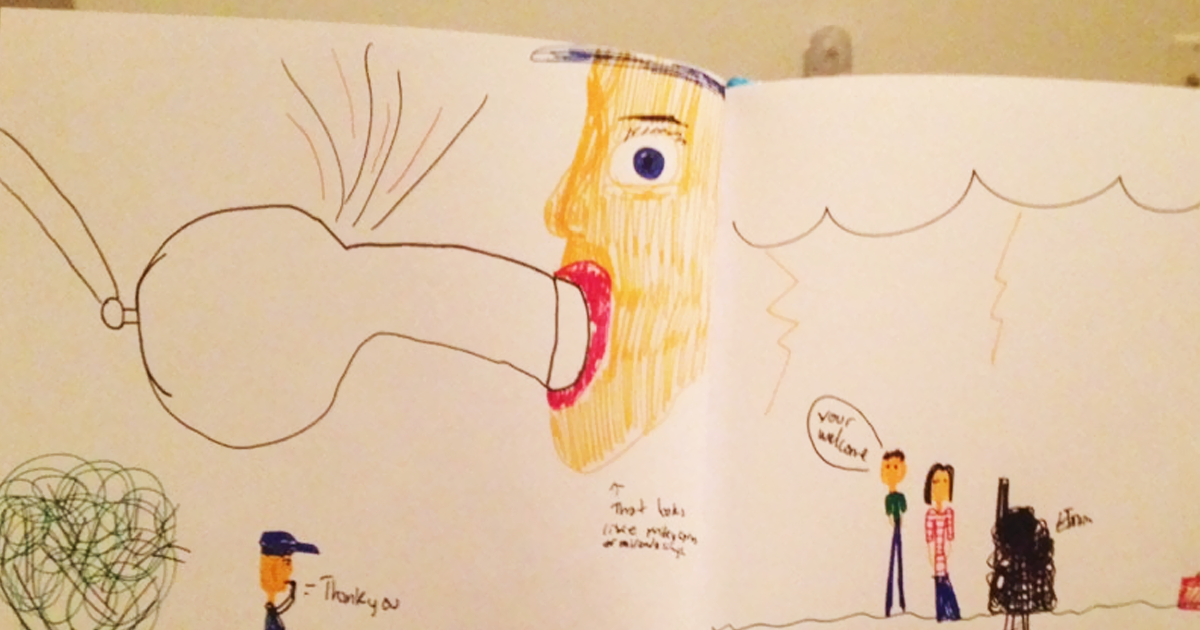
Every parent knows the sacred refrigerator gallery: a crooked sun, a floating house, a family portrait where Dad has seven fingers and the dog looks like a potato with anxiety. Then, once in a while, a child proudly hands over a masterpiece that makes every adult in the room pause, blink twice, and whisper, “I know what you meant… but that is not what you drew.”
That is the magic behind 64 hilariously inappropriate kids’ drawings. These are not “bad” drawings. They are innocent kid art, filtered through tiny hands, developing motor skills, fearless imagination, and absolutely zero concern for adult double meanings. A child sees a whistle, a rocket, a microphone, a giraffe, a snow shovel, or a birthday candle. Adults see something else because our brains are messy filing cabinets with questionable labels.
This article takes a family-safe, good-natured look at why funny kids’ drawings go viral, why children create unintentionally awkward art, and how parents can laugh without making kids feel embarrassed. Because honestly, if a six-year-old draws a horse that looks like a vacuum cleaner wearing legs, the correct response is not an art critique. It is admiration, documentation, and maybe a quiet laugh in the hallway.
Why Kids’ Drawings Accidentally Look Inappropriate
Children draw what they understand, not what adults expect. Their brains are still learning proportion, perspective, spacing, symbols, and how to make a crayon obey basic laws of physics. That is why a family portrait might include one giant head, four floating arms, and a cat the size of a school bus. It is not surrealism. It is Tuesday in kindergarten.
Young children often focus on the most important feature of an object. If a dog has a long tail, the tail becomes enormous. If a firefighter has a hose, the hose becomes the star of the drawing. If a teacher has big glasses, congratulations, the glasses now occupy 80 percent of the page. This is how innocent child art turns into accidental comedy.
There is also the problem of shape overlap. A rocket, a candle, a garden hose, a microphone, a banana, a tower, and a poorly drawn snowman can all become suspicious when placed at the wrong angle. Children do not know that adults may read those shapes differently. They are too busy deciding whether the sun needs eyelashes.
The 64 Funniest Types of Inappropriate Kids’ Drawings
Instead of copying real children’s artwork, here is an original, family-safe tour of the kinds of drawings that commonly make parents laugh, teachers cough politely, and grandparents suddenly need their reading glasses.
1-16: Everyday Objects Gone Wild
- A microphone that looks more dramatic than the school concert required.
- A rocket ship with fins placed in deeply unfortunate locations.
- A garden hose drawn with heroic confidence and questionable proportions.
- A birthday candle that seems to have skipped birthday etiquette class.
- A lighthouse that accidentally becomes the most awkward building in town.
- A snow shovel held at an angle that causes immediate parent panic.
- A toothbrush so large it deserves its own dental insurance.
- A banana that raises more questions than a banana should.
- A whistle that looks innocent until an adult brain ruins the moment.
- A telescope pointed at the moon but shaped like a school-office incident report.
- A hot dog with legs, arms, and far too much personality.
- A vacuum cleaner hose drawn like a mysterious creature from the basement.
- A thermometer that looks like it belongs in a comedy sketch.
- A rolling pin that appears to be threatening the cookie dough.
- A cactus that somehow looks guilty.
- A trophy that makes the soccer coach quietly turn the paper sideways.
17-32: Animals With Design Problems
- A giraffe with a neck that exits the body like bad plumbing.
- A dog whose tail begins where no tail should begin.
- A cat with whiskers so intense it looks like a secret agent.
- A horse with legs attached by pure optimism.
- A duck that looks like a banana got promoted.
- A fish with a smile so wide it becomes mildly unsettling.
- A snake wearing a hat and creating confusion at every angle.
- A turtle with a shell that resembles a lumpy couch.
- A dinosaur whose tiny arms somehow become the entire joke.
- A rabbit with ears taller than the house beside it.
- A cow with spots placed with maximum chaos.
- A chicken that appears to be yelling at taxes.
- A frog with eyes floating independently from its face.
- A lion whose mane looks like spaghetti after recess.
- An elephant trunk drawn with too much enthusiasm.
- A butterfly that looks like a pair of flying socks.
33-48: Family Portraits That Reveal Too Much
- Mom drawn asleep on the couch with the label “Mom is tired again.”
- Dad drawn “fixing the sink” while water explodes everywhere.
- Grandpa drawn with giant ears because “he hears snacks opening.”
- A sibling drawn tiny because “he is annoying but small.”
- A baby drawn as a circle with noise lines.
- A family dinner where everyone looks happy except the broccoli.
- A parent drawn holding coffee like it is a survival tool.
- A teacher drawn with superhero muscles and a very tired face.
- A babysitter drawn as a queen because she allows extra crackers.
- A family car trip where one child labels the back seat “the yelling zone.”
- A school picture where the principal has monster eyebrows.
- A pet portrait where the dog is bigger than the adults.
- A dentist drawn as a smiling villain with helpful intentions.
- A doctor drawn with a stethoscope that looks like tangled headphones.
- A parent labeled “boss of vegetables.”
- A sibling portrait titled “My Brother Being Weird,” which is legally accurate in many homes.
49-64: Words, Labels, and Spelling Accidents
- A “beach day” label with one missing letter and a lot of classroom silence.
- A “cook” label where the letters lean dangerously close together.
- A “sheet” of paper spelled in a way that alarms the teacher.
- A “duck” that loses its first letter and becomes a hallway emergency.
- A “class trip” caption where spacing creates accidental drama.
- A “public library” sign with letters squeezed into chaos.
- A “best friend” note that accidentally reads like a resignation letter.
- A “happy birthday” banner missing enough letters to become mysterious.
- A “fire truck” with the truck part doing too much work.
- A “school bus” with wheels bigger than the building.
- A “grandma’s pie” label attached to something that looks like a UFO.
- A “family rules” poster where the biggest rule is “no screaming,” written in screaming letters.
- A “quiet corner” sign decorated with explosions.
- A “nice monster” that looks like it has legal problems.
- A “rainbow” with one color labeled “angry blue.”
- A self-portrait titled “Me Being Normal,” which usually means the opposite.
What Makes These Drawings So Funny?
The comedy comes from the gap between a child’s intention and an adult’s interpretation. Kids are literal. Adults are layered. A child draws a long shape because the object is long. An adult sees the drawing, remembers every awkward joke ever told in human history, and immediately loses the ability to behave normally.
Funny kid drawings also work because children are brutally honest. They draw Dad with a round belly because Dad has a round belly. They draw Mom with huge eyes because Mom “sees everything.” They draw Grandma with a giant purse because Grandma’s purse contains snacks, tissues, receipts, mystery candy, and possibly the original Constitution. Children are not trying to be rude. They are reporting from the front lines of observation.
Another reason these drawings are funny is that kids are still mastering visual planning. A child may start drawing a person, run out of room, and simply attach the legs to the ears. Problem solved. Adults may call it anatomically confusing; the child calls it done. In a world full of perfection pressure, that confidence is refreshing.
Why Parents Should Laugh Kindly, Not Cruelly
There is a big difference between laughing at the situation and laughing at the child. The best response to an awkward drawing is gentle curiosity: “Tell me about your picture.” That one sentence can save everyone. The child may explain that the strange-looking object is a trumpet, a tree branch, a submarine, or “a machine that makes pancakes for astronauts.” Suddenly, the drawing makes perfect sense, at least by kindergarten logic.
Parents should avoid saying, “That looks wrong,” or “You drew something inappropriate.” Children may not understand the adult meaning, and unnecessary embarrassment can make them feel nervous about creating. A better approach is to enjoy the creativity, ask questions, and only redirect if the drawing was intentionally mean, unsafe, or hurtful.
In classrooms, teachers often understand this better than anyone. They have seen hundreds of innocent drawings turn into accidental comedy. The professional teacher move is simple: praise the effort, ask for the story, and quietly place the paper in the take-home folder before the staff room sees it and collapses into laughter.
The Developmental Side of Funny Kids’ Art
Behind every wobbly drawing is real development. Drawing helps children practice fine motor control, hand-eye coordination, planning, memory, language, and emotional expression. When children draw, they are not just making marks; they are organizing ideas. A scribble may represent a storm. A circle may be a face. A rectangle may be a house, a bus, or “the place where cookies live.”
Young children also use art to tell stories before they can fully explain those stories in words. That is why asking about the picture matters. The drawing may look like random lines to an adult, but to the child it may contain a full adventure: the dog ran away, the superhero saved the pizza, and the moon needed a hat because space was chilly.
This is also why process matters more than product. A perfect coloring-page result is not always more valuable than a messy, original drawing. The messy drawing shows decision-making. It shows experimentation. It shows the child learning that a blank page can become anything, even if that anything looks like a confused potato wearing shoes.
How to Share Funny Kids’ Drawings Responsibly
Because funny children’s drawings often spread online, parents should think carefully before posting. A drawing may be hilarious, but the child is still a real person with feelings and a future. If the art includes the child’s full name, school name, location, or private family details, crop or cover that information. Better yet, ask older children for permission before sharing their work.
It is also smart to keep captions kind. A caption like “My kid made this innocent drawing and I can’t stop laughing” feels affectionate. A caption that mocks the child feels different. The internet is already loud enough; children’s creativity does not need to become a public roast.
For publishers, bloggers, and social media pages, the best approach is to focus on the universal humor: the double take, the innocent explanation, the wildly confident spelling, and the charming gap between intention and result. That keeps the topic funny without becoming mean or uncomfortable.
What Parents Can Do With These Masterpieces
First, save the best ones. A folder of funny kids’ drawings becomes priceless later. Today it is a confusing picture of a “fire truck.” Ten years from now it is family treasure. You may forget the exact day, but you will remember the laugh.
Second, write the child’s explanation on the back. This is crucial. Without context, future adults may stare at the page like archaeologists decoding a crayon civilization. With context, the drawing becomes a tiny story from childhood.
Third, celebrate the creativity. Say things like, “I love how much detail you added,” “Tell me what is happening here,” or “You worked hard on this.” These comments encourage effort without pretending the drawing is museum-ready. Although, to be fair, some modern art museums have displayed stranger things with better lighting.
Personal Experience: What These Drawings Teach Adults
The funniest thing about inappropriate kids’ drawings is that they often reveal more about adults than children. A child draws a tall oval with two circles and proudly announces, “It’s a rocket going to space.” The adults exchange glances like they have just witnessed a legal problem. But the child is not being inappropriate. The child is being efficient. Rockets are tall. Space is up. Case closed.
Anyone who has spent time around children has seen this happen. A child creates a birthday card for a parent, and the cake looks like a volcano. A classroom poster about healthy habits includes a toothbrush shaped like a microphone from a very suspicious talent show. A drawing of a firefighter becomes dominated by one enormous hose because, in the child’s mind, the hose is the exciting part. Adults may giggle, but the child’s logic is perfectly clean.
These moments are a reminder that children are not miniature adults. They do not carry the same cultural references, awkward associations, or social filters. They are learning through shapes, symbols, and stories. Their artwork is not polished because their thinking is still expanding. That is what makes it wonderful. Every odd proportion is a clue. Every strange label is a language experiment. Every accidentally hilarious drawing is a snapshot of a brain building its own map of the world.
There is also something refreshing about the confidence children bring to art. Adults hesitate. We worry whether something is good enough, neat enough, realistic enough, or worthy of being shown. Children just grab the purple marker and begin. If the dog has six legs, maybe it runs faster. If the sun is green, maybe it is a special alien sun. If Mom’s hair takes up half the page, maybe Mom had a big-hair day and history demanded accuracy.
Parents can learn from that freedom. The goal is not to turn every child into a professional artist. The goal is to give children room to observe, imagine, explain, and laugh. The awkward drawings are part of the process. They show courage, experimentation, humor, and the beautiful lack of self-consciousness that many adults spend years trying to recover.
So the next time a child hands you a picture that makes you nearly choke on your coffee, pause before reacting. Ask what it is. Listen to the story. Compliment the effort. Then, when the child runs off to draw a dragon wearing roller skates, quietly take a photo for the family archive. One day, that strange little drawing may become the funniest, sweetest proof that childhood was happening in full color.
Conclusion
64 hilariously inappropriate kids’ drawings are funny because they are innocent, unexpected, and wildly creative. They remind us that children see the world differently: more directly, more imaginatively, and with far fewer worries about adult interpretation. A drawing that makes grown-ups laugh may simply be a rocket, a whistle, a dog tail, or a very ambitious banana.
The best way to enjoy funny kids’ drawings is with kindness. Laugh at the accidental double meaning, not the child. Ask for the story behind the picture. Save the masterpiece. Celebrate the effort. Childhood art is messy, honest, and occasionally so awkward that it deserves its own comedy award. And that is exactly why we love it.
Note: This article is an original, family-safe synthesis based on real child-development, parenting, education, and humor-publishing themes. No source links or citation placeholders are embedded, so the HTML is ready for web publishing.