Every profession has a secret backstage area. Behind the polished uniforms, tidy counters, glowing computer screens, and suspiciously confident weather forecasts are complicated systems held together by specialized knowledge, endless documentation, emotional resilience, and, occasionally, a heroic spreadsheet. Workers from remarkably different fields have shared the job facts outsiders rarely see. Their experiences reveal why waiting does not always mean nobody is working, why “just a quick question” may require an hour of research, and why many successful workdays end with nothing dramatic happening at all.
Editor’s note: The following entries summarize recurring experiences reported by workers and supported by established descriptions of these professions. Duties and workplace conditions vary by employer, location, specialty, and level of experience.
The Invisible Systems Keeping Everyday Life Running
Most people judge a job by what they can see. Customers see a package arrive, a computer restart, a weather warning appear, or a library book land on the correct shelf. They rarely see the planning, verification, maintenance, risk management, and frantic troubleshooting that made the visible result possible.
1. Major companies may depend on surprisingly fragile systems
Huge corporations do not necessarily run on flawless futuristic technology. Employees frequently encounter legacy software, aging databases, improvised processes, and spreadsheets performing jobs for which spreadsheets were never emotionally prepared. A polished customer experience may be sitting on top of a digital basement full of extension cords.
2. Restarting a device is a real diagnostic step
IT professionals do not recommend restarting equipment because they have run out of ideas. A reboot clears temporary processes, refreshes memory, restarts services, and helps determine whether a failure is persistent. When that does not work, the apparently simple problem can become a deep investigation involving networks, permissions, hardware, software, and user behavior.
3. Software workers spend enormous amounts of time maintaining old code
The public imagines programmers inventing exciting new apps all day. Much of professional software development involves reading existing code, correcting small defects, reviewing someone else’s changes, writing tests, updating dependencies, and preventing a minor adjustment from setting the digital curtains on fire.
4. Postal work begins long before a carrier reaches your street
Mail delivery is the visible final step in a much larger operation. Items must be accepted, labeled, transported, scanned, sorted, routed, and loaded before a carrier begins a route. Incorrect addresses, damaged labels, weather, traffic, and improperly packaged items can disrupt several stages rather than inconveniencing only the person at the front door.
5. Meteorologists forecast probabilities, not certainties
Weather forecasting combines radar, satellite observations, weather balloons, surface stations, computer models, and professional interpretation. Models can disagree because the atmosphere is constantly changing. A forecast is therefore an evidence-based estimate, not a personal promise from someone who controls the rain and has chosen to ruin your barbecue.
6. Museum displays may include replicas for excellent reasons
Complete fossils, delicate artifacts, and historically important objects are not always suitable for permanent open display. Museums may use casts, reconstructions, supports, or replacement components to protect originals and show visitors what an incomplete object once looked like. Conservators also spend substantial time controlling light, humidity, pests, storage, and handling.
7. Librarians do considerably more than organize books
Modern librarians teach research skills, evaluate information sources, assist with technology, organize community programs, manage digital collections, maintain websites, and help patrons navigate databases or public services. They are part researcher, instructor, technology guide, event coordinator, and diplomatic guardian of the printer that refuses to cooperate.
8. Wastewater treatment is a scientific balancing act
Wastewater operators manage mechanical equipment, chemical processes, biological treatment systems, testing, safety procedures, and regulatory requirements. The organisms used during treatment need suitable conditions to function. Operators are not merely moving unpleasant water through pipes; they are protecting waterways and public health through continuous monitoring.
9. Construction involves planning for hazards that may never become visible
A safe construction site depends on fall protection, equipment inspections, traffic control, protective gear, communication, and careful sequencing. The public usually notices safety procedures only when they slow something down. Workers know that the delay may be the exact reason everyone goes home with the same number of limbs they brought to work.
10. A few minutes of factory downtime can become extremely expensive
Modern production lines coordinate people, parts, robots, tools, transportation, and strict timing. One missing component or failed machine can stop everything downstream. Employees may experience intense pressure during a breakdown because every minute affects output, staffing, shipping schedules, and customer orders.
The Emotional and Administrative Work Customers Rarely See
11. Nursing includes constant observation, judgment, and advocacy
Nurses do far more than carry out medical orders. They monitor changes, administer treatments, educate families, coordinate care, document findings, prevent errors, and alert other clinicians when something looks wrong. A nurse who appears to be typing may be creating a legal and clinical record essential to the patient’s continued care.
12. Emergency departments do not operate on a first-come, first-served basis
Emergency teams use triage to identify who faces the greatest immediate danger. Someone who arrived later may be treated first because breathing problems, severe bleeding, stroke symptoms, or unstable vital signs cannot wait. A quiet patient may be critically ill, while a loudly frustrated patient may still be medically stable.
13. A 911 dispatcher may begin lifesaving care before responders arrive
Public safety telecommunicators gather locations, determine the nature of emergencies, dispatch appropriate units, monitor responders, document calls, and provide instructions. They may coach a caller through CPR or safety procedures while listening for crucial details. They must sound calm even when the situation coming through the headset is anything but calm.
14. Teachers continue working after students leave
The school bell does not magically complete lesson planning, grading, family communication, meetings, training, classroom preparation, and administrative paperwork. Teachers often perform these tasks before school, after school, during evenings, or on weekends. Summer may also include planning, professional development, curriculum work, or second jobs.
15. Veterinary medicine carries substantial emotional pressure
Veterinary professionals balance animal welfare, medical realities, client expectations, financial limitations, emergencies, and end-of-life decisions. They may move from welcoming a new puppy to supporting a grieving family within minutes. Loving animals helps, but the profession also demands communication skills, emotional endurance, and comfort with difficult decisions.
16. Occupational therapy is about participating in daily life
Despite its name, occupational therapy is not limited to helping people find employment. Practitioners help patients perform meaningful everyday activities such as dressing, cooking, studying, working, traveling, or using technology. Treatment may involve exercises, adaptive equipment, environmental changes, new routines, or safer ways to complete familiar tasks.
17. Public defenders often have extensive courtroom experience
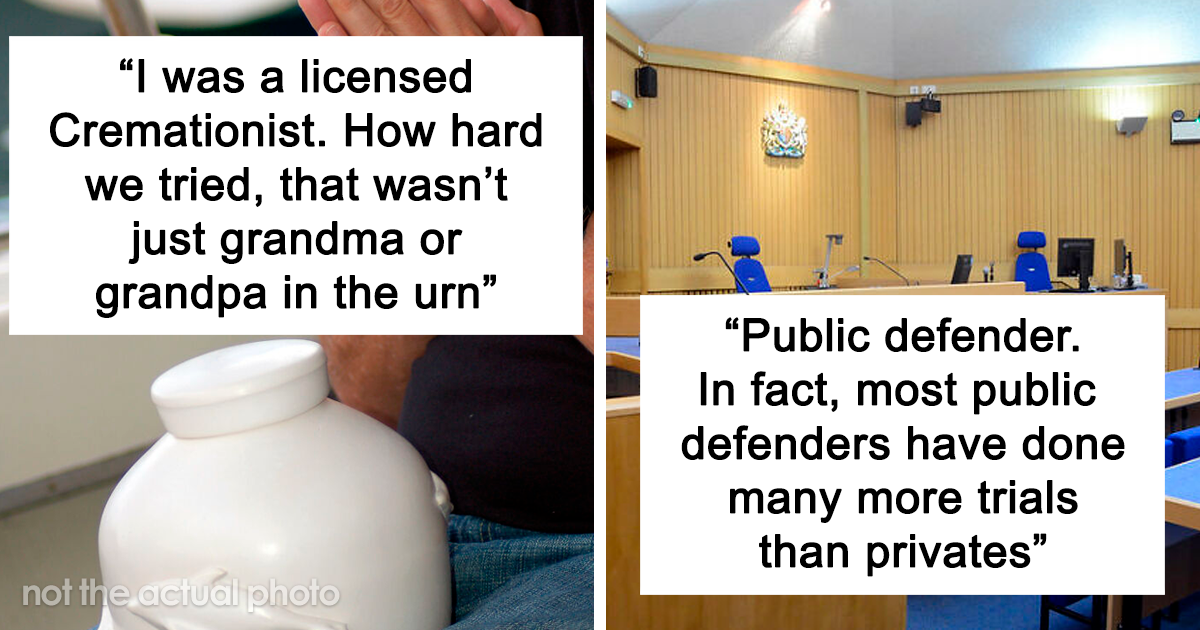
A public defender is not automatically a less capable attorney. Many handle large numbers of cases and accumulate significant courtroom experience. The central problem is often workload: limited time must be divided among client meetings, investigation, negotiation, legal research, motions, hearings, and trials.
18. Social workers spend considerable time coordinating systems
Social work is not simply having supportive conversations. Professionals may assess risk, develop service plans, document contacts, coordinate healthcare or housing, communicate with agencies, appear in court, and respond to crises. Progress can depend on resources outside their control, which makes persistence one of the job’s least advertised requirements.
19. Funeral professionals manage logistics while families are grieving
Funeral service work requires careful identification, legal documentation, transportation, scheduling, preparation, coordination with cemeteries or crematories, and sensitive communication. Professionals must be precise while supporting people who may be shocked, confused, or exhausted. The work is both technical and deeply interpersonal.
20. Hotel housekeepers notice far more than guests realize
Housekeepers work under time pressure while lifting, bending, sanitizing surfaces, changing linens, restocking supplies, identifying damage, and reporting maintenance or safety concerns. A room that looks effortlessly fresh represents disciplined physical labor. The decorative towel did not fold itself into a swan through the power of hospitality.
Specialized Skills That Look Easier From the Outside
21. Air traffic controllers must meet demanding medical and performance standards
Controllers manage rapidly changing information while communicating precisely and maintaining awareness of multiple aircraft. The profession involves strict medical qualifications, specialized training, rotating schedules, and continuous concentration. Much of the work is deliberately uneventful because the entire purpose is to prevent conflicts before passengers ever know one was possible.
22. Professional pilots rely on checklists rather than memory alone
Checklists are not evidence that a pilot forgot how to fly. They help crews verify important actions consistently, especially when workload rises. Pilots also devote years to training, examinations, medical evaluations, simulator sessions, recurrent checks, weather decisions, and accumulating experience before reaching many desirable positions.
23. Court reporters translate speech into text at remarkable speed
Stenographic court reporters can capture speech at more than 200 words per minute by using combinations of keys to represent sounds, phrases, and words. They preserve the official record, prepare transcripts, and may provide real-time text for judges, attorneys, broadcasters, or people who are deaf or hard of hearing.
24. Pharmacists routinely catch problems before medication reaches a patient
Dispensing medication involves checking doses, allergies, interactions, duplicate therapies, timing, legal requirements, and prescription clarity. Pharmacists also counsel patients, communicate with prescribers, administer vaccines, manage inventory, and wrestle with insurance systems. Counting tablets is one visible action inside a much larger safety process.
25. Truck drivers leave space because heavy vehicles cannot stop like cars
The gap in front of a commercial truck is a safety buffer, not an invitation for another driver to squeeze in. Large vehicles require more distance to slow down and have significant blind spots. Cutting closely in front of a truck can erase the space its driver intentionally created to protect everyone nearby.
26. Anesthesia teams need honest information, not perfect patients
Questions about medications, alcohol, nicotine, cannabis, or other substances are medically important. Substance use can affect tolerance, breathing, circulation, pain control, withdrawal risk, and interactions with anesthetic drugs. Withholding information to avoid embarrassment can make treatment less predictable and less safe.
27. Professional translation is not simple word replacement
Translators and interpreters must account for meaning, tone, context, technical terminology, cultural references, ambiguity, and the intended audience. A sentence can be grammatically accurate yet completely wrong for the situation. Human language remains stubbornly unwilling to behave like a tidy column in a bilingual spreadsheet.
28. Restaurant cooking is mostly preparation, timing, and cleaning
The dramatic moment when food meets a hot pan is only part of kitchen work. Cooks prepare ingredients, organize stations, monitor temperatures, prevent cross-contamination, coordinate orders, manage waste, and clean constantly. A successful rush depends less on theatrical flames than on preparation completed hours earlier.
29. Archivists preserve context, not merely old objects
An archive must explain where records came from, how they relate to one another, and why they matter. Archivists organize collections, create descriptions, manage access, preserve fragile materials, digitize records, and maintain electronic files. Saving a document without its context can preserve the words while losing much of the meaning.
30. Cybersecurity success often looks like nothing happened
Security teams monitor systems, investigate unusual activity, update software, control access, test defenses, educate employees, and prepare incident plans. When their work succeeds, customers see an ordinary day. Preventive professions share this strange challenge: their best evidence of competence is frequently the disaster that never occurred.
What These Hidden Job Experiences Teach Us
Reading workers’ behind-the-scenes experiences changes the way ordinary encounters look. The employee staring at three monitors may not be ignoring anyone; a complicated safety or documentation process may be unfolding. The teacher who answers an email the next morning may have spent the previous evening grading assignments. The pharmacist who asks a customer to wait may be clarifying a dangerous dosage rather than slowly moving a bottle from one counter to another.
One recurring experience across professions is that calm results are carefully manufactured. Flights land safely because pilots, mechanics, controllers, dispatchers, and weather specialists identify problems early. Clean water arrives because operators monitor infrastructure that most residents never see. A museum artifact survives because a conservator worried about humidity while everybody else admired the gift shop. Smooth service is rarely effortless; it is effort made invisible.
Another shared experience is the gap between urgency and priority. Customers naturally experience their own problem as the most immediate one. Professionals must compare it with every other problem occurring simultaneously. Emergency departments prioritize medical danger. IT teams prioritize failures affecting entire organizations. Maintenance crews address hazards before cosmetic concerns. This does not mean an individual’s concern is unimportant. It means the worker may be managing a larger picture that customers cannot see.
Documentation is another frequently misunderstood part of modern work. Forms and records can feel bureaucratic, but accurate documentation protects continuity, accountability, safety, and legal rights. Nurses record patient changes so the next clinician understands what happened. Court reporters preserve exact proceedings for possible appeals. Social workers document decisions that affect vulnerable people. Safety inspectors record conditions before memories fade or responsibility becomes disputed. Paperwork may be annoying, but missing paperwork can become catastrophic.
Workers also describe carrying experiences home with them. A dispatcher may remember a frightened caller. A veterinarian may replay an end-of-life conversation. A teacher may worry about a student without stable housing. A public defender may continue researching after dinner because a client’s future depends on the next morning’s hearing. Professional boundaries matter, yet emotionally difficult work does not always remain politely inside the building when a shift ends.
These accounts also show that expertise is often preventive. The public notices a firefighter when flames are visible, but not the inspector who identified blocked exits months earlier. People appreciate a surgeon after an operation, yet may overlook the anesthesia professional monitoring breathing, circulation, medications, and consciousness throughout the procedure. We tend to celebrate dramatic interventions while taking quiet prevention for granted.
Finally, these job experiences offer a practical lesson in empathy. Customers do not need to understand every technical detail before treating workers with patience and respect. Honest information helps medical professionals make safer decisions. Clear addresses help delivery workers and emergency dispatchers. Leaving adequate road space protects truck drivers and motorists. Reasonable expectations allow teachers, service employees, and public workers to focus on doing the job correctly rather than managing unnecessary conflict.
The world functions through millions of tasks that are rarely visible, glamorous, or thanked. Behind almost every ordinary convenience is someone checking, documenting, cleaning, repairing, coordinating, translating, planning, or preventing. The next time a process feels mysteriously slow, it may be worth remembering that the worker in front of you could be holding together a system with training, judgment, and one spreadsheet that absolutely must not crash.
Conclusion
The most surprising job facts are not always bizarre secrets. Often, the revelation is how much skill hides inside familiar work. Careers that look simple from the outside may demand technical knowledge, emotional control, physical endurance, legal accuracy, or constant risk assessment. Listening to workers describe those realities does more than satisfy curiosity. It encourages us to become safer drivers, more honest patients, more patient customers, and more appreciative human beings.