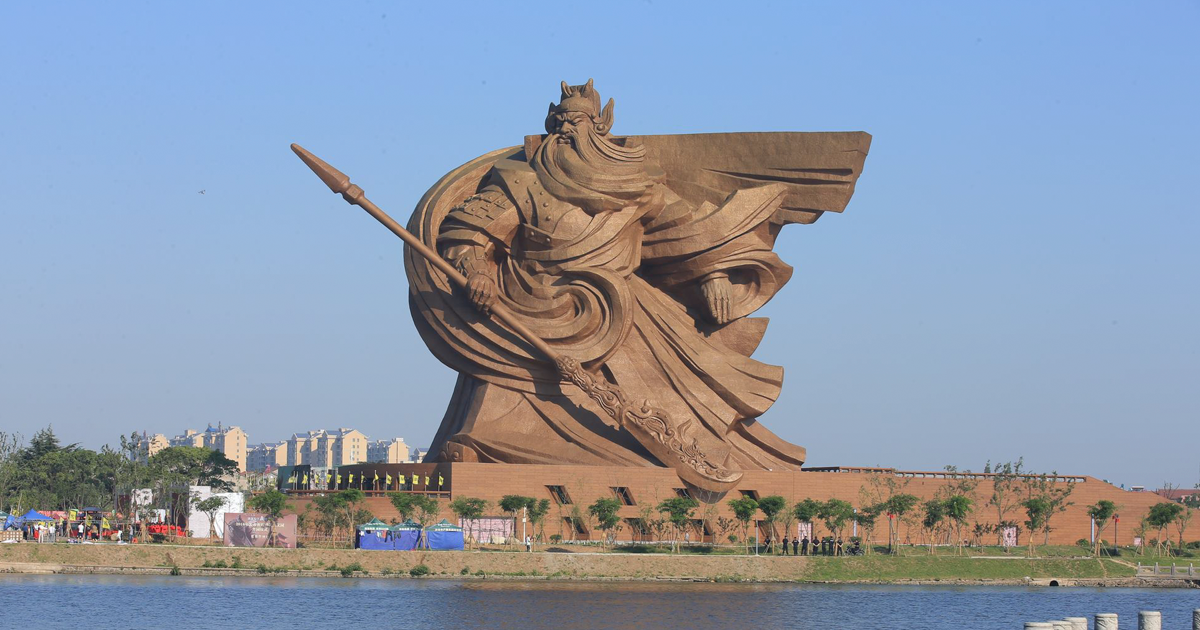
China has never been shy about making history feel larger than life, but the colossal Guan Yu statue in Jingzhou, Hubei province, took that idea and put it on a 190-foot pedestalalmost literally. Reported at its unveiling as weighing more than 1,320 tons, the bronze-clad monument honored Guan Yu, the legendary Three Kingdoms general who became one of East Asia’s most recognizable symbols of loyalty, righteousness, courage, and martial honor.
At first glance, the statue looked less like a civic monument and more like the final boss from an ancient Chinese epic. Guan Yu stood in flowing robes, beard sweeping downward, one hand gripping the Green Dragon Crescent Blade, a weapon so huge that it reportedly weighed well over 100 tons by itself. That is not a prop; that is a small building with attitude.
The statue was unveiled at Guan Gong Cultural Park in Jingzhou, a city deeply connected with Three Kingdoms history. It was designed by Han Meilin, the Chinese artist widely known for creating the Fuwa mascots for the 2008 Beijing Olympics. With thousands of bronze strips covering its structure and a museum tucked inside its massive base, the monument was intended to turn cultural memory into a tourism magnet.
Who Was Guan Yu?
Guan Yu was a real military general who lived during the late Eastern Han dynasty and the Three Kingdoms period. He served Liu Bei, the founder of Shu Han, and became famous for his loyalty, battlefield courage, and dramatic role in the stories surrounding ancient China’s political fragmentation.
Over centuries, Guan Yu’s reputation grew far beyond the historical record. Literature, temple worship, opera, folklore, and the classic novel Romance of the Three Kingdoms transformed him into Guan Gong or Guandi, a divine figure associated with war, protection, honesty, brotherhood, and righteous conduct. In some businesses and homes, he is honored not only as a warrior but also as a guardian of integrity and prosperity.
That explains why a city would build a giant statue of him rather than, say, a giant accountant with a calculator. Guan Yu is not merely a character; he is a cultural shorthand for moral strength. In Chinese visual culture, his red face, long beard, green robes, and crescent blade are instantly recognizable.
The Scale: A Statue Built to Overwhelm
The Guan Yu statue stood about 58 meters, or roughly 190 feet, tall. Its main figure rose above a 10-meter pedestal shaped like an ancient warship, a design choice that gave the whole monument the feeling of a warrior sailing through history. The statue was covered in more than 4,000 bronze strips, giving it a layered, armored surface that looked both ancient and futuristic.
Inside the base was a museum of approximately 8,000 square meters dedicated to Guan Yu culture. The idea was simple: visitors would not just take a selfie outside; they would step inside the story. The monument was meant to combine architecture, sculpture, tourism, and cultural education in one very large package.
The numbers made headlines for good reason. A 1,320-ton statue is not something a city casually places in a park like a bench. The weight, height, cost, and engineering all turned the project into a global curiosity. International media described it as epic, enormous, jaw-dropping, and slightly unbelievable. All fair. When your statue’s weapon alone could make a crane operator sweat, “large” feels like an understatement.
Why Jingzhou Built It
Jingzhou has legitimate historical connections to the Three Kingdoms era. The region is associated with military campaigns, political drama, and stories involving Guan Yu. By building a monumental statue, local planners hoped to transform that history into a destination brand. In modern tourism language, Guan Yu became the city’s cultural “IP,” a recognizable figure that could anchor museums, festivals, souvenirs, and travel campaigns.
This strategy is common around the world. Cities build landmarks because landmarks simplify identity. Paris has the Eiffel Tower. New York has the Statue of Liberty. Rio has Christ the Redeemer. Jingzhou wanted a Guan Yu so dramatic that tourists would immediately understand: this is a city of warriors, legends, and Three Kingdoms heritage.
In theory, the plan had logic. A giant statue can create instant visibility. It can appear in travel photos, drone videos, postcards, and social media feeds. It can also help a lesser-known city compete with better-known destinations. In the age of Instagram, a 190-foot bronze god of war is basically a billboard with a beard.
The Design: Ancient Symbolism Meets Modern Spectacle
Han Meilin’s design leaned heavily into motion and personality. Guan Yu was not presented as a stiff, sleepy figure. He appeared alert, powerful, and ready to move. The robes and cloak suggested wind and action. The giant blade created a diagonal line that made the statue feel even more dynamic.
The warship-shaped pedestal added another layer of symbolism. It connected the monument to military movement, river culture, and ancient campaigns. The museum inside the base turned the structure into more than a sculpture; it became a cultural complex. That combination made the project especially ambitious.
However, ambition can be a tricky beast. A monument this large does not merely decorate a city. It changes the skyline. It affects traffic, planning rules, public opinion, maintenance budgets, and the way residents feel about their own historic environment. A landmark can inspire pride, but it can also make people ask, “Who approved this giant bronze roommate?”
The Backlash: When Epic Becomes Excessive
The statue’s story did not end with applause and tourist photos. In 2020, Chinese authorities criticized the monument as a “vanity project” and said it damaged the historic character of Jingzhou. Reports also noted that the project had planning problems, including concerns that approval had been granted for the base structure rather than the full statue itself.
Another issue was scale. The statue reportedly exceeded local height restrictions and dominated the skyline of a historic city. For critics, the problem was not Guan Yu himself. The problem was that the statue seemed too big, too costly, and too disconnected from careful urban planning.
Financial concerns made the criticism sharper. The statue cost a large sum to build, but visitor revenue reportedly fell far short of expectations. Instead of becoming a runaway tourism success, it became a national example of what can happen when cities chase spectacle without enough attention to planning, cultural fit, and long-term sustainability.
The Relocation Controversy
Eventually, officials ordered the statue to be moved to a less prominent site about eight kilometers away. The relocation itself was reported to cost around 155 million yuan, or roughly $24 million at the time. In other words, the city had to spend a huge amount of money not only to build the statue but also to undo part of the decision.
Images and reports of the dismantling spread widely online. The removal process was dramatic because the statue had to be taken apart piece by piece. The head and major components were separated, creating surreal scenes of a once-dominant warrior reduced to giant bronze sections. For a monument built to project permanence, the dismantling was a powerful visual lesson in impermanence.
The relocation debate raised a serious question: who should pay when a public-facing project goes wrong? Residents and commentators criticized the waste of money, while planning experts pointed to the need for stronger approval systems. A statue meant to symbolize righteousness became, somewhat ironically, a case study in accountability.
Was the Statue a Failure?
Calling the Guan Yu statue a total failure would be too simple. Artistically, it was unforgettable. As a feat of sculpture and engineering, it was astonishing. As a viral image, it succeeded spectacularly. Many people around the world learned about Jingzhou because of this monument.
But as an urban development project, the results were more complicated. A landmark must work with its surroundings. It needs legal approval, structural safety, public support, maintenance planning, and a realistic tourism strategy. Size alone does not guarantee success. Sometimes it only guarantees a bigger invoice.
The statue shows the difference between attention and value. Attention is easy to measure: photos, headlines, clicks, and social media shares. Value is harder: repeat tourism, local pride, cultural education, sustainable revenue, and long-term harmony with the city. The Guan Yu statue had attention in abundance. Whether it delivered enough lasting value is the real debate.
What the Statue Teaches About Mega-Monuments
Mega-monuments are tempting because they promise instant identity. Build something big enough, and people will look. But the best landmarks are not only large; they are meaningful, integrated, and loved. They become part of daily life instead of looming over it like a bronze reminder of a budget meeting gone rogue.
The Guan Yu statue teaches that cultural heritage should be handled with respect, not just volume. Guan Yu’s symbolism is powerful because it carries centuries of meaning. A monument honoring him should strengthen that meaning, not reduce it to a race for height and headlines.
It also reminds planners that historic cities require special care. Jingzhou is not an empty stage. It has ancient walls, layered history, and a cultural atmosphere that can be overwhelmed by oversized development. A landmark should help visitors understand the place, not distract from it.
Why People Still Talk About It
The story remains fascinating because it contains everything: mythology, engineering, art, tourism, money, controversy, and a giant weapon. It is the kind of article people click because the headline sounds impossible, then keep reading because the real story is even stranger.
The statue also fits into a broader global conversation about how cities market themselves. Around the world, local governments and developers often search for iconic projects that can put them on the map. Sometimes those projects become beloved symbols. Sometimes they become cautionary tales. The Guan Yu statue managed to become both.
Experience Section: Visiting a Monument Like the Guan Yu Statue
Imagine approaching the Guan Yu statue as a traveler. At first, you would probably see the blade before you fully understood the figure. It would cut across the sky like a piece of myth made metal. Then the rest of the statue would come into view: the robes, the beard, the stern posture, the huge pedestal beneath. Your first reaction would likely be less “interesting cultural artifact” and more “well, that is definitely not a normal Tuesday.”
Standing near a monument of that size changes the way you feel your own body. You become small, and that is partly the point. Giant statues are designed to shrink the visitor so the story feels bigger. The Guan Yu statue would have made the legend physical. Instead of reading about loyalty and battlefield honor in a book, you would stand beneath a bronze warrior and feel the message pressing down from above.
The museum inside the base would have offered another kind of experience. After the outdoor shock of scale, visitors could move indoors and learn about Guan Yu’s historical life, his role in Three Kingdoms culture, and his transformation into a deity. That contrast matters. The outside says, “Behold!” The inside should answer, “Why does this matter?” Without that second part, a monument risks becoming only a photo stop.
For families, the statue might have been exciting because it turned history into something visible and dramatic. Children who might not sit still for a long lecture could understand immediately that Guan Yu was important. For fans of Chinese history, games, novels, and television dramas, the statue likely felt like walking into a real-world version of an epic scene.
At the same time, a visitor sensitive to urban design might have felt uneasy. A monument can be impressive and still feel out of place. If the statue overwhelmed nearby historic scenery, the experience could shift from awe to discomfort. The best cultural travel moments usually happen when a site feels rooted in its surroundings. When a landmark seems to shout louder than the city itself, the visitor may remember the spectacle but miss the soul of the place.
That is why the Guan Yu statue is such a useful travel lesson. Bigger is not automatically better. A small temple, a weathered city gate, or a quiet museum artifact can sometimes communicate history more powerfully than a thousand tons of bronze. But when scale, story, and setting work together, a monument can be unforgettable in the best way.
If you were writing a travel journal after seeing the statue, you might describe it as thrilling, strange, beautiful, excessive, and slightly unbelievable all at once. That mix is exactly why the story continues to travel online. The Guan Yu statue was not just a sculpture; it was an experience wrapped in metal, mythology, and municipal controversy.
Conclusion
China’s epic 1,320-ton God of War statue was more than a giant tribute to Guan Yu. It was a bold experiment in cultural tourism, a technical achievement, and eventually a warning about the risks of oversized civic ambition. The monument captured the grandeur of a legendary warrior, but its later relocation showed that even the biggest symbols must answer to planning rules, public value, and the character of the cities they inhabit.
In the end, the Guan Yu statue remains unforgettable because it stands at the intersection of myth and modern development. It reminds us that culture is powerful, but power needs proportion. A city can honor its heroes without letting them trample the skyline. And when your statue requires a multimillion-dollar moving bill, perhaps the real god of war is urban planning.
Note: This article is written as publication-ready editorial content and synthesizes publicly reported facts about the Guan Yu statue, including its design, scale, cultural background, unveiling, criticism, and relocation history.