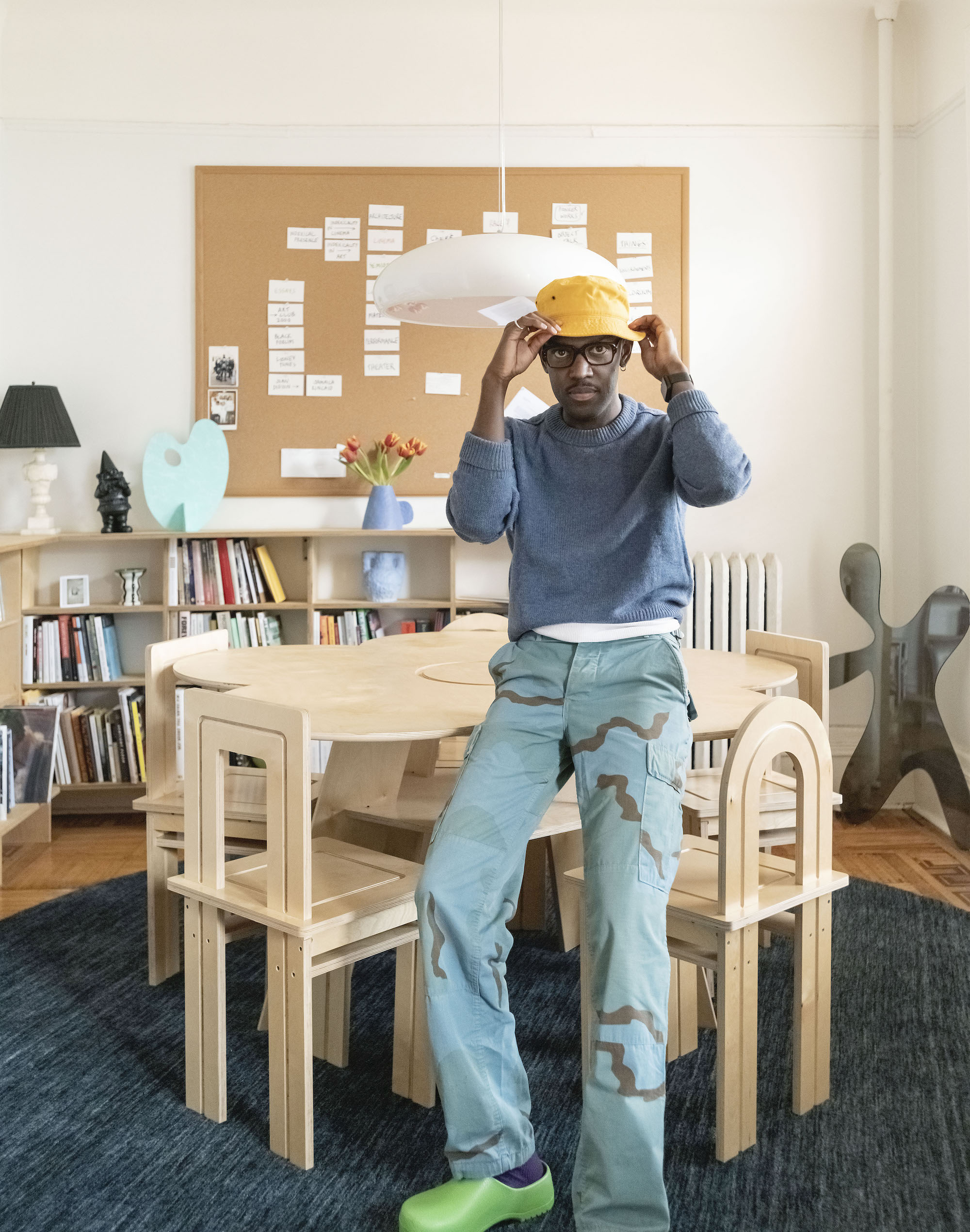
There’s a certain kind of New York apartment that doesn’t just house a personit edits them.
You can feel it in neighborhoods where the streets are leafy enough to make you forget you’re on an island of concrete,
where the architecture still carries the muscle memory of older eras, and where your walk home includes at least one
beautiful building you pretend you’re not staring at.
In Bed-Stuy, those moments arrive on a schedule. The brownstones line up like a well-rehearsed chorus. Light hits stoops
at a flattering angle. Somebody’s music leaks out of a window like it’s part of the weather. And inside a first-floor,
pre-war two-bedroom flat on a tree-lined street, Emmanuel Olunkwa’s home reads like a creative manifesto you can sit on.
Not the “manifesto” that yells at you in all caps. The better kindthe one that whispers, “Pay attention,” and then hands you
a chair that looks simple until you realize it’s been designed with a point of view.
The Multi-Hyphenate Who Actually Earned the Hyphens
Emmanuel Olunkwa’s rise makes sense once you understand how he thinks: design is not a lane, it’s a language.
He’s been known as a writer, editor, and filmmaker. He’s worked across publishing and art spaces. He’s also built a furniture
line that doesn’t feel like “merch” from a creative careerit feels like a natural extension of how he sees the world:
practical, poetic, and quietly bold.
If you’ve ever met someone who can talk about a table the way other people talk about a movieplot, pacing, character arc, and all
you already understand the vibe. His home doesn’t feel like a showroom. It feels like an ongoing draft, where each object is
included for a reason, and nothing is there just to be “nice.”
A Home That Works Like a Studio (Without Feeling Like an Office)
The apartment is not enormous, which is importantbecause the story here isn’t “Look at this huge space,” it’s
“Look at how intention turns an ordinary layout into something personal.”
Pre-war details tend to come with quirks: radiators that demand respect, corners that don’t cooperate, and proportions that
force you to make decisions instead of accumulating random stuff like a raccoon with a credit card.
One of the sharpest choices in the space is how it handles work. Instead of pretending productivity lives in a separate universe,
the apartment uses everyday architecturedoors, thresholds, and sightlinesto create a rhythm.
Think: a living area that can host, a workspace that can focus, and a visual flow that keeps the apartment from feeling chopped up.
The Radiator Problem (Solved Like a Designer)
New York radiators are basically roommates. Loud, hot, occasionally dramatic, and absolutely not moving out.
Instead of fighting that, this home leans in with built solutionslike a cutout plywood desk that wraps around a cast iron radiator.
It’s the kind of move that says, “I acknowledge the city,” and then turns a nuisance into a design feature.
Kitchen Reality, Elevated
Many apartments treat the kitchen like a corner you apologize for. Here, the approach is more honestand more stylish:
stainless tables that echo restaurant supply practicality. It’s functional, clean, and a little cheeky, like the apartment is saying,
“Yes, I cook. No, I don’t need to cosplay a Tuscan villa to prove it.”
The result is a home that can handle life: writing, thinking, friends coming over, projects spreading out across surfaces.
And that’s where the most famous object in the space steps in.
The Flower Table: Serious, Fun, and Built for Conversation
“Conversation piece” is one of those phrases that gets abused. Most of the time it just means “expensive” or “oddly shaped.”
In this case, it’s literal: a flower-shaped table designed to bring people in, invite them to sit, and make the room feel alive.
The origin story is refreshingly human. At one point, he wanted a bigger tablesomething you could really sit at and “embrace,”
not a token dining surface pressed against a wall. But he didn’t want another circle. And he didn’t want a square, either.
The room, after all, was already a perfect square. A flower shape was the third optionthe curveball that made the space feel less obvious.
That’s what good design often is: a refusal to accept the default choices.
Not because the defaults are “bad,” but because they’re not always you.
Why It Works (Even If You Think It Shouldn’t)
The flower table lands because it does two jobs at once:
- Social utility: it’s a magnet for gatheringpeople want to sit at it, touch it, get to know it.
- Visual logic: the curves soften a room’s geometry and keep the layout from feeling like a grid.
The table is also rooted in a material choice that’s deceptively deep: plywood.
Designers often talk about plywood as humble, generic, almost anonymous. That’s exactly the point.
Plywood can behave like papera blank surface that becomes expressive through cutting, shaping, and proportion.
In other words: the material is ordinary, but the imagination isn’t.
And maybe that’s the quiet thesis of the whole apartment: the objects don’t have to be precious to be meaningful.
They just have to be intentional.
Furniture-Making as Editing (and Editing as Design)
One of the most illuminating ways Emmanuel talks about furniture is through the lens of collaboration.
He’s described himself as a “second editor” in the processsomeone who shapes the final form, even if he’s not physically assembling every piece.
That editorial mindset shows up in how the designs evolve: prototypes, adjustments, and decisions made to protect the integrity of the idea.
This also makes his work relatable for people who aren’t industrial designers.
It reframes furniture not as some mysterious discipline guarded by secret handshakes, but as problem-solving:
you see a need, you imagine a better object, and you persist until it exists in three dimensions.
It helps that his furniture line, E&Ko., has a clear point of view: functional objects for everyday use.
Not “museum-only,” not “look but don’t touch,” and not “so minimal it feels like it’s mad at you.”
The best pieces are playful without being goofy, and practical without being boring.
The Home as Proof of Concept
Some designers build products first and then stage a home to match. This is the reverse.
The apartment feels like the lab where ideas get tested in real life. The flower table isn’t an abstract sketchit’s a living object.
It has a job. It hosts. It holds things. It absorbs the energy of the room and gives it back.
There’s also an emotional logic here that’s easy to overlook: designing for happiness.
The guiding principle isn’t just “clean lines” or “timeless taste.” It’s closer to: serious, but fun.
In other words, the room can be intellectually rigorous and still make you smile.
Like a well-written magazine that teaches you something without acting like it’s doing you a favor.
Why Bed-Stuy Matters to the Story
A home is never only a home. It’s also an address, a neighborhood, a set of cultural signals, andespecially in Brooklyn
a relationship with architecture.
Bed-Stuy is famous for its residential streets: rows of 19th-century brownstones, early apartment buildings, churches and institutions
that rise above the low scale of the blocks. It’s a place where preservation isn’t an academic discussion; it’s daily life.
When you live amid historic housing stock, you’re constantly negotiating between what’s old and what’s next.
That context makes Emmanuel’s home feel even more pointed. His furniture is contemporary, but it isn’t trying to erase the building’s past.
The radiator stays. The bones stay. The new pieces don’t compete with historythey converse with it.
How to Steal the Vibe (Without Copying the Apartment)
The goal isn’t to recreate someone else’s home. The goal is to borrow the strategy:
make your space tell the truth about you, and make it usable enough to survive your actual life.
1) Pick One “Anchor Object” and Let It Do the Heavy Lifting
An anchor object isn’t necessarily expensive. It’s the thing that gives the room a pulsea table, a sofa, a painting, a lamp.
In this case, the flower table works because it’s both functional and emotionally legible.
People understand it immediately: “Oh, this is where we gather.”
2) Don’t Hide Your ConstraintsDesign Around Them
Your radiator, your weird corner, your narrow room, your doors that swing the wrong waythese aren’t just obstacles.
They’re prompts. A cutout desk wrapping a radiator is a perfect example: it treats the constraint as a fixed point,
then designs a solution that feels custom rather than compromised.
3) Use “Everyday Materials” Like They’re Luxury
Restaurant-supply stainless tables in a kitchen? That’s not a downgrade. That’s clarity.
The trick is to commit: if it’s practical, let it be elegantly practical.
If it’s plywood, let the form prove the point.
4) Make Space for Storytelling
The most compelling rooms aren’t the ones with the most stuffthey’re the ones with the most meaning.
Books that are annotated. Objects collected over time. A chair that reminds you of a person.
A table that exists because you wanted people to talk.
Conclusion: A Home You Can Read, and a Life You Can Sit With
What makes Emmanuel Olunkwa’s Bed-Stuy home memorable isn’t a single décor trend or a perfect color palette.
It’s the through-line: curiosity, intention, and the belief that everyday life deserves thoughtful objects.
The apartment is a reminder that design doesn’t have to be loud to be brave.
Sometimes it’s a flower-shaped table in a square room. Sometimes it’s a desk that politely coexists with a radiator.
Sometimes it’s a kitchen that chooses stainless practicality and calls it a daybecause the day has work to do.
And sometimes the most “on the up” thing a designer can do is the simplest: make a home that welcomes people in,
gives them a place to sit, and sparks the kind of conversation you remember after you leave.
Experiences: Bringing the Bed-Stuy Creative Energy Home (A 500-Word Field Guide)
You don’t need the same apartmentor the same neighborhoodto tap into the experience behind this story.
What you can borrow is the rhythm: a little city observation, a little material play, and a lot of intention.
Here are a few experiences you can try (and repeat) to get closer to that “serious but fun” design mindset.
1) Take a “Tree-Lined Block” WalkEven If Your Block Isn’t Tree-Lined
The Bed-Stuy magic starts outside: the slow reveal of stoops, doors, brick, ironwork, and the small choices people make
with planters and porch lights. Re-create that by walking your neighborhood as if you’re scouting a film location.
Look for repeating patterns (window shapes, fence details, colors). Notice where things feel calm versus chaotic.
Then bring one observation homejust one. Maybe it’s “I like when things line up,” or “I prefer softer edges,” or
“I’m drawn to yellow-green colors.” The point is not taste-policing. The point is attention. Attention is where design begins.
2) Host a “Table Moment” That Isn’t About Food
The flower table story works because it’s about gathering, not just eating.
Try hosting one small hang that centers the table as a shared surface: zines and magazines, sketch pads, a deck of cards,
a few good objects that invite touch (a vase, a small sculpture, a smooth stone, a stack of postcards).
Put one question in the middle on an index cardsomething like, “What object do you keep that makes no sense to anyone else?”
You’ll be shocked how quickly people start telling stories.
Your home becomes a social tool, not a backdrop.
3) Build a “Constraint Ritual”
Every apartment has something mildly annoyingradiators, narrow rooms, weird outlets, low light.
Instead of complaining (okay, complain once; it’s healthy), pick one constraint and design a ritual around it.
If you have a radiator, make it the anchor for a reading chair and a small side table.
If you have a narrow hallway, make it a mini gallery with two frames and a mirror.
If your kitchen is tiny, give it one restaurant-supply-style surface that’s always clean and ready for action.
The ritual turns the constraint into a feature, and your brain stops treating it like a problem.
4) Try the “Everyday Material” Challenge
Choose one humble materialplywood, stainless, plain cotton, a simple ceramicand make it the star for a week.
Not by buying ten new things, but by noticing what you already own and how it behaves.
What does the material feel like? How does it age? Does it look better in morning light or at night?
This is the secret of good interiors: most of them are made from ordinary stuff, arranged with uncommon care.
5) Write Your Apartment Like an Essay
Take ten minutes and write a short paragraph that starts with: “My home is trying to teach me…”
Finish the sentence without censoring yourself. Then ask: what object supports that lesson?
If your answer is “My home is trying to teach me calm,” maybe you need fewer visual “shouts” and one clear anchor piece.
If your answer is “My home is trying to teach me to invite people in,” maybe you need a better gathering surface.
This exercise isn’t therapy (though it can feel suspiciously helpful). It’s design clarityturning vibes into choices.
That’s the real takeaway from a Bed-Stuy creative home: the style is not just what you buy.
It’s what you notice, what you keep, what you build, and what you make possible for yourself and other people
one thoughtful object at a time.