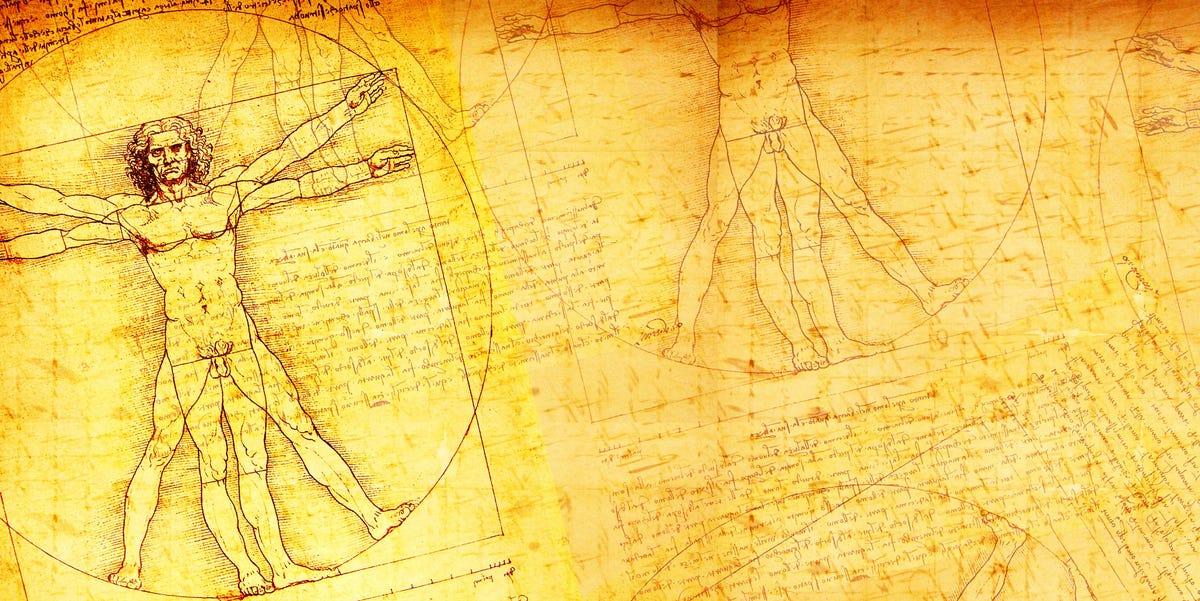
It sounds like the setup to a very niche joke: a dentist walks into a 500-year-old art mystery and leaves with geometry. But that is more or less what happened when London dental surgeon Rory Mac Sweeney published a new interpretation of Leonardo da Vinci’s Vitruvian Man. His idea is simple enough to fit on a napkin and strange enough to make you put the napkin down and squint at it: the secret to one of the most famous drawings in history may be hiding in a triangle between the figure’s legs.
That headline-friendly claim has gotten plenty of attention for good reason. Leonardo’s Vitruvian Man has been pored over by artists, historians, anatomists, architects, math lovers, and the occasional overconfident person with a ruler for centuries. Everyone agrees the drawing is brilliant. Fewer agree on exactly how Leonardo solved the geometric puzzle at its core: how to fit the ideal human body into both a circle and a square without making the poor guy look like a pretzel. Mac Sweeney argues that Leonardo may have used a hidden equilateral triangle related to jaw anatomy, not the much-hyped golden ratio, to organize the image.
Is that definitely the answer? Not quite. Is it a fascinating theory that feels wildly on-brand for Leonardo, the original art-science overachiever? Absolutely.
Why Vitruvian Man Still Messes With People’s Minds
To understand why this new theory landed so well, it helps to remember what Vitruvian Man actually is. Leonardo created the drawing around 1490, inspired by the Roman architect Vitruvius, whose writings argued that the human body contains harmonious proportions. Vitruvius believed an ideal man could fit inside both a circle and a square. Nice idea. Tiny problem: he did not include a usable illustration that showed exactly how to make that happen.
That left Renaissance thinkers with a challenge that was part geometry exercise, part philosophical flex. The circle symbolized the cosmic and the divine; the square stood for the earthly and material. Put a human body inside both, and suddenly the body becomes more than anatomy. It becomes a map of the universe in miniature. No pressure, Leo.
Leonardo did not merely copy Vitruvius. He tested proportions, studied bodies, and used his own observations. That is one reason the drawing remains so powerful: it is both scholarly and empirical, poetic and practical. In the square pose, the man stands with legs together and arms stretched straight out. In the circular pose, the limbs spread wider, with the navel as the center of the circle. Leonardo effectively offset the two shapes, which was a major leap beyond earlier attempts to illustrate Vitruvius. This was not just a drawing of a man. It was a carefully engineered argument about proportion.
What the Dentist Says He Found
Mac Sweeney’s 2025 paper, published in the Journal of Mathematics and the Arts, argues that the clue to Leonardo’s construction has been visible the whole time. Leonardo’s own notes mention that when the figure spreads his legs and raises his arms, the space between the legs forms an equilateral triangle. For centuries, that detail mostly sat there like a prop in a mystery movie that nobody bothered to pick up.
Mac Sweeney picked it up.
His argument is that this triangle is not decorative and not accidental. Instead, it may be the structural key to the whole composition. He links the triangle in Vitruvian Man to a concept in dentistry called Bonwill’s triangle, an equilateral triangle formed by the two mandibular condyles and the midpoint of the lower incisors. In plain English: there is a well-known geometric relationship in the jaw, and Mac Sweeney thinks Leonardo may have echoed a similar spatial principle in the body as a whole.
From there, the theory gets even more mathematical. Mac Sweeney argues that if the equilateral triangle in the drawing is replicated around the navel, it produces a hexagonal arrangement that yields a ratio of about 1.64 between the square’s side and the circle’s radius. That is close to 1.633, a value associated with tetrahedral packing and mechanically efficient spatial organization. In other words, he thinks Leonardo may have stumbled onto, or intentionally used, a geometric relationship connected to optimized structure in nature and anatomy.
Yes, this is the moment where art history casually wanders into the room wearing a lab coat.
Why a Dentist Noticed What Everyone Else Missed
The most delightful part of the story is that the person proposing this interpretation was not approaching the drawing as a traditional art historian or pure mathematician. He was approaching it through craniofacial anatomy. That matters, because Bonwill’s triangle is not just a dusty term from a dental textbook. It has long been important in thinking about jaw function, occlusion, articulation, and denture design.
William Bonwill introduced the concept in the 19th century, and dental literature still references it as a useful geometric model. So when Mac Sweeney looked at Vitruvian Man, he did not just see legs and lines. He saw a familiar structural pattern. The leap from jaw mechanics to Renaissance drawing may sound outrageous at first, but Leonardo himself spent years investigating anatomy with an intensity that makes most modern hobbyists look adorable.
He dissected bodies, drew muscles, bones, skulls, organs, and vascular structures, and treated the body as a machine without stripping it of wonder. If any artist from that era might have embedded a mathematically suggestive anatomical idea into a famous drawing, Leonardo is the guy. This is the man who could turn curiosity into a full-time occupation.
Why the Golden Ratio Keeps Showing Up, Even When It Shouldn’t
Whenever a famous artwork and mathematics appear in the same sentence, the golden ratio is never far behind. It is basically the celebrity guest star of proportion theories. For years, people have claimed that Vitruvian Man encodes phi, the famous number approximately equal to 1.618. The problem is that many analyses have found the drawing does not line up neatly with that explanation.
That does not stop the golden ratio from showing up in articles, documentaries, social posts, coffee mugs, and probably at least one person’s tattoo. But in the case of Vitruvian Man, the fit appears shakier than popular myth suggests. That is one reason Mac Sweeney’s theory gained traction. It offers an alternative ratio and ties it to something anatomical rather than purely mystical or aesthetic.
This is where the new interpretation feels refreshing. It does not ask you to believe Leonardo sprinkled magic dust over geometry. It asks you to imagine that he noticed how form, balance, and function work together in living bodies. That is a much more Leonardo-like proposition.
Why This Theory Feels So Very Leonardo
Even if Mac Sweeney’s reading does not become the final answer, it fits the spirit of Leonardo’s work remarkably well. Leonardo was obsessed with relationships: body to machine, motion to structure, nature to mathematics, visible form to hidden law. He did not treat art and science as rival departments. He treated them as roommates sharing the same sketchbook.
The historical Leonardo was not just drawing a handsome fellow inside tidy shapes. He was testing whether the human body could reveal a larger order. That is why Vitruvian Man became such a durable symbol of humanism. It presents the body as measurable without making it mechanical, idealized without making it cold. The image says that the body is not random. It has rhythm, pattern, and proportion.
Mac Sweeney’s theory taps directly into that legacy. His proposal suggests that Leonardo may have recognized a form of optimized biological architecture centuries before modern terminology existed. Whether or not that exact claim holds up, it highlights something important: Leonardo’s genius often came from seeing connections between disciplines that other people kept in separate boxes.
He would probably be very pleased that a dentist, of all people, helped drag one of his drawings back into a live interdisciplinary argument. Honestly, that feels like exactly the sort of chaos he would enjoy.
Does This Actually Solve the 500-Year-Old Mystery?
Here is where the grown-up answer has to enter the chat: maybe, maybe not.
Mac Sweeney’s theory is intriguing, elegant, and grounded in a real anatomical concept. It also remains a theory. Popular Mechanics noted that not everyone is convinced, and that some scholars think other geometric constructions remain just as plausible. One expert quoted there even suggested that “none of the above” could still be the right answer: Leonardo may not have intended one neat hidden code at all.
That skepticism is healthy. Famous works attract overinterpretation the way porch lights attract moths. Once a drawing becomes iconic enough, every line starts looking like a secret message. Sometimes a triangle is a key. Sometimes a triangle is just a triangle doing triangle things.
Still, the new theory deserves attention because it does three useful things at once. First, it takes Leonardo’s note about the equilateral triangle seriously. Second, it ties the image to a concrete anatomical model rather than vague numerology. Third, it restores a sense of active problem-solving to the drawing. Instead of treating Vitruvian Man as a static cultural logo, it treats it as what it originally was: an investigation.
Why People Can’t Stop Reading About This
Part of the appeal is obvious. “Dentist finds hidden math in Leonardo masterpiece” is a spectacularly clickable sentence. It has surprise, authority, mystery, and just enough weirdness to feel irresistible. But the story is sticky for a deeper reason too: it reassures us that great art can still reveal something new.
In an age when people sometimes act like all the major cultural questions were solved by 2014 and then turned into podcasts, there is something thrilling about the idea that a Renaissance drawing can still provoke fresh interpretation. Better yet, the interpretation did not come from the most predictable corner. It came from someone trained to think about jaws, function, and anatomical geometry.
That is the real charm here. It reminds us that knowledge does not always move in tidy lanes. Sometimes dentistry wanders into art history. Sometimes anatomy gives mathematics a nudge. Sometimes a drawing you thought was finished turns out to be having another conversation entirely.
What Readers Should Actually Take Away
If you remember only one thing from this story, make it this: the new “hidden math” claim is not best understood as a dramatic final verdict. It is better understood as a persuasive new lens.
Through that lens, Vitruvian Man looks less like a poster of perfect proportion and more like a compressed masterpiece of observation. Leonardo used geometry, anatomy, and philosophy to ask how the human body occupies space. Mac Sweeney’s contribution is to suggest that one overlooked triangle may help explain the answer. Even if later scholars debate or revise the idea, the theory has already done something valuable: it has made people look harder.
And really, that is one of the highest compliments you can pay Leonardo da Vinci. Five centuries later, he is still making people measure things, argue about circles, and stare at a drawing until their brains start humming.
Experiences Related to “A Dentist Uncovered Hidden Math in Da Vinci’s Vitruvian Man”
One reason this topic feels so gripping is that it connects to real experiences people already have, even if they have never opened an art history book. Think about the odd mix of precision and vulnerability in a dental exam. You sit there under a bright light while someone studies your jaw not as an abstract idea but as a physical structure with angles, alignment, movement, and force. That alone makes Mac Sweeney’s theory feel unexpectedly relatable. Most people do not usually think of their mouth as geometry, but the minute a dentist starts talking about bite, symmetry, or alignment, math quietly enters the room.
There is also the museum experience. Even when people see Vitruvian Man only as a reproduction in a book, on a poster, or online, they tend to respond in two steps. First comes recognition: “Oh, that image.” Then comes surprise: “Wait, why is this so compelling?” The drawing looks simple until you actually sit with it. The overlapping poses, the square, the circle, the notes, the calm confidence of the figure it all creates the strange feeling that you are looking at a diagram, an artwork, and a philosophical statement at the same time. The new triangle theory intensifies that experience because it gives viewers permission to look again, not casually but attentively.
Another experience tied to this topic is the moment people realize the body is full of pattern. This can happen in a life drawing class, a yoga studio, a biomechanics lab, or even while trying to stand straight in front of a mirror after a chiropractor tells you one shoulder sits higher than the other. Human beings are not abstract rulers, but we are deeply structured. We balance, compensate, extend, rotate, and distribute weight in ways that are measurable. That is part of why Vitruvian Man still lands. It turns an everyday fact that bodies occupy space in organized ways into an unforgettable image.
There is also a more emotional experience at work: the pleasure of discovering that disciplines overlap. People love this story because it breaks the boring rule that art belongs in one room and science in another. If you have ever had the experience of suddenly understanding something because it was explained from the “wrong” angle history through architecture, math through music, anatomy through drawing then this story feels instantly familiar. A dentist seeing something in Leonardo that others overlooked is not just quirky. It reflects how insight often works. Expertise in one field can sharpen vision in another.
And finally, there is the private experience of encountering an old masterpiece and realizing it is not old at all. The paper may be centuries old, but the questions inside it are still alive. How does the body work? What makes a structure stable? Can beauty come from function? Can geometry describe life without draining it of mystery? Those are modern questions dressed in Renaissance clothing. That is why this story keeps traveling so well. It is not only about Leonardo or a hidden triangle or even dentistry. It is about the thrill of recognition when a famous image suddenly becomes strange again, and in becoming strange, becomes richer.
Conclusion
A dentist did not “solve” Leonardo da Vinci in the grand, final, mic-drop sense. But Rory Mac Sweeney did something almost as interesting: he reopened a masterpiece. By connecting the equilateral triangle in Vitruvian Man to Bonwill’s triangle and a broader geometric ratio, he offered a theory that is bold, anatomically informed, and very hard to ignore. Whether future scholarship confirms it, reshapes it, or politely sends it back for revisions, the idea has already accomplished something worthwhile. It has reminded us that Leonardo’s most famous drawing is not a frozen symbol from the past. It is still a live puzzle and apparently, still capable of surprising anyone willing to look closely enough, even if that person arrives carrying dental anatomy instead of an art history syllabus.