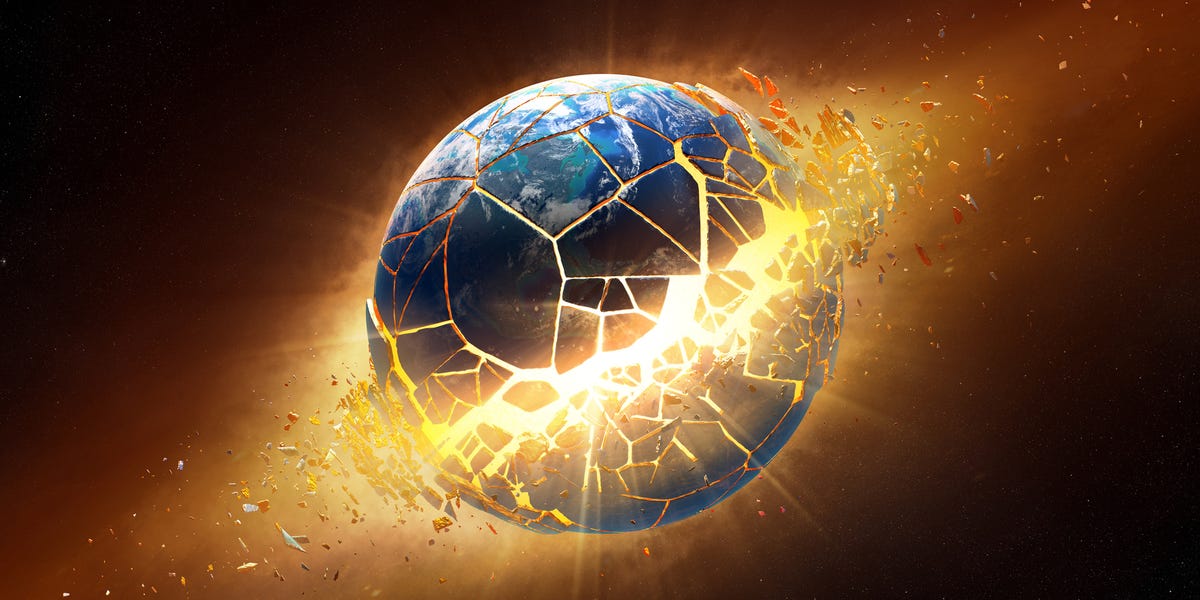
Some headlines sound like they were written by a science-fiction novelist after too much coffee. This one is real: for the first time ever, astronomers have directly witnessed a star devouring a planet. Not “found clues,” not “made a pretty convincing model,” not “saw suspicious cosmic crumbs on the stellar table.” Scientists caught the meal in progress.
The event, known as ZTF SLRN-2020, happened in our Milky Way galaxy, roughly 12,000 light-years away in the direction of the constellation Aquila. In 2020, a star suddenly brightened in visible light, then glowed for months in infrared. After careful follow-up observations with major telescopes and space-based instruments, researchers concluded that the most likely explanation was dramatic and deliciously unsettling: a star had swallowed a gas giant planet, probably similar in size or mass to Jupiter.
This discovery matters because astronomers have long predicted that aging stars can consume nearby planets. Our own Sun is expected to expand into a red giant billions of years from now, likely engulfing Mercury, Venus, and possibly Earth. Until this observation, however, the actual moment of planetary engulfment had never been directly seen. Now the universe has provided a front-row seat to one of its messiest dinner parties.
What Did Scientists Actually See?
The cosmic event was first detected by the Zwicky Transient Facility, or ZTF, at Caltech’s Palomar Observatory in California. ZTF scans the night sky for objects that change brightness over time. Think of it as a celestial security camera, except instead of catching raccoons stealing from your trash can, it catches stars doing extremely dramatic things.
In May 2020, astronomer Kishalay De noticed an unusual optical outburst. A star had brightened by more than a hundred times, but the event did not behave like a supernova, the powerful explosion of a dying massive star. It was much dimmer than a typical stellar explosion and cooler than expected. That made it strange, and in astronomy, strange is usually where the fun begins.
Follow-up observations revealed another important clue: the star had also produced a long-lasting infrared glow. NASA’s NEOWISE spacecraft, along with ground-based infrared telescopes, showed that dust had formed around the system. The visible flash was short-lived, but the infrared signal lingered, suggesting that material had been thrown into space, cooled, and condensed into dust.
When researchers pieced together the timeline, they saw a story unfold. A planet orbiting very close to its star began skimming through the star’s outer atmosphere. As the planet spiraled inward, friction stripped material from both the planet and the star. Gas was flung outward. Dust formed. Then the planet plunged deeper and disappeared. The star briefly puffed up, brightened, and left behind a dusty afterglowthe cosmic equivalent of a burp, if your burps were detectable across thousands of light-years.
Meet ZTF SLRN-2020: The Star That Ate a Planet
ZTF SLRN-2020 is not a household name, mostly because it sounds like a printer error. But in astronomy, names like this are practical. “ZTF” refers to the survey that discovered it, while the rest identifies the transient event. A transient is any astronomical object or event that changes over time, such as a nova, supernova, stellar flare, or merger.
The star involved was initially described as Sun-like and aging, possibly beginning to swell as it moved toward the red giant phase. In that scenario, the star expanded until its outer layers reached a close-orbiting planet. The doomed world was likely a hot gas giant, meaning a large planet orbiting extremely close to its host star. Some later research using the James Webb Space Telescope has suggested a slightly different possibility: the star may not have been as far along in its red giant phase as first thought, and the planet may have spiraled inward because of tidal interactions rather than simply being overtaken by an expanding star.
Either way, the central idea remains thrilling: scientists observed direct evidence of a planet being consumed by its star. That makes ZTF SLRN-2020 a landmark discovery in the study of star-planet interactions, planetary engulfment, and the long-term evolution of solar systems.
Why This Discovery Is a Big Deal
It Confirms a Long-Standing Prediction
For decades, astronomers have known that stars like the Sun change dramatically as they age. Once a star uses up the hydrogen fuel in its core, it begins to expand. Its outer layers swell outward, and it becomes a red giant. Any planets orbiting too close may be dragged into the star and destroyed.
Scientists had already found indirect evidence of stars eating planets. Some stars show unusual chemical signatures, such as high levels of lithium or heavy elements, which may point to swallowed planetary material. Other systems contain planets orbiting dangerously close to stars that are already expanding. But indirect evidence is like finding cookie crumbs on the floor. ZTF SLRN-2020 is more like walking into the kitchen and seeing the star with chocolate on its face.
It Shows How Planetary Systems Can End
We often think of planets as permanent worlds, stable and majestic, calmly circling their stars for eternity. The truth is less tidy. Planetary systems evolve. Orbits shift. Stars age. Worlds migrate inward or outward. Some planets are ejected into space. Others collide. And some, as this discovery shows, become lunch.
This event offers astronomers a rare look at the late-stage architecture of planetary systems. It helps answer questions such as: How often do stars consume planets? What kinds of planets are most vulnerable? What happens to the star after the meal? Can engulfment change a star’s rotation, brightness, chemistry, or dust environment?
It Gives Us a Preview of the Solar System’s Far Future
No, Earth is not about to be swallowed by the Sun next Tuesday. You may keep your lunch plans. The Sun still has roughly five billion years before it reaches the red giant stage. But when that happens, the inner solar system will change beyond recognition.
Mercury and Venus are widely expected to be engulfed. Earth’s fate is less certain. Some models suggest our planet could also be consumed; others suggest it might avoid direct engulfment but become uninhabitable long before then. Either way, the oceans will be gone, the atmosphere will be transformed, and beach vacations will be canceled with extreme prejudice.
ZTF SLRN-2020 gives scientists a real-world example of what planetary doom can look like. It is not merely an abstract prediction in a textbook. It is a cosmic event that telescopes actually recorded.
How a Star Swallows a Planet
A star does not eat a planet the way a person eats a sandwich. There are no teeth, no napkins, and thankfully no chewing sounds. The process is governed by gravity, heat, friction, and orbital decay.
First, a planet must orbit close enough to its star to be vulnerable. Many known exoplanets are “hot Jupiters,” huge gas giants that orbit their stars in just a few days. These worlds are far closer to their stars than Mercury is to the Sun. That closeness makes them easier to detect, but it also puts them in danger.
As a star evolves, its outer atmosphere can expand. If the planet’s orbit is close enough, the planet begins interacting with that atmosphere. Drag slows the planet down. When an orbit loses energy, the planet spirals inward. This creates more friction, which creates more heating, which strips more material. It is a runaway process, and the planet is not winning that race.
In the case of ZTF SLRN-2020, astronomers believe the planet skimmed the surface or outer layers of the star before finally plunging in. The interaction released energy and caused the star to brighten. Material ejected from the system cooled into dust, producing the infrared glow observed by NEOWISE and other instruments.
The Telescopes Behind the Discovery
This discovery was not made by one telescope acting alone like a heroic space detective in a tiny hat. It required teamwork across multiple observatories and instruments.
Zwicky Transient Facility
The Zwicky Transient Facility played the starring role in spotting the initial optical outburst. ZTF is designed to scan large portions of the sky quickly, making it ideal for catching transient events that appear, fade, or change over short timescales.
NASA’s NEOWISE Mission
NEOWISE provided crucial infrared data. Infrared observations are especially useful for detecting warm dust, which can reveal material ejected during violent cosmic interactions. In this case, NEOWISE showed that the system had brightened in infrared even before the visible-light flare, suggesting dust production had begun earlier in the planet’s fatal spiral.
Ground-Based Infrared Observatories
Observatories such as the W. M. Keck Observatory and Gemini South helped gather additional details about the event. Spectroscopic observations allowed researchers to analyze the light and compare it with known types of stellar eruptions. The data showed that ZTF SLRN-2020 resembled a low-energy version of a red nova, a type of event often associated with stellar mergers. But this one was too faint to be a typical star-star merger, pointing instead to a smaller object: a planet.
James Webb Space Telescope Follow-Up
Later observations with the James Webb Space Telescope added new layers to the story. Webb’s infrared sensitivity helped researchers study the dusty aftermath and refine ideas about what happened. Some Webb-based interpretations suggest that the host star may have been less evolved than initially assumed, meaning the planet may have spiraled inward due to tidal forces rather than being swallowed simply because the star expanded. That twist makes the event even more interesting, because it suggests planets can die by more than one stellar dining method.
What Happened to the Planet?
The swallowed planet was probably a gas giant, perhaps similar to Jupiter, though likely much closer to its star than Jupiter is to the Sun. If it was a hot Jupiter, it would have endured extreme heat even before the final plunge. These planets live fast, orbit close, and apparently do not always die quietly.
As the planet entered the star’s outer atmosphere, it would have experienced intense drag and heating. Its outer layers may have been stripped away. Gas from the star and planet likely mixed, creating an outflow. The final plunge would have deposited the planet’s remaining mass and orbital energy into the star.
Afterward, the planet no longer existed as a separate world. Its material became part of the star and surrounding debris. In poetic terms, the planet returned to the cosmic furnace from which planets ultimately form. In less poetic terms, it got absolutely wrecked.
Could This Happen to Earth?
Yes, but not soon. The Sun is currently about 4.6 billion years old and still in its stable main-sequence phase. It fuses hydrogen into helium in its core and will continue doing so for billions of years. Eventually, the Sun will exhaust its core hydrogen, expand into a red giant, and transform the inner solar system.
Long before the Sun physically engulfs any planet, Earth will face severe changes. As the Sun gradually brightens over time, Earth’s climate will become hotter. The oceans may evaporate. The atmosphere may change dramatically. Life as we know it would become impossible well before the Sun reaches its largest red giant size.
Still, the distant possibility of Earth being swallowed gives this discovery emotional weight. ZTF SLRN-2020 is not just an odd event in a faraway constellation. It is a preview of the kind of cosmic future that may await many planetary systems, including our own.
What Scientists Can Learn From a Planetary Engulfment
Planetary engulfment events are rare to catch because they are brief on astronomical timescales. A star can live for billions of years, while the visible outburst from a swallowed planet may last days, weeks, or months. That is like trying to notice a single camera flash during an entire lifetime.
By studying ZTF SLRN-2020, scientists can improve models of stellar evolution and planetary survival. They can estimate how much energy is released when a planet falls into a star, how much mass gets ejected, and what kind of dust forms afterward. They can also compare this event with other unusual transients to identify future planet-swallowing candidates more quickly.
The discovery also improves our understanding of exoplanet demographics. Astronomers have found thousands of planets beyond our solar system, including many that orbit extremely close to their stars. If close-in planets are common, then planetary engulfment may also be common. The universe may be full of stars quietly snacking on worlds, which is both scientifically useful and mildly rude.
Why the Discovery Captured Public Imagination
Part of the appeal is obvious: “star eats planet” is a headline with blockbuster energy. It is simple, dramatic, and a little terrifying. But beneath the spectacle is a deeper reason people care. This discovery connects human curiosity with cosmic mortality.
We live on a planet. We orbit a star. Most of us do not think about that arrangement during breakfast, unless the coffee has not kicked in yet. But astronomy reminds us that planets are not permanent islands. They are participants in long, evolving systems. Stars are born, change, expand, and die. Planets form, migrate, collide, freeze, burn, or vanish. The night sky may look calm, but it is packed with slow-motion drama.
Seeing a star devour a planet makes the universe feel dynamic. It turns the sky from a static wallpaper into a living story. And occasionally, that story includes a gas giant having a very bad day.
Experience and Reflection: What This Discovery Teaches Us About Our Place in the Universe
There is something strangely humbling about learning that a star can swallow a planet. On one hand, the discovery is distant and abstract. The event happened about 12,000 light-years away, which means no telescope is showing us a neighborhood emergency. No one is evacuating Aquila with a suitcase and a confused dog. But on the other hand, the physics behind the event is connected to our own solar system. The same basic forcesgravity, heat, orbital motion, stellar agingshape our cosmic home.
For anyone who has ever looked up at the night sky and felt small, ZTF SLRN-2020 adds a new flavor to that feeling. It is not just that the universe is enormous. It is that the universe is active. It changes. It rearranges itself. The stars that seem fixed and polite from our backyard are actually engines with life cycles. Planets that seem solid and eternal may only be temporary chapters in a much longer book.
This discovery also makes science feel wonderfully human. The first clue was not a giant flaming label in the sky saying, “Planet being eaten here.” It was a weird brightness change in a survey dataset. A scientist noticed something odd, questioned it, compared it with other possibilities, and followed the evidence. That is how many breakthroughs happen: not with a thunderclap, but with someone saying, “That’s strange,” and refusing to ignore it.
There is a lesson here for everyday curiosity. The world, like the universe, is full of signals that can be overlooked. A pattern changes. A small detail refuses to fit. A question sticks around longer than expected. Good science begins by respecting those moments. ZTF SLRN-2020 was not understood immediately. Researchers had to rule out other explanations, gather more data, and revise their thinking as new observations arrived. That is not a weakness of science; it is the whole magic trick.
The discovery also offers perspective on time. Human life moves in decades. Civilizations rise and fall over centuries or millennia. Stars operate across millions and billions of years. A planetary engulfment event is brief compared with a star’s lifetime, yet ancient compared with a human news cycle. By the time the light from ZTF SLRN-2020 reached Earth, it had been traveling since long before modern telescopes existed. We are seeing a distant past event that still teaches us about the future.
And yes, it is impossible not to think about Earth. The Sun’s red giant phase is billions of years away, so this is not a practical worry. It belongs in the category of “cosmic perspective,” not “things to panic about before rent is due.” Still, the knowledge changes how we see our planet. Earth is precious not because it is guaranteed forever, but because it is rare, beautiful, and alive right now. Astronomy often gives us the gift of scale, and scale can sharpen gratitude.
In that sense, a star eating a planet is not merely a story about destruction. It is a story about transformation. The planet’s material did not vanish from the universe. It became part of the star and its surrounding dust. In cosmic history, endings often become ingredients. The atoms in our bodies were forged in stars and scattered by ancient stellar deaths. The universe recycles with a flair for drama.
So when scientists witness a star devouring a planet, they are not just documenting a celestial catastrophe. They are watching one more example of the universe doing what it has always done: building, breaking, mixing, and beginning again. It is awe-inspiring, slightly spooky, and, if we are being honest, a little rude to the planet. But it is also a reminder that even the most violent cosmic events can help us understand where we came from, where planetary systems are going, and why our small blue world deserves a little extra appreciation today.
Conclusion
The first direct observation of a star devouring a planet is one of the most remarkable astronomy discoveries of recent years. ZTF SLRN-2020 gave scientists rare evidence of planetary engulfment in action: a close-orbiting world spiraling into its host star, producing a visible outburst, infrared glow, ejected gas, and newly formed dust.
The event confirms that stars can and do consume planets, especially when planets orbit too close or when stars evolve into larger, more unstable phases. It also gives astronomers a real-world preview of processes that may shape the distant future of our own solar system. For the public, the discovery is unforgettable because it turns a complex astrophysical process into an image anyone can understand: a star ate a planet, and telescopes caught it in the act.
Note: This article was written in original language for web publication and synthesized from reputable scientific sources including NASA, NASA JPL, MIT News, Caltech, Nature, Smithsonian Magazine, NSF NOIRLab, Harvard ADS, and related astronomy research coverage.