Most walks in the woods deliver exactly what the brochure promised: trees, birds, fresh air, and at least one mosquito with an unhealthy interest in your ankles. Every so often, however, the forest adds a plot twist.
A hiker rounds a bend and discovers an abandoned car slowly becoming a flowerpot. A mushroom appears to have arrived from another planet. An old staircase climbs toward a house that no longer exists. Somewhere between the moss, roots, ruins, bones, and forgotten machinery, an ordinary afternoon hike suddenly feels like the opening scene of a mystery movie.
Forests preserve things remarkably wellor conceal them remarkably effectively. Fallen leaves cover old foundations. Tree trunks grow around wire and metal signs. Fungi transform dead wood into strange sculptures. Animals rearrange bones, feathers, snakeskins, and human trash in ways that can look deeply suspicious when encountered without context.
The following collection explores 40 weird things people have discovered in the woods. These representative scenes are inspired by documented natural phenomena, historical remains, wildlife behavior, abandoned places, and the kinds of unexpected forest finds hikers frequently photograph and share online. Some are fascinating, some are funny, and a few should be admired from a very respectful distance.
Abandoned Places the Forest Is Quietly Reclaiming
1. A Cabin With Trees Growing Through the Floor
An abandoned cabin is already eerie. Add a young tree rising through the floorboards, and it looks as though the forest has formally repossessed the property. Old logging, mining, hunting, and homestead structures remain scattered across many wooded areas.
2. A Staircase Leading to Absolutely Nowhere
Sometimes a house disappears long before its stone or concrete steps do. What remains is a staircase surrounded by ferns, climbing toward an invisible front door. It is less supernatural than social media would have you believe, but still magnificently creepy.
3. The Foundation of a Forgotten Home
A neat rectangle of stones can be easy to overlook until someone notices a chimney base, cellar depression, or rusted stove part nearby. Suddenly, random rocks become the footprint of somebody’s former living room.
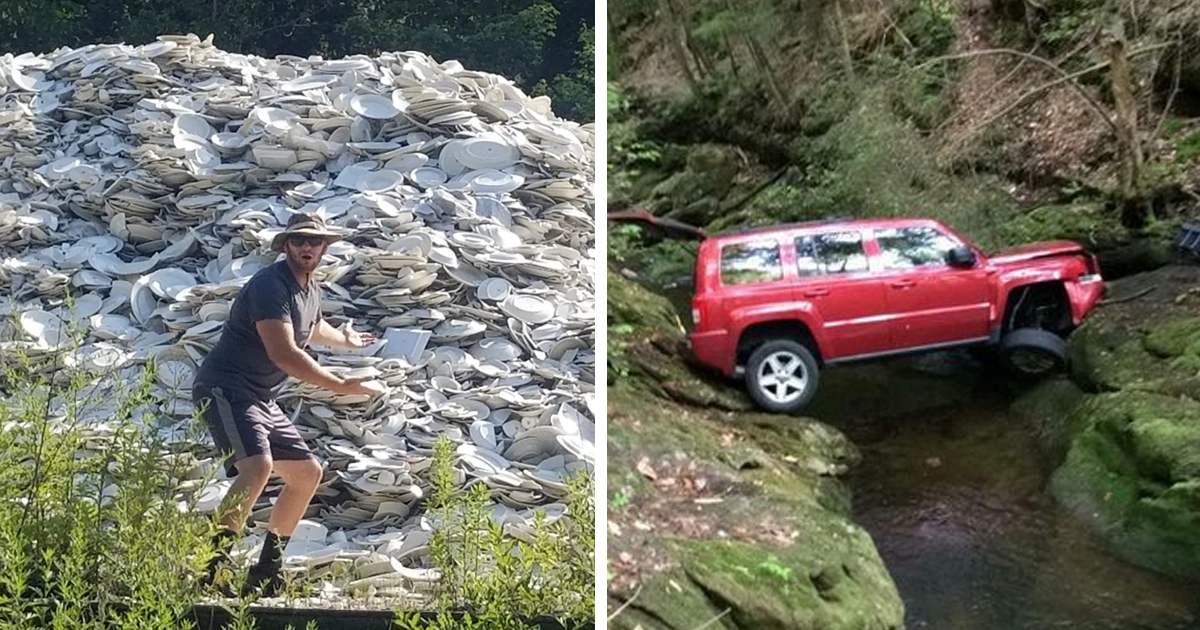
4. An Overgrown Car That Has Become an Ecosystem
Old vehicles occasionally remain where they broke down, crashed, or were dumped decades ago. Moss covers the hood, saplings grow through the engine compartment, and mice move into the upholstery without asking about the mileage.
5. Giant Dinosaurs From an Abandoned Theme Park
Life-size fiberglass dinosaurs hidden among real trees create a wonderfully confusing timeline. Several former roadside attractions and amusement parks have left oversized animals, broken rides, and fading signs behind in the woods.
6. The Remains of a Medieval Village
Abandoned Renaissance-fair properties can contain fake castles, timber stages, tavern façades, and crumbling towers. Encountering one unexpectedly feels like discovering that a low-budget fantasy kingdom lost a war against poison ivy.
7. An Old Fire Lookout Tower
Historic lookout towers still stand in many forests. Some remain active, while others have been retired. From below, an empty tower rising above the canopy can resemble either a valuable piece of conservation history or the headquarters of a very patient villain.
8. Mining Equipment Miles From the Nearest Road
Rusting boilers, rails, cables, ore carts, and machinery may mark forgotten mining operations. Their remoteness seems impossible until you remember that roads, settlements, and industries can vanish while several tons of iron stubbornly refuse to leave.
9. Telegraph Insulators Embedded in Old Trees
Some historic communication lines used living trees as convenient supports. Decades later, hikers may spot wire, brackets, or glass insulators partly swallowed by barka reminder that even the information superhighway once had squirrels running across it.
10. A Stone Wall Deep in the Forest
Old stone walls often reveal that today’s woodland was once pasture or farmland. Trees returned after fields were abandoned, but the walls remained, stretching through the forest like property boundaries drawn for ghosts.
Historical Objects That Should Stay Exactly Where They Are
11. A Stone Projectile Point
A carefully shaped point may be an archaeological object rather than a souvenir. Its position can help researchers understand how people used a site. Photographing it without moving it preserves far more information than dropping it into a backpack.
12. A Patch of Stone Flakes
Small flakes left from toolmaking may look insignificant, yet archaeologists often find them more frequently than complete tools. A cluster can indicate where people once worked, camped, or traveled.
13. Pottery Fragments Among the Leaves
Decorated or unusually shaped ceramic pieces can be historic or archaeological material. Their relationship to nearby soil, structures, and other objects matters, which is why moving them can erase part of the story.
14. A Mysterious Ring of Rocks
A rock circle might be a recent fire ring, a historic feature, or something much older. The correct response is not immediate amateur excavation. Take pictures, note the location privately, and contact the appropriate land manager.
15. Antique Bottles Near an Old Campsite
Glass bottles can survive long after labels, buildings, and owners disappear. Their shapes, seams, colors, and manufacturing marks may provide clues about age, trade, medicine, food, or daily life at a former camp.
16. A Rusted Object That Looks Suspiciously Military
Old training grounds and former defense sites can contain munitions or fragments that do not resemble modern weapons. Never kick, pick up, clean, or reposition a suspicious metal object. Retreat along the route you used and report it to authorities.
Animal Evidence That Looks Like a Warning From the Forest
17. A Perfectly Clean Animal Skull
Sun, insects, scavengers, and weather can reduce remains to surprisingly clean bones. A skull may look like a dramatic omen, but it is usually evidence of the forest’s extremely efficient recycling department.
18. A Huge Shed Antler
Deer, elk, and related animals naturally shed antlers. Rodents later gnaw them for minerals, so tooth marks are normal. Collection rules vary, and some protected lands prohibit removing antlers, skulls, bones, and other natural objects.
19. A Dense Pile of Small Bones
A concentration of bones can form below a predator’s feeding perch, den, or nest. Raptors may carry prey to the same location repeatedly, leaving a miniature archaeological site devoted entirely to lunch.
20. A Gray Pellet Packed With Fur and Teeth
Owls and other birds regurgitate compact pellets containing material they cannot digest. Pulling one apart can reveal tiny bones, but finding it unexpectedly may initially suggest that the forest has started manufacturing cursed granola bars.
21. Snakeskin Woven Into a Bird’s Nest
Some birds deliberately place shed snakeskin in their nests. Research suggests it may discourage certain predators. To an uninformed hiker, however, it looks as though a bird has decorated its nursery with a tiny warning flag.
22. A Nest Made With Human Objects
Birds sometimes incorporate string, plastic, fabric, fishing line, paper, or other manufactured materials into nests. The result can be colorful, but synthetic fibers and netting may entangle adults or chicks.
23. A Hole in a Tree That Appears Professionally Built
Woodpecker cavities can be remarkably round. Once the original builder leaves, other birds and mammals may move in. One forest apartment can pass through many tenants, none of whom will return your security deposit.
24. A Tiny Door-Shaped Opening at Ground Level
Roots, erosion, rodents, insects, and decay can create openings with suspiciously architectural proportions. Add a miniature door placed by a playful visitor, and the internet immediately concludes that woodland real estate has become unaffordable for fairies too.
Trees That Apparently Chose Body Horror
25. A Massive Burl Resembling a Face
Burls are rounded woody swellings that continue growing with a tree. Their folds often resemble eyes, noses, mouths, or entire human faces because our brains are enthusiastic pattern-detection machines with very little respect for personal boundaries.
26. A Tree Swallowing a Metal Sign
Tree trunks expand outward as they grow, gradually surrounding signs, fences, bicycle parts, or other objects left against them. The tree is not eating the object, although it certainly appears to be taking a very long, fibrous bite.
27. Branches Forming a Witch’s Broom
Dense clusters of shoots can develop after fungal infection, insect activity, plant parasites, genetic changes, or environmental stress. From a distance, the tangled growth may look like a giant nest or a broom parked by someone with questionable transportation choices.
28. Black Knots Wrapped Around Branches
Black knot disease produces swollen growths that eventually become dark, hard, and rough. A badly affected tree can look as though charred animal limbs have attached themselves to its branches.
29. Orange Tentacles Emerging After Rain
Cedar-apple rust produces orange, gelatinous structures on infected junipers during wet spring weather. These bright tendrils shrink when conditions dry, making the tree appear to alternate between ordinary conifer and deep-sea creature.
30. Two Trees Fused Into One
Closely positioned trunks or branches can rub together until their tissues join. The resulting natural graft may create arches, windows, or intertwined forms that resemble woodland sculpture.
Fungi and Slime Molds With Excellent Alien Costumes
31. A Bright Yellow Blob Crawling Across a Log
Slime molds can appear as yellow, white, gray, or purplish masses before drying into crusty structures. Despite their appearance, they are not alien eggs, spilled paint, or evidence that the log has developed a digestive system.
32. A Mushroom That Smells Like Something Died
Stinkhorn fungi use powerful odors to attract flies that spread their spores. They can emerge rapidly from egg-like structures and develop bizarre shapes, combining botanical elegance with the fragrance of a dumpster experiencing personal difficulties.
33. A Perfect Circle of Mushrooms
Fairy rings form when underground fungal growth expands outward and mushrooms appear around the edge. Folklore supplied dancing fairies; biology supplied mycelium. Both explanations are more charming than “circular fungus colony.”
34. Shelving Made Entirely of Fungi
Bracket fungi grow outward from wood in layered fans. A long stack can resemble a staircase, a row of dinner plates, or an apartment complex designed for beetles.
35. White Threads Beneath a Rotting Log
Fine fungal structures may spread through soil, roots, and decaying material. Mycorrhizal fungi form relationships with plants, exchanging resources belowground. The visible threads are only a small glimpse of a much larger biological network.
36. A Fallen Log Covered in New Trees
A decaying nurse log can hold moisture and nutrients while supporting seedlings, mosses, fungi, insects, and small animals. What looks like a dead tree may function as a crowded nursery with unusually relaxed building codes.
Geological and Human-Made Mysteries
37. One Enormous Boulder That Matches Nothing Nearby
A glacial erratic is a rock transported by moving ice and deposited far from its original source. Sitting alone among different local rock, it can look as though a giant placed it there and forgot to finish the landscaping.
38. Wood That Has Turned to Stone
Petrified wood preserves the shape and structure of ancient trees after minerals replace organic material. A piece can resemble freshly split timber until its weight reveals that the lumber department closed millions of years ago.
39. A Secret Box Disguised as Part of the Forest
Geocaches may be hidden inside artificial rocks, hollow logs, fake bolts, birdhouses, or weatherproof containers. Finding one accidentally can feel like uncovering spy equipment, although the contents are usually a notebook and several tiny plastic dinosaurs.
40. A Shiny Monolith or Unexplained Art Installation
Metal columns, mirrored panels, hanging doors, doll arrangements, and homemade shrines periodically appear in remote places. Some are commissioned art, some are pranks, and others remain unattributed. Either way, they guarantee that the return hike will be much faster.
What It Feels Like to Discover Something Weird in the Woods
The strangest part of an unusual forest discovery is often the moment before you understand what you are seeing. Your brain begins with familiar categoriesanimal, plant, rock, buildingand then briefly crashes when the object refuses to cooperate.
A burl becomes a face. A mossy automobile becomes a sleeping creature. An owl pellet becomes evidence of a miniature crime scene. A concrete staircase surrounded by mature trees produces an especially strong sense of wrongness because stairs are supposed to connect places. When there is no visible destination, the imagination cheerfully supplies one, usually involving ghosts with excellent masonry skills.
These discoveries also change the pace of a hike. People stop talking, circle the object, take photographs, and debate theories. Someone confidently announces an explanation based on absolutely no qualifications. Another person searches for cell service. The most cautious member of the group says, “We probably shouldn’t touch that,” and is almost always correct.
Photographs are useful, but context matters. Capture the object from a safe distance and include nearby trees, trails, rocks, or structures for scale. Avoid posting exact coordinates for fragile archaeological sites, rare plants, nests, or objects that could attract collectors and vandals. A mysterious find can become damaged quickly once its location spreads online.
Resisting the urge to take something home is equally important. An old bottle may contribute to a historic site. A skull or antler may provide minerals and habitat value. A strange plant could be rare. A military-looking object could be dangerous even when it appears rusty, broken, or empty. The safest souvenir is usually a photograph and a story your friends will pretend not to envy.
When a discovery may involve human remains, weapons, hazardous materials, damaged infrastructure, an active wildlife den, or a possible archaeological site, leave the area undisturbed and contact local authorities, park staff, or the relevant land-management agency. Do not investigate by poking it with a hiking pole. Humanity has developed telephones specifically so we can stop solving every mystery with a stick.
It also helps to accept that not every mystery will receive a satisfying answer. Forests alter evidence continuously. Roots move stones. Floods carry objects. Scavengers scatter bones. Trees grow around metal. Fungi transform familiar surfaces into strange shapes. A discovery may be natural, historical, accidental, artistic, or all four at once.
That uncertainty is part of the appeal. Weird things found in the woods remind us that landscapes have histories extending far beyond the afternoon we happen to walk through them. A quiet trail may cross former farmland, an old transportation route, a forgotten settlement, an animal territory, and an underground fungal network within a single mile.
The next time you head into the forest, pay attention to details that do not fit. Look for lines too straight to be natural, stones arranged with unusual regularity, plants with unexpected structures, or trees growing around objects. Stay on permitted routes, respect closures, and leave discoveries in place. You may not solve the mystery, but you could come home with a photograph that makes everyone ask the same irresistible question: “What on earth is that?”