Note: This original article synthesizes real information from wildlife organizations, museum explainers, scientific research, and reputable reporting about London’s ring-necked parakeets. Source links are intentionally omitted as requested.
London in winter usually arrives wearing its classic uniform: gray sky, damp pavement, bare branches, and a breeze that somehow feels personal. So when a leafless tree suddenly appears to glow bright green at dusk, the first thought is not usually, “Ah yes, parrots.” It is more like, “Did spring get lost and land in January?”
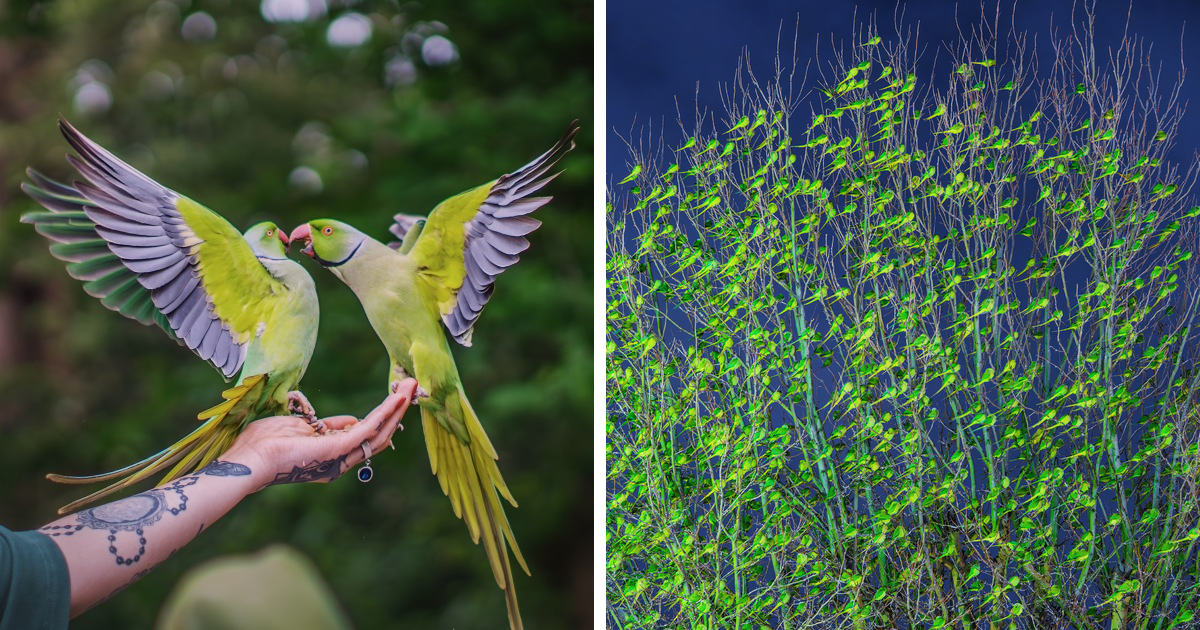
Then the tree moves. It chirps. It squabbles. It flaps. And suddenly the mystery solves itself: those “leaves” are not leaves at all. They are ring-necked parakeets, hundreds or even thousands of them, gathering in a communal winter roost and turning London’s ordinary cold-season scenery into something that looks as if a tropical screensaver has escaped into real life.
The photo series behind the title “I Thought London’s Winter Had Turned Green, Until I Realized It Was A Thousand Parakeets (35 Pics)” captures exactly that strange magic. It is a visual surprise, but it is also a story about urban wildlife, climate tolerance, migration by accident, public fascination, and the complicated question of what happens when a non-native species becomes part of a city’s identity.
Meet London’s Bright Green Winter Residents
The birds in these pictures are ring-necked parakeets, also known as rose-ringed parakeets. Their scientific name is Psittacula krameri, which sounds like a spell you would say before turning a London plane tree into a parrot hotel. They are medium-sized parrots with vivid green bodies, long tapering tails, strong red beaks, and pointed wings. Adult males often show a dark and rosy ring around the neck, while females and younger birds may look plainer but are still unmistakably green.
They are not native to Britain. Their natural range includes parts of South Asia and Africa, yet they have become one of the most recognizable birds in London’s parks, gardens, cemeteries, and leafy neighborhoods. In a city famous for pigeons acting like they own the lease, the parakeets bring a very different energy: louder, flashier, and more tropical than anyone expects from a British winter.
Why Do Parakeets Gather In Such Huge Winter Flocks?
The “thousand parakeets” effect is most dramatic in winter because bare trees make the birds easier to see. During spring and summer, green parakeets vanish into green foliage like tiny feathered ninjas. In winter, however, their bodies stand out against black branches, silver bark, and twilight skies. A single bird is charming. Fifty birds are surprising. A thousand birds make the tree look as if it has given up on botany and chosen performance art.
Large communal roosts also serve practical purposes. Roosting together can help birds reduce individual risk from predators, share information about feeding areas, and settle into protected spots after a day of foraging. At dusk, parakeets often arrive in waves, calling loudly as they choose branches, jostle for position, and engage in the kind of noisy neighborhood negotiation that would make any apartment board meeting look peaceful.
For photographers, the result is irresistible. The birds glow against the dimming sky. Wings blur into green streaks. Bare branches become crowded with color. The flock looks chaotic at first, but there is rhythm in it: arrivals, departures, calls, pauses, and sudden bursts of flight.
How Did Parakeets End Up In London?
Ask ten Londoners where the parakeets came from, and you may hear ten confident answers, half of them involving celebrities, movie sets, or storms. The most famous legend claims that Jimi Hendrix released parakeets in London during the 1960s. Another says they escaped during the filming of The African Queen. A third blames damaged aviaries after the Great Storm of 1987.
These stories are delightful, but the real explanation is probably less cinematic and more ordinary: escaped or released pet birds gradually established breeding populations. Scientific research suggests the population did not come from one single dramatic release, but likely from multiple introductions over time. By the late 1960s, breeding populations were being confirmed around London and Kent. Once the birds found suitable nesting holes, steady food, and relatively mild urban conditions, they did what successful city dwellers do: they adapted, multiplied, and got louder.
The Myth Is Fun, But The Biology Is Better
The celebrity origin stories survive because they are colorful, and colorful stories pair nicely with colorful birds. But the more interesting truth is that ring-necked parakeets are highly adaptable. They can live in cities, use mature trees for nesting, eat a varied diet, and tolerate cooler climates better than many people assume. They did not need a rock star rescue mission. They needed opportunity, and London gave them plenty.
Why London Is Perfect For Them
London may not seem like parrot paradise if your main experience of it involves wet socks and delayed trains, but from a parakeet’s point of view, the city has excellent amenities. It has mature parks with old trees, private gardens, cemeteries, riverside greenery, and year-round food sources. It also has people who plant fruiting trees, hang bird feeders, drop snacks, and sometimes intentionally feed wildlife, even when park authorities ask them not to.
Ring-necked parakeets are opportunistic feeders. They eat seeds, nuts, berries, fruit, buds, flowers, and other plant material. In gardens, they may visit bird feeders for peanuts, sunflower seeds, and fat-based foods. In parks, they forage in trees and shrubs. Their diet is flexible enough to help them survive seasonal changes, and their social behavior helps them locate food efficiently.
They Love Tree Holes
Parakeets nest in cavities, which means they rely on holes in trees, wall crevices, or existing spaces rather than building open nests like many familiar garden birds. Mature trees are especially valuable because older trunks often contain natural hollows or cavities previously used by other species. This explains why historic parks, large gardens, and woodland edges can become prime parakeet real estate.
They Are Loud For A Reason
Many Londoners hear the birds before they see them. Their calls are sharp, ringing, and persistent. To some people, the sound is cheerful and exotic. To others, it is the audio equivalent of a smoke alarm with wings. Either way, the noise is part of their social life. Flock birds communicate constantly, especially while flying, feeding, and roosting.
Are London’s Parakeets Beautiful, Invasive, Or Both?
This is where the story gets more complicated than “green birds are cute.” Ring-necked parakeets are widely considered a non-native or invasive species in the UK. That does not mean every individual bird is a villain twirling its tiny mustache. It means the species was introduced outside its natural range and may affect ecosystems, agriculture, or native wildlife.
Potential concerns include competition for nesting cavities with native birds and bats, pressure at garden feeders, damage to fruit crops, and impacts on trees, flowers, or buds in areas where numbers are high. In some European cities, parakeets have raised serious management debates. In Britain, scientists and conservationists continue to monitor their spread and ecological effects, especially as their numbers expand beyond London and southeast England.
At the same time, public reaction is mixed. Many people love them. They bring color to winter, excitement to parks, and a sense of surprise to ordinary commutes. Children notice them. Tourists photograph them. Even people who know nothing about birds often stop and stare when a flock flashes overhead. The parakeet debate is not simply science versus sentiment; it is also about how cities change, how people define “belonging,” and whether urban nature must always look like it did a century ago.
What The 35 Pictures Really Show
A gallery like “35 Pics” does more than say, “Look, birds!” It shows scale. One parakeet on a branch is a portrait. Several parakeets in flight are a wildlife moment. Hundreds packed into a winter tree become a phenomenon. The pictures likely work because they create a double take: the viewer first sees a green tree, then realizes the green is alive.
That surprise is the heart of the story. London’s winter palette is usually muted, but the parakeets interrupt it with impossible brightness. Their plumage looks almost artificial against the season’s browns and grays. When photographed at dusk, the contrast becomes even stronger: neon-green birds, black branches, and a deep blue or purple sky. Nature rarely looks this edited without actually being edited.
Why Winter Makes The Photos So Striking
Winter removes visual clutter. Without leaves, every bird becomes visible. Branches create natural lines, silhouettes, and frames. The parakeets become both subject and pattern: individual animals and repeated shapes. In a wide shot, they look like ornaments. In a close-up, they look alert, clever, and slightly judgmental, as parrots often do.
The Best Moments To Photograph Them
The most dramatic time to see large gatherings is usually around dusk, when birds return to roost. Morning can also be active as flocks leave to feed. A longer lens helps capture behavior without disturbing the birds. For ethical wildlife photography, keeping distance matters. So does avoiding hand-feeding, chasing, shouting, or using flash directly at roosting birds. The goal is to document the spectacle, not become the reason the spectacle panics and flies into the next borough.
Where People Often Spot Them In London
Ring-necked parakeets are now associated with many parts of London, especially the west and southwest. Parks such as Richmond Park, Kensington Gardens, Hyde Park, St. James’s Park, and areas around Wormwood Scrubs have become known for sightings, though the birds also appear in gardens, neighborhoods, and smaller green spaces. They are not restricted to postcard locations. Sometimes the best encounter happens above a bus stop, behind a supermarket, or in a car park where a tree suddenly sounds like a tropical argument.
One reason they feel so London now is that they occupy both grand and ordinary spaces. They are in royal parks and back gardens, near historic buildings and suburban feeders. They fly over traffic, perch in plane trees, and treat the city as a connected habitat rather than a map of human neighborhoods.
Should You Feed London’s Parakeets?
It may be tempting to feed them, especially when they appear bold enough to land near people. But wildlife organizations and park managers generally discourage feeding wild animals. Human food can be unhealthy, repeated feeding can change behavior, and crowded feeding spots may increase disease risks or pressure on other wildlife. Bread, crisps, sweets, and processed snacks are especially unsuitable. A parakeet does not need a potato chip, no matter how convincingly it looks at you.
The best approach is simple: observe, photograph respectfully, and let the birds forage naturally. London’s parks already provide food sources that are better suited to wildlife. Enjoying parakeets does not require turning yourself into a walking buffet.
Why These Birds Feel Like A Symbol Of Modern London
London has always been a city of arrivals. People, foods, languages, plants, architecture, and ideas have layered themselves into the city for centuries. The parakeets fit awkwardly but vividly into that pattern. They are not native, and their ecological role deserves serious attention. Yet they are also undeniably present, undeniably successful, and undeniably part of the everyday experience of many Londoners.
That tension is what makes them interesting. They are beautiful and problematic, beloved and criticized, natural and unnatural depending on how wide your definition of nature is. They remind us that cities are not separate from wildlife. Cities are habitats, and wildlife responds to them in unexpected ways.
When a thousand parakeets turn a winter tree green, the scene feels almost comic. But it also reveals something serious: urban ecosystems are alive, flexible, and changing. Some changes are joyful. Some require management. Most are both at once.
Experience: A Winter Walk Under A Living Green Sky
The first time you encounter a major parakeet roost in winter, it can feel less like birdwatching and more like stumbling into a secret meeting. The street may be ordinary. The air may be cold enough to make your fingers question your life choices. Then you hear the calls: sharp, bright, and layered, coming from somewhere above the roofs or beyond the park railings. At first, the sound is hard to place. It is too tropical for the temperature and too excited for the hour.
As you get closer, the sky begins to move. Small green shapes cross overhead in pairs and clusters, all flying toward the same place. They come from different directions as if the whole city has sent out parakeet invitations. One flock cuts over the road. Another swings around a block of flats. A few birds land early, gripping the upper branches with red beaks tucked briefly into feathers before another wave arrives and starts the negotiations all over again.
The tree itself becomes the main character. A few minutes earlier, it was just another winter skeleton. Now it is alive from trunk to tip. Birds line the branches like glowing punctuation marks. Some hang upside down. Some shuffle sideways. Some appear to argue over a twig that, to human eyes, looks identical to every other twig. The noise rises and falls. Wings flick open. Tails overlap. Green bodies turn golden whenever they catch the last available light.
What makes the experience memorable is not only the number of birds, but the mismatch between expectation and reality. London winter trains you to look for subtle beauty: reflections in puddles, warm windows, a brave crocus, the clean geometry of bare trees. The parakeets are not subtle. They arrive like confetti with opinions. They make the season feel briefly theatrical, as if the city has decided to brighten itself without asking permission.
People react in wonderfully human ways. Some stop mid-walk and stare upward with their mouths open. Some take photos that will later be captioned, “You won’t believe this.” A few locals pass by with the casual confidence of people who have seen the show before. Children point. Dogs remain deeply unimpressed unless snacks are involved. Photographers lift cameras and try to catch the exact instant when the flock becomes a pattern instead of a blur.
Standing under that tree, it is easy to understand why the parakeets inspire such strong feelings. They are noisy, bold, and impossible to ignore. They are also beautiful in a way that feels almost rude during winter, like someone wearing a lime-green suit to a funeral and somehow pulling it off. You may arrive thinking you are looking at an odd seasonal trick of the light. You leave knowing you have seen one of London’s strangest urban wildlife spectacles: not a tree turning green, but a thousand green lives choosing the same tree for the night.
Conclusion
London’s ring-necked parakeets are more than a surprising photo opportunity. They are a living example of how wildlife adapts to cities, how myths grow around unusual animals, and how beauty can arrive with ecological questions attached. The winter roosts are especially unforgettable because they transform bare branches into green, noisy, living architecture.
Whether you see them as charming neighbors, disruptive newcomers, or complicated symbols of urban change, one thing is certain: London’s parakeets know how to make an entrance. In a season of gray skies and leafless trees, they bring the kind of color that makes people stop, look twice, and reach for a camera.