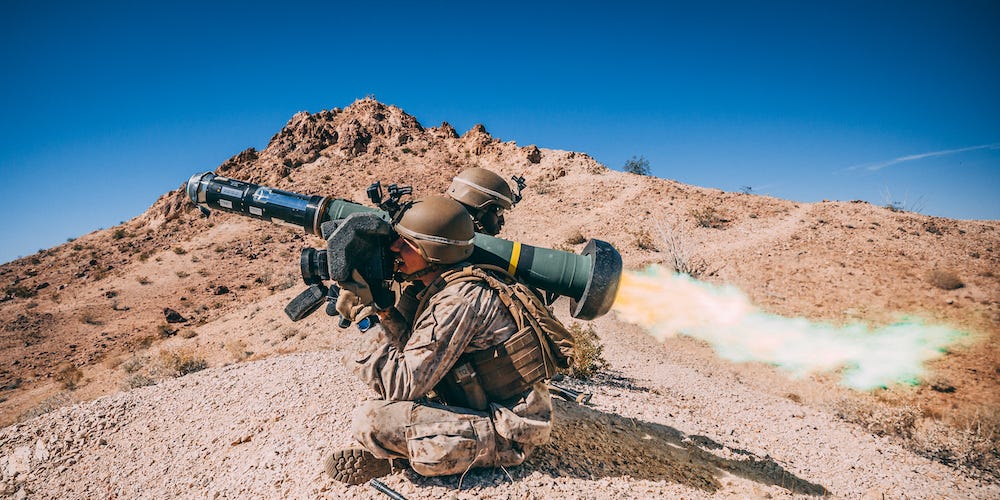
If you’ve been following Ukraine’s battlefield improvisation, you already know the vibe: someone looks at a piece of gear,
asks “Can it do this too?”and the answer is increasingly, “Honestly… yeah, kind of.”
The latest headline making the rounds says Ukraine’s Javelin missiles can take on cruise missiles now. That sounds like a
plot twist, because the FGM-148 Javelin is famous for turning tanks into instant scrap, not for swatting fast, low-flying
threats out of the sky.
Here’s the real story (and it’s still genuinely interesting): the Javelin system’s upgraded launcherthe
Lightweight Command Launch Unit (LWCLU)has been demonstrated firing Stinger missiles.
In other words, the “Javelin” part of the headline is mostly about the launcher’s optics and networking, not the
anti-tank missile suddenly becoming a cruise-missile interceptor. It’s less “tank killer learns to dogfight,” and more
“high-end thermal sight gets a second job.”
The headline needs a footnote: Javelin the missile vs. Javelin the launcher
The FGM-148 Javelin is a man-portable, fire-and-forget anti-tank guided missile system designed primarily for armored
vehicles, with acknowledged capability against certain other targets (like fortifications and helicopters). It’s been a
major part of Ukraine’s anti-armor success since 2022, and it’s one reason the Javelin industrial base has been ramping
up production. But “Javelin takes on cruise missiles” doesn’t mean Ukrainian teams are lobbing anti-tank rounds at
Kalibrs and calling it a day. The physics (and economics) would be… adventurous.
The more accurate takeaway is this: a newer Javelin launcher can be paired with a Stinger
surface-to-air missile, creating a more capable shoulder-fired air-defense setup than older Stinger sights typically
allow. That matters because cruise missiles and drones are often hardest to defeat at the “close-in” layerwhen they’re
low, moving fast, and giving defenders very little time to see, decide, and engage.
Meet the LWCLU: the Javelin’s “smart binoculars” got lighterand more versatile
Think of a command launch unit as the brains and eyes of a shoulder-fired missile system. The LWCLU is an upgraded,
lighter version of the original Javelin CLU, built around improved sensors, displays, and image processing. The pitch is
straightforward: better target detection and recognition, in a package that’s easier to carry and faster
to employespecially at night or in poor visibility.
According to Raytheon (an RTX business), the LWCLU weighs less than the prior unit and provides dramatically improved
sight range and image quality. But the eyebrow-raiser is what comes next: Raytheon has publicly describedand
demonstratedfiring a Stinger missile from a Javelin LWCLU, validating a combined
capability against airborne targets. In a 2021 test at Eglin Air Force Base, the LWCLU was networked and used with a
Stinger missile to engage and defeat a UAV target, with sensor cueing and command-and-control support in the loop.
That matters because the Stinger’s legacy setup can be extremely “Mark-1 Eyeball” heavygood operators can do a lot, but
giving them a modern infrared optic and potential network cueing is a serious upgrade in how quickly they can find and
track small, low-contrast threats.
Why “better optics” is not a small thing
Cruise missiles, drones, and loitering munitions don’t politely announce themselves. They can be low, fast, and
background-clutteredmeaning the defender’s biggest problem is often the simplest one: seeing the threat in
time. Better thermal imaging, clearer video, and improved image processing turn “I think I heard something” into
“I have a track, I have confidence, I can act.”
The War Zone has also highlighted that the LWCLU can be networked so an operator can receive targeting
data from off-board sensors via command-and-control systemsanother step up from the classic “spot it visually, then
shoot” approach that older MANPADS often rely on.
So… can this actually help against cruise missiles?
Let’s be precise: cruise-missile defense is usually a job for layered systemsradars, command-and-control, and interceptors
optimized for speed and timing. But the real world doesn’t always hand you the perfect tool at the perfect spot.
Ukraine’s air defense has had to stretch across cities, energy infrastructure, and frontline units while facing mixed
salvos of drones and missiles. When you have gaps, you fill them.
A shoulder-fired interceptor like Stinger is not “the answer” to cruise missiles. But it can be a
answerespecially in last-ditch situationsif three things happen:
- The threat is detected and identified early enough to get a shot off.
- The shooter has a stable track and the confidence to engage quickly.
- The missile’s lethality is sufficient against small, fast targets (including with enhancements like proximity effects).
This is where the LWCLU’s strengths matter. A Stinger on a basic launcher is limited by what a human can spot and track.
A Stinger paired with a high-quality thermal sightand potentially network cueingshrinks the “find and decide” part of
the timeline. And in air defense, saving seconds is not a nice-to-have; it’s the whole game.
Stinger “PROX” and why proximity effects matter
There’s another piece of the puzzle: improvements to Stinger lethality against small, hard-to-hit targets. Defense News
has reported on U.S. Army testing of Stinger missiles with a proximity capability intended to improve
performance against dronesimportant because a pure hit-to-kill requirement can be brutally unforgiving when targets are
small, maneuvering, or simply hard to “touch” at the last moment. Raytheon has also described using a Stinger
Block I proximity fuse missile in the networked LWCLU demonstration.
Put those ideas together and you get a believable concept: a modernized sighting and cueing setup that helps MANPADS
operators engage difficult aerial targetspotentially including cruise missiles in rare, opportunistic, “in a pinch”
scenarios.
Ukraine has already shown “MANPADS can surprise you”
Popular Mechanics reported in October 2022 that a Ukrainian shoulder-fired air-defense team intercepted a Russian cruise
missile, noting the system in the video was not conclusively identified (it could have been Igla, Stinger, or another
MANPADS). The point isn’t that MANPADS are now cruise-missile magic wands. The point is that in real combat conditions,
low-flying threats sometimes wander into the worst possible place at the worst possible timeright where a motivated
team is waiting with a clean shot.
That’s exactly where an LWCLU-style upgrade could matter: the more reliably a team can spot, track, and commit to a
shot, the more often those rare opportunities turn into actual interceptions.
Why this matters to Ukraine: the air-defense “math problem”
Ukraine’s air defense has to manage a brutal equation: lots of incoming threats, not enough interceptors, and a need to
protect both military forces and civilian infrastructure. Even when high-end systems are available, they can’t be
everywhere at onceand using premium interceptors on cheaper drones can be financially painful and logistically
draining.
That’s why the middle and lower tiers of air defense are so important. Mobile firing units, shoulder-fired missiles,
cueing from radars, and quick-reaction teams create a flexible “mesh” that can defend more places with fewer resources.
A multi-role sight like the LWCLUused for anti-armor by day and air defense by night (or vice versa)fits this reality.
The U.S. pipeline and why “numbers” still matter
Early U.S. security-assistance fact sheets listed deliveries and commitments including thousands of Javelin anti-armor
systems and large quantities of Stinger systems for Ukraine. Later announcements continued to include both Stinger
missiles and Javelin/anti-armor systems in packages intended to address urgent battlefield needs, including air defense.
In parallel, the Javelin Joint Venture has described major production ramp-ups to replenish stocks and meet demand.
The practical implication: if you already have Javelin launch units in the ecosystem (and Ukraine has had a lot of
Javelin-related support), adding flexibility at the launcher/sight level is an efficient way to stretch capability
without inventing an entirely new system from scratch.
What this capability isand what it is not
What it is
- A survivable, mobile, short-range air-defense option that can be moved with small teams.
- An optics and cueing upgrade that helps operators detect and track difficult aerial targets faster.
- A logistics simplifier in some scenarios: fewer separate “boxes” to carry if one unit can cover more missions.
- A gap-filler that complements larger systems rather than replacing them.
What it is not
- Not a substitute for Patriot, NASAMS, IRIS-T, or other dedicated air-defense systems with larger engagement envelopes.
- Not a guaranteed cruise-missile solution; it’s opportunistic and depends heavily on detection, positioning, and timing.
- Not a “one weird trick”; sustained defense still requires layered sensors, command-and-control, and steady interceptor supply.
In short: pairing Stinger with the LWCLU can make the lower tier sharper and more responsivebut it doesn’t magically
turn every shoulder-fired team into a cruise-missile shield.
Zooming out: modern warfare loves “multi-role” systems
One of the clearest trends in modern conflict is that systems are being asked to do more than their original job.
Anti-tank missiles have been used against helicopters and drones; air-defense sensors are being cued by distant systems;
command-and-control is trying to connect every sensor to every shooter. The LWCLU fits this pattern perfectly: it’s a
launcher, a high-quality optic, and (in some configurations) a node that can be connected to a wider network.
And for Ukrainewhere the threat set changes by the week and the defense has to adapt in real timeflexibility is not a
buzzword. It’s survival economics.
Quick FAQ (because readers will ask anyway)
Can a Javelin missile shoot down a cruise missile?
The Javelin is primarily an anti-armor weapon. Some analysts note anti-tank missiles can have secondary anti-air
utility against certain slow, low-flying targets, but the “cruise missile” angle here is better understood as
the Javelin LWCLU enabling Stinger launches, not the anti-tank missile suddenly becoming a standard
cruise-missile interceptor.
What’s the real upgrade: the missile or the sight?
Mostly the sight (and the system integration). A better thermal optic and potential network cueing can meaningfully
improve how fast a team can detect, track, and engage aerial targets using Stinger missiles.
Why not just use bigger air-defense systems everywhere?
Because geography, cost, and inventory are real. Larger systems are limited in number, require more support, and can’t
be placed everywhere at once. Short-range, mobile teams help cover gaps and protect more points on the map.
Field Notes: of “Experience” From the Idea in Action
Imagine you’re on a cold night shift with a small air-defense team. You’re not sitting in a high-tech command center
with a wall of screens; you’re in the real world, where the sky is huge, the horizon is cluttered, and every odd sound
could be nothingor it could be the start of a very bad minute. What you want most is clarity. Not drama, not hype:
clarity.
That’s the part people miss when they talk about “interceptors” like they’re abstract chess pieces. The first battle is
almost always perception. Can you see what’s coming? Can you tell what it is? Can you decide fast
without guessing? A launcher like the LWCLU changes the emotional temperature of that moment. Better thermal imagery
doesn’t just make the picture prettierit makes the decision less shaky. Instead of scanning and second-guessing, you’re
confirming. Instead of “I think,” you get closer to “I know.”
Now layer in the messy reality of Ukraine’s air-defense fight: drones that buzz in by the dozens, missiles that arrive
in mixed waves, shifting routes, nighttime attacks, and the constant pressure of protecting something that mattersan
electrical substation, a bridge, a warehouse full of repair parts, a neighborhood that just wants to sleep. In that
environment, a piece of gear that can switch roles feels like a gift. The “tank killer” kit you trained on doesn’t get
stuck in one lane. The same optic that helps you spot ground threats can help you hold a steady track on a small airborne
signature that would have been easy to miss before.
There’s also a very practical kind of confidence that comes from not hauling a whole extra set of specialized equipment.
When your team can carry less and do more, you move faster, you reposition faster, and you’re harder to predict. That’s
not a Hollywood detailit’s the boring, decisive stuff. Mobility is its own form of protection.
And then there’s the moment everyone imagines: the sudden cue, the quick confirmation, the snap of action. You don’t
celebrate in the moment. You don’t do speeches. You do the next step. You check again. You stay ready. Because in a war
of repeated strikes, the goal isn’t one dramatic saveit’s consistency. It’s turning a chaotic sky into something that
can be managed, one decision at a time.
That’s why the “Javelin takes on cruise missiles” storyline resonates, even if the technical detail is more nuanced.
People aren’t cheering for a headline. They’re cheering for an idea: adaptation. The ability to take
what you have, make it sharper, and widen the set of problems it can solveespecially when the threats don’t wait for
you to be perfectly equipped.
Conclusion
Ukraine’s Javelin system isn’t literally transforming into a dedicated cruise-missile interceptor. But the
LWCLU’s combination of improved optics, potential networking, and demonstrated compatibility with Stinger
points to something that matters just as much: a more flexible, faster-reacting short-range defense layer that can help
catch difficult threats in the moments when timing and visibility decide everything. In a war defined by mixed salvos
and constant adaptation, that “second job” for a Javelin launcher is exactly the kind of advantage you takeespecially
when you can’t afford gaps.