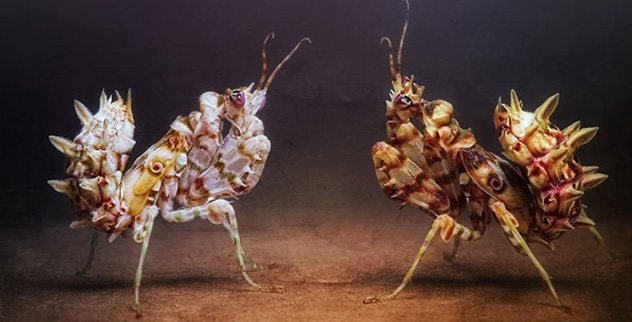
Some insects look like they were designed by evolution. Others look like they were sketched during a late-night sci-fi meeting where nobody said, “Maybe that’s too much.” Our planet is packed with alien-looking insects that glow, spray chemicals, wear disguises, fake being flowers, carry trash like fashion accessories, and stroll around with body parts that seem borrowed from unrelated animals.
The wild part? These bizarre insects are not fantasy creatures. They are real, breathing, crawling, flying examples of adaptation. Their strange bodies help them hunt, hide, mate, defend themselves, or simply survive in habitats where “normal” is not a winning strategy. From the orchid mantis that fools pollinators to the bombardier beetle with a built-in chemical cannon, these weird insects prove Earth already has its own alien world. We just call it nature.
Why Do Some Insects Look So Alien?
Insects have been experimenting with body plans for hundreds of millions of years, and they are very good at it. Their exoskeletons, segmented bodies, wings, mouthparts, and fast life cycles give evolution a lot of material to work with. Add predators, camouflage, competition, and courtship, and suddenly you get a bug that looks like a flower, a thorn, a lizard head, or a walking pile of lint.
These strange insects may seem ridiculous at first glance, but almost every odd feature has a job. A horn can help win a mate. A fake eye can scare a bird. A glowing body can warn predators. A dead-ant backpack can turn a tiny hunter into a horror-movie extra with excellent survival odds. So, before we judge these creatures for looking like they crash-landed from Planet Nope, let’s give them credit: they are not weird by accident.
10 Insects That Belong in an Alien World
1. Orchid Mantis: The Flower That Bites Back
The orchid mantis looks like a delicate pink-and-white blossom until it suddenly grabs dinner with spiny forelegs. Found in Southeast Asia, this mantis has petal-like limbs and floral coloring that help it blend into vegetation and lure unsuspecting pollinators. It is not just hiding near flowers; it can look attractive enough to fool insects that normally visit flowers for nectar.
This is aggressive mimicry at its most glamorous. The orchid mantis does not need a billboard saying “free snacks.” Its body is the billboard. Flies, bees, and other insects approach, expecting a peaceful meal. Instead, they meet the insect equivalent of a velvet rope bouncer with knives for arms. Beautiful? Absolutely. Friendly? Not unless you are too large to eat.
2. Brazilian Treehopper: The Tiny Bug With Sci-Fi Headgear
If aliens needed helmets for a microscopic parade, they might borrow ideas from the Brazilian treehopper. Treehoppers are known for their enlarged pronotum, the body segment behind the head, which can grow into dramatic shapes. Some look like thorns, leaves, ants, or bizarre antenna towers. The Brazilian treehopper, often associated with the species Bocydium globulare, is famous for its ball-tipped structures that look wildly impractical until you remember that predators are easily confused customers.
Treehoppers feed on plant sap with piercing mouthparts, but their visual drama is what makes them unforgettable. Their odd “helmets” may help with camouflage, mimicry, or predator confusion. Scientists have found that treehopper helmet development involves genetic pathways related to wings, which makes the whole thing even stranger. It is not a hat. It is not a wing. It is a biological “what if?” with legs.
3. Giraffe Weevil: The Insect With a Neck for Drama
The giraffe weevil of Madagascar looks like someone attached a beetle body to a cartoon crane. Males have especially long necks, often much longer than those of females, and they use them in competition with other males. Imagine two tiny red-and-black insects having a neck-wrestling match on a leaf. Nature saw that and said, “Yes, keep it.”
But the neck is not only for insect soap opera combat. Female giraffe weevils use plant leaves to create rolled nurseries for their eggs, and the long-necked body plan is part of a life built around careful plant manipulation. Its bright red wing covers and exaggerated proportions make it look unreal, but the giraffe weevil is a very real example of island evolution producing creatures with personality, style, and absolutely no interest in looking ordinary.
4. Trilobite Beetle: A Living Fossil Costume
Trilobites vanished from Earth long before humans arrived, but trilobite beetles seem determined to keep the aesthetic alive. Female trilobite beetles, found in parts of Southeast Asia, keep a larva-like, flattened, armored appearance as adults. Their bodies resemble ancient marine arthropods, with broad plates and ridges that look more Paleozoic than modern.
The males are much smaller and more traditionally beetle-like, which makes the contrast almost absurd. The female looks like an ancient shield crawling through leaf litter; the male looks like he took a different evolutionary taxi. This condition, where adult females retain juvenile-looking features, is called larviform adulthood. In plain English: she grows up, but she keeps the monster-larva look. Respect.
5. Mantidfly: The Insect Built From Spare Parts
The mantidfly looks like a praying mantis and a lacewing had a design disagreement and both won. It belongs to the order Neuroptera, the same broader group as lacewings and antlions, but its front legs resemble the raptorial graspers of a mantis. With delicate, veined wings and folded predator arms, it seems assembled from a bug parts catalog labeled “advanced level.”
Despite the name, mantidflies are not true flies and are not mantises. They are their own strange thing, which is exactly why they deserve a spot on this list. Some species have larvae with fascinating life histories, including associations with spider egg sacs. Adults hunt small insects and look elegant while doing it, as if they were invited to a garden party and decided to bring ambush tactics.
6. Scorpionfly: The Harmless Insect With a Villain Tail
The scorpionfly has a long beak-like face, patterned wings, and, in males, a curled structure at the end of the abdomen that looks disturbingly like a scorpion’s stinger. The plot twist: it is not a stinger. It is male genitalia. Nature is many things, but subtle is not always one of them.
Scorpionflies belong to the order Mecoptera, a lesser-known insect group with ancient roots. Many adults feed on dead or dying insects, nectar, or rotting fruit. They are not dangerous to people, despite their miniature supervillain appearance. The male’s scorpion-like tail is used in mating, not in attack. So if you see one, you can admire its weirdness without preparing a last will and testament.
7. Giant Wētā: The Cricket That Looks Like It Guards a Dungeon
New Zealand’s giant wētā is one of the most impressive insects on Earth. These large, flightless relatives of crickets and katydids can look prehistoric, with heavy bodies, long antennae, and powerful spiny legs. Some species are among the heaviest insects known, and their size makes them feel less like bugs and more like forest creatures from a fantasy map marked “do not camp here.”
Wētā evolved in New Zealand, where native land mammals were absent for much of the islands’ natural history. In that unusual ecological setting, insects had room to become larger and more prominent than many people expect. Giant wētā may look intimidating, but they are mostly plant eaters and nocturnal wanderers. They are not here to conquer Earth. They are here to nibble leaves and be ancient-looking icons.
8. Bombardier Beetle: The Bug With a Chemical Cannon
The bombardier beetle deserves a special award for “most dramatic exit strategy.” When threatened, it can mix chemicals inside its abdomen and eject a hot, irritating spray toward predators. Some species release the spray in rapid pulses, creating a defensive blast that sounds and functions like something from a tiny action movie.
The chemistry is remarkable. Reactants are stored separately until the beetle needs them, then combined in a specialized chamber. The result is a noxious spray that discourages frogs, ants, spiders, and other would-be diners. Plenty of insects rely on camouflage. The bombardier beetle relies on chemistry and attitude. If an alien engineer designed a pocket-sized defense system, it might accidentally invent this beetle.
9. Debris-Carrying Lacewing Larva: The Walking Trash Monster
Adult lacewings are delicate insects with transparent, net-like wings. Their larvae, however, can look like something swept from under a couch and given a hunger for aphids. Many lacewing larvae are active predators with sickle-shaped jaws, and some carry debris, plant bits, lichen, and even the dried remains of past prey on their backs.
This “junk bug” disguise is not laziness. It is stealth technology. The debris can hide the larva from birds and other predators, and it may also help the larva sneak past ants that guard aphids. Under the messy backpack is a fierce little hunter sometimes called an aphid lion. That is a great name, although “haunted lint nugget” would also be scientifically satisfying.
10. Railroad Worm: The Bioluminescent Night Train
Railroad worms are not worms at all. They are larviform beetles in the glowworm beetle family, and some are famous for producing rows of light along the body. At night, the glowing spots can resemble train windows, which explains the name. Certain species can even produce different colors of bioluminescence, including yellow-green body lights and reddish head lights.
That combination makes the railroad worm feel genuinely extraterrestrial. It crawls through the dark like a living signal system, using light that may help warn predators or play a role in communication. Fireflies get most of the public attention, but railroad worms are the moody underground synth band of the bioluminescent insect world. They glow, they crawl, and they refuse to be normal.
What These Alien-Looking Insects Teach Us
The strangest insects on Earth are not just curiosities. They show how flexible life can be. The orchid mantis demonstrates deception. The treehopper shows how body structures can evolve into elaborate shapes. The bombardier beetle proves that chemistry can be a survival tool. The lacewing larva reminds us that camouflage does not have to be pretty to be brilliant.
Insects also challenge the way we think about beauty. A butterfly is easy to admire. A trash-carrying larva takes a little more emotional maturity. Yet both are part of the same evolutionary story. The more closely we look, the more obvious it becomes that “alien” often just means “life solving problems in ways we did not expect.”
These bizarre bugs also matter ecologically. Predatory insects help control other insect populations. Sap feeders become food for birds, reptiles, spiders, and other animals. Decomposers and scavengers recycle nutrients. Even the weirdest insect is connected to a larger system. Remove enough strange little creatures, and the world becomes less stable, less resilient, and much less interesting.
How to Observe Weird Insects Without Bothering Them
You do not need to travel to another planet to see alien-looking insects. Start with your backyard, porch light, garden, local park, or nearby woodland trail. Look under leaves, along tree bark, near flowers, around compost piles, and in sandy patches where antlions may dig traps. Use a flashlight at night and move slowly. Many insects reveal themselves only after your eyes adjust and your brain stops labeling everything as “leaf.”
A phone camera or clip-on macro lens can open up a hidden universe. Suddenly a tiny hopper has armor, a beetle has sculpted plates, and a lacewing larva looks like a creature from a forgotten moon. The key is patience. Do not squash first and identify later. Observe, photograph, and give the insect space. Some, like assassin bugs or large beetles, may bite or pinch if handled. Others are fragile and easily injured.
If you want to encourage insect diversity, plant native flowers, reduce pesticide use, leave a little leaf litter, and allow parts of your garden to be less tidy. A perfectly sterile yard is not a habitat; it is an outdoor waiting room. A slightly wild corner can support pollinators, predators, decomposers, and the occasional bug that makes you whisper, “What on Earth is that?”
Personal Experiences With Alien-Looking Insects
There is a special kind of surprise that happens when you meet a strange insect in real life. Photos are impressive, but seeing one move changes everything. A treehopper on a stem may look like a thorn until it sidesteps with tiny mechanical confidence. A lacewing larva may look like a fleck of bark until the fleck grows legs and begins patrolling like a dust-covered tank. These moments are small, but they make the ordinary world feel newly invented.
One of the best experiences related to alien-looking insects is simply slowing down enough to notice them. Most people walk past dozens of miniature dramas every day. On a garden plant, aphids may cluster like green punctuation marks while a lacewing larva creeps toward them under its messy disguise. Near a porch light, beetles arrive like armored aircraft, folding and unfolding wings with engineering that looks too complicated for something so small. In sandy soil, antlion pits appear like tiny craters, each one hiding a predator below the surface. Once you know what to look for, the ground stops being background scenery.
Children often understand this better than adults. Show a kid a weird insect and they rarely begin with disgust. They ask questions. Why does it glow? Why does it have horns? Why is it carrying trash? Why does that bug look like a leaf with legs? That curiosity is exactly the right response. Alien-looking insects invite us to investigate before judging. They remind us that nature is not trying to match our expectations; it is trying to survive.
For photographers and nature lovers, these insects are also a lesson in humility. The best shot is rarely the first shot. You may have to crouch, wait, miss focus, get bitten by mosquitoes, and explain to a neighbor why you are staring intensely at a fence post. Then, finally, the insect turns, the light catches its wing, or the camouflage suddenly makes sense. That tiny discovery feels larger than it should. It is not just a bug photo; it is proof that wonder was hiding in plain sight.
There is also value in changing the story we tell about insects. Many people grow up thinking bugs are pests, threats, or things to remove. Some are pests, of course, especially invasive species or insects that damage crops and homes. But many are beneficial, harmless, or essential. Even the frightening-looking ones often want nothing to do with humans. The scorpionfly cannot sting. The giant wētā is not a monster. The orchid mantis is dangerous only if you are bite-sized and buzzing with poor decision-making skills.
Spending time with these creatures makes the world feel less human-centered in the best possible way. It becomes clear that Earth is not a simple stage built for us; it is a crowded, ancient, experimental planet full of lives running on different rules. Some communicate with light. Some fight with necks. Some wear debris. Some spray chemistry. Some pretend to be flowers. If that does not feel like visiting an alien world, maybe we have been spoiled by living on the strangest planet in the neighborhood.
Conclusion
The insects that look most alien are often the ones that reveal nature’s most creative solutions. Their strange forms are not mistakes or decorations. They are survival tools shaped by predators, prey, habitat, mating, and time. The orchid mantis, Brazilian treehopper, giraffe weevil, trilobite beetle, mantidfly, scorpionfly, giant wētā, bombardier beetle, debris-carrying lacewing larva, and railroad worm all prove that Earth has no shortage of sci-fi creatures.
So the next time you see a strange bug, pause before panicking. It may be a predator, a pollinator, a recycler, a mimic, or simply a tiny neighbor wearing the most dramatic outfit evolution could provide. Alien worlds are usually imagined as distant planets. But sometimes, they are waiting on the underside of a leaf.
Note: This article is based on real entomology, museum, university extension, conservation, and natural-history information. External source links are intentionally omitted as requested.