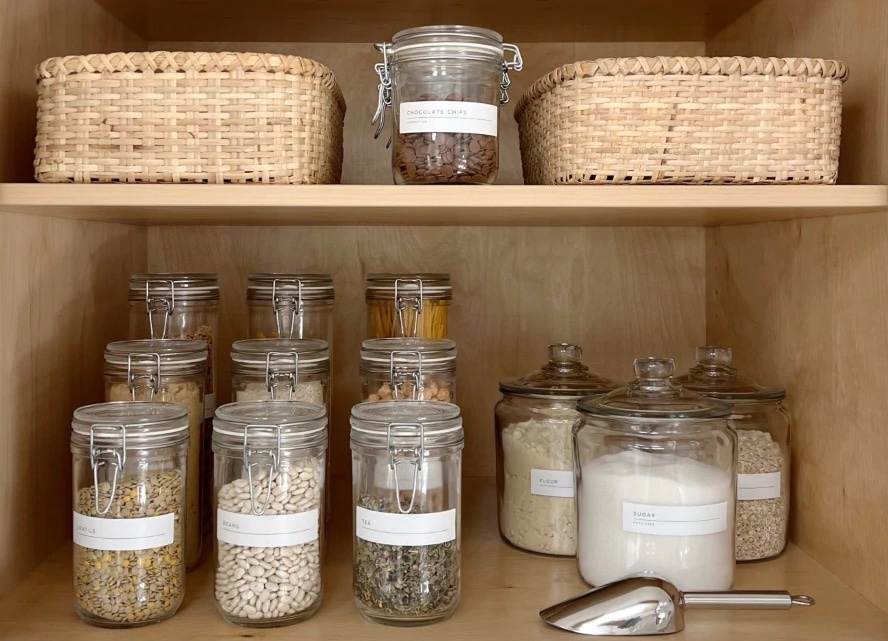
A pantry rarely begins as a glamorous room. It is where half-used bags of rice lean against cereal boxes, three jars of cinnamon mysteriously multiply, and one heroic can of chickpeas waits years for its big moment. Designer Kara Mann looked at this everyday chaos and saw an opportunity: pantry storage that works hard without looking like it belongs in a warehouse supply catalog.
Through Kept, her line of thoughtfully designed household essentials, Mann introduced a coordinated pantry collection centered on Italian-made glass jars, streamlined labels, stainless-steel tools, natural woven baskets, and ready-made storage bundles. The collection debuted in 2022, but its central idea remains relevant: practical household objects can be durable, attractive, and pleasant enough to leave in full view.
From Interior Design to Everyday Housekeeping
Kara Mann is known for interiors that balance polish with a little attitude. Her work often combines traditional shapes, contemporary proportions, tactile materials, and an unexpectedly playful detail. She has designed residences, hotels, retail spaces, furniture, and a wide-ranging collaboration with CB2.
Kept brought that design perspective into less glamorous corners of the home. Instead of beginning with sofas or sculptural lighting, the brand focused on brooms, hangers, dishcloths, hampers, storage boxes, and other useful objects that are usually hidden the second guests arrive.
The philosophy was refreshingly straightforward: make ordinary tools so useful and good-looking that people will keep them longer. The pantry collection extended that idea into food storage, where disposable packaging, mismatched containers, and awkward accessories often create more frustration than order.
Mann has explained that creating a pantry she genuinely liked took considerable trial and error. Rather than treating those mistakes as wasted effort, she used them as product research. The resulting system addressed the small annoyances that become obvious only after living with a pantry: jars that do not line up, labels that smudge, openings too narrow for a scoop, and baskets that conceal everything in one mysterious heap.
What Was Included in the Kept Pantry Collection?
Italian-Made Glass Pantry Jars
The collection’s visual foundation was a series of clear glass pantry jars made in Italy. At launch, the jars were offered in four heights, while each size shared the same diameter. That detail may sound minor, but it helps create orderly rows without forcing shelves to accommodate a circus of unrelated footprints.
The smallest containers could hold ingredients such as seeds, lentils, or baking decorations. Taller versions were better suited to pasta, flour, cereal, oats, or rice. Because the jars were transparent, shoppers could see quantities without opening every lid or relying on memory.
At their original launch, individual jars were listed at approximately $10 to $15. They were not positioned as extravagant display objects, but neither were they bargain-bin containers. The value proposition rested on consistent sizing, durable glass, and a restrained form that could remain useful even after kitchen trends changed.
Minimal Pantry Labels
Matching containers can make a pantry look calm, but matching containers filled with unidentified beige powders can turn breakfast into a chemistry exam. Kept addressed that issue with modern, easy-to-read labels designed to resist oil and water.
The original label pack contained 42 preprinted names for familiar pantry ingredients and 18 blank labels for customized entries. At launch, the set was priced at $20. The clean typography suited Mann’s understated aesthetic while remaining practical enough to read during the morning coffee scramble.
Labels also serve a purpose beyond decoration. When food is removed from its original package, the container should identify what is inside. Adding a purchase date, opening date, or best-quality date is even more useful, especially for ingredients such as baking powder, nuts, specialty flours, and spices.
A Stainless-Steel Funnel and Scoop
Anyone who has attempted to pour a floppy bag of quinoa into a glass jar knows how quickly kitchen organization can become kitchen confetti. The collection included a wide-mouth stainless-steel pantry funnel to guide dry ingredients into containers with fewer spills.
A separate stainless-steel scoop offered a convenient way to portion flour, sugar, grains, or pet food. At launch, the funnel was listed for $20 and the scoop for $22. These were small supporting characters, but they made the decanting process easier and helped keep hands out of frequently used ingredients.
Natural Rattan and Bamboo Baskets
Not everything belongs in a transparent jar. Packets, snack bags, paper napkins, onions, baking supplies, and miscellaneous refills are easier to manage when grouped in baskets. Mann incorporated woven Den baskets made from rattan and bamboo, originally designed as part of her collaboration with CB2.
The baskets introduced warmth and texture to rows of clear glass. Their organic weave softened the collection’s orderly appearance, preventing the pantry from feeling overly clinical. At the time of the pantry launch, individual sizes were listed in the range of approximately $40 to $60.
Woven baskets are particularly useful for category storage. One can hold breakfast refills, another can contain baking chocolate and decorations, and a third can collect the snack bags that otherwise migrate across three shelves like tiny, crinkly nomads.
Starter and Complete Pantry Sets
For shoppers who preferred a ready-made system, Kept offered coordinated bundles. The original 13-piece Starter Set was priced at $131, while the 51-piece Completely Kept Pantry Set was listed at $745.
Bundles reduced the guesswork involved in selecting jars, tools, baskets, and labels separately. They also reinforced the collection’s strongest visual idea: repetition creates calm. A shelf containing five matching jars usually looks more intentional than a shelf containing five individually beautiful containers that refuse to cooperate with one another.
Why Uniform Pantry Storage Looks So Satisfying
Human eyes naturally search for patterns. When containers share a common shape, diameter, material, or label style, the brain processes the shelf as a unified arrangement instead of a collection of competing packages. That visual simplicity can make even a modest cupboard feel more spacious.
Uniform storage is especially effective in kitchens with open shelves or glass-front cabinets. Commercial packaging is designed to compete for attention in a grocery store. Put 20 colorful boxes together at home, and they continue shouting at one another long after the shopping trip is over.
Decanting selected ingredients into clear jars removes much of that visual noise. It also makes inventory easier. You can see that the rice is running low, the oats are nearly gone, and the expensive almond flour remains untouched because apparently everyone has quietly retired from baking macarons.
The goal, however, should not be perfect uniformity at any cost. A functional pantry must serve the people who use it. Matching jars are not helpful when they are too heavy, too tall for the shelf, difficult to clean, or impossible for a child or older adult to open safely.
How to Apply Kara Mann’s Pantry Approach at Home
Begin With an Honest Inventory
Remove everything from the pantry and group similar items together. Check for damaged packaging, stale ingredients, duplicate purchases, and foods that no one in the household actually enjoys. Organization cannot fix overbuying; it merely gives the surplus a nicer apartment.
Measure shelf depth, width, and height before ordering containers. Pay special attention to fixed shelves, door clearance, and the narrow spaces around hinges. A beautiful 12-inch jar is considerably less beautiful when the available shelf height is 11.75 inches.
Create Zones Based on Real Habits
Organize the pantry around routines rather than magazine photographs. Useful zones might include breakfast, baking, weeknight meals, canned foods, snacks, beverages, entertaining supplies, and refills.
Frequently used foods should remain between waist and eye level. Heavy containers belong on lower shelves, where lifting is safer. Rarely used appliances, holiday supplies, and oversized serving pieces can occupy upper shelves.
Families may benefit from a dedicated snack basket that children can reach without climbing. Home bakers might reserve an entire shelf for flour, sugar, cocoa, leavening agents, and extracts. A household that orders takeout four nights a week probably does not need a heroic wall of 24 grain jarsand that is perfectly fine.
Decant Selectively
Decanting works best for dry ingredients purchased regularly and used frequently. Rice, pasta, oats, beans, cereal, flour, sugar, coffee, and common baking ingredients are strong candidates.
Do not automatically transfer every product. Original packaging may include cooking instructions, allergen warnings, lot numbers, nutrition information, and recall details. Keep that information when it matters, either by saving the package, photographing it, or recording key details on the container.
Dry goods should be placed in clean, fully dry, food-safe containers with secure lids. Moisture can reduce quality and encourage mold. The U.S. Department of Agriculture advises that packaged dry foods can receive additional protection when stored in glass or food-grade plastic containers.
Label for Daily Life, Not Just Photographs
A useful label identifies the ingredient clearly. A better label also records the date it was opened or transferred. This is particularly important when topping off containers, since pouring fresh food over older food can leave the oldest portion permanently stranded at the bottom.
Whenever practical, finish the remaining ingredient, wash and dry the container, and then refill it. Rotate canned and packaged goods by placing newer purchases behind older ones. This simple first-in, first-out habit helps reduce waste and prevents archaeological discoveries involving soup from another decade.
Use Baskets as Portable Drawers
Deep shelves often become black holes. A basket converts the back half of a shelf into usable storage because the entire category can be pulled forward at once.
Choose open or low-sided baskets for items you need to identify quickly. Use more concealed baskets for visually messy supplies such as party napkins, reusable shopping bags, or snack multipacks. Avoid stuffing baskets so tightly that removing one item causes a small avalanche.
Style Should Support Food Safety
A polished pantry still needs sensible storage conditions. Keep shelf-stable foods in a cool, dry location away from direct sunlight, heat-producing appliances, plumbing leaks, and extreme temperature changes. Inspect cans for leaks, bulges, severe dents, or rust before using them.
Not every attractive jar provides an airtight seal, so confirm the manufacturer’s intended use before filling it with food. Decorative baskets should not directly hold loose ingredients unless they contain an appropriate food-safe liner or container.
Transparent jars are excellent for monitoring quantities, but light can affect certain foods over time. Oils, spices, nuts, tea, and other light-sensitive ingredients may benefit from opaque containers, closed cabinets, or darker pantry locations.
The smartest system combines beauty with accurate labels, clean containers, safe materials, proper rotation, and realistic quantities. A gorgeous pantry full of forgotten food is still a wasteful pantryjust one with excellent lighting.
Is a Designer Pantry System Worth the Cost?
The answer depends on priorities. Kara Mann’s Kept collection was aimed at shoppers who value durable materials, consistent proportions, and a coordinated appearance. Buying a full system can save time and create immediate visual cohesion, but it is not the only route to an organized pantry.
Repurposed glass jars, restaurant-supply containers, Mason jars, and affordable bins can perform many of the same jobs. The most economical strategy is often a hybrid: invest in a few durable containers for heavily used staples, then use simpler baskets and reused jars for secondary ingredients.
Before purchasing dozens of containers, test two or three. Fill them, clean them, stack them, open them with damp hands, and live with them for several weeks. A pantry organizer should survive real cooking, not merely look photogenic while empty.
The deeper lesson of the Kept collection is not that every home needs a $745 pantry makeover. It is that ordinary tools deserve thoughtful design. A well-proportioned jar, legible label, practical funnel, and sturdy basket can remove small points of friction from a routine repeated every day.
Experience Report: Living With a Designer-Inspired Pantry
The most surprising part of reorganizing a pantry in Kara Mann’s style is how quickly the room begins to influence daily behavior. Before the makeover, grocery unloading often involved placing new purchases wherever a gap appeared. A bag of pasta might land beside the tea, while peanut butter somehow joined the baking supplies. Nothing was technically lost, but finding dinner occasionally required the investigative instincts of a private detective.
The first improvement came from limiting the number of container shapes. I used medium glass jars for rice, beans, oats, and pasta, then smaller jars for seeds and baking ingredients. The containers were not identical to the Kept collection, but I followed its principle of using the same diameter in multiple heights. Shelves immediately looked calmer, and empty spaces became easier to understand.
A wide-mouth funnel proved far more valuable than expected. Without one, decanting flour required the concentration of a bomb technician and still ended with a white cloud on the counter. With the funnel, refilling jars became fast enough that it no longer felt like a ceremonial weekend activity.
Labels created another noticeable change. Initially, I labeled only the ingredient names. Within a month, I realized dates mattered just as much. Two containers of oats looked equally wholesome, but one had been opened many weeks earlier. Adding small opening dates removed the guesswork and encouraged older ingredients to be used first.
The baskets were most useful for foods that did not deserve individual jars. One basket held noodles, rice paper, and sauce packets for quick Asian-inspired meals. Another contained baking decorations and chocolate chips. A third became the “use this soon” basket for open packages and ingredients approaching their best-quality dates.
That last basket had the greatest effect on food waste. Instead of discovering an aging package during an annual cleanout, I saw it every time I opened the pantry. Dinner planning became partly visual: an open bag of tortillas suggested tacos, extra coconut milk suggested curry, and a neglected box of crackers suggested either soup or an emergency cheese board.
There were also mistakes. I purchased several containers before measuring the upper shelf, and they missed fitting by less than half an inch. I decanted specialty flour, discarded the package, and later had to search online for the recommended liquid ratio. I also learned that large glass jars become surprisingly heavy when filled with sugar or rice.
The system improved after those errors. Heavy jars moved to lower shelves. Cooking instructions were clipped and stored in a small envelope. Frequently used breakfast items stayed near the pantry entrance, while entertaining supplies moved higher. Organization became less about achieving symmetry and more about reducing unnecessary movement.
Maintenance proved easier than expected because every category had a boundary. When the snack basket was full, the solution was not another basket; it was to finish what was already there. When an empty jar appeared, it became a visible shopping reminder. The pantry began functioning as an inventory system rather than a decorative storage room.
Most importantly, the space never needed to remain showroom-perfect. A few colorful packages stayed visible. Handwritten labels appeared beside printed ones. One recycled jam jar joined the matching set and behaved itself admirably. The designer-inspired framework created order without requiring the household to audition for a home organization television show.
Conclusion: A Pantry Designed to Be Used
Kara Mann’s pantry collection translated her polished, slightly rebellious design language into practical household equipment. Italian glass jars established visual order, resistant labels improved identification, stainless-steel tools simplified decanting, and woven baskets gave irregular packages a natural-looking home.
The collection also offered a useful reminder: an organized pantry is not defined by how much money was spent or how perfectly every shelf matches. Success is measured by whether ingredients are visible, accessible, safely stored, rotated, and easy to return to their proper places.
Choose containers that suit the shelf, label them with information you will genuinely use, and organize food around the way your household cooks. The finished pantry may not remain flawless every day, but it should make finding dinner easierand prevent another surprise purchase of the cinnamon you already own three times over.
SEO Information
Editor’s note: The Kept pantry collection discussed here debuted in 2022. Product availability, package contents, and prices may have changed or individual pieces may have been discontinued since the original launch.