Imagine beginning your morning without checking a phone, flipping on a light, opening a refrigerator, or turning a faucet. Instead, your first tasks might involve lighting a stove, carrying water, feeding animals, emptying ashes, and quietly questioning whether winter truly needed to exist.
For many Americans who lived from the late 1800s through the early decades of the 20th century, activities we now consider exhausting historical demonstrations were simply ordinary life. Convenience was limited, physical work was unavoidable, and everyday survival required practical skills that rarely appear on a modern résumé.
Of course, historical experiences differed enormously according to region, race, income, occupation, and whether someone lived in a city, a rural community, or on a farm. The title is also intentionally playful. Some people still use outhouses, preserve food, deliver babies at home, or write letters today. However, most modern Americans will never depend on these practices in the same way their great-grandparents did.
Here are 10 things your great-grandparents did that reveal just how dramatically everyday American life has changed.
1. They Planned Their Day Around Daylight
Electricity was a privilege, not an assumption
Your great-grandparents could not casually stay awake until 1 a.m. watching “just one more episode.” In homes without electricity, productive hours depended heavily on sunlight. After dark, families relied on candles, kerosene lamps, fireplaces, or other fuel-burning lights that required maintenance and created smoke, odors, and fire risks.
Electric service reached American cities long before it became common in the countryside. According to the Smithsonian’s National Museum of American History, only about 10% of rural America had electricity by 1932. Many rural families continued pumping water manually, heating irons on stoves, and reading under kerosene lamps well into the 20th century.
Sunrise was less of a pretty background for inspirational photographs and more of a daily starting whistle. When daylight disappeared, so did the safest and cheapest source of illumination.
2. They Pumped and Carried Their Own Water
Every gallon arrived through human effort
Modern Americans use water with almost no thought. We shower, flush, wash vegetables, run dishwashers, and leave faucets flowing while deciding which toothpaste flavor best represents our personality.
Many earlier households had no indoor plumbing. Water came from a well, pump, spring, cistern, or nearby stream. Someone had to collect it, carry it home, heat it when necessary, and carefully decide how it would be used. A preserved National Park Service account of Herbert Hoover’s childhood home notes that the family used a hand pump for water and a backyard privy because the small house had no running water, electricity, or automobile access.
Carrying water turned simple activities into multi-step projects. A bath required hauling, heating, pouring, washing, and cleaning up. By the time everything was ready, remaining slightly dusty probably seemed like a reasonable lifestyle choice.
3. They Used an Outhouse in Every Kind of Weather
The bathroom was outside, including in February
Indoor bathrooms are one of those inventions people rarely appreciate until a plumbing problem forces them to negotiate with a bucket.
For families without sewer connections or indoor plumbing, an outhouse was the bathroom. It might be located a short walk from the home, which was mildly inconvenient during pleasant weather and deeply offensive during snowstorms, heavy rain, darkness, or encounters with wildlife.
Archaeologists studying early-20th-century Seward, Alaska, discovered the remains of multiple privies dating from approximately 1905 to 1920. Such structures were not unusual frontier curiosities; they were ordinary features of homes and communities across the United States.
There was no heated floor, lavender soap dispenser, or cheerful sign asking guests to “wash, brush, floss, and flush.” There was a wooden seat, a door that hopefully latched, and a powerful incentive to finish quickly.
4. They Turned Laundry Day Into an Athletic Event
Washing clothes required strength, heat, and patience
A washing machine transforms laundry into a background task. Your great-grandparents often treated it as a major household operation.
Without electric appliances, families had to carry water, heat it over a stove or fire, prepare soap, soak clothing, scrub fabric by hand or against a washboard, rinse everything, squeeze out the water, and hang each item to dry. Heavy sheets, work clothes, and blankets became significantly heavier when wet.
Ironing was equally demanding. Metal irons were heated on a wood- or coal-burning stove, used until they cooled, and then reheated. Smithsonian records on rural electrification describe households cooking and heating clothes irons on wood stoves before electric service became available.
Today, people complain when a dryer takes 70 minutes. Earlier generations would probably listen politely, hand us a washboard, and wait for the apology.
5. They Managed an Icebox Instead of a Refrigerator
Keeping food cold involved a melting block of ice
Before electric refrigerators became widely affordable, many households used insulated wooden iceboxes lined with metal. A large block of ice kept food cool, but the ice gradually melted and had to be replaced.
Customers could place a card in the window showing an iceman whether they needed a 25-, 50-, 75-, or 100-pound block. The ice was delivered, lifted with tongs, and placed inside the cabinet. Families also had to empty the water produced as it melted. Forgetting that chore could turn the kitchen floor into an indoor pond.
The Smithsonian reports that iceboxes were common in American households by the late 1800s and remained in use into the 1930s. Electric refrigerators gained popularity after the General Electric Monitor Top model was introduced in 1927 and became more affordable during the following decade.
Opening the refrigerator simply to stare at its contents would have seemed absurd. Every open door wasted precious cold generated by a block of ice that another human being had physically carried into the house.
6. They Grew, Preserved, and Stored Much of Their Food
Seasonal eating was a necessity rather than a trend
In the early 1900s, nearly 40% of Americans lived on farms, and much of the food people consumed was grown locally. Long-distance refrigerated shipping was limited, so diets depended heavily on local harvests and seasonal availability. Common preservation methods included drying, smoking, salting, pickling, and canning.
Home canning required careful preparation. Produce had to be cleaned, trimmed, cooked, packed into sterilized containers, processed, sealed, labeled, and stored. The USDA began publishing formal home-canning guidance in the early 20th century and announced in 1917 that pressure canning was the only safe method for low-acid foods.
During World War II, these skills became especially important. Roughly half of American households planted Victory Gardens, and millions of families grew vegetables in yards, school grounds, workplace plots, window boxes, and community spaces. Excess produce was frequently canned for later use.
Your great-grandparents could not order strawberries in January and expect them to arrive looking suspiciously perfect. If the garden did not produce enough food, winter had opinions.
7. They Started Working at an Age We Now Associate With Recess
Childhood often included adult responsibilities
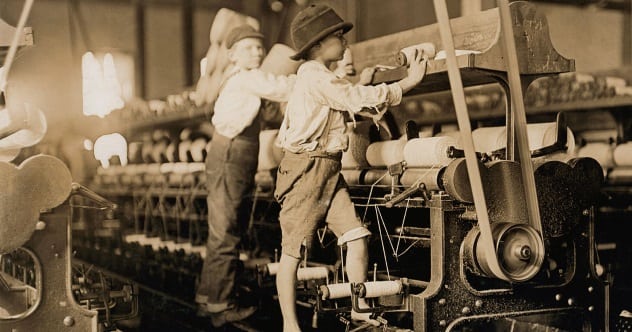
Children have always helped their families, but many children in the early 20th century performed dangerous paid labor in factories, mills, mines, farms, canneries, and city streets.
Photographer Lewis Hine documented American child labor for the National Child Labor Committee from 1908 to 1924. The Library of Congress preserves more than 5,100 photographic prints showing young workers and the conditions in which they lived and labored. His images include children tending textile machinery, selling newspapers, picking crops, and working around industrial equipment that would make a modern safety inspector quietly lie down.
Even children who did not hold industrial jobs often had demanding household and farm duties. They carried water, gathered fuel, cared for siblings, fed livestock, harvested crops, cooked meals, and repaired tools.
Complaining that the Wi-Fi password is too long would not have impressed them.
8. They Gave Birth at Home Without Modern Emergency Care
Childbirth was familiar, dangerous, and deeply personal
Hospital birth was not always the American norm. Many women delivered babies at home with assistance from relatives, neighbors, physicians, or midwives.
The transition from home birth to hospital birth accelerated during the first half of the 20th century. Historical research indicates that approximately half of U.S. births still occurred at home in 1938, while fewer than 1% did by 1955.
A skilled birth attendant could provide valuable support, but families lacked today’s blood banks, fetal monitoring, modern anesthesia, sterile operating rooms, emergency transportation, and rapid access to surgical care. Complications that can now be treated quickly could become life-threatening.
Pregnancy also involved fewer diagnostic tools. There were no routine ultrasound images, home gender-reveal explosions, or apps comparing the baby’s size to increasingly creative produce. Families often knew much less about the pregnancy until labor began.
9. They Faced Infections Before Antibiotics
A small injury could become a serious medical crisis
Before modern antibiotics, bacterial infections were far more difficult to treat. A cut, infected tooth, respiratory illness, or childbirth-related infection could become dangerous with alarming speed.
Alexander Fleming discovered penicillin in 1928, but it was not produced in substantial quantities for medical use until the 1940s. Its widespread adoption during and after World War II changed medicine by making many previously deadly bacterial infections treatable.
Your great-grandparents relied on rest, isolation, basic wound care, traditional remedies, limited medical treatments, and a considerable amount of luck. Doctors could diagnose many illnesses, but identifying the problem and curing it were very different achievements.
Modern medicine is not magical, and antibiotics must be used responsibly. Still, it is difficult to overstate how dramatically these drugs reduced the danger associated with common infections.
10. They Attended One-Room Schools and Wrote Letters by Hand
Education and communication moved at human speed
In rural communities, students of different ages often studied together in one-room schoolhouses under a single teacher. Books and supplies were limited, lessons relied heavily on memorization, and children commonly carried lunch from home in a metal pail.
The Library of Congress notes that by 1920, every state required children ages 8 to 14 to attend school for at least part of the year. Rural school calendars could be shorter because children were needed for farm work. Several grade levels studied in the same room, often using little more than slate and chalk.
Communication outside the community was equally slow. Letters were the primary way to maintain relationships across long distances. Rural Free Delivery, officially established around the turn of the 20th century, made mail more accessible to isolated households and helped connect countryside residents with newspapers, businesses, relatives, and the wider nation.
Writing required thought because there was no delete key. After mailing a letter, people waited days or weeks for a reply. Nobody sent “Did you get my message?” six minutes later.
What These Old-Fashioned Habits Teach Us
It is tempting to romanticize great-grandparent life as simpler, quieter, and more authentic. In some ways, it probably was. Families repaired possessions, understood where food came from, depended on neighbors, and developed practical skills that modern technology has made less necessary.
However, simpler did not mean easier. Daily routines consumed enormous amounts of physical energy. Healthcare was limited. Child labor was widespread. Women carried a disproportionate share of unpaid domestic work. Poor families and marginalized communities faced hardships that nostalgia tends to crop out of the photograph.
The lesson is not that everyone should throw away the washing machine and begin digging an outhouse. It is that ordinary conveniences represent generations of innovation, public investment, labor reform, medical progress, and infrastructure development.
Your great-grandparents might be amazed by video calls, electric cars, grocery delivery, and modern hospitals. They might also be slightly disappointed that, despite having every labor-saving device imaginable, we still lose one sock during every load of laundry.
A Weekend Experiencing Great-Grandparent Life
A realistic modern experiment in historical daily routines
To understand how different life once felt, imagine spending a carefully planned weekend using only technology available to a modest American household in the early 20th century. This would not recreate the dangers, inequalities, or emotional realities of the period, but it would reveal how much time and effort basic household tasks required.
The experiment begins on Friday evening by switching off electric lights and putting away phones, televisions, computers, and small appliances. Within an hour, the house feels strangely large and quiet. A kerosene-style lamp or safe battery lantern illuminates only a small circle. Instead of lighting the entire room, you bring the light to the task. Reading becomes deliberate. Moving around requires attention. The evening ends earlier because darkness has transformed bedtime from a personal preference into a practical suggestion.
Saturday begins with water collection. For safety, the water may still come from a clean household source, but it must be carried in buckets from an outdoor faucet or storage container. The first surprise is its weight. One gallon weighs more than eight pounds, and a family can use many gallons before breakfast is finished. Suddenly, every unnecessary rinse feels financially irresponsible, even though the water is technically free.
Next comes hand-washing clothing. Warm water must be prepared, garments soaked, stains scrubbed, fabric rinsed, and each item wrung out. After 20 minutes, the hands feel tired. After an hour, the shoulders join the protest. Large towels reveal themselves to be water-loving monsters that refuse to surrender their moisture. Hanging everything outside brings satisfaction, but it also creates anxiety when clouds appear.
Food storage becomes another challenge. Instead of using a refrigerator, place perishables in a cooler with a large block of ice. Every opening becomes a strategic decision. The ice melts steadily, producing water that must be drained. Meal planning changes immediately. Ingredients that spoil quickly are eaten first, leftovers are carefully managed, and buying food for an entire week suddenly seems ambitious.
Lunch and dinner come from basic pantry ingredients, seasonal vegetables, bread, eggs, and preserved foods. Cooking without electric gadgets makes every step visible. Vegetables are chopped manually. Dough is mixed by hand. Coffee requires heating water. Nothing is impossible, but nothing happens automatically while you scroll through social media.
In the afternoon, write a real letter. Without autocorrect or instant editing, each sentence receives more consideration. There is no pressure to reply immediately because the recipient cannot possibly answer immediately. The slow pace feels inconvenient at first and surprisingly peaceful a few minutes later.
By Sunday, the most important lesson becomes clear: earlier life was organized around tasks rather than minutes. People could not squeeze laundry, water collection, food preservation, cooking, heating, and communication between other activities. These duties were the activities.
The experiment may create admiration for your great-grandparents’ endurance, cooperation, and practical intelligence. It may also produce intense gratitude for indoor plumbing, electric refrigeration, washing machines, antibiotics, and the humble bathroom light. Historical life offers valuable lessons in patience and resourcefulness, but after two days of hauling water, most participants would happily welcome the future back into the house.
Conclusion
The 10 things your great-grandparents did that you never will were not unusual adventures. They were ordinary responsibilities woven into everyday American life. Carrying water, using an outhouse, preserving food, hand-washing clothes, managing an icebox, working from childhood, attending a one-room school, and waiting for handwritten letters demanded time, physical effort, and patience.
Technology has removed much of that labor, but remembering it gives us a better understanding of both historical hardship and modern privilege. The next time your refrigerator makes a strange noise or your washing machine needs a second cycle, pause before declaring civilization a failure. Somewhere in the family tree, an ancestor who spent Monday scrubbing sheets by hand is rolling their eyes.
SEO Metadata
Note: Historical living conditions varied widely by location, income, race, gender, occupation, and access to public infrastructure. The examples above describe practices experienced by many American families rather than one universal great-grandparent experience.