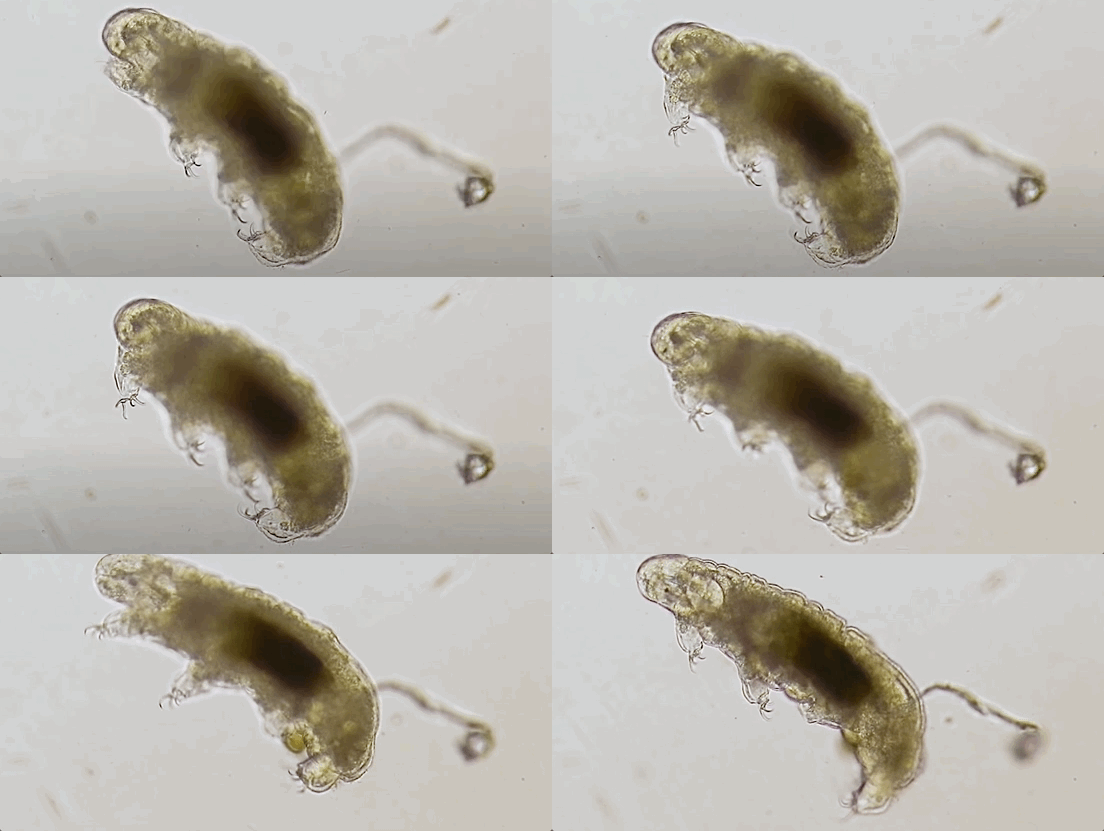
Tardigrades are proof that nature occasionally looks at its own rulebook, shrugs, and writes a tiny eight-legged loophole. Also known as water bears or moss piglets, these microscopic animals look like gummy bears that joined a space program. They are small enough to hide in moss, weird enough to star in science memes, and tough enough to make cockroaches seem emotionally fragile.
But the real reason tardigrades have become internet-famous is not just their adorable lumbering walk. It is their almost absurd ability to survive conditions that would instantly ruin the day of nearly every other animal on Earth. Dehydration? They can handle it. Freezing? They can wait it out. Radiation? They have cellular tricks. Space vacuum? They have been there, done that, and somehow remained scientifically interesting afterward.
Still, tardigrades are not magic. They are not immortal, and they do not actively party inside volcanoes while sipping boiling water. Their “badass” status comes from biology: cryptobiosis, protective proteins, compact bodies, and a survival strategy that is less “fight everything” and more “pause life until the universe calms down.” Let’s break down seven reasons why tardigrades are among the toughest, strangest, and most fascinating animals ever discovered.
1. Tardigrades Are Tiny, But Built Like Survival Tanks
The first thing that makes tardigrades so cool is their size. Most adult tardigrades are less than a millimeter long, with many hovering around the half-millimeter mark. In plain English: you could fit one on the period at the end of this sentence and still have room for its attitude.
Under a microscope, tardigrades have a short, barrel-shaped body divided into segments. They usually have four pairs of stubby legs, often tipped with claws or claw-like structures. Their movement is slow and slightly clumsy, which is how they earned the name “tardigrade,” meaning “slow walker.” It is also why they look like they are constantly late to a meeting but determined to attend anyway.
Their small size is not a weakness. It is part of the strategy. A tardigrade does not need lungs, a complex circulatory system, or a dramatic internal plumbing setup. Its tiny body allows oxygen and other substances to move through tissues efficiently. That simplicity makes them compact, efficient, and surprisingly resilient.
Small body, big advantage
Because tardigrades are so small, they can live in microhabitats that larger animals completely ignore. They are found in damp moss, lichens, leaf litter, soil, freshwater, marine sediments, and even extreme environments such as polar regions and high mountains. To a human, a patch of moss is a green carpet. To a tardigrade, it is a fully furnished apartment complex with snacks.
Their miniature size also helps them spread. Tardigrades and their eggs can be moved by wind, water, animals, and shifting environmental conditions. They are not exactly packing suitcases, but they are excellent accidental travelers.
2. They Can Enter Cryptobiosis, Nature’s Pause Button
The most famous tardigrade superpower is cryptobiosis. When conditions become too dry, too cold, too salty, or otherwise miserable, some tardigrades can shut down nearly all visible signs of life. They pull in their legs, curl into a dried form called a “tun,” and wait.
This is not sleep. It is more like putting biology into airplane mode. In the tun state, metabolism drops dramatically, water content falls, and the animal becomes far more resistant to environmental stress. When conditions improve and water returns, the tardigrade can rehydrate, uncurl, and resume life as if it simply took the world’s most intense nap.
Cryptobiosis is why tardigrades can survive long dry spells that would kill ordinary animals. It is also why people often describe them as nearly indestructible. The key word is “nearly.” A tardigrade can die. It can be damaged. It is not a superhero in the comic-book sense. But compared with most animals, it has an astonishing ability to wait out disaster.
The tun: a tiny survival bunker
During the tun stage, the tardigrade’s body becomes compact and resistant. Imagine a microscopic camping trailer designed for apocalyptic weather. This form helps reduce exposure and protects internal structures during dehydration. Some species use special molecules and proteins to stabilize cells while water is missing, preventing the cellular equivalent of crumbling crackers.
That ability matters because water is essential for normal life. Cells usually need water to maintain structure, move nutrients, and run chemical reactions. Remove water too quickly, and cells can collapse or become damaged. Tardigrades have evolved ways to make dehydration survivable, which is one reason scientists study them so closely.
3. Their Lifespan Can Stretch When Life Gets Rough
An active tardigrade does not live forever. Depending on the species and conditions, active lifespans may range from months to a few years. That alone is interesting, but not exactly legendary. The legend begins when tardigrades enter cryptobiosis.
In a dormant state, some tardigrades can survive for years, and certain reports describe survival across decades under the right conditions. This does not mean the animal is aging normally the whole time. Its metabolism is so reduced that time, biologically speaking, becomes strangely negotiable.
This is one of the most badass things about tardigrades: they do not beat time by running faster. They beat it by barely participating. When the environment says, “Everything is terrible now,” the tardigrade responds, “Cool, wake me when the moisture comes back.”
Not immortal, just extremely good at waiting
It is important to separate science from exaggeration. Tardigrades are often described as immortal online, but that is not accurate. They have limits. Long-term survival depends on the species, age, conditions before dormancy, humidity, temperature, radiation exposure, and other factors.
What makes them remarkable is not that they cannot die. It is that they can suspend normal activity so effectively that hostile periods become survivable interruptions instead of final chapters. In the animal kingdom, that is an elite move.
4. Tardigrades Can Survive Extreme Temperatures
Tardigrades have survived exposure to temperatures that would turn most animals into biological soup or frozen confetti. Some can endure extreme cold near absolute zero for short periods, while others have survived intense heat well above what humans could tolerate.
However, here is the science-friendly fine print: survival does not mean comfort. A tardigrade is not thriving in these extremes. It is enduring them, usually while dormant. Think of it less like a beach vacation and more like hiding in a storm cellar until the tornado leaves.
This distinction matters. Tardigrades are better described as extremotolerant than as creatures that happily live in every extreme condition. Many organisms called extremophiles actively grow in harsh places, such as hot springs or salty lakes. Tardigrades, by contrast, often survive extremes by shutting down and waiting them out.
Cold, heat, and the art of not panicking
Temperature extremes damage cells in different ways. Freezing can form ice crystals that puncture delicate structures. Heat can distort proteins and membranes. Dehydration can trigger chemical and structural chaos. Tardigrades reduce these risks by changing their physical state and using protective molecules that help stabilize proteins, membranes, and DNA.
That is why tardigrades are such valuable research subjects. They help scientists ask a huge question: how can living tissue be protected when conditions get nasty? The answers could someday influence medicine, space biology, agriculture, and preservation technologies.
5. They Have Survived Space Conditions
Yes, tardigrades have been to space. In 2007, tardigrades were exposed to low-Earth orbit conditions during a mission that tested their ability to survive vacuum and radiation. Some survived the trip, especially when shielded from the most damaging ultraviolet radiation. NASA has also supported space-station research using tardigrades to understand how organisms respond to microgravity, radiation, and other spaceflight stressors.
This does not mean tardigrades are aliens, although they do look suspiciously like something that might sell snacks on a moon base. They evolved on Earth. Their space survival is impressive precisely because space is not an environment they naturally evolved to inhabit.
For most animals, space is a brutal combination of vacuum, radiation, temperature swings, and microgravity. Tardigrades do not stroll around outside a spacecraft waving tiny flags. But in a dormant state, some can survive exposure that would instantly kill more complex organisms.
Why NASA cares about water bears
NASA research has treated tardigrades as a model organism for studying biological survival under extreme stress. Scientists want to know which genes and cellular responses help tardigrades tolerate spaceflight. That information could contribute to future work on protecting astronauts, preserving biological materials, and understanding how life responds beyond Earth.
In other words, tardigrades are not just cute microscope celebrities. They are research partners. They may help answer serious questions about long-duration space travel, radiation protection, and the boundaries of life.
6. Their DNA Protection Is Seriously Impressive
Radiation is dangerous because it can damage DNA. For most organisms, enough DNA damage means cells malfunction or die. Tardigrades, however, have several protective strategies, including a famous protein called Dsup, short for “damage suppressor.”
Studies have shown that Dsup can bind to DNA-related structures and help reduce damage caused by radiation and reactive molecules. In laboratory research, introducing tardigrade proteins into other cells has offered clues about how these microscopic animals protect themselves.
This is where tardigrades go from “fun fact” to “biotechnology inspiration.” Their survival tools may eventually help researchers think about new ways to protect cells, stabilize medicines, improve crop resilience, or reduce damage in certain medical contexts. That does not mean a tardigrade protein will magically turn humans into radiation-proof superheroes. Please do not walk into a reactor wearing a water-bear T-shirt and confidence. But the biology is genuinely promising.
Protection beyond one protein
Dsup gets a lot of attention, but tardigrade toughness is not a one-gene trick. Different species use different combinations of protective proteins, antioxidants, repair systems, and dormancy strategies. Some tardigrade-specific proteins appear to help cells survive drying by stabilizing cellular material when water disappears.
That complexity makes tardigrades more fascinating. Their toughness is not a single magic shield. It is a layered defense system: reduce metabolism, change body form, protect DNA, stabilize proteins, resist oxidative stress, and repair what can be repaired when normal conditions return.
7. They Are Everywhere, Yet Easy to Miss
One of the funniest things about tardigrades is that they sound exotic, but they may be living near you right now. They are found worldwide in terrestrial, freshwater, and marine habitats. Moss on a sidewalk, damp roof lichens, pond sediment, garden soil, leaf litter, and beach sand can all host tardigrades.
They are not rare monsters hiding in one mysterious cave. They are more like microscopic neighbors who never attend homeowners’ association meetings. Their global distribution includes polar regions, deep marine environments, forests, mountains, and ordinary patches of moss. The world is full of water bears; we are simply too large and visually unimpressive to notice them without help.
This wide distribution makes tardigrades ecologically interesting. They feed on plant cells, algae, bacteria, and sometimes other tiny organisms. Some species are predators. Others are more like quiet moss grazers. They also become food for other small creatures, meaning they play roles in miniature ecosystems that most humans never see.
The hidden drama of moss
To us, moss looks peaceful. Under a microscope, it is a bustling jungle. There are rotifers, nematodes, protozoa, algae, bacteria, and tardigrades moving through thin films of water. A tardigrade’s universe may be only a few drops wide, but it is full of competition, feeding, reproduction, stress, dormancy, and survival.
That hidden world is part of the charm. Tardigrades remind us that nature’s most extraordinary designs are not always large, loud, or obvious. Sometimes the wildest animal in the neighborhood is smaller than a grain of sand and shaped like a walking couch cushion.
What Tardigrades Eat, How They Move, and Why They Look So Weird
Tardigrades usually feed using a specialized mouth structure with sharp stylets. These stylets can pierce plant cells, algae, or small prey, allowing the tardigrade to suck out nutrients. Some species are plant or algae feeders; others are predators that snack on nematodes, rotifers, or even smaller tardigrades. Yes, water bears can eat other water bears. Nature is adorable until it suddenly is not.
Their walk is another reason people love them. Despite being tiny, tardigrades move with a lumbering gait that resembles a bear’s stroll. Their legs are not jointed like insect legs, and their body plan is compact and unusual. Watching one crawl under a microscope feels like seeing a plush toy trying to cross a wet window.
Their strange appearance has made them cultural icons. Tardigrades show up in cartoons, science education, memes, museum exhibits, plush toys, jewelry, and space discussions. Few microscopic animals have achieved this level of public relations success. Somewhere, a paramecium is furious.
Are Tardigrades Really the Toughest Animals on Earth?
Tardigrades are often called the toughest animals on Earth, and they deserve a spot in that conversation. They can survive dehydration, freezing, intense pressure, radiation, oxygen deprivation, and space exposure under certain conditions. That is an absurd résumé for something that looks like a squishy vacuum cleaner bag with legs.
But the title “toughest” depends on how toughness is defined. Some bacteria and archaea can thrive in extreme environments where animals cannot. Some organisms tolerate acid, heat, salt, pressure, or radiation in specialized ways. Tardigrades are remarkable because they are animals with a broad toolkit for enduring multiple stresses, not because they can survive anything forever.
The best description is this: tardigrades are among the most resilient animals known to science. They are not invincible. They are not immortal. They are not secretly waiting to inherit the Earth after humans make one too many questionable decisions. But they are spectacular at surviving conditions that make most animals look delicate.
500-Word Experience Section: What Studying Tardigrades Teaches Us About Resilience
There is something oddly personal about learning how tardigrades survive. At first, the topic feels like a collection of wild science facts: tiny animal survives space, tiny animal survives freezing, tiny animal refuses to be normal. But the more you read about tardigrades, the more they become a surprisingly good metaphor for resilience.
Imagine looking at a piece of moss and realizing it may contain an entire hidden world. That experience changes the way you see ordinary places. A sidewalk crack is no longer just a crack. A damp stone wall becomes a possible ecosystem. A clump of moss near a tree starts to feel like a miniature rainforest, complete with microscopic grazers, hunters, and survivors. Tardigrades make the everyday world feel deeper.
For students, science lovers, gardeners, or anyone with access to a basic microscope, searching for tardigrades can feel like a treasure hunt. You collect a little moss, soak it in water, place a drop on a slide, and scan slowly. Most of what you see at first may be debris, air bubbles, plant fragments, and tiny organisms you cannot immediately identify. Then, if luck is on your side, something stubby moves. It crawls with four pairs of legs, looking both ancient and ridiculous. That moment is unforgettable. You are suddenly face-to-face with a creature that has survived in some form through an enormous stretch of evolutionary history.
The experience also teaches patience. Tardigrades are not always easy to find. They do not perform on command. They are tiny, slow, and often hidden among particles that look nearly identical to beginner eyes. You have to slow down, adjust focus, and pay attention. In a world that constantly rewards speed, a tardigrade hunt rewards careful observation. That alone is refreshing.
There is also a humbling lesson in scale. Humans often associate importance with size. Big animals get documentaries. Big storms get headlines. Big mountains get names. Tardigrades laugh at that logic, or they would if they had the facial equipment for it. They are almost invisible, yet they have inspired research in space biology, molecular protection, dehydration tolerance, and evolutionary survival. Their impact is far larger than their bodies.
On a practical level, tardigrades also challenge how we think about toughness. They do not survive by being aggressive. They do not dominate their environment with teeth, speed, or muscle. Their strategy is flexibility. When conditions are good, they feed and reproduce. When conditions turn brutal, they change state. They conserve. They protect the essentials. They wait.
That is a useful lesson beyond biology. Resilience is not always about pushing harder. Sometimes it is about knowing when to pause, reduce unnecessary activity, protect what matters, and restart when conditions improve. Tardigrades are not motivational speakers, which is good because their voices would be extremely tiny. But their biology offers a quiet message: survival can be strategic, patient, and surprisingly elegant.
So the next time you see moss after rain, picture the hidden water bears inside it. Somewhere in that green fuzz, a tardigrade may be crawling, feeding, resting, or preparing to outlast circumstances that would humble almost anything else. It is tiny. It is strange. It is scientifically ridiculous in the best possible way. And yes, it is absolutely badass.
Conclusion: Tiny Animal, Giant Reputation
Tardigrades are badass because they combine cuteness, weirdness, and extreme biology in one microscopic package. They are small enough to miss, tough enough to study in space, and complex enough to keep scientists asking new questions. Their ability to enter cryptobiosis, survive dehydration, tolerate radiation, endure temperature extremes, and reanimate when water returns makes them one of nature’s most impressive survival stories.
They are not indestructible, and that makes them even more interesting. Tardigrades survive not by breaking the rules of life, but by using those rules in astonishing ways. Their biology shows how flexible life can be when evolution has enough time, pressure, and creativity to work with. Whether you call them water bears, moss piglets, or microscopic legends, one thing is clear: tardigrades have earned their reputation.