Editorial context: Because Christmas 2026 has not yet occurred, this retrospective uses “this year” to describe the 2025 holiday seasonthe most recent completed Christmas season as of July 2026.
Christmas is supposed to arrive carrying peace, goodwill, and enough cookies to make everyone temporarily forget their differences. During the 2025 holiday season, however, peace frequently got stuck in traffic behind political protests, labor disputes, artificial intelligence, religious arguments, and some very expensive imported toys.
The biggest Christmas controversies of the year revealed how easily familiar traditions can become battlegrounds. A Nativity scene was no longer just a Nativity scene. A coffee cup was not merely a container for peppermint-flavored caffeine. Even putting up lights too early became an issue involving leases, military housing, and the eternal question of whether November 1 is a reasonable date to begin behaving like an enthusiastic department-store elf.
Some of these disputes were serious. Others were strange. A few managed to be both serious and strange, which is practically the official mood of modern social media. Here are 10 Christmas controversies that shaped the 2025 holiday season and explain why the holidays once again generated nearly as many arguments as gift receipts.
Why the 2025 Christmas Season Became So Contentious
Holiday traditions carry emotional weight. People connect Christmas decorations, music, worship services, advertisements, family gatherings, and shopping rituals with childhood memories and personal values. When a company, government agency, church, or community organization changes one of those traditions, people rarely respond as if someone merely rearranged the furniture.
The 2025 Christmas controversies also unfolded during a period of political polarization, economic anxiety, labor unrest, and rapid technological change. Those forces turned the holiday season into a sparkling mirror reflecting larger national arguments. The tinsel was festive. The debates underneath it were not.
The 10 Biggest Christmas Controversies of 2025
1. Tariffs Put Christmas Prices and Product Choices Under Pressure
Long before shoppers started making lists, retailers were worrying about tariffs. Changing import policies complicated decisions about what products to order, how much inventory to carry, and what prices consumers would eventually see.
The toy industry was especially vulnerable because a large share of toys sold in the United States are manufactured in China. At one point during 2025, tariff rates on some Chinese imports climbed dramatically before being revised, delayed, or renegotiated. Retailers described a frustrating cycle of adjusting orders every time the rules changed.
Companies selling artificial Christmas trees and decorations also warned that customers might encounter thinner catalogs, fewer choices, and higher prices. The controversy was bigger than whether a plastic reindeer cost five dollars more. Supporters argued that tariffs could encourage domestic manufacturing and reduce dependence on foreign supply chains. Critics said families and small businesses were being asked to pay the immediate price for a long-term economic experiment.
In short, Santa’s workshop had apparently been reassigned to the international trade department.
2. AI Shopping Assistants Joined the Holiday Rush
Major retailers and technology companies introduced or expanded AI-powered shopping tools during the 2025 holiday season. These systems promised to recommend gifts, compare products, summarize reviews, and help overwhelmed shoppers find something for the relative who always says, “Oh, I don’t need anything.”
The convenience was obvious. Instead of opening 37 browser tabs, shoppers could ask an AI assistant for gift ideas within a budget. But the tools also created new questions. Were recommendations genuinely helpful, or were they influenced by retailer partnerships and sponsored placement? How much information about a shopper’s habits, finances, family, and preferences was being collected? Could an AI-generated summary overlook safety warnings or promote unreliable reviews?
No single scandal defined the debate. The controversy came from how quickly these tools moved into everyday shopping before consumers fully understood their limitations. The technology could save time, but it also risked turning personal gift buying into an invisible auction controlled by algorithms.
3. Coca-Cola Doubled Down on AI-Generated Christmas Advertising
Coca-Cola’s classic holiday trucks once represented the unofficial moment when Christmas advertising shifted into high gear. In 2025, those trucks returned in another generative-AI campaignand so did the criticism.
The company had already faced backlash for using AI in its 2024 Christmas commercials. Rather than retreat, it produced another AI-heavy campaign featuring glowing trucks, snowy landscapes, and animated animals. The production involved human creative teams and thousands of generated clips, but many viewers still described the finished advertisements as emotionally flat, visually inconsistent, or strangely artificial.
Defenders saw the campaign as an ambitious experiment combining new technology with a familiar brand tradition. Critics saw a wealthy corporation replacing part of the human creative process with software while using nostalgia to make the result feel warmer than it actually was.
The larger argument was not really about whether a polar bear moved awkwardly. It was about whether speed and lower production costs are worth sacrificing the human touch that makes sentimental advertising work.
4. Starbucks Red Cup Day Became a Labor Protest
Starbucks Red Cup Day is normally a cheerful promotion in which customers receive limited-edition reusable cups with qualifying holiday-drink purchases. In 2025, it also became the launch point for a strike involving more than 1,000 unionized workers at dozens of stores across the United States.
Workers used one of the company’s busiest promotional days to call attention to staffing levels, pay, scheduling, stalled contract negotiations, and unresolved allegations of unfair labor practices. Starbucks argued that its compensation package was competitive and said the union had stepped away from negotiations. Organizers countered that many employees remained overworked and unable to secure sufficient hours.
The timing was deliberately powerful. A strike on an ordinary Tuesday might receive limited attention. A strike while customers are forming lines for collectible red cups puts labor conditions directly beside the company’s carefully polished holiday image.
For some customers, the cup symbolized seasonal fun. For workers on the picket line, it symbolized a company celebrating demand without adequately addressing the people responsible for meeting it.
5. Military Families Were Told Their Christmas Decorations Were Too Early
Residents of a privately managed housing community near Tyndall Air Force Base in Florida received instructions to remove outdoor Christmas decorations installed before Thanksgiving. Community standards limited holiday decorations to a period beginning roughly 30 days before the relevant holiday, with winter lights generally allowed after Thanksgiving.
The story quickly became a miniature national debate about “Christmas creep,” lease enforcement, and whether anyone should have the authority to tell a military family when to plug in an inflatable snowman.
The Air Force clarified that the rule came from the private housing manager rather than a military-wide policy. The company also said residents would not face formal penalties for early decorating. That clarification lowered the temperature, but the original notice had already done what controversial holiday rules do best: escape into the internet and become much larger than the neighborhood where they started.
Supporters of the rule favored visual consistency. Opponents believed harmless decorations should not require calendar-based enforcement. Somewhere in the middle stood a confused plastic Santa waiting for legal clearance.
6. Anti-ICE Nativity Scenes Divided Churches and Communities
Several churches transformed traditional Nativity scenes into protests against federal immigration enforcement. Displays in Illinois, Massachusetts, Texas, and other locations portrayed the Holy Family as refugees or detainees.
One scene showed the infant Jesus with zip-tied wrists and an emergency blanket while Mary wore a gas mask. Another replaced the figures with a message saying the Holy Family was hiding from immigration agents. A Massachusetts parish displayed an “ICE was here” sign in place of the missing infant Jesus.
Supporters argued that the installations connected the biblical story of a vulnerable family with the experiences of modern migrants. They viewed the displays as an expression of Christian teaching about welcoming strangers and protecting the powerless.
Criticsincluding some religious authoritiessaid sacred imagery was being manipulated for partisan purposes. They considered the displays disrespectful, inflammatory, or unfair to law-enforcement personnel. The controversy raised an enduring question: Should churches preserve Christmas traditions as comforting symbols, or use those symbols to challenge uncomfortable government policies?
7. A Tennessee Christmas Parade Excluded Both Pride and Republican Groups
A Christmas parade in Middle Tennessee drew criticism after organizers excluded a local Pride organization and a Republican group. Parade representatives said they wanted to minimize distractions and keep the event focused on Jesus.
Excluding organizations from opposing parts of the political spectrum did not prevent controversy. Instead, it created arguments about fairness, religious expression, free speech, and who gets to define what counts as a “distraction.”
Supporters of the decision said a privately organized religious parade should be allowed to preserve its chosen message. Critics argued that community parades occupy public spaces and should not selectively exclude residents based on identity or political affiliation.
The unusual pairing made the case especially revealing. Organizers were not simply accused of favoring one party over another; they were accused of narrowing a community celebration until participation depended on avoiding almost any visible civic identity.
A parade intended to focus attention on one message therefore attracted far more attention than it probably expected.
8. White House Christmas Decorations Included an Assassination-Attempt Painting
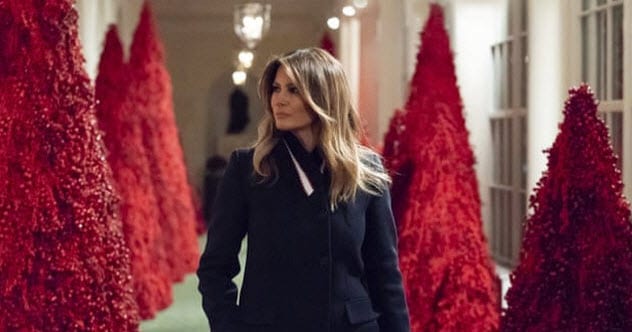
The 2025 White House holiday display featured the expected abundance of wreaths, ribbons, lights, and Christmas trees. It also included a painting depicting President Donald Trump raising his fist after surviving the 2024 assassination attempt in Pennsylvania.
Supporters regarded the artwork as a historic image representing courage and national resilience. Critics questioned whether a dramatic piece of campaign-era political imagery belonged in an official Christmas display presented as a celebration for the entire country.
Presidents have always influenced White House holiday themes, and political symbolism inside the building is hardly new. Still, Christmas decorations are generally designed to emphasize tradition, service, family, or national unity. Including an image closely associated with a candidate’s political brand blurred the line between presidential history and partisan messaging.
It also ensured that visitors discussing garlands and gingerbread would eventually find themselves discussing electoral politics. Nothing completes a peaceful holiday tour quite like an argument about campaign iconography.
9. A Kennedy Center Christmas Concert Was Canceled Over Trump’s Name
Musician Chuck Redd canceled the Kennedy Center’s traditional Christmas Eve Jazz Jam after President Trump’s name was added to the building’s exterior and official branding.
The concert had been part of the center’s holiday programming for years. Redd said he withdrew after seeing the name change, which he viewed as inconsistent with the institution’s identity as a memorial to President John F. Kennedy.
The renaming itself was already disputed. Legal scholars, historians, and Kennedy family members questioned whether the center’s board had authority to add another president’s name without congressional action. Supporters of Trump’s leadership changes argued that the center needed a new cultural direction and credited him with revitalizing the institution.
The canceled concert turned an institutional naming dispute into a Christmas controversy. Audiences lost a holiday performance, the musician made a high-profile protest, and the Kennedy Center became another example of a cultural institution caught in a national political struggle.
10. Explicitly Christian Government Messages Sparked Church-State Objections
Several federal departments and administration officials used official government accounts to publish openly Christian Christmas messages in 2025. Some referred to the birth of Jesus as the arrival of “our Savior” and paired government communications with crosses, mangers, or explicitly devotional language.
Supporters welcomed the messages as a refreshing acknowledgment of Christmas’s Christian origins. They argued that public officials should not be expected to remove faith from every seasonal statement.
Church-state advocates objected that a federal agency represents citizens of every religion and no religion. In their view, an official account crosses an important line when it moves from recognizing a religious holiday to affirming a particular theological belief on behalf of the government.
The dispute was not about whether an individual official could celebrate Christmas. The question was whether an agency with regulatory, military, or law-enforcement authority should speak as though the entire nation shares one faith.
That argument guaranteed the return of the familiar “War on Christmas” debatenow updated for the age of official social-media accounts.
What These Christmas Controversies Had in Common
Although the disputes looked unrelated, most involved one of three tensions: tradition versus change, inclusion versus identity, or commerce versus authenticity.
AI-generated advertisements promised innovation but challenged the value of human creativity. Political Nativity scenes updated an ancient story but divided people over how sacred symbols should be used. Government messages recognized the religious meaning of Christmas but raised concerns about citizens who did not share that belief.
Even the lighter controversies reflected competing expectations. Early decorators valued personal joy, while housing managers valued uniform rules. Starbucks promoted a collectible holiday item, while employees used that same event to expose workplace frustration. Retailers wanted full shelves, while trade policies disrupted supply chains in pursuit of broader economic goals.
Christmas becomes controversial partly because people expect it to remain stable. When a familiar song, cup, parade, advertisement, or Nativity scene changes, the reaction is rarely limited to the object itself. People respond to what they believe the change represents.
Experiences That Defined a Controversial Christmas Season
Beyond the national headlines, the 2025 controversies shaped ordinary holiday experiences in surprisingly personal ways. Families encountered these arguments while shopping, attending community events, scrolling through social media, and deciding whether to discuss politics at dinner or hide in the kitchen with the pie.
Shopping Felt More Complicated Than Festive
Many consumers entered stores already worried about prices. A parent comparing toys was not simply choosing between two brands; that person might also be wondering whether tariffs had increased the price, whether waiting would produce a discount, or whether the item would sell out because retailers had reduced inventory.
AI shopping assistants added another layer. They could produce a gift list in seconds, which was genuinely useful for busy households. Yet the experience sometimes felt less like asking a knowledgeable friend and more like consulting a cheerful robot working inside the store. Shoppers had to decide whether recommendations were independent, sponsored, accurate, or merely confident.
Holiday Advertising Became a Test of Authenticity
Watching a Christmas commercial used to be a passive experience. In 2025, viewers examined ads for signs of generative AI: strange movement, inconsistent backgrounds, unnatural faces, or vehicles that appeared to change shape.
That changed the emotional contract between advertisers and audiences. Instead of simply enjoying a snowy scene, viewers asked who made it, how it was made, and which creative jobs might have disappeared in the process. The technology became more memorable than the message, which is not ideal when the message is supposed to make people feel warm, nostalgic, and mysteriously thirsty for soda.
Community Events Forced People to Choose Sides
Parades, church displays, and public concerts are meant to create shared experiences. During a polarized season, they often required participants to interpret political messages before enjoying the event.
A family attending a parade might see an exclusion policy as protection of religious tradition or as rejection of neighbors. A church member viewing an anti-ICE Nativity might experience it as a powerful moral lesson or as an inappropriate political stunt. The same display could inspire compassion in one person and anger in the person standing three feet away.
These disagreements made public Christmas celebrations feel less universal. People increasingly sought events aligned with their values rather than events designed for the entire community.
Workplace Frustrations Followed Employees Into the Holidays
The Starbucks strike highlighted a familiar seasonal experience for retail and service workers: customers see decorations, promotions, and festive menus, while employees see heavier workloads, unpredictable schedules, and long lines.
Holiday cheer can be difficult to manufacture during a short-staffed shift. That does not mean workers dislike Christmas. It means the commercial version of Christmas depends on labor that consumers often notice only when service becomes slow.
The strike encouraged some customers to think about the person behind the red cup. Others simply wanted their latte. That difference in perspective explains why labor actions during major promotions are both disruptive and effective.
Social Media Made Every Dispute Feel National
A decoration rule affecting one housing community could become a nationwide debate within hours. A local Nativity scene could be photographed, stripped of context, and presented to millions of people as evidence that either Christianity or immigration enforcement was under attack.
This created an exhausting holiday experience in which every controversy seemed enormous. Social platforms rewarded the angriest interpretation, not the most careful explanation. Users were encouraged to react before learning who owned the property, what the written rule said, or whether the original report had been clarified.
The most useful personal lesson from the season was therefore simple: pause before joining the outrage. Christmas already provides enough opportunities for stress without volunteering to become furious about a stranger’s inflatable reindeer in another state.
Conclusion: Christmas Remains Merry, Complicated, and Highly Debatable
The 10 Christmas controversies of 2025 show that the holiday season is no longer separated from the year’s biggest cultural conflicts. Artificial intelligence changed advertising and shopping. Tariffs affected prices. Labor disputes challenged corporate holiday promotions. Immigration policy reshaped Nativity scenes. Political identity entered parades, concert halls, government greetings, and White House decorations.
None of this means Christmas has lost its meaning. It means Christmas carries many meanings at once. It can be a sacred observance, a family ritual, a commercial season, a public celebration, a workplace rush, or a nostalgic media event. Trouble begins when one institution assumes that everyone experiences it in exactly the same way.
The best response may not be to eliminate disagreement. That would require a Christmas miracle with an unusually ambitious project scope. A more realistic goal is to examine the facts, recognize the competing values involved, and resist turning every seasonal disagreement into proof that civilization is collapsing.
After all, Christmas survived tariffs, AI polar bears, political Nativity scenes, canceled jazz, labor strikes, and decoration deadlines. It will probably survive the next argument too.