War is usually explained through maps, military briefings, casualty reports, and grim photographs. Yet those formats do not always capture the strange, intimate details of living through an invasion: a family refusing to abandon its dog, a ceramic rooster surviving on a kitchen shelf, volunteers turning ordinary businesses into aid centers, or an air-raid siren interrupting the most painfully normal moment imaginable.
That is where the 22 Ukraine war comics created by Bloome Comics find their power. Published in May 2022, the series grew from the artist’s volunteer experience, concern for relatives in Ukraine, and stories shared by Ukrainians living in places affected by Russia’s full-scale invasion. The drawings are colorful and approachable, but their subjects include occupation, forced displacement, propaganda, civilian deaths, destroyed homes, abandoned animals, and the siege of Mariupol. Cute artwork, meet devastating reality. It is not the most comfortable introduction, but comfort was never the assignment.
How Volunteer Work Became a Comic Series About Ukraine
Bloome Comics originally focused on relatable lifestyle humor, everyday frustrations, relationships, and the kind of small personal disasters that feel enormous until an actual disaster arrives. After Russia launched its full-scale invasion on February 24, 2022, the artist struggled to continue producing lighthearted work. Family roots in Ukraine and fear for relatives made the news intensely personal.
For several weeks, drawing no longer felt useful. Then the artist reached a different conclusion: illustration could become a form of assistance. It could explain experiences that disappeared behind geopolitical terminology, challenge false narratives, and help international readers understand why Ukrainians continued resisting.
Volunteer work also revealed how much of Ukraine’s wartime response depended on ordinary people. Civilians organized food deliveries, transported medicine, housed displaced families, gathered protective equipment, supported shelters, repaired vehicles, and delivered supplies to communities that formal systems could not always reach quickly. In many cases, the person coordinating logistics had previously been a lawyer, designer, teacher, restaurant owner, or office worker. Apparently, a national emergency is one way to discover that your neighbor has been secretly qualified to run a warehouse all along.
Independent reporting has repeatedly documented this vast civilian network. Volunteer groups became essential links between donors, displaced families, animal shelters, hospitals, and frontline communities, often moving faster than traditional institutions because they could respond directly to urgent requests.
Why Comics Can Explain War Differently
A comic cannot replace investigative journalism, verified photographs, legal documentation, or testimony collected by human rights organizations. It can, however, make an overwhelming subject emotionally understandable.
Each panel reduces a complex event to a recognizable human choice. Do you flee without knowing where you will sleep? Do you take your pet even when there is barely room for your children’s belongings? Do you keep working when an air-raid alarm sounds? Do you volunteer because sitting at home refreshing the news has turned your nervous system into a malfunctioning browser tab?
Small Images Can Carry Large Stories
The simplicity of a comic is not necessarily a weakness. A damaged apartment building can be represented by one broken wall. A child’s absence can be conveyed by an abandoned toy. A surviving shelf can symbolize an entire country’s refusal to collapse.
These visual shortcuts allow readers to absorb the emotional meaning before confronting the larger historical context. They also make the work highly shareable, helping stories travel across language barriers and social platforms.
Humor Creates Breathing Room, Not Disrespect
Some of the comics use irony, exaggeration, or absurdity. The humor does not mock civilians or soften the violence. Instead, it exposes ridiculous propaganda, celebrates defiance, and gives readers a moment to breathe.
Wartime humor often functions as emotional armor. A joke cannot stop a missile, but it can deny fear complete ownership of the room. That distinction matters throughout the series.
What the 22 Ukraine Comics Depict
The collection does not unfold like a traditional graphic novel. It works more like an illustrated journal made from separate observations, reports, memories, and symbols. Together, the 22 comics form a mosaic of civilian life during the first months of the full-scale invasion.
1. Animals Left Behind by War
One of the earliest comics focuses on pets separated from their families. Some Ukrainians carried animals during dangerous evacuations, while others were forced to leave them behind. Shelters in occupied or bombarded areas struggled with damaged buildings, dwindling food, and animals injured by explosions.
The artist later described helping purchase special food and supplies for injured dogs and assisting with a large delivery of animal food. This theme matters because compassion during war is often measured in seemingly minor decisions. Saving a frightened dog does not end a conflict, but it preserves one small piece of humanity that conflict attempts to erase. Later reporting has continued to document volunteers risking their safety to evacuate abandoned animals from frontline communities.
2. A Society Reorganized Around Helping
Another comic shows businesses and ordinary citizens transforming themselves into support networks. Cafes became kitchens. Community centers became donation hubs. Drivers became transport coordinators. Artists raised money. People who had never touched military logistics suddenly knew the exact battery required by a specific unit three regions away.
The comic also raises a pointed question: when civilians are reorganizing their entire lives to help, are governments doing enough? It turns volunteer admiration into a challenge directed at institutions with far greater resources.
3. Children as Victims, Not Statistics
Several panels confront the deaths, displacement, and forced transfer of Ukrainian children. The drawings avoid graphic imagery, but their restraint makes the message more haunting. An empty space can sometimes say more than a crowded battlefield scene.
Reports by international investigators and major news organizations have documented children being separated from their families and transferred to Russia or Russian-controlled territories. The issue later became central to international war-crimes investigations.
4. The Loyalty of Pets
A comic referencing the famous story of Hachiko uses a waiting animal to show the confusion and loyalty of pets whose owners never return. It is a simple concept, but it turns an enormous war into one unanswered question: where did my person go?
5. Propaganda Taken to Absurd Extremes
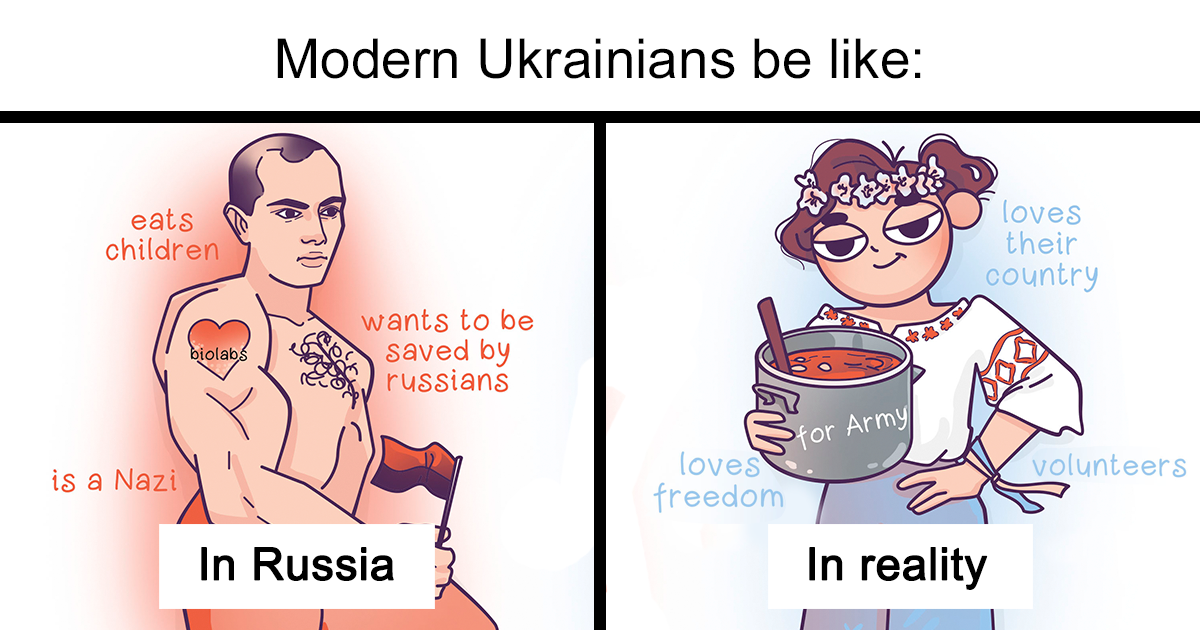
Some panels challenge Russian claims used to justify the invasion, including portrayals of Ukrainians as extremists and conspiracy theories involving biological laboratories. The artist uses satire because certain narratives become especially revealing when illustrated literally.
The joke is not that propaganda is harmless. The joke is that its logic can become cartoonishly absurd while still producing deadly consequences. In information warfare, nonsense does not need to be elegant; it only needs to be repeated often enough.
6. The Ceramic Rooster That Refused to Fall
One of the collection’s most recognizable images features the ceramic rooster and kitchen cabinet that remained attached to a wall in Borodianka after the surrounding apartment was destroyed. Photographs of the surviving objects quickly became symbols of Ukrainian resilience.
It was an almost perfect visual metaphor: the building was shattered, yet the tiny decorative rooster appeared to be standing there with the expression of someone who had already filed a complaint and intended to speak with management.
7. Poland’s Support for Ukrainians
Another comic acknowledges the complicated history between Poland and Ukraine while emphasizing the support offered by Polish communities during the refugee crisis. Millions of Ukrainians crossed western borders, and Polish families, volunteers, local authorities, and aid groups helped provide transportation, housing, food, and medical assistance.
The panel’s message is straightforward: friendship is demonstrated most clearly when circumstances become inconvenient, expensive, and frightening.
8. The “Protection” That Destroys
The Kremlin repeatedly framed the invasion as an effort to protect Russian-speaking people. The comic series responds by showing the contradiction between that language and the destruction experienced by predominantly Russian-speaking Ukrainian cities.
A government cannot credibly claim to protect a population while missiles destroy its homes. Even the most talented public relations department eventually runs out of glitter.
9. Looting and the Collapse of a False Narrative
One panel contrasts Russian propaganda about Ukrainian poverty with reports of soldiers looting homes in communities such as Bucha, Irpin, and Hostomel. The comic uses domestic items to demonstrate how invasion reaches beyond territorial ambition and enters bedrooms, kitchens, closets, and family memories.
10. Destruction Followed by Reconstruction
Another drawing looks past ruined buildings toward rebuilding. This is not cheerful denial. It is an assertion that destruction will not receive the final panel.
11. The Missing Children
The collection returns to children because their experiences cannot be treated as a footnote. The separation of families, uncertainty surrounding those transferred from occupied territories, and difficulty tracing individual children demonstrate how war continues long after a neighborhood stops appearing in headlines.
12. Bucha and the Weight of Testimony
Stories from Bucha influenced the series. Human Rights Watch and other investigators documented summary executions, torture, enforced disappearances, and other apparent war crimes committed during the Russian occupation. A comic cannot reproduce the full evidence, but it can direct attention toward the people behind it.
13. Air-Raid Sirens Interrupt Everything
One comic shows how alarms can arrive during any activity. There is no appointment system, no courteous reminder, and certainly no option to reschedule the missile for Thursday afternoon.
The normality of this disruption is part of the horror. People continue cooking, studying, working, caring for children, and making plans while remaining ready to move toward shelter.
14. Fear, Protest, and Civilian Resistance
The series contrasts repression inside Russia with Ukrainians confronting armed forces in occupied communities. Peaceful demonstrations in places such as Kherson showed civilians publicly rejecting occupation despite the obvious danger.
15. Ordinary People Discover Extraordinary Courage
Bravery in the comics does not belong only to soldiers. It appears in nurses, drivers, parents, retirees, volunteers, railway workers, and people delivering food. Heroism often looks less like a movie speech and more like somebody quietly saying, “Fine, put the boxes in my car.”
16. International Isolation
One panel references companies, artists, public figures, and organizations distancing themselves from Russia after the invasion. These actions varied in effectiveness, but together they demonstrated broad cultural and economic rejection of the war.
17. Grief That Cannot Be Neatly Illustrated
Some comics contain almost no explanatory text. Their silence reflects a limit every artist encounters: certain losses cannot be made tidy, balanced, or narratively satisfying.
18. Mariupol Under Siege
Mariupol became one of the collection’s darkest subjects. Residents endured prolonged bombardment, shortages of water and medicine, destroyed infrastructure, and limited evacuation routes. Associated Press reporting from inside the city documented mass graves, damaged hospitals, families sheltering underground, and widespread civilian suffering.
19. The Desire Not to Become History
Another panel captures the bitter irony of wishing for an uneventful future and then becoming part of a historic catastrophe. People generally enjoy history more when it arrives in hardcover and does not remove their windows.
20. Courage Without a Convenient Ending
The artist celebrates the bravery of Ukrainian men and women without pretending courage eliminates fear or guarantees survival. Real bravery often means acting while fear remains fully present and extremely talkative.
21. Why Ukraine’s Survival Matters Beyond Its Borders
The series argues that the invasion concerns more than one country’s territory. It raises broader questions about sovereignty, democratic self-determination, civilian protection, and whether powerful states can erase borders through force without meaningful consequences.
22. A Grandmother, a Jar, and National Defiance
The final comic refers to a widely shared story about a Ukrainian grandmother knocking down a drone with a jar from her balcony. Details of viral wartime stories can evolve through retelling, but the tale became popular because it captured an emotional truth: resistance appeared everywhere, including apartment windows and kitchens.
The image is funny, defiant, and impossible to separate from the larger atmosphere of civilian mobilization. It also offers an important tactical lesson: never underestimate a grandmother with excellent aim and preserved vegetables.
Art as Witness, Resistance, and Cultural Memory
The Bloome Comics series belongs to a much larger movement of Ukrainian wartime art. Illustrators, photographers, muralists, musicians, filmmakers, museum workers, and theater companies have documented daily life, raised money, protected cultural objects, and defended Ukrainian identity.
Art made during war performs several jobs at once. It preserves memories, communicates with international audiences, provides emotional release, challenges propaganda, and reminds people that Ukraine is not merely a battlefield. It is a society with humor, traditions, design, music, family arguments, favorite foods, annoying neighbors, beloved pets, and artists who would very much like to draw something silly again.
American museums and cultural organizations have highlighted Ukrainian artists whose work records occupation, displacement, resistance, and loss. Preservation teams have also worked with Ukrainian professionals to protect museum collections, sacred art, archives, and historic sites threatened by bombardment and looting.
The Ethical Challenge of Turning Trauma Into Comics
Creating art about an active war carries serious responsibilities. The artist must avoid turning suffering into decoration, spreading unverified claims, simplifying every person into a symbol, or treating trauma as material for audience engagement.
Center the People, Not the Artist
The strongest panels focus on Ukrainians and their experiences rather than presenting the creator as the hero. Volunteering may provide access to stories, but access does not create ownership. The people who lived through occupation, evacuation, loss, and bombardment remain the center of the narrative.
Separate Symbolic Truth From Verified Detail
Viral wartime anecdotes can express genuine cultural attitudes even when specific details are difficult to confirm. Responsible storytelling should make that distinction clear. A symbolic grandmother may represent defiance, but factual claims about attacks, casualties, or individual crimes require careful verification.
Do Not Let Resilience Hide the Damage
Celebrating courage can unintentionally create the impression that Ukrainians are somehow built to tolerate endless hardship. They are not. Resilience is an adaptation to danger, not permission for the danger to continue.
Why These Ukraine War Comics Still Matter
Public attention naturally moves from one crisis to another. News cycles accelerate, social media feeds refresh, and yesterday’s urgent story is pushed beneath celebrity gossip, product launches, and a video of a raccoon stealing an entire sandwich.
Comics resist that disappearance by giving readers memorable visual anchors. The rooster on the surviving shelf, the waiting dog, the crowded aid center, and the grandmother confronting a drone remain easier to recall than a column of statistics.
The series also protects complexity. Ukraine’s wartime story includes grief and humor, destruction and organization, fear and stubborn daily life. People hide in shelters, but they also fall in love, care for animals, complain about work, celebrate birthdays, and plan for reconstruction. Refusing to abandon ordinary life is itself a form of resistance.
Additional Reflections: What the Volunteer Experience Reveals
The most important lesson behind these comics is that volunteering changes the scale at which a person understands war. From a distance, a humanitarian emergency can appear as a collection of enormous numbers. Up close, need becomes specific. A shelter does not require “support” in the abstract; it needs a certain quantity of food, medicine, fuel, carriers, blankets, or diapers. A displaced family does not need a speech about solidarity; it may need a driver at 6:30 in the morning who knows which roads remain open.
This practical reality can be overwhelming, but it can also be clarifying. Volunteers rarely have the luxury of solving the entire crisis. They solve the next problem. One delivery. One animal evacuation. One temporary bed. One phone call to locate medicine. The scale may feel painfully small compared with the destruction, yet humanitarian work is built from these small units.
The experience also reveals that people respond to catastrophe in dramatically different ways. Some become intensely organized. Others freeze. Some make jokes at moments that seem completely inappropriate until the joke becomes the only thing keeping everyone functional. A volunteer space can contain grief, exhaustion, irritation, generosity, and somebody arguing about the correct way to label canned beansall before lunch.
Listening is often more valuable than arriving with a heroic plan. Local residents usually understand their communities’ needs better than visitors do. Effective volunteers follow local leadership, respect safety protocols, avoid photographing vulnerable people without permission, and resist the temptation to turn every act of assistance into personal branding.
That principle applies to comics as well. The most meaningful stories do not ask readers to admire the artist. They ask readers to notice the people represented: the family carrying a cat through an evacuation point, the shelter worker rationing food, the child trying to sleep during an alarm, or the resident returning to an apartment that now has a magnificent view because an entire wall is missing.
Another lesson is that humor and grief are not opposites. Volunteers often encounter dark humor because people need a language for experiences that ordinary conversation cannot comfortably hold. A joke can acknowledge fear without surrendering to it. The comic format makes room for that tension. One panel may be heartbreaking; the next may ridicule propaganda or celebrate a grandmother’s improvised air defense.
Burnout is equally real. The creator behind Bloome Comics described feeling unable to draw after the invasion. Continuous exposure to distressing news, requests for help, and fear for relatives can make creativity feel frivolous. Yet returning to art became a way to contribute rather than escape.
This transformation offers a useful model for other creators. A person does not need to abandon their existing skills during a crisis. Designers can create clear information. Translators can help displaced families understand documents. Programmers can support aid platforms. Drivers can transport supplies. Artists can preserve testimony and make complicated realities emotionally accessible.
Finally, volunteering teaches that solidarity is not a single dramatic gesture. It is repetition. People continue donating after the story leaves the front page. They check information before sharing it. They support credible organizations, listen to affected communities, and remember that reconstruction involves homes, schools, hospitals, cultural institutions, relationships, and mental healthnot only concrete and steel.
The 22 comics endure because they document that repetition. They show a society harmed by invasion but still organizing, caring, drawing, joking, rescuing, mourning, and imagining a future. None of those actions makes the war acceptable. They simply demonstrate that violence has not succeeded in making people less human.
Conclusion
“After I Volunteered In Ukraine, I Made These 22 Comics Depicting What’s Going On There” is more than a collection of shareable illustrations. It is a visual record of how civilians experienced the early months of Russia’s full-scale invasion and how one artist redirected creative skills toward awareness and humanitarian support.
The comics do not attempt to explain every military development or settle every political argument. Instead, they preserve the details that broad histories often lose: animals waiting for owners, volunteers moving supplies, children separated from families, air-raid alarms invading ordinary routines, and small symbols surviving among ruined buildings.
War tries to reduce people to numbers. These drawings reverse that process, returning faces, choices, memories, humor, and dignity to the story.