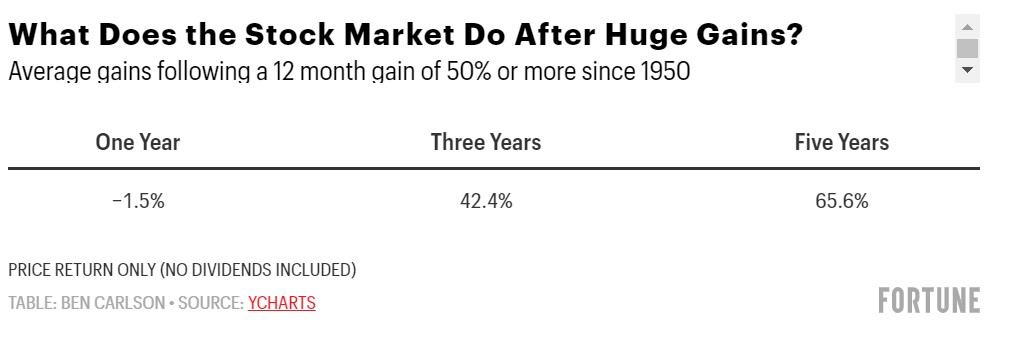
When the stock market is up big, investors suddenly become part-time philosophers, amateur economists, and full-time worriers. One person sees a strong rally and thinks, “Great, the good times are back.” Another sees the same chart and whispers, “This is how the movie starts before the monster appears.” Both reactions are understandable. Big stock market gains feel wonderful, but they also raise a serious question: what usually happens next?
The honest answer is less dramatic than a financial TV countdown clock: sometimes the market keeps rising, sometimes it takes a breather, and sometimes it trips over its own shoelaces. But history gives us a useful framework. A market that is up big is not automatically “due” for a crash. Strong returns often reflect real forces such as earnings growth, falling inflation, improving investor confidence, easier financial conditions, or enthusiasm around new technology. At the same time, a hot market can invite overconfidence, stretched valuations, and a dangerous urge to chase yesterday’s winners.
This article explains what typically happens after major stock market gains, why strong rallies can continue, where the risks hide, and how long-term investors can respond without turning their portfolio into a casino with better lighting.
Why Big Stock Market Gains Make Investors Nervous
Big gains create emotional whiplash. If you already own stocks, you may feel richer, smarter, and possibly tempted to use the phrase “I knew it” in public. If you are sitting in cash, the rally may feel like a train leaving the station while you are still buying snacks. That emotional pressure is one reason investors make poor decisions after a strong stock market rally.
The fear usually comes from a simple idea: what goes up must come down. That phrase works nicely for tossed baseballs, soufflés, and birthday balloons. It does not work as neatly for the stock market. Over long periods, the U.S. stock market has tended to rise because corporate earnings grow, productivity improves, inflation increases nominal revenues, and successful companies become more valuable. The path is not smooth, but the long-term direction has historically been upward.
That means a market high is not necessarily a warning sign. In fact, markets spend a surprising amount of time near highs because long-term growth creates new highs. If stocks never reached fresh highs, long-term investors would have a much bigger problem than whether to rebalance.
What History Says After the Market Is Up Big
Historical data does not offer a crystal ball, but it does offer a flashlight. Looking at the S&P 500, strong years have often been followed by more gains, though not always immediately and not always comfortably. The market has had many years with returns above 20%, and those years did not automatically lead to disaster the following year.
For example, after the S&P 500 gained strongly in 1995, the market continued rising in 1996 and 1997. After the strong rally in 2013, stocks were also positive in 2014. After the powerful 2019 rebound, the market still finished 2020 higher despite the sharp COVID-19 crash in March. However, after the strong 2021 market, 2022 brought a painful bear market as inflation surged and interest rates rose. In other words, the market does not follow a script. It prefers improv comedy.
Big Gains Can Lead to More Gains
Momentum is real in markets. When stocks are up big, it can mean investors are becoming more confident for good reasons. Corporate profits may be expanding. Economic growth may be holding up better than expected. Interest rates may be falling or expected to fall. Cash on the sidelines may move back into equities. The phrase “climbing a wall of worry” exists because markets often rise while investors still have a long list of complaints.
A strong market can also attract more buyers. Fund flows may increase, retirement contributions continue, and investors who waited too long may finally jump in. This does not guarantee future returns, but it explains why strength can persist longer than skeptics expect.
Big Gains Can Also Create Fragile Expectations
The risk is that a strong rally can pull future returns into the present. When investors pay higher prices for the same dollar of earnings, valuations rise. Higher valuations do not automatically cause a crash, but they can reduce the margin of safety. If earnings disappoint, inflation reaccelerates, interest rates rise, or a popular sector loses momentum, expensive markets can become grumpy very quickly.
This is why investors should distinguish between a healthy rally and a speculative sprint. A healthy rally is supported by broad earnings growth, reasonable valuations, and participation across many sectors. A speculative sprint is often driven by a narrow group of fashionable stocks, heroic assumptions, and people explaining valuation with phrases like “this time is different.” History has heard that sentence before. It usually asks for collateral.
What Usually Happens Next: Three Common Scenarios
After the stock market is up big, the next phase usually falls into one of three broad scenarios: continuation, consolidation, or correction. Knowing these possibilities helps investors prepare instead of panic.
Scenario 1: The Rally Continues
In this scenario, the market keeps moving higher because the original reasons for the rally remain intact. Earnings grow, inflation behaves, central banks avoid surprises, and investors continue to reward risk assets. This is common in bull markets. A stock market rally can last longer than expected because good conditions often improve gradually rather than all at once.
For long-term investors, this scenario rewards patience. Selling simply because the market is up can be costly if the rally continues. Markets do not stop rising just because they have already risen. If they did, bull markets would be about as short as a commercial break.
Scenario 2: The Market Moves Sideways
Sometimes the market digests big gains by going nowhere for a while. Prices may chop around as earnings catch up to valuations. This can feel frustrating, but sideways markets are not necessarily bad. They can reduce excess enthusiasm, allow fundamentals to improve, and create better entry points for disciplined investors.
Sideways periods also test investor patience. After a big rally, people often expect either fireworks or disaster. A boring market feels like ordering a thriller and receiving a documentary about beige paint. Yet consolidation can be healthy. It gives portfolios time to breathe.
Scenario 3: A Correction Arrives
A correction is commonly defined as a decline of 10% or more from a recent high. Corrections are normal, uncomfortable, and very good at making investors forget every long-term chart they have ever seen. After a big rally, corrections can happen because sentiment becomes too optimistic, valuations become stretched, or external shocks appear.
The important point is that corrections are not rare defects in the system. They are part of the system. The stock market offers higher long-term returns than cash partly because investors must endure volatility. No volatility, no equity premium. That is the bargain, even if the fine print is written in red ink during bad months.
Why “Up Big” Does Not Mean “Sell Everything”
One of the most common mistakes after a strong market is assuming that a gain must be “locked in” by selling everything. Taking profits can make sense in specific cases, especially if a single stock or sector has grown too large in your portfolio. But abandoning a long-term investment plan because the market performed well is usually market timing in a nice suit.
Market timing requires two correct decisions: when to get out and when to get back in. The second decision is often harder. Investors who sell after a big rally may wait for a perfect pullback that never arrives. Or they may get the pullback, become too scared to buy, and then watch the market recover without them. This is how cash becomes a comfortable chair with a very expensive view.
Long-term research from major investment firms consistently points to the same lesson: time in the market tends to matter more than timing the market. Missing a small number of the market’s best days can dramatically reduce long-term returns. The tricky part is that many of the best days occur near the worst days, when investors are most tempted to run away.
How Valuation Changes the Picture
Valuation matters, especially after big gains. If stocks rise faster than earnings, the market becomes more expensive. A higher price-to-earnings ratio means investors are paying more for each dollar of profit. That can be justified if future growth is strong, interest rates are low, or profit margins remain high. But it also means expectations are elevated.
Imagine a company as a restaurant. If the food is good and the place is busy, a higher price may be reasonable. But if the restaurant starts charging five-star prices for microwaved fries, customers eventually notice. Stocks work similarly. Great companies can become poor investments if the price already assumes perfection.
After a big market rally, investors should examine whether gains are supported by earnings growth or mostly by multiple expansion. Earnings-driven gains tend to be healthier. Valuation-driven gains can continue, but they are more vulnerable to disappointment.
Market Breadth: Are Many Stocks Rising or Just a Few?
Another key question is market breadth. A broad rally means many sectors and companies are participating. A narrow rally means the index is being carried by a small group of large stocks. Because the S&P 500 is market-cap weighted, a few mega-cap companies can have an outsized influence on index performance.
Narrow leadership is not automatically bearish, but it deserves attention. If only a handful of stocks are doing the heavy lifting, the market may be more fragile than the headline index suggests. If leadership broadens into industrials, financials, healthcare, small caps, and consumer sectors, the rally may have a stronger foundation.
Investors should avoid judging the entire market by one index number. Under the hood, there may be a completely different story. Sometimes the market looks calm on the surface while individual stocks are throwing furniture in the basement.
Interest Rates Still Matter
Interest rates are one of the biggest forces shaping what happens after a big stock market gain. Lower rates can support higher valuations because future earnings become more attractive compared with bonds and cash. Higher rates can pressure stocks by making bonds more competitive and increasing borrowing costs for businesses and consumers.
If the market is up big because investors expect rate cuts, the rally may become vulnerable if inflation stays hot or the Federal Reserve signals a more restrictive path. On the other hand, if inflation cools and the economy remains resilient, stocks may continue to benefit from improving financial conditions.
This is why investors should look beyond price charts. The stock market does not move in isolation. It is connected to inflation, employment, wages, credit conditions, corporate margins, and investor psychology. Yes, that is a crowded dinner table.
What Long-Term Investors Can Do After a Big Rally
The best response to a strong stock market is usually not excitement or fear. It is process. A good investing process helps you make decisions when your emotions are wearing a party hat or a helmet.
1. Rebalance Your Portfolio
If stocks have risen sharply, your portfolio may now be more aggressive than you intended. Rebalancing means trimming assets that have grown too large and adding to areas that are underweight. This is not panic selling. It is maintenance. Think of it as rotating your tires, except the tires are mutual funds and nobody smells like rubber.
2. Review Your Risk Tolerance
A rising market can make everyone feel brave. The real test comes during declines. If a 10% or 20% drop would cause you to abandon your plan, your allocation may be too aggressive. After a big rally, it is wise to ask whether your portfolio still matches your time horizon, income needs, and emotional reality.
3. Avoid Chasing Hot Sectors
Every strong market has stars. Sometimes it is technology. Sometimes it is energy. Sometimes it is small caps, growth stocks, dividend stocks, or whatever theme currently owns the financial headlines. Chasing performance after a huge move can leave investors buying at inflated prices just as leadership rotates elsewhere.
4. Keep Contributing
For investors with long time horizons, regular contributions can be more powerful than perfect timing. Dollar-cost averaging allows you to buy through highs, lows, and boring middles. This approach does not guarantee profits, but it reduces the pressure to guess the perfect entry point.
5. Hold Enough Cash for Real Needs
Cash is not a long-term growth engine, but it is excellent for short-term needs. Emergency funds, upcoming home purchases, tuition bills, and near-term retirement withdrawals should not depend on the market being cheerful next Tuesday. Holding appropriate cash reserves can help you avoid selling stocks during a downturn.
Common Mistakes Investors Make After Stocks Surge
After stocks are up big, mistakes usually come from emotion. Some investors become greedy and take more risk than their plan allows. Others become fearful and sell too early. Both reactions can hurt long-term results.
One mistake is confusing recent performance with guaranteed future performance. A stock or fund that did well last year may not lead next year. Another mistake is assuming the market must crash simply because it is high. High prices can become higher if earnings and investor demand continue to rise.
A third mistake is checking the portfolio too often. Daily market watching can turn normal volatility into emotional drama. If your investment plan is designed for years, judging it every afternoon is like planting an oak tree and yelling at it for not providing shade by lunch.
Specific Examples: What Happened After Big Years?
History offers several useful examples. The late 1990s showed that strong gains can continue for years, but also that valuations can eventually become extreme. The 2000–2002 bear market punished investors who assumed technology stocks could only go up. The post-2009 bull market showed that markets can recover and climb for a long time after a crisis, even while economic worries remain.
The 2019–2020 period is especially interesting. Stocks rose sharply in 2019, then suffered one of the fastest bear markets in history during early 2020 as the pandemic shocked the global economy. Yet the market recovered and finished the year positive. Investors who sold during the panic and waited for “clarity” often missed a major rebound. Clarity, unfortunately, tends to arrive after prices have already moved.
The 2021–2022 period tells the opposite story. After a strong 2021, inflation and aggressive rate hikes hit stocks hard in 2022. This example reminds investors that strong prior returns do not eliminate risk. The lesson is not “sell after every big year.” The lesson is to maintain a portfolio that can survive different environments.
So, What Happens After the Stock Market Is Up Big?
The most accurate answer is: many things can happen, but panic is rarely a strategy. A big rally can continue if fundamentals remain strong. It can pause while earnings catch up. It can correct if expectations become too optimistic or economic conditions change. The short term is uncertain, but long-term investing has historically rewarded discipline, diversification, and patience.
Investors should treat a strong market as a planning opportunity. Review your allocation. Rebalance if needed. Check whether your goals have changed. Avoid chasing the hottest stocks. Keep enough cash for near-term needs. Most importantly, do not let a rising market bully you into abandoning a sensible plan.
Experience-Based Reflections: Living Through a Big Market Rally
There is a special kind of confusion that appears when the market is up big. During a downturn, everyone knows they are supposed to be worried. During a rally, people are happy, but somehow still worried. The account balance looks better, headlines sound optimistic, and yet the investor brain starts asking, “Is this too good? Should I sell? Should I buy more? Why did my neighbor make more money than I did? Is my neighbor secretly Warren Buffett with a lawn mower?”
One practical experience many investors share is the feeling of regret. If they invested before the rally, they regret not investing more. If they held cash, they regret waiting. If they owned diversified funds, they regret not owning the single best-performing stock. This is why comparison can be so destructive. A diversified portfolio will almost always look silly compared with the hottest asset over a short period. But diversification is not designed to win every month. It is designed to keep you in the game.
Another common experience is the temptation to rewrite your risk tolerance. A person who carefully chose a balanced portfolio may suddenly want to become aggressive after seeing growth stocks soar. This is backward. Risk tolerance should be set before the emotional fireworks begin. Changing your plan after a huge rally is like deciding to train for a marathon because you watched someone else cross the finish line. The hard part happened before the applause.
Investors also learn that cash feels different depending on the market mood. In a falling market, cash feels safe and wise. In a rising market, cash feels lazy and embarrassing. But cash has a job. It protects short-term goals and gives you flexibility. The problem is not holding cash; the problem is holding too much cash because you are waiting for a perfect market entry that may never arrive.
A big rally also teaches humility. Even professional investors disagree about what comes next. Some analysts focus on earnings strength. Others worry about valuations. Some see innovation and productivity. Others see speculation and crowd behavior. The average investor does not need to win every forecast debate. The better goal is to build a portfolio that does not require perfect predictions.
One of the healthiest habits after a strong market is to write down your rules. For example: “I will rebalance once or twice a year,” “I will keep six months of expenses in cash,” “I will not let one stock become more than a set percentage of my portfolio,” or “I will continue automatic contributions regardless of headlines.” Written rules are useful because they speak calmly when the market is yelling.
The experience of investing after big gains is ultimately an exercise in emotional discipline. You can appreciate the rally without worshiping it. You can respect risk without hiding from opportunity. You can take profits where your portfolio has become unbalanced without pretending you know the market’s next move. The goal is not to be fearless. The goal is to be prepared enough that fear does not drive the car.
So when the stock market is up big, celebrate responsibly. Rebalance if your plan calls for it. Keep perspective. Remember that every long-term chart includes scary declines that felt obvious only in hindsight. The market will always give investors reasons to worry. It also has a long history of rewarding those who can stay patient while everyone else is trying to predict next week with a spreadsheet and a nervous twitch.
Conclusion
After the stock market is up big, the next move is uncertain, but the right investor behavior is clearer. Strong gains do not automatically predict a crash, and market highs are not automatically danger signs. Historically, stocks have often continued to perform well after reaching new highs or posting strong returns, although corrections and bear markets remain part of the journey.
The smartest response is not to guess the next headline. It is to focus on allocation, diversification, valuation awareness, cash needs, and long-term discipline. A rising market is a gift, but it is also a test. Investors who pass that test are not the ones who predict every turn. They are the ones who keep a sensible plan when the market gets loud.
Note: This article is for educational purposes only and should not be treated as personalized investment, tax, or financial advice. Investors should consider their goals, risk tolerance, time horizon, and professional guidance before making investment decisions.