Krakow is one of Europe’s most beautiful cities, the kind of place where cobblestone streets, church towers, and café windows can make the past feel charmingly close. But in the district of Podgórze, history does not whisper politely. It stands in the open, heavy and unmistakable. During World War II, Nazi Germany turned part of Krakow into a sealed Jewish ghetto, a place designed for terror, exploitation, deportation, and murder.
The Krakow Ghetto was not simply a “poor neighborhood” or a temporary wartime hardship. It was a deliberate instrument of the Holocaust. Families were uprooted, homes were seized, food was restricted, forced labor became routine, and public squares became staging grounds for deportations. The walls were not built to protect anyone inside. They were built to trap people until the Nazi system decided what to do with them next.
This article explores 10 harrowing facts about Krakow’s Ghetto, from its creation in March 1941 to its liquidation in March 1943. The goal is not to turn tragedy into trivia. It is to understand how ordinary streets became machinery for persecution, and how people inside the ghetto still found ways to resist, help one another, and preserve human dignity under conditions meant to erase it.
1. The Krakow Ghetto Was Created in Podgórze, Not the Historic Jewish Quarter
Before the war, Krakow’s Jewish life was strongly associated with Kazimierz, the old Jewish quarter known for its synagogues, markets, schools, and dense community life. So it might seem logical to assume the Nazis placed the ghetto there. They did not. In March 1941, German authorities established the Krakow Ghetto across the Vistula River in Podgórze, a district that had not been the center of Jewish life.
That choice was strategic. Podgórze could be more easily sealed off and controlled. Polish residents were forced out of apartments and houses, while Jewish residents from Krakow and nearby towns were forced in. A district that had once housed only a few thousand people was suddenly expected to hold many times that number. It was not urban planning; it was human compression with paperwork.
The move also severed people from familiar institutions and networks. For Krakow’s Jews, relocation meant losing not only homes but also the emotional geography of daily life: the street where a child played, the shopkeeper who knew your name, the synagogue courtyard, the school, the family kitchen. The ghetto was a prison disguised as a residential order.
2. Tens of Thousands of Jews Were Expelled Before the Ghetto Was Sealed
By late 1939, Krakow’s Jewish population had grown significantly as refugees and displaced Jews arrived from surrounding areas. Nazi occupation quickly transformed the city into an administrative center of the General Government, the German-ruled territory in occupied Poland. With that came anti-Jewish decrees: forced labor, property registration, identification armbands, and increasing restrictions.
In 1940, before the ghetto was formally sealed, German authorities expelled more than 55,000 Jews from Krakow into surrounding towns and villages. This was part of the Nazi effort to make Krakow appear “cleaner” and more German in the eyes of the occupiers. That phrase sounds almost bureaucratic, which is exactly the problem: genocide often arrived wearing the shoes of administration.
By the time the ghetto was established in March 1941, roughly 15,000 to 20,000 Jews were confined within its boundaries. Some were Krakow residents who had not been expelled. Others came from nearby communities. The result was a trapped population made up of people already weakened by displacement, confiscation, hunger, and fear.
3. The Ghetto Was Horribly Overcrowded
One of the most brutal facts about the Krakow Ghetto is its density. The area of Podgórze chosen for the ghetto had previously housed only a few thousand residents. After the Nazi order, it held between 15,000 and 20,000 Jews. Apartments were divided and subdivided. Families who had never met were forced to share cramped rooms. Privacy became a luxury item, and comfort was not even on the menu.
Overcrowding was not an accidental side effect. It was part of the cruelty. Packed living conditions made sanitation difficult, disease more likely, and daily stress unavoidable. Imagine trying to cook, sleep, mourn, raise children, care for the elderly, and stay alert for raids in a space too small for ordinary life. Now imagine doing that while food is scarce and armed guards control the exits.
For many people, the ghetto shrank the world to a few rooms, a street, a ration line, and the terrifying uncertainty of the next order. The Nazis weaponized space itself. A home could no longer provide safety. A window could no longer promise a view of freedom. Even walls became reminders that the city outside continued to exist, just beyond reach.
4. The Walls Were Designed to Look Like Tombstones
The Krakow Ghetto was enclosed with barbed wire and, in places, newly built stone walls. The most chilling detail is that portions of those walls were shaped in a way that resembled Jewish tombstones. Whether intended as mockery, intimidation, or grim symbolism, the effect was unmistakable. The ghetto’s architecture seemed to announce the fate the Nazis were preparing.
Some fragments of the ghetto wall still remain in Krakow today. They are not dramatic in the Hollywood sense. They do not need to be. A surviving wall fragment can be more unsettling than a grand monument because it is so physical and ordinary: bricks, mortar, street noise nearby, people walking past. History is not always a thunderclap. Sometimes it is a wall that stayed standing.
The tombstone-like design also reminds us how Nazi persecution combined violence with humiliation. It was not enough to isolate Jewish people. The regime also degraded, mocked, and psychologically crushed them. The ghetto wall was a border, a threat, and a message: you are cut off from the city, from rights, from normal time, and perhaps from life itself.
5. Streetcars Passed Through, But Did Not Stop
One of the strangest and most painful details of the Krakow Ghetto is that streetcars traveled through it but made no stops inside. For passengers outside the ghetto, the sealed district could become something glimpsed through a window: people behind walls, guards, overcrowded streets, a city within a city. For those inside, the streetcar was a moving reminder that ordinary life continued elsewhere.
That detail matters because the Holocaust was not hidden in another universe. It unfolded in cities, beside offices, near factories, along tram lines, and within sight of people going about their day. The passing streetcar is a brutal symbol of proximity. A person could be trapped in the ghetto while the outside world moved by on rails, scheduled and efficient, like nothing had happened.
There is no neat moral comfort here. The Krakow Ghetto forces modern readers to think about what people saw, what they knew, what they ignored, and what they risked by helping. It also reminds us that atrocity often relies not only on perpetrators but also on systems, routines, and the ability of daily life to keep functioning beside suffering.
6. Forced Labor Was Central to the Ghetto’s Existence
The Krakow Ghetto was not only a place of confinement. It was also a reservoir of forced labor. German authorities established factories inside and near the ghetto, including textile operations such as Optima and Madritsch. Jewish men and women were compelled to work under harsh conditions, often with the desperate hope that labor might temporarily protect them from deportation.
This is one of the cruelest traps of the Nazi system: work could mean survival for a day, but it did not mean safety. People sought work permits, factory assignments, and stamped documents because those papers might keep them alive during the next selection. The difference between “useful worker” and “deportable person” could be temporary, arbitrary, and terrifyingly thin.
Oskar Schindler’s enamelware factory was also connected to this world of forced labor in Krakow. Schindler began as a businessman profiting from the occupation, but his factory later became associated with the rescue of more than a thousand Jewish workers. That story is famous, partly because of film, but the broader context is essential: forced labor was embedded in a murderous system that treated human beings as disposable tools.
7. Plac Zgody Became a Square of Deportation
Today, Plac Bohaterów Getta, or Ghetto Heroes Square, is one of the most recognizable memorial sites connected to the Krakow Ghetto. During the war, it was known as Plac Zgody. It served as a major assembly point during deportations. Jews were forced to gather there with belongings, children, elderly relatives, documents, and whatever hope they could carry without dropping it.
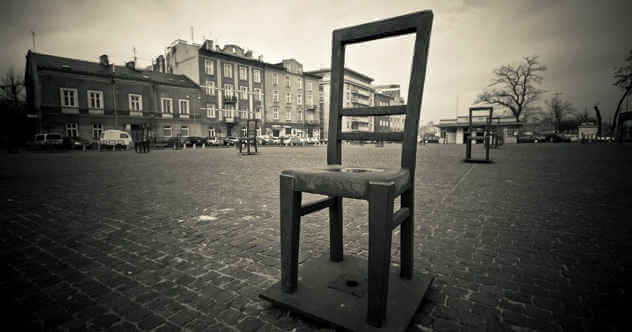
The square is now marked by an installation of empty chairs, a haunting memorial to absence. Chairs suggest homes, kitchens, classrooms, waiting rooms, and family tables. Empty chairs suggest the people who never returned to them. The symbolism is simple enough for anyone to understand and deep enough to keep working on the mind long after leaving the square.
Plac Zgody’s history shows how public space can be transformed into a tool of terror. A square, normally a place of errands and meetings, became a sorting ground for deportation. The ordinary urban setting makes the horror sharper. The Holocaust was not only camps behind fences. It also happened in city squares where people were counted, selected, beaten, separated, and sent away.
8. Deportations Sent Thousands to Belzec, Auschwitz-Birkenau, and Płaszów
The Krakow Ghetto became a staging point for mass deportations. In June 1942, German SS and police deported thousands of Jews from the ghetto toward the Belzec killing center. Another major deportation took place in October 1942, when around 6,000 people were sent away. During these operations, many were shot in the ghetto itself, including children.
Belzec was one of the Operation Reinhard killing centers, created for the murder of Jews in occupied Poland. Deportation notices often hid the truth behind language about “resettlement” or labor. But the destination was death for the overwhelming majority. The Nazis depended on deception, speed, fear, and violence to keep people from understanding or resisting the full scope of what was happening.
Płaszów, located near Krakow, functioned first as a forced-labor camp and later as a concentration camp. Many Jews from the Krakow Ghetto were sent there, where prisoners endured brutal conditions, forced labor, shootings, and arbitrary violence. During the final liquidation of the ghetto in March 1943, thousands were either murdered in the streets, sent to Płaszów, or deported to Auschwitz-Birkenau.
9. The Eagle Pharmacy Became a Rare Place of Help and Witness
Inside the ghetto stood the Pharmacy Under the Eagle, run by Tadeusz Pankiewicz, a Polish Catholic pharmacist. When the ghetto was created, Pankiewicz was allowed to keep operating his pharmacy within its boundaries. He became one of the few non-Jewish people with regular access to life inside the Krakow Ghetto.
The pharmacy became far more than a place to buy medicine. It served as a meeting point, a source of information, and at times a place of assistance. Pankiewicz and his staff helped ghetto residents in various ways, including providing medications, messages, hair dye, sedatives for frightened children during raids, and help in moments when every small act could carry enormous risk.
Pankiewicz later wrote about what he witnessed in the ghetto, making his testimony an important historical record. Today, the former pharmacy is a museum dedicated to the Holocaust of Krakow’s Jews and to Pankiewicz’s role as a witness and helper. His story does not “balance out” the horror; nothing does. But it shows that even in a system designed for cruelty, individual choices still mattered.
10. Jewish Resistance Existed Despite Terrible Odds
It is a mistake to imagine ghetto residents only as passive victims. The Krakow Ghetto had an underground resistance movement from early in its existence. At first, resistance focused on education, welfare, mutual aid, and underground organization. Later, youth movements and political groups helped form armed resistance networks.
One of the most important resistance efforts was connected to the Jewish Fighting Organization in Krakow, which was separate from the better-known Warsaw group of the same name. Rather than staging a doomed battle inside the tight boundaries of the ghetto, Krakow’s fighters chose to attack German targets in the city. In December 1942, members of the underground took part in an attack on Café Cyganeria, a location frequented by German officers.
Resistance did not always look like a weapon. It could mean teaching children, preserving religious practice, sharing food, hiding documents, warning neighbors, recording events, or refusing to let Nazi definitions become the final word on Jewish identity. In the Krakow Ghetto, survival itself required courage, but organized resistance showed something more: a refusal to let the Nazis control the meaning of Jewish life.
The Liquidation of the Krakow Ghetto
The final liquidation of the Krakow Ghetto took place in March 1943. German SS and police forces entered the ghetto and carried out a brutal operation over several days. Approximately 2,000 Jews were shot in the ghetto. Around 2,000 people considered capable of work were sent to Płaszów. Thousands more were deported to Auschwitz-Birkenau, where most were murdered shortly after arrival.
The word “liquidation” is cold and administrative. That is why it is so disturbing. It makes murder sound like inventory management. Behind the word were families torn apart, children killed, elderly people dragged from rooms, belongings abandoned in streets, and survivors forced into another layer of the Nazi camp system. The Krakow Ghetto did not simply close. It was destroyed.
After the liquidation, the physical space remained, but the community had been shattered. Some survivors endured Płaszów, Auschwitz, Gross-Rosen, or other camps. Some were saved through Schindler’s factory. Others escaped, hid, joined resistance networks, or survived through combinations of courage, luck, help, and timing. Most of Krakow’s prewar Jewish population did not survive the Holocaust.
Why These Facts Still Matter Today
The Krakow Ghetto matters because it shows how genocide is built step by step. It begins with propaganda, legal exclusion, forced identification, property theft, labor exploitation, segregation, and public humiliation. Then come walls, deportations, shootings, camps, and mass murder. The path is horrifying, but it is not mysterious. It was made by human decisions.
Learning about Krakow’s Ghetto also helps correct a common misunderstanding of Holocaust history. The Holocaust was not only Auschwitz. Auschwitz-Birkenau was central to Nazi mass murder, but ghettos like Krakow were also essential parts of the system. They isolated Jewish communities, stole labor and property, spread terror, and prepared people for deportation to killing centers and camps.
Finally, the story of the Krakow Ghetto matters because memory is not automatic. Buildings can be renovated. Streets can be renamed. Cafés can reopen. Tourists can take photos. Time, being the world’s most efficient dusting service, can soften almost anything unless people actively remember. Memorials, museums, survivor testimony, and honest historical writing help prevent that softening from becoming forgetfulness.
Experiences Related to Krakow’s Ghetto: How to Encounter This History With Respect
For travelers, students, writers, or anyone studying Holocaust history, Krakow offers a powerful but emotionally demanding experience. The former ghetto area in Podgórze is not a preserved movie set. It is a living urban district, with roads, apartments, shops, and people going about their day. That makes visiting it even more meaningful. You are not stepping into a sealed museum bubble. You are walking through a place where ordinary city life and catastrophic history occupy the same pavement.
A thoughtful visit often begins at Ghetto Heroes Square. The empty chairs stand quietly, but they do not feel passive. They seem to ask visitors to slow down, stop checking the map every seven seconds, and actually look. Each chair evokes absence: a person missing from a table, a family removed from a room, a city robbed of neighbors. It is one of those memorials that does not need to shout because the silence does the heavy lifting.
From there, the Pharmacy Under the Eagle adds human detail to the larger history. Inside, visitors can learn about Tadeusz Pankiewicz, his staff, and the role the pharmacy played during the ghetto years. The experience is intimate. Instead of only thinking in numbers, you encounter medicines, documents, rooms, witness accounts, and the fragile ways people tried to help one another. It is a reminder that history is not made only by generals and monsters. Sometimes it is made by a pharmacist who decides not to leave.
Walking to the remaining fragments of the ghetto wall is another sobering experience. The wall’s tombstone-like shape can feel almost unreal at first, as if symbolism has become architecture. But the bricks are real. The street is real. The discomfort is real, too, and it should be. A respectful visitor does not need to perform sadness for a camera. The better response is attention: read the plaques, learn the dates, understand what happened there, and resist the urge to turn every historic site into a quick backdrop.
Many visitors also connect the former ghetto with nearby sites such as the Oskar Schindler Factory museum and the former Płaszów camp area. Together, these places reveal how the ghetto, forced labor, deportation, and survival stories were linked. Schindler’s story is important, but it should not become the only lens. The broader history belongs first to Krakow’s Jewish community: its families, workers, children, teachers, religious leaders, resistance members, and the thousands whose names are not widely known.
The best way to engage with this history is to prepare before visiting and reflect afterward. Read survivor testimony. Learn basic chronology. Avoid treating the ghetto as “dark tourism” in the shallow sense. There is nothing wrong with travel, photography, or curiosity, but the subject demands maturity. Think of it less as sightseeing and more as bearing witness at a distance. You are not there to consume tragedy. You are there to understand what human beings did to other human beings, and what memory asks of us now.
Conclusion
The story of Krakow’s Ghetto is harrowing because it shows how quickly a city can be divided into those with rights and those marked for destruction. It reveals the mechanics of persecution: forced relocation, overcrowding, walls, labor exploitation, deportation, and murder. But it also preserves stories of resistance, documentation, aid, and witness.
To remember Krakow’s Ghetto is not only to mourn the dead. It is to study the process that led to their persecution and to recognize the warning signs that appear when a society begins sorting human beings into categories of worth. History does not repeat itself like a lazy copy machine, but it does rhyme when people stop listening. The former ghetto in Podgórze asks us to listen carefully.