Note: This article is an original, human-style synthesis based on publicly available information about Ceslovas Cesnakevicius, surreal photomontage, visual illusion art, and the broader tradition of dreamlike photography.
Some artists paint what they see. Others photograph what exists. Ceslovas Cesnakevicius, however, appears to look at reality, politely nod, and then ask, “But what if the moon needed flowers, a city floated like a suitcase, and an illusionist had a much bigger budget than rabbits and top hats?” That mischievous question sits at the heart of 29 Dreamlike Artworks That Will Take You To An Illusionists World By Ceslovas Cesnakevicius, a surreal visual journey where everyday landscapes become stages for impossible events.
Cesnakevicius is a Lithuanian surreal artist known for photographic manipulation, poetic visual storytelling, and a recurring character who often looks like a magician accidentally hired by the laws of physics. His work blends real-world photography with fantasy, creating images that feel familiar enough to trust and strange enough to make your brain request a lunch break.
The result is not just “weird art” for the sake of weirdness. His images invite viewers to think about perception, imagination, loneliness, freedom, nature, and the fragile little border between the ordinary and the impossible. In other words, his art does what great surreal art has always done: it makes reality wobble, then asks whether wobbling might be more honest than standing still.
Who Is Ceslovas Cesnakevicius?
Ceslovas Cesnakevicius is a Lithuanian artist whose portfolio focuses on surreal art, conceptual photography, and carefully crafted photomontage. His official body of work includes several series, such as The World according to an Illusionist, Cloudscapes, Hail New World, The Zoo, and Genetically modified reality. Across these projects, he uses photography as a foundation and then bends it into scenes that look as if dreams had access to professional lighting.
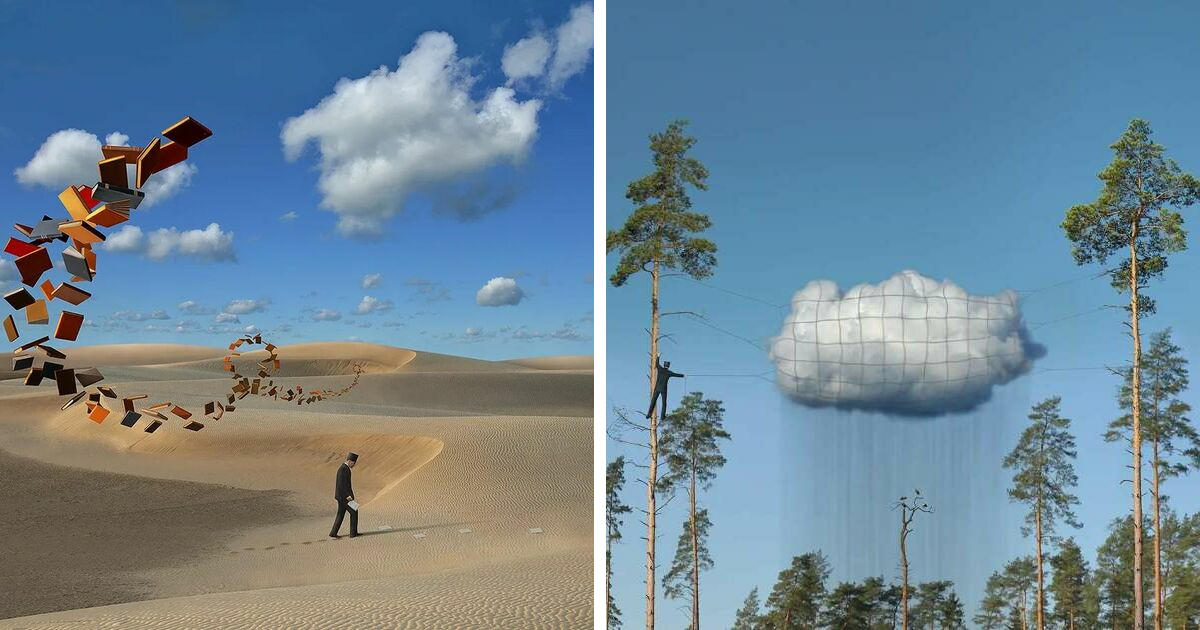
One of the most memorable parts of his creative identity is the “illusionist” figure: a suited, hat-wearing character who appears inside surreal environments, interacting with clouds, moons, doors, landscapes, floating structures, and other visual impossibilities. This character is not a superhero in the usual sense. He does not save cities from meteors or wear uncomfortable spandex. Instead, he quietly negotiates with reality, as if asking the universe to loosen its tie.
Cesnakevicius has described photography and photo montage as the tools that allow him to release creative energy. That detail matters because his artworks do not feel randomly assembled. They feel staged, thoughtful, and deliberate. The impossible elements are playful, but the mood is often philosophical. You laugh first, then wonder why the image is still following you around mentally ten minutes later.
The Magic Of “The World according to an Illusionist”
The series most strongly connected to these dreamlike artworks is The World according to an Illusionist. It explores a simple but irresistible idea: what if an illusionist could do more than perform tricks on a stage? What if he could rearrange nature, travel through impossible doors, balance strange forces, call clouds like pets, or treat the moon as a household object?
That idea gives the images their charm. They are not just fantasy scenes; they are visual jokes told with a straight face. A man may stand in a vast landscape, but the scale is off. A familiar object appears where it should not. A doorway opens into a place that politely refuses geography. A cloud behaves like something with a schedule. The humor is dry, elegant, and slightly cosmic, like a magician who has misplaced his assistant but found the horizon.
Works associated with Cesnakevicius’s illusionist universe include titles such as Levitation, The Searcher, Cloudhunter, Traveler, Birdcage, Learning to fly, Down the stream, and The moon conqueror. These titles alone sound like chapters from a book found in an attic, written by someone who knew too much about clouds.
Why These 29 Dreamlike Artworks Feel So Captivating
The power of Cesnakevicius’s surreal artworks comes from contrast. He often begins with believable photographic spaces: fields, skies, city scenes, water, forests, roads, and architectural details. Then he adds one impossible idea. That is the secret recipe. Not ten impossible ideas fighting for attention like overcaffeinated circus performers. Just one strong impossibility, placed carefully enough that the viewer almost accepts it.
1. The Art Feels Familiar Before It Turns Strange
Many surreal artworks fail because they rush straight into chaos. Cesnakevicius takes a smarter route. He lets the viewer enter through a familiar door: a landscape, a cloudy sky, a lonely figure, a clean horizon. Once the viewer feels comfortable, the image quietly pulls the rug out from under reality. Suddenly the moon is too close, a building seems to float, or a figure is doing something that physics would like to discuss with management.
2. The Illusionist Becomes A Guide
The recurring figure gives the series emotional continuity. He is not merely decoration. He becomes a guide through this illusionist’s world. His small human presence helps the viewer measure the scale of impossible events. Without him, the scenes might feel like abstract fantasy. With him, they feel like stories. We are not just looking at a strange world; we are watching someone try to live in it.
3. The Humor Makes The Philosophy Easier To Enter
There is a gentle comic intelligence in Cesnakevicius’s work. The images are often funny, but not in a loud way. They do not shout, “Look how quirky I am!” Instead, they smile from across the room while quietly replacing the ceiling with a sky. This humor helps viewers approach deeper themes: uncertainty, imagination, human smallness, freedom, and the temporary nature of material reality.
Surrealism, Photography, And The Art Of Bending Reality
Cesnakevicius’s work belongs to a long tradition of surreal art, but it also feels very contemporary. Classic surrealism explored dreams, the unconscious mind, irrational combinations, and the mysterious poetry of everyday objects. Artists such as René Magritte, Salvador Dalí, Max Ernst, Man Ray, and others helped establish a visual language where logic could take a vacation and still send postcards.
Photography has always had a special relationship with surrealism because photographs carry an automatic sense of evidence. We tend to believe a photograph before we question it. Cesnakevicius uses that trust brilliantly. His images begin with photographic realism, then introduce impossible events that feel oddly credible because the lighting, scale, and atmosphere are handled with care.
This is where photomontage becomes more than a technical method. It becomes a storytelling engine. By combining photographic elements into a single composition, the artist can create scenes that appear documented rather than invented. The viewer knows the scene cannot be real, but the eye keeps saying, “Are we absolutely sure?” That tiny argument between knowledge and perception is where the magic happens.
Notable Visual Themes In Ceslovas Cesnakevicius’s Art
Although each image has its own concept, several themes appear again and again throughout Cesnakevicius’s dreamlike artworks. These recurring ideas help make his visual world recognizable.
Clouds, Moons, And The Sky As A Playground
The sky in Cesnakevicius’s art is rarely just background. It often behaves like a character. Clouds become objects to chase, collect, manipulate, or inhabit. The moon may feel close enough to touch, carry, conquer, or decorate. This use of celestial imagery gives the artworks a dreamy, almost fairy-tale mood, but the compositions remain sharp and modern rather than sugary.
Doors, Journeys, And Secret Places
Titles such as The Searcher, Traveler, The Great Journey, My Secret Place, and Some Place You Are Always Welcome suggest movement between worlds. Doors and pathways are especially powerful symbols because they imply choice. Step through, and ordinary life may not survive the trip. Stay where you are, and you may spend forever wondering what was on the other side. No pressure, just existential architecture.
Nature Rewritten By Imagination
In many images, nature is not destroyed or conquered; it is reimagined. Landscapes bend, clouds respond, water becomes narrative, and animals or natural forms appear in unexpected contexts. This is not the aggressive fantasy of domination. It is closer to a conversation with the natural world, though the conversation may include a floating island and a very confused weather report.
The Role Of “The Zoo” And Urban Surrealism
Cesnakevicius’s series The Zoo offers another fascinating angle on his imagination. In that project, wild animals appear in everyday urban spaces, creating black-and-white scenes where cities become casual habitats for creatures that should not be there. The idea reportedly grew from observations of diverse city life in places such as London and Amsterdam, where people of many styles, cultures, and appearances move through public spaces while often keeping to themselves.
The humor is immediate: a wild animal walking through a city street should cause panic, paperwork, and at least one local news helicopter. Yet in Cesnakevicius’s imagined world, the creature seems strangely accepted, as long as it minds its own business. Beneath the joke is a thoughtful point about diversity, visibility, and the way urban life teaches people to coexist with the unexpected.
Why Viewers Love These Dreamlike Artworks
Part of the appeal is simple: the images are beautiful. They have atmosphere, clean composition, and a cinematic sense of space. But beauty alone is not enough to explain why people keep sharing and discussing Cesnakevicius’s art. The stronger reason is that his work gives viewers permission to wonder.
Modern internet life often trains people to scroll quickly, react instantly, and move on before a thought has time to put on shoes. Cesnakevicius’s artworks resist that habit. They reward slower looking. The longer you stay with an image, the more it opens. A visual joke becomes a metaphor. A fantasy scene becomes a question. A small figure under a huge sky becomes, inconveniently, all of us.
His art is also accessible. You do not need an advanced degree in art theory to enjoy it. The images speak clearly through mood, scale, and surprise. At the same time, they offer enough symbolic depth for viewers who enjoy analysis. That balance is difficult to achieve. It is also why his work can appeal to casual fans, digital artists, photographers, surrealism lovers, and people who simply enjoy seeing reality politely rearranged.
SEO-Friendly Analysis: What Makes This Topic So Searchable?
The phrase dreamlike artworks by Ceslovas Cesnakevicius naturally connects several strong search interests: surreal art, digital art, photo manipulation, illusion art, fantasy photography, conceptual photography, and contemporary surrealism. Readers searching for this topic are usually looking for visual inspiration, artist discovery, creative interpretation, or examples of imaginative digital artwork.
That makes the topic valuable for art blogs, design websites, photography communities, and creativity-focused publishers. The content is highly visual, emotionally engaging, and easy to organize into sections. It also supports related keywords such as surreal photo manipulation, illusionist world art, dreamlike digital photography, Lithuanian surreal artist, and fantasy photomontage.
For readers, the article works as both a guide and an invitation. It explains who the artist is, why the images matter, how they connect to surrealism, and what emotional experience they create. For search engines, the topic offers clear semantic relevance around art, photography, illusion, surrealism, and visual storytelling without awkward keyword stuffing. Nobody needs to repeat “dreamlike artworks” twenty times like a broken museum audio guide.
How Cesnakevicius Turns Illusion Into Emotion
The best illusion art does not merely trick the eye. It creates a feeling. Cesnakevicius understands this. His images are technically clever, but they are not cold demonstrations of editing skill. They have mood. Some feel lonely. Some feel adventurous. Some feel comic. Some feel like the moment just before a dream becomes too strange to explain at breakfast.
This emotional range is what separates memorable surreal art from ordinary digital manipulation. A floating object can look impressive, but if it has no emotional purpose, it becomes a software demo. In Cesnakevicius’s work, the impossible detail usually changes the meaning of the scene. The illusion is not added on top; it is the heart of the story.
Experiences Inspired By “29 Dreamlike Artworks That Will Take You To An Illusionists World By Ceslovas Cesnakevicius”
Viewing Ceslovas Cesnakevicius’s dreamlike artworks can feel less like browsing an online gallery and more like taking a quiet walk through someone else’s impossible memory. At first, you may notice the obvious charm: a moon behaving badly, a cloud in the wrong place, a traveler facing a doorway that probably does not appear on Google Maps. But after a while, the images begin to shift from clever visual tricks into personal experiences. They remind you of the strange way dreams work: perfectly normal while you are inside them, completely ridiculous when you try to explain them later.
One relatable experience is the feeling of being small in a world that is much larger, stranger, and less predictable than we pretend. Many of Cesnakevicius’s compositions place a lone figure inside a vast landscape. The person is not always frightened. Sometimes he seems curious, determined, or mildly inconvenienced, like someone who packed a sandwich for a journey and accidentally found the edge of reality. That mood can resonate with anyone who has ever faced a big life change, started over, moved to a new city, or realized that adulthood does not come with enough instructions.
Another experience is the joy of rediscovering imagination without embarrassment. Children have no problem believing that clouds are animals, doors lead to secret worlds, and the moon might need help getting home. Adults often bury that instinct under schedules, bills, passwords, and the mysterious disappearance of matching socks. Cesnakevicius’s art gives that imaginative instinct a respectable suit and lets it walk back into the room. It reminds viewers that wonder is not childish. Wonder is a way of paying attention.
There is also a creative lesson hidden in these artworks. They show that fantasy becomes stronger when it is grounded in reality. The realistic textures, believable spaces, and photographic details make the impossible elements feel more powerful. For writers, designers, photographers, and digital artists, this is a useful principle: do not make everything strange. Make one important thing strange, then allow the ordinary world to react around it. That contrast gives the audience something to hold onto while their imagination takes the scenic route.
Personally, the most memorable experience these works create is the sensation of standing at a threshold. Many of the images feel like a pause before action: before entering, before flying, before searching, before leaving, before understanding. That pause is emotionally rich because real life is full of thresholds too. We stand before decisions, opportunities, endings, and beginnings, often pretending we are calm while our inner narrator is screaming into a decorative pillow. Cesnakevicius turns that familiar human moment into visual poetry.
Finally, these 29 dreamlike artworks offer the rare pleasure of art that is both intelligent and generous. They do not make viewers feel excluded. They invite people in with beauty and humor, then leave enough mystery for the mind to wander. In a noisy online world, that is a gift. The illusionist’s world is not an escape from reality so much as a reminder that reality has more doors than we usually notice.
Conclusion
29 Dreamlike Artworks That Will Take You To An Illusionists World By Ceslovas Cesnakevicius is more than a collection of surreal images. It is an invitation to see ordinary life as flexible, symbolic, and full of hidden theatrical potential. Cesnakevicius uses photomontage, surreal humor, and poetic composition to create artworks that are easy to enjoy and difficult to forget.
His illusionist does not simply perform tricks. He opens doors, chases clouds, questions scale, and turns the landscape into a stage for imagination. Through this character and the worlds around him, Cesnakevicius reminds us that art does not need to explain everything. Sometimes it only needs to tilt reality slightly and let us discover how much wonder spills out.