Introduction: Spanish Numbers Are Friendly… Until They Put on a Mustache
Learning how to write numbers in Spanish sounds simple at first. You learn uno, dos, tres, feel like a linguistic superhero, and briefly consider ordering coffee in Madrid with dramatic confidence. Then Spanish says, “Wonderful. Now please explain why veintiuno becomes veintiún años, why cien turns into ciento uno, and whether 1,5 is the same as 1.5.” Suddenly, the superhero cape feels suspiciously like a tablecloth.
The good news is that Spanish numbers follow clear patterns. Once you understand the main systems, writing numbers becomes much easier. In this guide, we will explore 3 ways to write numbers in Spanish: spelling numbers as words, adjusting numbers for grammar and gender, and formatting numbers as digits in Spanish-speaking contexts. These three skills cover everyday situations such as writing ages, prices, dates, quantities, percentages, decimals, addresses, schoolwork, travel notes, and business documents.
Whether you are a beginner learning Spanish numbers from 1 to 100 or an intermediate learner trying to avoid tiny grammar traps, this guide gives you practical rules, clear examples, and real usage tips. No robotic worksheets. No grammar fog machine. Just numbers behaving themselvesmostly.
Way 1: Write Spanish Numbers as Words
The first and most traditional way to write numbers in Spanish is to spell them out as words. This is especially useful in language learning, formal writing, checks, literary writing, invitations, and any sentence where the number is small enough not to make the reader pack a lunch before finishing it.
Start with the basic numbers from 0 to 15
Spanish numbers from zero to fifteen are best memorized because they do not follow one perfect pattern. They are the “learn me as I am” group:
- 0: cero
- 1: uno
- 2: dos
- 3: tres
- 4: cuatro
- 5: cinco
- 6: seis
- 7: siete
- 8: ocho
- 9: nueve
- 10: diez
- 11: once
- 12: doce
- 13: trece
- 14: catorce
- 15: quince
These words appear constantly in everyday Spanish. You will use them for time, age, classroom counting, prices, scores, room numbers, and quick conversations. For example: Tengo cinco libros means “I have five books,” and Son las ocho means “It is eight o’clock.”
Learn the connected forms from 16 to 29
From 16 to 19, Spanish combines forms based on diez and the unit number. These are written as one word:
- 16: dieciséis
- 17: diecisiete
- 18: dieciocho
- 19: diecinueve
From 21 to 29, Spanish uses veinti- plus the unit. These are also written as one word:
- 21: veintiuno
- 22: veintidós
- 23: veintitrés
- 24: veinticuatro
- 25: veinticinco
- 26: veintiséis
- 27: veintisiete
- 28: veintiocho
- 29: veintinueve
Notice the accent marks in dieciséis, veintidós, veintitrés, and veintiséis. Accent marks are not decorative confetti; they matter. Leaving them out may not always destroy meaning, but correct Spanish writing includes them.
Use separate words from 31 upward
For numbers from 31 onward, the standard written pattern uses the ten, the word y, and the unit:
- 31: treinta y uno
- 42: cuarenta y dos
- 56: cincuenta y seis
- 78: setenta y ocho
- 99: noventa y nueve
Think of y as the little bridge between the tens and the ones. In English we say “forty-two” with a hyphen; Spanish says cuarenta y dos, which literally feels like “forty and two.” Spanish is not being dramatic. It is simply being Spanish.
Write hundreds, thousands, and millions carefully
Spanish hundreds have their own forms:
- 100: cien
- 101: ciento uno
- 200: doscientos
- 300: trescientos
- 400: cuatrocientos
- 500: quinientos
- 600: seiscientos
- 700: setecientos
- 800: ochocientos
- 900: novecientos
Use cien for exactly 100. Use ciento when another number follows: ciento cinco for 105, ciento treinta for 130, and ciento noventa y nueve for 199.
For thousands, use mil. One thousand is simply mil, not un mil in standard everyday use. For example, 1,000 is mil, 2,000 is dos mil, and 25,000 is veinticinco mil. For millions, Spanish uses millón in the singular and millones in the plural: un millón, dos millones, tres millones de personas.
Way 2: Write Numbers with Correct Spanish Grammar
The second way to write numbers in Spanish is not just about spelling the number correctly. It is about making the number behave grammatically in a sentence. Spanish numbers sometimes change form depending on the noun that follows. This is where learners often trip, then blame the furniture.
Use uno, un, and una correctly
The number one has three common forms: uno, un, and una. Use uno when counting or when the number stands alone:
- Uno, dos, tres. One, two, three.
- ¿Cuántos boletos tienes? Uno. How many tickets do you have? One.
Use un before a masculine singular noun:
- un libro one book
- un estudiante one student
- un problema one problem
Use una before a feminine singular noun:
- una casa one house
- una mesa one table
- una pregunta one question
This rule also affects compound numbers ending in one. For example, 21 can be veintiuno, veintiún, or veintiuna, depending on the sentence.
Adjust numbers ending in one before nouns
When a number ending in uno comes before a masculine noun, it changes to un. This is called apócope, which sounds like a fancy medical condition but simply means a word gets shortened before another word.
- veintiún años twenty-one years
- treinta y un días thirty-one days
- ciento un libros one hundred one books
Before feminine nouns, use the feminine form:
- veintiuna páginas twenty-one pages
- treinta y una personas thirty-one people
- ciento una casas one hundred one houses
Be especially careful with common learner phrases. You say Tengo veintiún años, not Tengo veintiuno años. But if someone asks your age and you answer with only the number, you can say veintiuno. The noun changes the game.
Make hundreds agree with gender
Spanish hundreds from 200 to 900 can change gender when they describe feminine nouns. For masculine nouns, use forms such as doscientos, trescientos, and cuatrocientos. For feminine nouns, use doscientas, trescientas, and cuatrocientas.
- doscientos libros two hundred books
- doscientas sillas two hundred chairs
- quinientos estudiantes five hundred students
- quinientas entradas five hundred tickets
This rule makes Spanish numbers more precise. It also means that copying a number from a chart into a sentence is not always enough. You need to look at the noun and ask, “Are we dealing with masculine, feminine, or grammar mischief?”
Do not confuse cardinal and ordinal numbers
Cardinal numbers answer “how many?” Examples include uno, dos, tres, and cien. Ordinal numbers answer “which position?” Examples include primero, segundo, tercero, and cuarto.
Use cardinal numbers for quantity:
- Tengo tres hermanos. I have three siblings.
- Compramos diez manzanas. We bought ten apples.
Use ordinal numbers for order:
- Es mi primer día. It is my first day.
- Vivo en el segundo piso. I live on the second floor.
A useful detail: primero and tercero become primer and tercer before masculine singular nouns, as in el primer capítulo and el tercer piso. Spanish likes efficiencyexcept when it doesn’t.
Way 3: Write Numbers as Digits in Spanish Style
The third way to write numbers in Spanish is to use digits. This is common in addresses, prices, measurements, dates, statistics, school assignments, recipes, invoices, and digital content. But Spanish formatting can differ from English formatting, especially with decimals, thousands, dates, and percentages.
Understand decimals: comma or point?
In English, especially in the United States, decimals are usually written with a point: 3.5, 12.75, 99.9. In Spanish-speaking contexts, both the comma and the point may appear as decimal separators depending on country, publication style, or technical standard. You may see:
- 3,5 or 3.5
- 12,75 or 12.75
- 99,9 or 99.9
When writing for a specific Spanish-speaking audience, follow the local or editorial style. If you are writing for a class, ask the teacher which format they prefer. If you are writing for international readers, consistency matters more than trying to impress everyone at once. Pick one format and stick with it like it owes you money.
Use spaces carefully in large numbers
In many formal Spanish-language style guides, large numbers may be grouped with spaces rather than commas. For example:
- 10 000 ten thousand
- 250 000 two hundred fifty thousand
- 3 500 000 three million five hundred thousand
However, you will still see commas or periods used in many real-world materials, especially across different countries and websites. This is one reason numbers can feel confusing for learners. The safest approach is to recognize several formats but use one consistent style in your own writing.
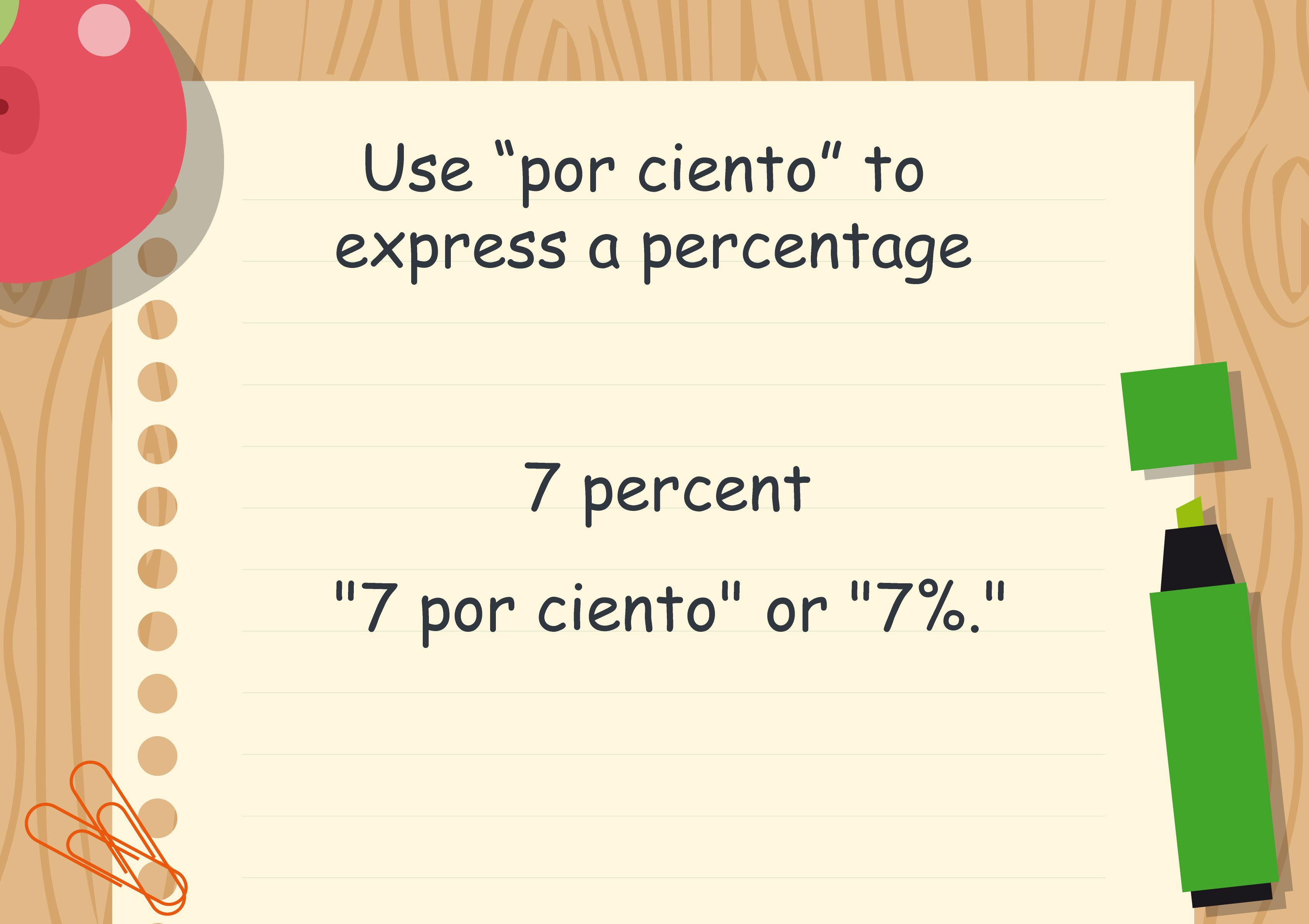
Write percentages with a space before the symbol
In Spanish, percentages written with digits commonly place a space before the percent symbol:
- 25 % twenty-five percent
- 7,5 % seven point five percent, depending on decimal style
- 100 % one hundred percent
If you spell out the percentage, use por ciento: veinticinco por ciento. Do not mix a spelled-out number with the percent symbol in ordinary writing. In other words, 25 % and veinticinco por ciento are clean; veinticinco % looks like it got dressed in the dark.
Write dates with numbers the Spanish way
Spanish dates typically use the day-month-year order. For example, May 4, 2026, can be written as 4 de mayo de 2026. In numeric form, you may see 4/5/2026 in day-month-year style, which can confuse American readers because U.S. English often uses month-day-year order.
To avoid confusion, spell out the month when clarity matters:
- 4 de mayo de 2026
- 15 de agosto de 2026
- 21 de diciembre de 2026
This format is especially useful in travel plans, school assignments, business emails, and international documents. Nobody wants a birthday party on the wrong month because the date format played hide-and-seek.
Use digits for addresses, measurements, and technical writing
Digits are often better than words when the number is part of an address, code, price, measurement, recipe, statistic, or technical detail:
- Calle 8 8th Street or Street 8
- 2 kg de arroz 2 kilograms of rice
- 15 minutos 15 minutes
- $20 or 20 dólares 20 dollars
In educational writing, small numbers are often spelled out, while larger numbers are written as digits. But rules vary by style guide. The key is readability. If spelling out a number makes the sentence elegant, do it. If spelling it out makes the sentence look like a medieval scroll, use digits.
Common Mistakes When Writing Numbers in Spanish
Mistake 1: Writing “veinte y uno” instead of “veintiuno”
In modern standard Spanish, 21 through 29 are written as single words: veintiuno, veintidós, veintitrés, and so on. A learner might guess veinte y uno because 31 is treinta y uno. The guess is logical, but Spanish says, “Nice try, bring snacks next time.”
Mistake 2: Using “cien” before another number
Use cien only for exactly 100. When another number follows, use ciento. Correct examples include ciento uno, ciento veinte, and ciento noventa y nueve.
Mistake 3: Forgetting gender agreement
Numbers ending in one and hundreds from 200 to 900 may need to agree with the noun. Write treinta y un libros, but treinta y una revistas. Write cuatrocientos platos, but cuatrocientas tazas.
Mistake 4: Mixing English and Spanish punctuation
If you are writing Spanish numbers in an English-speaking environment, it is easy to mix conventions. A number like 1.500 may mean one thousand five hundred in some contexts, but one and a half in others. When accuracy matters, spell out the number or use a clear format.
Quick Practice: Write These Numbers in Spanish
Try these examples before peeking at the answers. Yes, peeking still counts as learning, but your conscience may raise one eyebrow.
- 18: dieciocho
- 22: veintidós
- 31: treinta y uno
- 45: cuarenta y cinco
- 100: cien
- 101: ciento uno
- 200 books: doscientos libros
- 200 chairs: doscientas sillas
- 21 years: veintiún años
- 21 pages: veintiuna páginas
Real-Life Experiences: What Writing Numbers in Spanish Teaches You
One of the funniest things about learning Spanish numbers is that they seem small until they appear in real life. A student may memorize uno through cien perfectly, then freeze at a hotel desk when asked for a room number. Suddenly, habitación cuatrocientos dieciséis feels like a password to a secret castle. That is normal. Numbers are not just vocabulary; they are speed, listening, grammar, and confidence all wearing the same jacket.
In my experience helping learners think through Spanish number patterns, the biggest improvement comes from using numbers in everyday mini-situations. Instead of only reciting uno, dos, tres, write tiny sentences: Tengo dos gatos, Necesito tres boletos, La clase empieza a las ocho. This makes the numbers useful. Your brain stops treating them like a chart and starts treating them like tools.
Another helpful experience is practicing numbers with money and shopping. Prices force you to understand both words and digit formats. If a menu says 12,50 €, you need to recognize the decimal comma. If a market seller says veinticinco, you need to hear 25 quickly. It is a tiny workout for the ears, eyes, and wallet. The wallet usually complains first.
Ages are also excellent practice because they teach the grammar of un. Many learners first say tengo veintiuno años because they correctly learned that 21 is veintiuno. Then they discover that before años, it becomes veintiún años. This correction feels annoying for about five minutes, and then it becomes natural. The secret is to learn numbers in phrases, not just alone.
Dates offer another practical lesson. English-speaking learners often write dates in month-day-year order because that is familiar in the United States. Spanish usually uses day-month-year order, so writing 5/4/2026 can create confusion. Is it May 4 or April 5? To avoid calendar chaos, write 4 de mayo de 2026. It is clear, elegant, and unlikely to send someone to the airport on the wrong day.
Finally, numbers in Spanish teach patience. You may know the rule and still make a mistake while speaking or writing fast. That does not mean you are bad at Spanish. It means your brain is building a new filing system. Keep practicing with real examples: addresses, birthdays, recipes, prices, class schedules, sports scores, and travel plans. Little by little, Spanish numbers stop looking like a puzzle and start feeling like part of the language. And when you can write trescientas veintiuna páginas without sweating, you deserve applauseor at least a cookie.
Conclusion: Spanish Numbers Make Sense When You Learn the Patterns
Writing numbers in Spanish becomes much easier when you divide the skill into three practical methods. First, learn to spell numbers as words, especially the essential forms from 0 to 100, the hundreds, thousands, and millions. Second, pay attention to grammar, including uno, un, una, gender agreement, and the difference between cardinal and ordinal numbers. Third, understand how digits are formatted in Spanish-speaking contexts, especially with decimals, percentages, dates, and large numbers.
The goal is not to memorize every possible number in one heroic afternoon. The goal is to recognize patterns and use them in real sentences. Start with common numbers, write short examples, practice with nouns, and notice how numbers appear in Spanish websites, menus, schedules, and forms. Before long, treinta y siete, ciento veinte, and dos mil veintiséis will feel less like grammar homework and more like normal communication.