Once upon a time, a “real company” needed an office. Preferably one with exposed brick, suspiciously expensive chairs, a coffee machine that sounded like a small motorcycle, and at least one conference room named after a planet. Then work changed. Employees proved they could sell, code, design, hire, support customers, close deals, and attend too many meetings without sitting under fluorescent lights. Suddenly, the office was no longer the automatic heart of the company. For many businesses, it became a question mark with a lease attached.
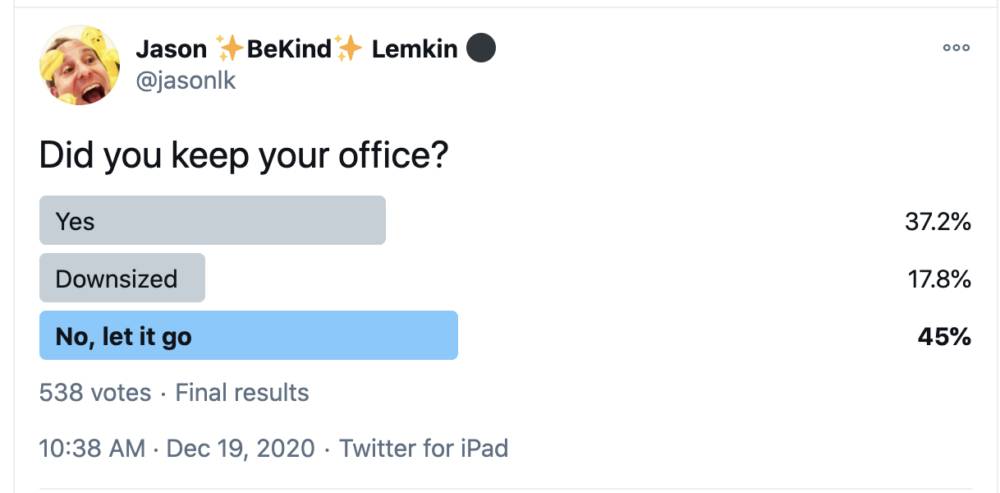
The title “45% of You Let Your Office Go” comes from a SaaStr discussion that captured a major shift: 45% of respondents said they had let their office go, another 18% had downsized, and 37% had kept their office. That small snapshot said a lot. It was not simply about rent. It was about how founders, employees, and teams were rethinking the purpose of physical space.
Today, the office is not dead. It is just no longer allowed to coast on vibes, badge swipes, and stale muffins from last Thursday’s all-hands meeting. If a company asks people to commute, the workplace has to earn the trip.
What “Letting the Office Go” Really Means
Letting the office go does not always mean becoming a fully remote company with employees scattered across time zones like confetti. In many cases, it means replacing the traditional headquarters model with a lighter, more flexible workplace strategy. Companies may move to coworking spaces, rent meeting rooms as needed, create regional hubs, or keep a smaller office designed for collaboration rather than daily desk-sitting.
The old office model was simple: sign a lease, assign desks, buy monitors, and hope everyone enjoys the commute enough not to bring it up in every employee survey. The new model is more complicated but also more honest. Leaders now have to ask: What work actually improves when people are together? Which meetings deserve a room? Which tasks are better done at home? How much office space supports the business instead of merely decorating the balance sheet?
This shift matters because office space is expensive, slow to change, and emotionally loaded. A company can cancel a software subscription in five minutes. A lease, unfortunately, has the flexibility of a grand piano in a studio apartment. Once businesses learned that productivity did not always require a desk farm, many started questioning whether they needed the same footprint at all.
The Great Office Reset: Why Companies Walked Away
1. Remote work proved more durable than expected
Remote work was once treated like an emergency umbrella: useful during a storm, then shoved back in the closet. But for knowledge workers, it became a normal part of work life. Pew Research Center found that among employed adults whose jobs can be done from home, 75% were working remotely at least some of the time. That is not a temporary blip. That is a workplace habit with roots.
The U.S. Bureau of Labor Statistics also showed that working from home remained common in 2024. About 33% of employed people spent some time working at home on days they worked, roughly similar to 2023. Workers with a bachelor’s degree or higher were especially likely to do some work from home, reflecting the reality that remote work is concentrated in professional and office-based roles.
2. Employees now see flexibility as compensation
For many employees, flexibility is no longer a perk. It is part of the job offer. McKinsey’s American Opportunity Survey found that flexible work remains one of the top reasons people look for a new job, behind pay and career opportunities. That should make every executive pause before saying, “Everyone back five days a week,” with the confidence of someone who has never sat in traffic behind a landscaping truck at 7:42 a.m.
Pew’s research found that nearly half of remote-capable workers who currently work from home at least sometimes would be unlikely to stay at their job if working from home were no longer allowed. FTI Consulting reported similar tension: many remote and hybrid workers said they would look for another job if forced back to the office full time at the same salary.
The lesson is not that employees hate offices. Many do not. The lesson is that employees dislike losing control. Flexibility gives people time, focus, and breathing room. Take it away without a compelling reason, and the office starts to feel less like culture and more like punishment with parking validation.
3. Hybrid work became the compromise that actually works
The strongest workplace model for many companies is not fully remote or fully in-office. It is hybrid. Stanford economist Nicholas Bloom and coauthors published research in Nature showing that a two-days-at-home hybrid schedule improved retention without hurting performance. In the study, hybrid workers were just as productive and just as likely to be promoted as their fully office-based peers, while quit rates fell significantly.
That finding helps explain why so many companies are redesigning offices rather than abandoning them completely. The modern office is becoming less of a daily destination and more of a collaboration hub. People come in for brainstorming, onboarding, mentoring, customer meetings, culture-building, and the kind of conversations that happen faster when no one has to say, “You’re on mute.”
The Office Is Not Gone. The Bad Office Is in Trouble.
There is a big difference between “the office is dead” and “the office must justify itself.” The second statement is closer to the truth. Companies are still using offices, but they are using them differently. CBRE’s 2025 Americas Office Occupier Sentiment Survey found that many organizations have communicated attendance policies and are measuring compliance more actively than before. At the same time, average attendance remains uneven, with peak days often feeling busy while other days feel like the set of a workplace documentary after the cast went home.
Kastle’s office occupancy data also shows a clear midweek pattern. Tuesday tends to be a peak day, while Mondays and Fridays often remain softer. This tells us something important: people are not rejecting offices completely. They are choosing specific office moments. The commute has become an investment, and employees expect a return.
That return might be faster decisions, better collaboration, stronger relationships, or access to tools they do not have at home. But if someone travels 45 minutes to sit on video calls with people in the same building, the office has failed the assignment. That is not workplace strategy. That is synchronized inconvenience.
Why Smaller Offices and Flexible Spaces Are Winning
Many businesses that let their office go did not eliminate in-person work. They eliminated waste. Instead of paying for empty desks five days a week, they shifted to smaller spaces, coworking memberships, on-demand meeting rooms, or team off-sites. CBRE noted that organizations continue to use flexible office space to reduce capital expenditure, solve uncertain demand, and provide meeting and collaboration space when needed.
This is especially useful for startups. A young company may grow quickly, shrink unexpectedly, hire across multiple cities, or pivot so hard the original office layout becomes a fossil. Flexible space gives companies options. It also protects them from building a workplace strategy around headcount guesses that were created in a spreadsheet at midnight after too much cold brew.
For larger companies, the strategy often looks different. Many are moving toward better-quality offices with fewer total square feet. JLL has reported that companies are still reducing large office footprints while interest in smaller, higher-quality spaces continues. In other words, some companies are trading quantity for quality. Fewer desks, better rooms. Less beige carpet, more intentional design.
The Hidden Cost of Keeping an Office Nobody Uses
An unused office is not just a real estate expense. It is a morale problem wearing a security badge. When employees walk into a half-empty workplace, they may wonder whether the company is thriving, drifting, or simply waiting for the lease to expire. Empty space creates awkward energy. It is hard to feel momentum when the “collaboration zone” contains one person eating yogurt in silence.
There is also an opportunity cost. Money spent on unnecessary office space cannot be spent on hiring, product development, customer success, better tools, employee benefits, or team retreats. For startups, that matters even more. Runway is oxygen. Paying for empty desks is like buying a treadmill and using it as a coat rack: technically possible, financially questionable.
The commercial real estate market reflects this tension. Axios, citing Moody’s Analytics REIS data, reported that U.S. office vacancy reached 21% in the first quarter of 2026 across 79 markets, up from 17% in 2020. Return-to-office policies are real, but so is the long-term reduction in how much office space many employers need.
When Keeping the Office Still Makes Sense
Letting the office go is not automatically smart. Some companies genuinely benefit from a physical headquarters. Hardware teams, biotech labs, design studios, manufacturing-adjacent businesses, healthcare operations, financial firms, and high-touch sales organizations may need more in-person work. Early-stage teams may also move faster when founders and core employees share space during intense product-building periods.
The key is not whether a company has an office. The key is whether the office matches the work. A great office has a clear purpose. It supports rituals, speeds up communication, strengthens mentoring, and gives people a reason to be present. A weak office is just expensive furniture plus a Wi-Fi password.
Leaders should also remember that newer employees may need the office differently than senior employees. Gallup has reported that Gen Z is less likely than older generations to prefer fully remote work. That makes sense. If you are early in your career, you may want mentorship, visibility, friendships, and casual learning. Remote work can be efficient, but it does not always teach you how decisions are made, how conflict is handled, or why Karen from finance can approve anything in under six minutes but only if you ask before lunch.
How to Decide Whether to Let Your Office Go
Ask what the office is for
Before renewing a lease, leaders should define the office’s job. Is it for focused work? Team building? Client meetings? Product sprints? Onboarding? Social connection? If the answer is “because companies have offices,” that is not a strategy. That is nostalgia with a rent invoice.
Measure real usage, not executive feelings
Badge data, room bookings, employee surveys, project velocity, retention, and collaboration patterns can reveal how the office is actually used. The goal is not surveillance. The goal is clarity. If Tuesday is packed and Friday is a ghost town, design for reality instead of pretending every weekday is equal.
Create anchor days with purpose
Hybrid work works best when in-office days are coordinated. Random attendance creates the worst of both worlds: people commute but still miss each other. Anchor days can help, especially when they include team meetings, mentorship, workshops, or decision-heavy sessions. The office should feel like a useful gathering, not an attendance quiz.
Invest in the digital office too
If a company reduces physical space, it must improve digital systems. Documentation, project management, asynchronous updates, clean meeting norms, and reliable communication tools become the new infrastructure. A company cannot close the office and run everything through chaotic Slack threads titled “quick question.” That way lies madness, duplicate work, and someone accidentally approving the wrong logo.
Specific Examples of Smarter Office Strategies
A 25-person SaaS startup might drop its permanent office and use coworking rooms twice a month for planning sessions. This keeps costs low while preserving human connection. A 300-person company might keep a smaller headquarters but remove assigned desks, using neighborhoods for teams and reservable rooms for collaboration. A national company might create regional hubs in cities where employees already cluster, reducing travel while supporting in-person culture.
Another smart approach is the quarterly off-site. Instead of forcing weak office attendance every week, some remote-first companies bring teams together for focused planning, product demos, customer analysis, and relationship building. Done well, this can create more connection in three days than a vague office mandate creates in three months.
Still, off-sites are not magic. They need structure. A good off-site has clear goals, thoughtful sessions, informal time, and follow-up. A bad off-site is just a hotel ballroom, lukewarm coffee, and an icebreaker where adults are asked to describe themselves as breakfast foods. Nobody needs that. Society has suffered enough.
The Employee Experience: What It Feels Like When the Office Goes Away
When a company lets the office go, employees often feel two things at once: freedom and uncertainty. The freedom is obvious. No commute. More control over the day. Fewer interruptions. Lunch that does not cost $18 plus emotional damage. For many people, remote or hybrid work means better focus, easier family logistics, and more energy left at the end of the day.
The uncertainty is quieter. Without an office, employees may worry about visibility, promotion, mentorship, or belonging. New hires may wonder how to build relationships. Managers may struggle to notice burnout. Teams may become efficient but less creative if they never make room for messy, spontaneous conversation.
That is why remote-first companies need intentional culture. They need better onboarding, clearer communication, regular one-on-ones, documented decisions, and moments where people connect as humans instead of profile pictures. The office used to create accidental interaction. Without it, companies must design interaction on purpose.
Experience Section: What “Letting the Office Go” Teaches You
The first experience many companies have after letting the office go is relief. The monthly rent disappears or shrinks. The office manager no longer has to restock oat milk like it is a critical business function. Employees stop planning their lives around traffic patterns. Leaders look at the budget and suddenly see room for better software, hiring, customer programs, or a proper team retreat. It feels like clearing a giant piece of furniture from a small room. Everyone can breathe.
Then comes the second experience: the awkward adjustment period. Without the office, small problems become visible. Maybe the team relied too much on hallway conversations. Maybe decisions were never documented. Maybe meetings were carrying the entire operating system of the company, which is like using a shopping cart as a family sedan. People begin asking where files are, who approved what, and why the same conversation happened in three different channels. This stage can be annoying, but it is also useful. It forces the company to become more mature.
The third experience is learning that flexibility does not mean randomness. A good remote or hybrid company still has rules. It has working hours, communication expectations, response norms, meeting etiquette, and clear ownership. The best teams do not confuse freedom with chaos. They know when to use video, when to write a memo, when to meet in person, and when to leave people alone so they can actually finish the work everyone keeps discussing.
Another important lesson is that people experience office loss differently. A senior engineer with a quiet home office may love remote work. A junior marketer sharing a small apartment with two roommates may miss the office deeply. A parent may value flexibility because school pickup waits for no one. A new graduate may crave in-person learning because “just ask questions” is harder when everyone is a tiny square on a screen. Smart companies do not assume one policy feels the same to everyone.
Letting the office go also changes how trust works. In an office, some managers confuse visibility with productivity. They see someone at a desk and assume work is happening. Remote work exposes that lazy measurement. Output matters more. Clear goals matter more. If a manager cannot explain what success looks like without pointing to a chair, the chair was doing too much management.
Finally, companies learn that culture is not a room. Culture is how decisions are made, how quickly people get help, how honest leaders are, how meetings are run, how wins are celebrated, and how conflict gets handled. An office can support culture, but it cannot substitute for it. A weak culture in a beautiful office is still weak. A strong culture in a distributed team can still feel alive, connected, and ambitious.
The best experience after letting the office go is realizing that the company has more choices than it thought. It can gather when gathering matters. It can work remotely when focus matters. It can rent space when space matters. It can stop treating the office as a symbol of legitimacy and start treating it as a tool. That is the real upgrade. Not remote work for its own sake. Not office work for tradition’s sake. Just better work, designed with more honesty.
Conclusion: The Office Has to Earn Its Keep
“45% of you let your office go” is more than a catchy line. It is a marker of a deeper business reset. Companies discovered that an office is not automatically the center of work. Employees discovered that flexibility has real value. Leaders discovered that collaboration, culture, and productivity require more than a lease.
The office still has a future, but it is a more demanding future. It must be useful, intentional, and worth the commute. It must support the work people cannot do as well alone. It must help employees connect, learn, create, and move faster. Otherwise, it becomes what many companies quietly realized it had already become: a very expensive place to answer email.
The smartest companies will not ask, “Remote or office?” They will ask, “What combination helps our people do their best work and helps the business grow?” That question leads to better answers: smaller offices, better offices, flexible hubs, hybrid rhythms, stronger digital systems, and more thoughtful leadership.
Letting the office go is not giving up on culture. Done well, it is giving up on assumptions. And in business, assumptions are often more expensive than rent.