Most people think they already know the Titanic tragedy. Big ship. Bigger iceberg. Endless cultural fascination. Cue dramatic violins. But the real power of rare Titanic photos is that they ruin the neat, simplified version of the story. They remind us that the RMS Titanic was not born a legend. It was a real machine, built by real workers, boarded by real families, and later rediscovered as a fragile wreck slowly being reclaimed by the ocean.
That is why archival images and Titanic wreck photos still matter. They do more than illustrate history. They correct it. A drydock image makes the ship feel industrial, not mythical. A lifeboat photograph makes the disaster feel painfully human. An underwater view of the bow turns the “unsinkable ship” into something quieter, sadder, and strangely humbling. In other words, these images do not just show the Titanic. They change the way we think about it.
This article walks through 50 fascinating Titanic photographs and photo subjects that continue to shape how we understand the ship, the passengers, the rescue, and the wreck itself. Some are famous in museum and archive circles. Some are less celebrated but arguably more revealing. Together, they tell a fuller story than the polished legend ever could.
Why Rare Titanic Photos Still Matter
One reason these photos feel so powerful is simple: there are not many original images of Titanic from its brief life. The ship sank on its maiden voyage, which means the visual record is surprisingly thin compared with the size of its legend. That scarcity makes every authentic image feel like a small time machine. It also means each surviving photo carries unusual weight. A single frame of the promenade deck, a lifeboat on the way to the Carpathia, or the bow covered in rusticles can shift the emotional center of the entire story.
And no, the photos do not all say the same thing. Some celebrate engineering. Some expose overconfidence. Some preserve moments of rescue and survival. Others, especially later underwater images, show deterioration, memory, and the ethics of preserving a maritime grave site. The point is not to stare at old pictures and say, “Wow, history was black-and-white.” The point is to understand that the RMS Titanic history we inherited has often been filtered through movies, myths, and hindsight. Photographs cut through that fog.
50 Rare And Fascinating Titanic Photos And What They Reveal
Construction, Scale, And The Confidence Before Disaster
- The hull under construction in Belfast. These early shipyard images strip away the glamour and reveal Titanic as a colossal steel project built piece by piece by labor, noise, and mathematics.
- Workers standing beneath the giant gantries. Nothing explains Titanic’s scale better than tiny human figures next to an enormous skeleton of steel. Suddenly “large ship” sounds like an understatement.
- Steel plates being fitted along the hull. Rare construction views remind us that Titanic was a product of early 20th-century industrial ambition, not magic, luck, or a Hollywood budget.
- The stern and rudder in drydock. This kind of photo makes the ship feel almost architectural. You do not just see a vessel. You see engineering swagger.
- The massive propellers before launch. Photos of the propellers are visual bragging rights in metal form. They announce power, speed, and confidence long before the voyage began.
- The launch-day scene. Launch images capture pride, ceremony, and public excitement. Nobody in those crowds was looking at a tragedy. They were looking at progress.
- Fitting-out photos with cranes overhead. These images show that Titanic was not merely built. It was curated, polished, and perfected as a symbol of modern luxury.
- The funnels during final outfitting. Even in still photos, the funnels feel iconic. They helped turn Titanic into a floating brand before it became a global cautionary tale.
- A sea trials photograph. Photos from sea trials feel eerie in hindsight because everything still appears calm, orderly, and under control. History had not yet kicked in the door.
- A full side-profile image of Titanic afloat. This is the photo that sells the myth: elegant lines, towering decks, and the sort of visual confidence that made “unsinkable” sound believable.
- Tugboats guiding Titanic into Southampton. This image is quietly important because it shows the ship not as an abstract legend but as a working liner entering a real port with real routines.
- Titanic at berth in Southampton. Dockside photographs ground the story. The ship was not floating in myth yet. It was parked, loaded, staffed, and preparing like any other voyage.
- The promenade deck before departure. This kind of photo changes the story from mechanical achievement to social world. It hints at leisure, class, routine, and the everyday life aboard.
- The boat deck lined with lifeboats. In hindsight, these images hit hard. The lifeboats are right there, plain as day, yet history already knows they will not be enough.
- Passengers gathered on upper decks before departure. Photos like this remind us that Titanic was filled with travelers, dreamers, workers, immigrants, and families, not anonymous extras in a disaster story.
The Final Voyage, Rescue, And The Human Story
- The final departure scene from Ireland. Last-voyage images have an unbearable stillness because the camera catches normalcy only hours before catastrophe reshaped everything.
- A sparse lifeboat drifting after the sinking. Few images challenge the Titanic myth more effectively. The emptiness is a visual argument about confusion, urgency, and missed capacity.
- Lifeboats on the way to the Carpathia. These photographs are history stripped to essentials: darkness, survival, cold, and one ship coming to help another far too late.
- The last lifeboat successfully launched. This kind of image feels like a frozen breath. It captures a moment where rescue was still possible, but only for some.
- Survivors being taken aboard the Carpathia. Rescue photos move the Titanic story away from spectacle and toward relief, shock, exhaustion, and human kindness.
- Survivors huddled on the Carpathia’s deck. These are among the most emotionally revealing Titanic survivor photos because they make survival look less triumphant than stunned.
- Piles of discarded life vests on the rescue ship. It is a small visual detail, but one with enormous emotional force. The disaster becomes tangible through ordinary objects suddenly made sacred.
- A famous sparse lifeboat photo taken from the Carpathia. This frame is haunting because it turns a massive maritime disaster into a lonely cluster of people in open water.
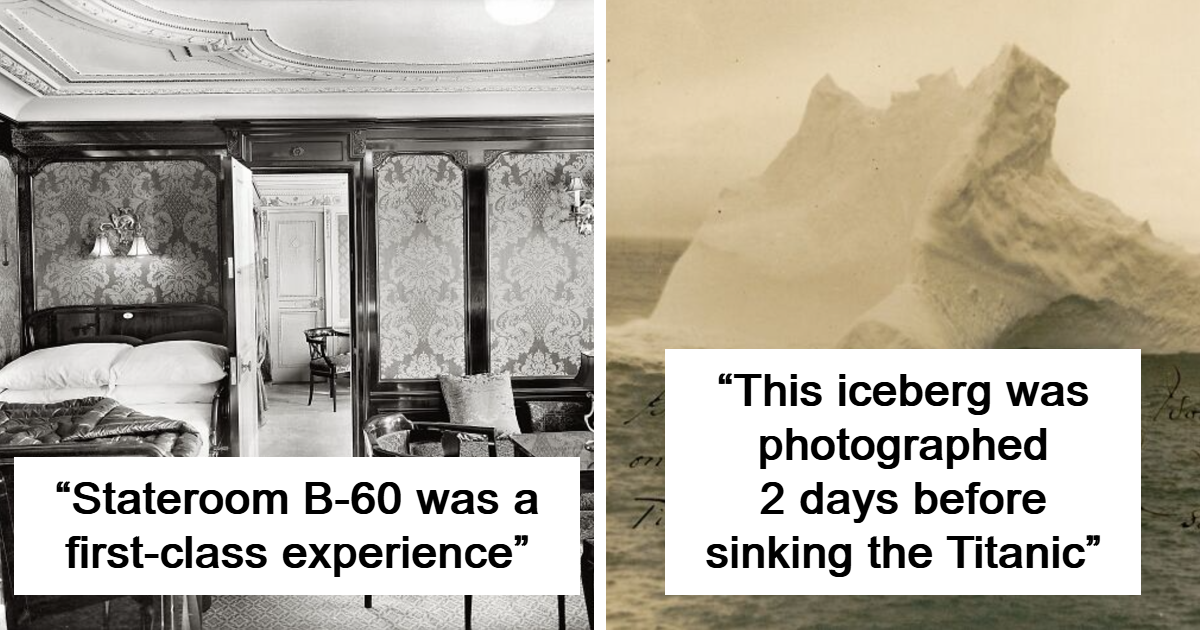
- Bernice Palmer’s iceberg photograph. Few images are more chilling in Titanic lore. It gives the disaster a physical face, which history rarely does so neatly.
- Another iceberg photo taken days later. Whether people focus on paint marks, shape, or timing, these images show how badly the public wanted something concrete to blame.
- Captain Arthur Rostron and the Carpathia officers. Rescue history matters too. These photos shift attention from the doomed liner to the people who responded with speed and discipline.
- Carpathia arriving in New York with survivors. Port-arrival photographs feel like the moment private suffering became world news.
- Titanic lifeboats returned to the White Star berth. Few images are as devastatingly symbolic. The ship is gone, but its small wooden evidence comes back home.
- Crowds waiting outside White Star offices. These photographs matter because they document uncertainty, rumor, and the agony of waiting for names and news.
- Families gathered in rain at the docks. The Titanic disaster was not confined to the ship. It spread through cities, piers, and newspaper offices in waves of dread.
- Street scenes filled with newspaper extras. These images show how modern mass media turned Titanic into an international obsession almost in real time.
- Child survivors photographed after rescue. Images of rescued children cut through the grandeur of the story and reveal its raw human stakes without saying a word.
- The famous Navratil brothers photo. This image has lasted because it contains everything history struggles to hold at once: innocence, survival, confusion, and public curiosity.
- Survivors meeting the press in New York. These photos remind us that memory was already being shaped, sold, retold, and dramatized within days of the sinking.
- Photographs from the early inquiries. Images linked to the investigations matter because Titanic was not only mourned. It was examined, argued over, and used to change maritime safety.
The Wreck, Rediscovery, And The Long Afterlife Of Titanic
- The distant bow emerging from darkness underwater. Once you see the wreck, the story changes. Titanic stops being a legend and becomes a place.
- A close photo of the bow railings. These railings are now among the most recognizable wreck images, partly because they look both majestic and heartbreakingly fragile.
- Bow details covered in rusticles. The famous “rusty icicles” make the wreck look like it is dissolving in slow motion, which, scientifically speaking, it is.
- Anchor gear swallowed by corrosion. Photos of working hardware in decay reveal how time defeats even the most confident engineering.
- The promenade deck underwater. This is where the ship’s elegant social life collides with deep-sea silence. It is one of the most perspective-shifting views in Titanic history.
- The forecastle deck in the deep. Once a place of movement and routine, it now appears still, dim, and alien. Same ship. Different universe.
- The mast and surrounding wreckage. Images of the mast area remind viewers that the ship did not descend as a tidy museum exhibit. It broke, scattered, and settled violently.
- A porthole close-up. Few underwater photos are more unsettling than windows staring back through darkness, as if the ship is still quietly watching the Atlantic.
- A first-class cabin interior underwater. These photos wreck the old glamour in the best possible way. Luxury did not survive the ocean’s long memory.
- Collapsed deck sections on the seafloor. They show that Titanic is not frozen in time. The wreck is actively changing.
- A hull fragment lying apart from the main structure. Debris images make the sinking feel mechanical and physical, not cinematic.
- The propeller half-buried in sediment. It is one of the strongest visual symbols of failed motion. All that power, now resting in silence.
- Household objects in the debris field. These photos are often the most moving because they connect the massive disaster to small, ordinary human lives.
- A cooking pot resting on the ocean floor. The emotional weight of Titanic sometimes arrives through the humblest objects, not the grandest architecture.
- A wide shot of the bow under expedition lights. Modern wreck photography can look almost cathedral-like, which is exactly why it changes the tone from spectacle to reverence.
How These Photos Change The Way We See Titanic
First, they make the ship less mythical. Construction photos reveal that Titanic was built by people solving practical problems with steel, rivets, cranes, and schedules. The ship starts to look less like destiny and more like industry.
Second, they make the passengers feel real. A photo of survivors on the Carpathia does more emotional work than ten dramatic retellings. You notice posture, clothing, expressions, distance, and silence. The tragedy becomes human-sized.
Third, they challenge the old “unsinkable” narrative. Boat deck and lifeboat images expose the gap between technological confidence and emergency reality. The disaster becomes a story about judgment, preparedness, and systems, not just bad luck.
Fourth, they expand the timeline. Many people think of Titanic as one terrible night. But the photos tell a longer story: construction, publicity, departure, rescue, inquiry, rediscovery, preservation, and ongoing deterioration. The ship had a before and it still has an after.
Finally, they force humility. Underwater images of the wreck are not just visually stunning. They are reminders that history ages, materials decay, and even the most famous ship in the world eventually becomes vulnerable to bacteria, corrosion, darkness, and time.
A More Honest Conclusion About Rare Titanic Photos
The most fascinating rare photos of the Titanic are not necessarily the most dramatic ones. Often, they are the quietest. A shipyard view. A lifeboat with too much empty space. A rescue deck covered with life vests. A corroded railing on the ocean floor. These are the images that puncture the legend and replace it with something more valuable: perspective.
That perspective matters because the Titanic has been repackaged for more than a century as romance, entertainment, cautionary tale, engineering failure, class story, and cultural obsession. Rare photographs do something healthier. They slow us down. They remind us that the Titanic tragedy was built in steel, lived in ordinary moments, shattered in crisis, and preserved in fragments. That is a much more interesting story than the simplified version, even if it comes without a soundtrack.
The Experience Of Looking At Rare Titanic Photos For Hours
Spending time with rare Titanic photos is a strange experience because the emotional effect changes as you go. At first, there is curiosity. You want to see the famous ship from unusual angles, compare pre-sinking images with Titanic wreck photos, and maybe confirm a few details you think you already know. But after a while, the experience becomes less like browsing and more like slowly walking through a historical echo chamber.
The construction images are usually the first surprise. They do not feel tragic at all. They feel proud. Organized. Busy. Human. You notice scaffolding, steel, and workers who probably could not have imagined that their project would still be discussed more than a century later. That alone changes your relationship to the story. Titanic stops being born as a legend and starts looking like a real workplace.
Then the departure and deck photos take over, and the mood shifts again. These images can feel almost annoyingly normal in the most powerful way possible. People are standing around, preparing for travel, doing ordinary ship things. Nobody in the frame is posing for “history.” They are simply existing before the future ambushes them. That normalcy is what makes the images memorable. Disaster stories often flatten people into symbols, but photographs restore their everyday reality.
Rescue images are the point where many viewers slow down. A lifeboat moving toward the Carpathia is not loud or theatrical. It is just small. That smallness says everything. The scale of the Atlantic becomes real. The vulnerability becomes real. The survivors do not look like movie characters stepping into a final act. They look cold, tired, and stunned. That is one of the biggest perspective shifts these photos create: survival does not necessarily look heroic. Sometimes it just looks quiet.
And then come the underwater images, which feel almost like visiting two different centuries at once. The wreck photographs are visually beautiful in a way that can make you uncomfortable. The bow still carries dignity. The railings are recognizable. The deck spaces still hint at where people once walked. But the corrosion, darkness, and marine growth remind you that the ship is not waiting for us. It is disappearing. Slowly, steadily, and without caring about nostalgia.
That is why looking through rare Titanic imagery can be so affecting. You begin with fascination, move into empathy, and end somewhere close to humility. The ship no longer feels like a polished legend preserved in perfect detail. It feels temporary. Human. Fragile. And oddly intimate. In the end, the real experience is not about seeing 50 old photos. It is about realizing that each image peels away a layer of myth and leaves behind something far more haunting: a real story, captured in pieces, that time still has not completely finished telling.