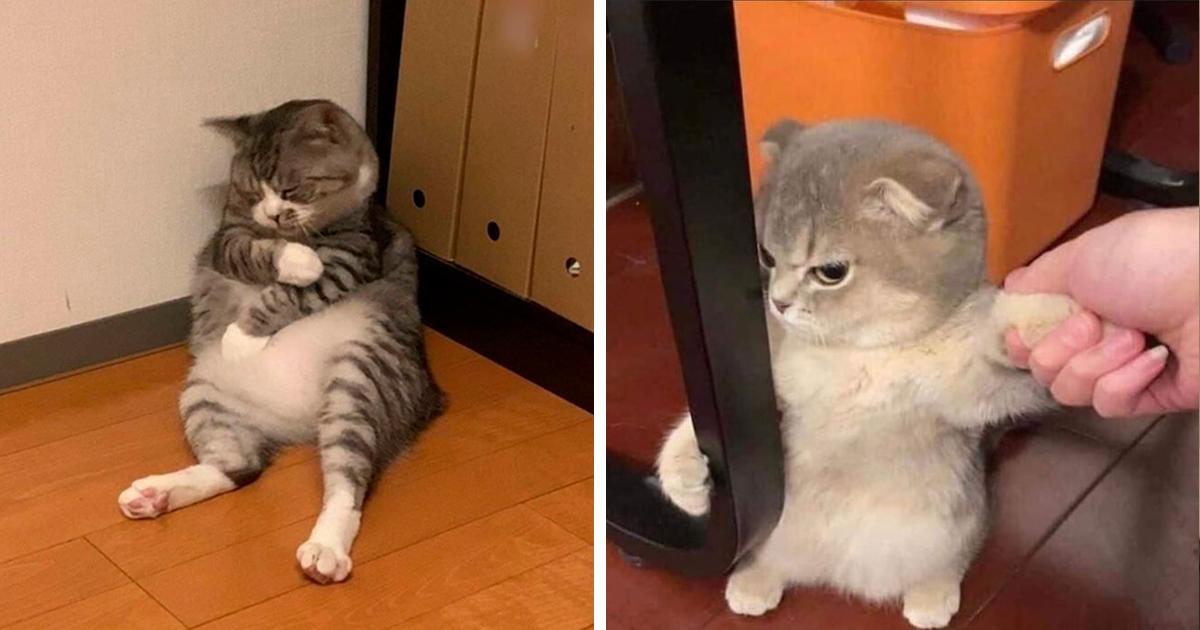
Cats are graceful predators equipped with excellent balance, lightning-fast reflexes, sharp claws, sensitive hearing, and enough confidence to stare down a vacuum cleaner from across the room. They are also perfectly capable of sitting upside down in a sink, falling asleep with one leg pointing toward the ceiling, or staring at a blank wall as though it just revealed the secrets of the universe.
That contradiction is exactly why goofy cat pictures have become one of the internet’s most dependable sources of entertainment. The Cat Virus.Exe page turned the phenomenon into something resembling a digital museum of feline software failures: strange expressions, impossible poses, questionable decisions, and cats apparently forgetting how chairs work.
The joke, of course, is that most of these cats are not “broken” at all. Their behavior often makes considerably more sense when viewed through feline instincts rather than human logic. Zoomies can release energy. Boxes offer security. Kneading is connected with kittenhood. Strange hunting poses may be practice for catching prey. And sometimes a cat simply seems determined to prove that gravity is more of a suggestion than a law.
Here are 50 wonderfully ridiculous examples of the kind of feline chaos celebrated by Cat Virus.Exe, followed by a closer look at why perfectly healthy cats can behave like their operating system has crashed.
Why the Cat Virus.Exe Formula Is So Funny
The name works because anyone who has lived with a cat recognizes the metaphor immediately. Your cat may spend five minutes elegantly grooming every strand of fur, then suddenly stare into space with its tongue sticking out. It may calculate a six-foot jump with mathematical precision and later become temporarily defeated by a paper bag.
Earlier coverage of the page described it as an archive devoted to memorable internet cat pictures. That simple idea works because cats rarely appear to be performing for an audience. Their comedy feels accidental. A goofy expression is funny precisely because the cat wearing it often looks completely serious about the situation.
50 Glorious Examples of Cats Apparently Experiencing Technical Difficulties
1–10: Facial Expressions That Require a System Reboot
- The accidental vampire. A wide-eyed cat flashes tiny fangs while looking delighted with absolutely nothing in particular.
- The unwilling traveler. Held upright for a moment, a cat appears to reconsider every decision that led outside its favorite room.
- The dramatic romance. Two cats arrange themselves in such an awkward pose that the picture resembles experimental theater.
- The permanent surprise face. Huge pupils and a slightly open mouth create the expression of someone who just checked the grocery bill.
- The forgotten tongue. The classic “blep” happens when a cat leaves a tiny piece of tongue hanging out and apparently forgets to retrieve it.
- The upside-down inspection. Instead of simply looking at something, the cat rotates its entire head until the world seems correctly misaligned.
- The sneeze freeze-frame. Capture a cat in the middle of a sneeze and even the most majestic feline can resemble a malfunctioning accordion.
- The suspicious squint. Nothing has happened, yet the cat looks convinced that someone in the household has committed tax fraud.
- The post-nap loading screen. Eyes half open, ears pointing in unrelated directions, the cat looks as if consciousness is still buffering.
- The extreme close-up. Put a camera near a curious nose and suddenly the internet gets two nostrils, six whiskers, and no explanation.
11–20: Sitting Positions Designed by Nobody
- The human sit. A cat props itself upright with hind legs forward, looking suspiciously like someone waiting for a television commercial to end.
- The boneless puddle. Every limb seems to disappear as the cat melts across a couch cushion.
- The chair-leg embrace. Why sit beside furniture when you can wrap your entire body around one wooden leg?
- The vertical loaf. The cat achieves a position halfway between sitting, standing, and questioning existence.
- The upside-down couch creature. Head below body, paws facing sideways, dignity apparently stored elsewhere.
- The staircase gargoyle. A perfectly ordinary stair becomes a throne from which the cat silently judges everyone passing below.
- The laptop occupation. The keyboard becomes irresistible precisely three seconds after its owner begins important work.
- The sink installation. A round bathroom basin apparently offers superior accommodations to the expensive cat bed six feet away.
- The shelf pancake. Part of the cat rests safely on a shelf while the remaining 40 percent hangs over the edge.
- The leg-in-the-air nap. No explanation is available. The leg simply stays there.
21–30: Cats Versus the Laws of Physics
- The impossible box fit. The container is clearly too small according to geometry. The cat disagrees with geometry.
- The drawer invasion. Open a drawer for five seconds and you may discover it has acquired a furry tenant.
- The gravity-defying wall pose. A cat clings to an unlikely surface as though vertical living were completely normal.
- The curtain mountaineer. A peaceful living room instantly becomes an unauthorized climbing expedition.
- The door-top supervisor. Somehow the cat reaches the top of a door and then looks offended that nobody prepared an exit strategy.
- The refrigerator summit. The highest appliance in the kitchen becomes a strategic observation deck.
- The narrow-rail balance. A wide comfortable surface exists nearby, so naturally the cat selects the thinnest possible ledge.
- The cardboard compression test. Fur bulges through every available opening while the cat insists the box fits beautifully.
- The backwards descent. Climbing up was easy. Getting down becomes a committee meeting involving several worried humans.
- The couch launch. One second the cat is asleep. The next, it has become a projectile headed toward another room.
31–40: When the Hunting Software Activates
- The invisible enemy. A cat attacks absolutely nothing on the floor and appears to win.
- The ankle ambush. A harmless human walking past the couch becomes prey in a highly organized domestic safari.
- The window chatter. Birds outside trigger rapid jaw movements and strange little sounds from the frustrated indoor hunter.
- The toy assassination. A stuffed mouse receives a level of violence normally reserved for action-movie villains.
- The blanket monster attack. Moving a toe beneath a blanket transforms bedtime into a predator-prey documentary.
- The paper-bag stakeout. The cat disappears inside, waits silently, then attacks the first shoelace foolish enough to pass.
- The sideways kitten charge. Arched back, puffed fur, sideways hops: intimidating in theory, unbearably funny in practice.
- The laser investigation. The red dot disappears, but the detective remains on the case long after everyone else has gone home.
- The midnight sprint. At 2:13 a.m., apparently without warning, the hallway becomes the Indianapolis Motor Speedway.
- The tail betrayal. The cat notices its own tail, becomes suspicious of it, and begins a circular battle with itself.
41–50: Everyday Objects That Somehow Break the Cat
- The cucumber-level surprise. An unfamiliar harmless object appears nearby and produces a theatrical double take.
- The mirror meeting. A cat discovers another extremely handsome cat who refuses to respect territorial boundaries.
- The empty box victory. A premium toy arrives. The toy is ignored. Its cardboard packaging wins by unanimous decision.
- The laundry basket takeover. Freshly washed clothes immediately become property of the Department of Cat Affairs.
- The faucet obsession. Flowing water deserves intense investigation, preferably while placing the entire head inside the sink.
- The printer emergency. Every sheet emerging from the machine must be inspected, slapped, and possibly arrested.
- The robotic vacuum standoff. Some cats flee. Others climb aboard and accept promotion to captain.
- The plastic-bag fascination. Crinkly material attracts attention, although bags with handles should be kept away for safety.
- The catnip transformation. A previously dignified adult suddenly rolls, rubs, kicks, and behaves as though dignity has expired.
- The completely unexplained moment. No box, bird, toy, noise, food, or visible stimulus is involved. The cat is simply being a cat.
Why Do Cats Behave Like Their Software Has Crashed?
Zoomies Are Usually Normal Feline Energy Bursts
One of the most dramatic examples of weird cat behavior is the zoomies, sometimes called frenetic random activity periods, or FRAPs. A relaxed cat suddenly accelerates through the house, changes direction at impossible speed, launches onto furniture, and stops almost as abruptly as it began.
This behavior often reflects pent-up energy, play, excitement, or natural predatory patterns. Cats are typically especially active around dawn and dusk, so evening races are hardly surprising from a biological perspective. Younger cats tend to perform these high-speed episodes more often because they have abundant energy and are still practicing coordination.
Boxes Make More Sense to Cats Than Expensive Furniture
The phrase “if I fits, I sits” became an internet cliché because it describes an authentic feline preference. Enclosed spaces can provide security, warmth, concealment, and a useful position from which an ambush predator can observe its surroundings.
Experiments have even suggested that cats may be attracted to square-like visual boundaries, not merely physical cardboard walls. To a human, a shipping box is recycling. To a cat, it may be a bunker, bedroom, hunting blind, scratching surface, and executive office.
Kneading, Chattering, and Other Supposed “Glitches” Have Roots
Kneading, affectionately called “making biscuits,” begins during kittenhood when nursing kittens press their paws against their mother. Many cats continue kneading as adults when relaxed or comfortable. Scent glands around the paws may also contribute to the behavior.
Chattering at birds is another internet favorite. A cat watching inaccessible prey through a window may produce rapid jaw movements, chirps, or chattering sounds associated with intense predatory excitement. What looks like a broken jaw animation may therefore be a very functional hunting brain operating behind glass.
Goofy Cats Still Need Serious Enrichment
A cat’s funniest behavior often appears when it has opportunities to climb, hide, stalk, scratch, chase, investigate, and play. Indoor cats benefit from environments that let them perform these natural behaviors safely.
Useful enrichment does not have to resemble a feline amusement park financed by a billionaire. Cardboard boxes, sturdy scratching surfaces, elevated perches, puzzle feeders, safe balls, and interactive wand toys can provide meaningful stimulation. Rotating toys can make familiar objects interesting again.
Interactive play is particularly useful because it gives cats an outlet for the stalk-chase-pounce sequence. Several short sessions may suit many cats better than expecting them to entertain themselves all day and then wondering why the curtains become tonight’s recreational activity.
Strings, ribbons, loose feathers, cords, and small detachable toy pieces should be supervised because swallowing them can cause serious problems. The goal is to encourage the comedy without accidentally turning the evening into an emergency veterinary visit.
When a “Broken Cat” Joke Should Become a Vet Question
Most weird poses, bleps, zoomies, box invasions, kneading sessions, and awkward naps are harmless. What matters is whether the behavior is normal for that individual cat.
A sudden behavioral change deserves more attention. New excessive vocalization, hiding, difficulty jumping, unusual aggression, changes in appetite, altered litter-box habits, apparent confusion, breathing problems, repeated gagging, or signs of pain should not simply be dismissed as another funny cat moment.
Body language matters as well. Relaxed ears and playful movement tell a different story from flattened ears, a tense body, puffed fur, persistent hiding, or defensive aggression. When something genuinely seems wrong, recording a short video can help a veterinarian understand an intermittent behavior that may not appear during an appointment.
What Living With a Goofy Cat Is Actually Like: The Owner Experience
Living with a cat eventually changes your definition of “normal.” During the first few weeks, an owner may rush into the hallway after hearing a tremendous crash, expecting to discover a major household emergency. Instead, the cat is standing beside an overturned cardboard tube looking mildly surprised that physics has once again become involved in its evening.
After a few months, patterns begin to emerge. You learn that the 9 p.m. sprint is not necessarily an emergency. It is simply the scheduled Grand Prix. You recognize the facial expression that appears immediately before an ambush. You know that opening a closet door creates approximately four seconds in which to retrieve what you need before a cat materializes inside it.
You also learn that buying cat products is an exercise in humility. The luxurious bed may receive one investigative sniff before being abandoned. The box it arrived in becomes prime real estate. A sophisticated electronic toy loses the competition to a bottle cap skittering across the kitchen. A carefully arranged blanket is ignored until you need it, at which point it becomes the most important sleeping location in the Western Hemisphere.
Photography becomes part wildlife documentary and part evidence collection. Owners discover hundreds of phone pictures showing tongues, paws, upside-down heads, blurry midnight sprints, and cats occupying objects that were never designed to contain mammals. The funniest pictures are rarely staged. A person notices something absurd, slowly reaches for a phone, and hopes the cat remains ridiculous for another three seconds.
There is also a surprisingly useful side to observing all this nonsense. The more time someone spends watching a cat, the better that person becomes at recognizing the animal’s normal habits. You learn how your cat usually sits, walks, vocalizes, sleeps, eats, plays, and interacts. That baseline can make genuine changes easier to notice.
A normally energetic cat that suddenly stops jumping deserves attention. A quiet cat that begins yowling repeatedly may be communicating discomfort. A cat that always sleeps folded like an improperly assembled lawn chair, on the other hand, may simply have found its preferred configuration.
Perhaps the biggest lesson is that cats do not organize their lives around looking sensible to humans. Their bodies, instincts, senses, and priorities are different from ours. What appears irrational from the couch may make perfect feline sense: the box feels secure, the moving shadow resembles prey, the high shelf provides a better view, or the mysterious sound behind the wall deserves investigation immediately.
And sometimes there may be no satisfying explanation at all. That is part of the appeal. A cat can be elegant, athletic, observant, affectionate, independent, calculating, and profoundly silly within the same ten-minute period. Living with one means accepting that the household occasionally operates according to rules that have not been made available to management.
The Cat Virus.Exe phenomenon captures that experience beautifully. The photographs are funny because cat owners recognize them. Somewhere in the world, another person has also looked across the room, seen their pet sitting backward inside a basket with one paw on a wall, and quietly wondered whether turning the cat off and back on again would help.
Conclusion: The Cat Is Probably Working Exactly as Designed
Goofy cats are one of the internet’s longest-running comedy genres for a reason. Their strange poses and sudden bursts of chaos collide hilariously with the dignified reputation cats seem determined to maintain.
Behind many of those supposedly broken-cat moments are completely normal feline behaviors: hunting, hiding, playing, climbing, kneading, resting, exploring, and releasing energy. Give cats safe places to retreat, things to climb and scratch, regular interactive play, and opportunities to investigate their surroundings, and they will probably continue doing bizarre things anywayjust more happily.
So when your cat freezes halfway through grooming with one foot in the air and a thousand-yard stare, resist the temptation to call technical support. The operating system is probably fine. It is simply running Cat.
Editorial note: This article is an original editorial synthesis inspired by the publicly documented Cat Virus.Exe collection and established feline-behavior research. It does not reproduce the original gallery’s captions or photographs. References to a cat being “broken,” “malfunctioning,” or experiencing a “virus” are humorous descriptions, not medical claims.