A 60-minute round timer is wonderfully uncomplicated: turn the dial, hear the mechanism begin ticking, and wait for the alarm to rescue dinner, end a meeting, or politely inform you that your “quick break” has lasted nearly an hour. In a world where refrigerators have Wi-Fi and phones demand attention every six minutes, a mechanical timer feels almost rebellious.
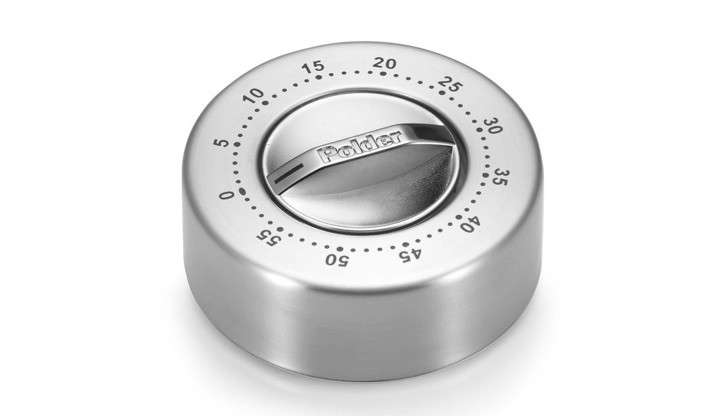
The classic Polder 60-Minute Round Timer is a particularly clean example of this old-school tool. The model historically identified as TMR-528-90 combines a circular dial, one-minute markings, a brushed-steel body, a magnetic back, and a short audible alarm. It does one job without requesting a password, downloading an update, or trying to sell you premium countdown features.
This guide examines how a round kitchen timer works, where it is most useful, what its limitations are, and why a simple one-hour countdown can still earn permanent space on a refrigerator door.
What Is a 60-Minute Round Timer?
A 60-minute round timer is a compact countdown device built around a circular dial. Most traditional versions use a spring-driven mechanical movement rather than batteries or digital electronics. The user rotates the dial to the desired number of minutes, and the timer gradually returns to zero before sounding an alarm.
The one-hour range covers a large percentage of everyday timing jobs. It is long enough for roasting vegetables, proofing dough, managing a study session, limiting a meeting, or scheduling a household chore. At the same time, its face remains readable because the scale does not need to squeeze several hours onto one tiny dial.
The Classic Polder Design
The round Polder timer gained attention because it avoided the novelty styling often associated with mechanical kitchen timers. There was no tomato costume, chicken head, smiling chef, or plastic fruit attempting to supervise the casserole.
Its commonly published features included:
- A countdown range of up to 60 minutes
- Markings in one-minute increments
- A brushed-steel outer housing
- A magnet for vertical placement
- An alarm lasting approximately four seconds
- A simple round face that can be read at a glance
That combination makes the timer useful without making it visually noisy. It looks at home beside stainless-steel appliances, but it is small enough to disappear into a drawer when the countertops need to look suspiciously organized.
How a Mechanical Kitchen Timer Works
Inside a mechanical countdown timer is a wound spring connected to gears and an escapement mechanism. Turning the dial stores energy in the spring. The mechanism releases that energy gradually, moving the pointer back toward zero. At the end of the countdown, the remaining energy activates the bell or alarm.
This system requires no battery and no electrical connection. The faint ticking is the sound of the mechanism regulating the spring’s release rather than a recording designed to make the timer feel “authentic.”
Why You Usually Wind It to 60 First
Many spring-wound timers should be turned clockwise to the maximum setting before being rotated backward to the required time. For example, to set 12 minutes, you would first turn the dial to 60 and then return it to 12.
This procedure fully tensions the spring and helps the alarm receive enough power to ring properly. Setting a short period directly from zero may produce a weak alarm, an inaccurate countdown, or no useful result at all. The timer is not being temperamental; it simply wants a proper wind-up before performing its tiny mechanical concert.
Instructions can vary by model, so the manufacturer’s directions should take priority. The “wind fully, then set” method is common, but it is not a universal license to force every timer dial past its intended stopping point.
Why Choose an Analog Round Timer?
No Batteries or Charging
A mechanical 60-minute timer is always ready. There is no battery compartment to corrode, no charging cable to misplace, and no low-power warning appearing precisely when both hands are covered in bread dough.
Fast, Physical Operation
Turning a dial is often faster than unlocking a phone, locating a clock app, entering a duration, and resisting the sudden urge to check three notifications. The physical action also creates a clear start to the task. Once the timer begins ticking, the countdown feels real.
Visible Remaining Time
An analog dial gives a rough visual picture of the time left. A pointer near 30 means approximately half an hour remains. A pointer hovering near 5 means it is time to stop wandering around the house and remember what is in the oven.
Helpful Separation From a Smartphone
Using a dedicated timer keeps the timing function separate from calls, messages, social media, and app alerts. Research on task switching shows that repeatedly moving between activities creates cognitive costs. A physical timer cannot eliminate distraction, but unlike a phone, it does not arrive carrying an entire amusement park in its pocket.
Compact and Easy to Place
A magnetic back allows the timer to live on a refrigerator, range hood, metal cabinet, or other suitable surface. This keeps it visible and reduces the risk of losing it beneath a stack of mail marked “important” three months ago.
Best Uses for a 60-Minute Round Timer
Cooking and Baking
The most obvious use is tracking recipe stages. A mechanical cooking timer is useful for simmering sauces, resting dough, checking cookies, steeping tea, roasting vegetables, or remembering that something is cooling on the counter.
For recipes that provide a range, set the timer for the earliest recommended checking point. Food can usually cook longer, but no timer has yet invented a reliable method for unburning a cake.
Timing should not be confused with testing doneness. Meat, poultry, seafood, and egg dishes may require a food thermometer to confirm that a safe internal temperature has been reached. A timer tells you when to check; a thermometer tells you what is actually happening inside the food.
Focused Work Sessions
A round timer can support timeboxing, a productivity method in which a defined period is reserved for one task. Set 20, 30, 45, or 60 minutes, choose a specific objective, and work until the alarm sounds.
The timer creates a boundary. “Work on the report sometime today” is vague and negotiable. “Draft the introduction for 35 minutes” is concrete. The countdown also makes unpleasant tasks feel finite. Even an overstuffed email inbox becomes less intimidating when the agreement is to face it for 20 minutes rather than until retirement.
Pomodoro-Style Study Blocks
The traditional Pomodoro Technique uses 25 minutes of focused work followed by a five-minute break. A 60-minute dial can handle both intervals easily. Students can also experiment with 40-minute study periods, 10-minute review sessions, or a full hour for practice exams.
The important part is not worshipping a magical number. It is assigning a clear task to a clear period and taking intentional breaks rather than accidental 47-minute expeditions through short-form videos.
Meetings and Presentations
A visible timer can help prevent meetings from expanding to fill every available minute. A 60-minute meeting might be divided into 10 minutes for context, 30 minutes for discussion, 15 minutes for decisions, and five minutes for assigning next steps.
A mechanical timer works best when everyone knows it is being used. Secretly placing one under the conference table and allowing it to ring during the chief executive’s speech may produce excellent comedy but uncertain career outcomes.
Exercise and Mobility Breaks
A one-hour timer can structure walking sessions, stretching routines, circuit training, or movement breaks during desk work. It is suitable for longer blocks, such as a 30-minute workout, but it is less convenient for rapid intervals that alternate every 20 or 30 seconds.
For high-intensity interval training, a programmable interval timer is usually more practical because it can automatically alternate work and recovery periods. The round timer is better for broad segments: warm up for 10 minutes, train for 30, cool down for 10, and spend the remaining 10 wondering why lunges were invented.
Household Routines
The timer can also create manageable limits for cleaning, decluttering, reading, screen time, laundry, gardening, or children’s routines. A 15-minute cleanup sprint often feels easier than the vague instruction to “clean the entire house,” which is less a task and more a declaration of war.
Accuracy and Limitations
A basic mechanical timer is designed for ordinary household timing, not laboratory measurement. Small variations may occur because of spring tension, manufacturing tolerances, temperature, age, wear, or incomplete winding.
One-minute markings are adequate for casseroles and meetings but unsuitable when seconds matter. Scientific experiments, medication schedules requiring exact precision, competitive training intervals, or technical processes should use a more appropriate calibrated device.
The Alarm Is Brief
The classic round Polder model was described with an alarm lasting roughly four seconds. That is enough for many kitchens, especially when the timer is nearby, but it may be missed in a large house, a noisy workshop, or a room containing a blender that sounds like it is processing gravel.
People who are hard of hearing or who frequently leave the room may prefer a digital timer with adjustable volume, flashing lights, vibration, or a continuous alarm.
Only One Countdown at a Time
A single-dial timer cannot independently track pasta, garlic bread, vegetables, and dessert. Complicated meals may require several timers or a digital multi-event model. The analog timer remains excellent for one primary countdown but becomes less charming when asked to manage an entire holiday dinner alone.
No Automatic Appliance Control
A freestanding kitchen timer is normally an alert device. It does not switch off the oven, burner, curling iron, or space heater. When the bell rings, a human still has to respond. Confirm that an appliance has actually been turned off rather than assuming the sound completed the job.
How to Choose the Right 60-Minute Timer
Before purchasing a round countdown timer, consider where and how it will be used.
- Readability: Look for high-contrast numbers and clear minute marks.
- Alarm volume: Choose a sound that can be heard in the intended environment.
- Mounting: A strong magnet is helpful, but a tabletop base may be more useful in a nonmetallic kitchen.
- Grip: The dial should be easy to turn with damp or flour-covered hands.
- Construction: Metal housings feel substantial, while plastic models may be lighter and less expensive.
- Precision: Check whether the scale provides one-minute markings or only broad five-minute divisions.
- Alarm duration: A brief ring suits quiet rooms; a continuous alarm is safer for distracted cooks.
Mechanical Versus Digital
Choose mechanical if you value immediate operation, tactile control, battery-free use, and classic design. Choose digital if you need seconds, multiple timers, memory functions, count-up capability, adjustable volume, or a longer range.
Neither format is universally superior. A well-designed mechanical timer is pleasant because it is limited. A capable digital timer is useful because it is not. The right choice depends on whether simplicity feels freeing or suspiciously under-featured.
Care and Maintenance
Keep the timer away from direct flame, intense heat, steam, and splashing grease. Although it belongs in the kitchen, it should not be treated like cookware. Wipe the exterior with a lightly dampened cloth and dry it promptly. Do not immerse it in water unless the manufacturer specifically describes it as waterproof.
Avoid forcing the dial backward beyond zero or past the maximum setting. If the timer becomes inconsistent, test it against a reliable clock at several settings, such as 10, 30, and 60 minutes. Repeated large errors may indicate that the spring or gear mechanism is worn.
When using a magnetic timer, place it on a stable surface where vibration will not make it slide. Also confirm that the chosen location does not become excessively hot during cooking.
Practical Experience: What Daily Use Feels Like
The most noticeable thing about living with a 60-minute round timer is how little instruction it requires. After the first reminder to wind the mechanism fully, setting it becomes automatic. Turn, return, release. There are no modes to select and no icons that require archaeological interpretation.
In a kitchen, the magnetic placement is more valuable than it initially appears. A timer kept on the refrigerator has a permanent home, remains visible, and is less likely to be buried in a drawer behind an avocado slicer nobody remembers purchasing. Because the dial can be checked from across the room, it also discourages constant phone checking.
The ticking divides users into two camps. Some people find it reassuring, like a tiny mechanical assistant working nearby. Others hear it as the soundtrack to an unusually low-budget suspense movie. Placement helps: a timer on the refrigerator is usually less intrusive than one sitting six inches from a laptop keyboard.
For cooking, the best experience comes from treating the alarm as a checkpoint rather than a verdict. Set it for the earliest point at which food might be ready, then inspect texture, color, and temperature as appropriate. This avoids the classic mistake of assuming that every oven, pan, room temperature, and potato behaves exactly like the recipe writer’s equipment.
The timer is surprisingly effective for chores. Setting 12 minutes for clearing a countertop or 20 minutes for folding laundry creates a small challenge with an obvious finish line. The task feels less endless, and the visible countdown encourages steady movement. It will not make anyone love matching socks, but it can shorten the negotiations.
During focused work, the physical dial creates stronger separation than a browser timer. Once the session begins, the timer does not display email badges, headlines, or messages. A 30-minute block can be devoted entirely to drafting, editing, bookkeeping, or reading. When the alarm rings, standing up for a short break feels earned rather than evasive.
The limitations become clear during complex activities. Cooking several dishes at once quickly exceeds the capacity of one countdown. A short alarm can also disappear beneath a range hood, television, vacuum cleaner, or enthusiastic family conversation. In those situations, pairing the round timer with a louder digital model works better than demanding that one small spring-powered device become mission control.
Short settings reveal another practical lesson: proper winding matters. Turning directly from zero to a few minutes may leave too little spring tension for a confident alarm. Fully winding the timer and returning to the desired setting usually produces a clearer ring and more consistent operation.
Over time, the appeal is less about technical performance than dependable ritual. Turning the dial means something has begun. The ticking says the task has boundaries. The ring says stop, check, move on, or rescue the cookies. That physical sequence is satisfying in a way a silent notification often is not.
A 60-minute round timer therefore works best for people who prefer tools with obvious controls and narrow responsibilities. It is not the most advanced timer available, but that is precisely its charm. It measures an hour and then makes noise. Sometimes good design is simply a product that knows when it has done enough.
Final Verdict
The 60-Minute Round Timer remains useful because it turns an abstract hour into a visible, physical countdown. The classic Polder version adds a restrained stainless-steel appearance, one-minute markings, magnetic mounting, and a straightforward mechanical alarm.
It is an excellent option for everyday cooking, study sessions, meetings, household routines, and focused work. It is less suitable for second-by-second intervals, multiple simultaneous tasks, extremely noisy environments, or situations requiring calibrated precision.
Most importantly, it removes the unnecessary ceremony from timing something. Wind the dial, choose the minutes, and get on with the task. No account. No app. No notification asking whether you enjoyed your countdown. Just a steady tick followed by a ringwhich may be the most honest user interface in the house.
SEO Metadata