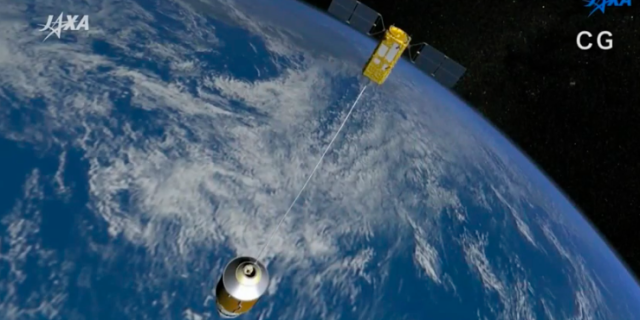
Space is often described as the final frontier, which is a poetic way of saying humans found one more place to leave our stuff lying around. Low Earth orbit is now packed with dead satellites, spent rocket stages, broken fragments, and enough metallic chaos to make any janitor quit on the spot. Against that backdrop, Japan once launched one of the most ambitious early attempts to clean up orbital debris. It was bold, practical, and gloriously nerdy. It also failed.
The mission in question was not some flashy sci-fi stunt with giant robot claws and dramatic movie-trailer music. It was a real engineering test by the Japan Aerospace Exploration Agency, or JAXA, attached to the HTV-6 cargo spacecraft, also known as Kounotori 6. The idea was elegant: prove that an electrodynamic tether could help drag dangerous debris out of orbit. Instead, the tether never deployed, the spacecraft reentered the atmosphere, and the experiment ended before it could properly begin.
Still, this was not just a story about a broken cable in space. It was a revealing moment in the larger battle against orbital debris, one that showed how hard space junk removal really is. It also helped shape the next generation of cleanup efforts, including Japan’s later partnership with Astroscale, which has taken a much more cautious step-by-step approach. In other words, this failure mattered. A lot.
Why the Space Junk Problem Is Such a Big Deal
If you are wondering why anyone would go to such trouble to clean up dead hardware floating around Earth, the answer is simple: because even tiny junk in orbit can act like a bullet. Objects in low Earth orbit move at extreme speeds, and collisions do not politely dent things. They shatter them. One bad impact can create a cloud of fragments, and those fragments can trigger more collisions, which is how you end up with the nightmare scenario often called the Kessler syndrome.
That danger is no longer hypothetical background noise. Orbital traffic is getting denser, and the debris problem keeps growing. Tracked objects number in the tens of thousands, while the estimated population of smaller but still destructive fragments is vastly larger. The result is a crowded orbital environment where operational satellites, science missions, and crewed spacecraft all have more to dodge than they would like.
Why large debris matters most
Small fragments are terrifying, but big dead objects are the real long-term troublemakers. A defunct rocket stage or dead satellite is basically a future fragmentation event waiting for the wrong impact. That is why active debris removal has focused so much attention on large, uncooperative targets. If you can remove the big stuff before it breaks apart, you reduce the odds of turning orbit into a cosmic blender.
Japan’s experiment was designed with exactly that logic in mind. It was not trying to vacuum up every speck in the sky. It was testing whether a spacecraft could use a long conductive tether to slow debris down and eventually pull it into a destructive reentry. In theory, it was one of the more clever and fuel-efficient concepts on the table.
The Mission: Kounotori 6 and the KITE Experiment
HTV-6 launched in December 2016 as part of a routine cargo run to the International Space Station. The spacecraft did its day job successfully, delivering supplies, experiments, and lithium-ion batteries. It berthed to the station, stayed there for weeks, and handled its logistics work like a pro. So far, so good.
Then came the side quest that made the mission famous: the Kounotori Integrated Tether Experiment, or KITE. This was JAXA’s attempt to test a roughly 700-meter electrodynamic tether in orbit after HTV-6 departed the station. The tether was made of aluminum and stainless steel wire, and the mission also included a field emission cathode to help support the electrical system needed for the concept to work.
How the tether was supposed to work
The idea behind an electrodynamic tether is wonderfully weird. Instead of relying on traditional propellant, the system uses a long conductive wire moving through Earth’s magnetic field. That motion can generate an electromotive force. If the system collects electrons at one end and emits them at the other, current flows through the tether. Once that happens, the interaction between the current and the geomagnetic field creates a braking force.
In plain English, the tether would act like a slow, steady orbital brake. Attach that kind of system to a large piece of debris, and you could gradually lower its orbit until it falls into the atmosphere and burns up. No explosive fireworks. No giant engine. Just physics doing the heavy lifting with a very long metal ribbon and a lot of patience.
That patience part matters. This was never meant to be a dramatic one-shot cleanup. It was a technology demonstration, the kind of mission engineers love and movie audiences would probably leave early. But in the real world of orbital debris cleanup, that kind of boring test is exactly how progress happens.
What Went Wrong
Unfortunately, KITE never got the chance to prove the concept in full. After HTV-6 left the International Space Station in late January 2017, ground teams attempted to deploy the tether. It did not extend as planned. JAXA later confirmed that the tether could not be unrolled because of a deployment system failure. Later technical reviews described the problem more specifically as a mechanical malfunction in the holding and releasing mechanism for the end mass.
That detail is important. The mission did not fail because the physics of electrodynamic tethers suddenly became nonsense. It failed because one of the most painfully ordinary things in engineering happened: a mechanical subsystem did not do what it was supposed to do. Space history is full of missions defeated not by bad ideas, but by stubborn hardware that refused to cooperate at exactly the wrong moment. Space is rude like that.
Not everything failed
There was at least one silver lining. JAXA reported that the field emission cathode operated successfully, and later reviews noted that other onboard components also returned useful engineering data. So while the tether deployment failed, parts of the broader experiment did generate valuable information.
That may sound like engineer-style coping, but it actually matters. Failed demonstrations can still raise the technology readiness of specific subsystems, expose design weaknesses, and save future missions from making the same mistakes. In a field where one launch can cost a fortune, every lesson is expensive. Better to extract as many as possible.
Why Space Junk Cleanup Is So Hard
Japan’s failed space junk experiment was a reminder that orbital cleanup is not like sending a tow truck to fetch a broken sedan. Debris in orbit does not sit still, does not wait politely, and does not come with a standard hitch. Many targets are tumbling, damaged, or poorly characterized. Some were launched decades ago, long before anyone bothered to design them for capture or servicing.
That means cleanup systems have to solve several problems at once. First, they need to find and approach the object safely. Then they need to understand its motion. Then they need to capture, redirect, or deorbit it without creating even more debris. That is already difficult before lawyers and national security experts enter the room and make everything even more exciting.
The legal and political headache
There is also a legal wrinkle: old space junk still belongs to someone. Even a dead satellite or spent rocket body remains under the ownership and responsibility of its launching state. So active debris removal is not just an engineering challenge. It is also a diplomatic one. You cannot simply grab another country’s dead hardware like you are cleaning out a shared office fridge.
On top of that, debris-removal technology is deeply dual-use. A spacecraft capable of approaching and manipulating another object in orbit could also be viewed as a potential anti-satellite tool. That makes trust, transparency, and international rules just as important as robotics, sensors, and propulsion.
Nets, harpoons, robotic arms, and other orbital cleanup ideas
Japan’s tether was only one approach. Other groups have tested or proposed nets, harpoons, drag sails, robotic arms, magnetic systems, and even laser-based concepts. Europe's RemoveDEBRIS mission famously tested both a net and a harpoon in orbit. Those demonstrations showed that capture technologies can work under controlled conditions, but they also underlined the obvious truth: every target is different, and there is no universal gadget that solves orbital debris in one heroic swing.
A net might be useful for one type of object. A robotic arm might be better for another. A tether may make sense when low-mass, propellant-light deorbiting is the goal. The field is still figuring out which tools belong in the toolbox and which ones belong in the category labeled, "Interesting idea, but maybe not on a billion-dollar mission."
Japan Did Not Quit. It Got Smarter.
One of the most interesting parts of this story is what happened after the failure. Japan did not abandon the space debris problem. Instead, the country shifted toward a more incremental strategy, especially through JAXA’s work with Astroscale.
That newer approach looks much more cautious and much more realistic. Before trying to grab and remove a large piece of debris, the mission architecture first focuses on inspection and close-range characterization. In other words, before you attempt orbital cleanup surgery, you take the X-ray.
From KITE to ADRAS-J
In 2024, Astroscale launched ADRAS-J, a spacecraft designed to approach and inspect a defunct Japanese H-2A upper stage in low Earth orbit. This was a major milestone because it involved a real piece of debris, not a friendly mock target built for the experiment. The mission succeeded in approaching the object, capturing close-range imagery, conducting fly-around observations, and validating autonomous collision-avoidance capabilities.
By March 2026, Astroscale announced that ADRAS-J had completed operations after 293 days in orbit and had begun deorbit operations of its own. A follow-on mission, ADRAS-J2, is planned to go further by approaching, observing, and then removing the same rocket body using robotic-arm technology. That is a direct line from early failure to more mature execution.
Why this new approach matters
The difference between KITE and ADRAS-J is not just technological. It is philosophical. KITE aimed to demonstrate a clever deorbiting concept. ADRAS-J focuses first on understanding the target in painstaking detail. That shift reflects a bigger lesson in the space industry: orbital cleanup is not a one-step stunt. It is a chain of carefully managed problems, and each problem needs its own mission logic.
That may be less romantic than a giant orbital lasso, but it is also how serious cleanup is likely to become real.
So, Did Japan’s Space Junk Experiment End in Failure?
Yes. On its own terms, the mission failed. The tether did not deploy, the full demonstration did not happen, and the spacecraft eventually burned up without completing the experiment’s primary goal. There is no need to dress that up with motivational glitter.
But it would also be wrong to call the effort pointless. KITE exposed mechanical risks, produced subsystem data, sharpened the industry’s understanding of electrodynamic tether challenges, and helped underline why active debris removal needs staged development. In space engineering, that is not a consolation prize. It is part of the process.
Early failure often looks embarrassing in headlines because headlines love drama and hate nuance. Real technology development is messier. It stumbles, iterates, redesigns, and tries again. If anything, Japan’s failed experiment was a very honest portrait of what progress in orbital sustainability actually looks like.
Experience and Lessons From Japan’s Failed Space Junk Test
One of the clearest lessons from Japan’s ambitious space junk experiment is that orbital cleanup is not just about having a smart idea. It is about surviving every tiny, boring, brutally important detail between idea and execution. That may be the most relatable part of the whole story. Grand visions are easy to admire. Deployment mechanisms, release systems, end masses, and mission sequencing are where dreams go to sweat.
The KITE failure teaches engineers something valuable: never underestimate the humble mechanical problem. In public imagination, space programs fail because of giant explosions, software chaos, or dramatic cosmic bad luck. In reality, they often fail because a release mechanism sticks, a component does not separate, or a sequence does not unfold exactly as required. There is a practical wisdom in that. The future of space sustainability may depend less on flashy invention and more on ruthless reliability.
There is also a lesson for policymakers and the commercial space industry. The debris problem is now too large to be treated like a niche concern for science agencies alone. Cleanup requires money, legal frameworks, insurance logic, international coordination, and incentives strong enough to create a real market. If governments want companies to remove junk, they have to make that work economically, not just morally. Hoping for heroic cleanup missions without building the rules and business models behind them is a bit like asking someone to mop the floor while the sink is still overflowing.
For the broader public, the experience is a reminder that progress often arrives disguised as disappointment. Japan’s failed tether test did not solve the space junk problem. It did something less glamorous but arguably more useful: it showed where the problem bites back. It revealed how hard it is to operate around noncooperative objects in orbit, how unforgiving hardware design can be, and why future missions need more inspection, more caution, and better capture strategies.
That is exactly what later missions began to reflect. The move toward closer inspection, autonomous rendezvous, and robotic-arm concepts suggests that the industry learned the right lesson from KITE. Instead of charging ahead with wishful thinking, teams started breaking the challenge into steps that can be tested, verified, and improved. That is not failure culture. That is engineering maturity.
There is even a broader cultural lesson here. Human beings are very good at inventing new systems and very bad at budgeting for the mess afterward. We did it with plastics, traffic, old electronics, and apparently orbit. Japan’s experiment sits inside that bigger pattern. It reminds us that infrastructure is not just about launching new things. It is also about taking responsibility for what stays behind. In that sense, KITE was ahead of its time. It failed technically, but it succeeded in forcing a more serious conversation about what a sustainable space age should look like.
So the real experience of this failed mission is not just one of disappointment. It is one of transition. It marks the awkward moment when spacefaring nations had to admit that orbit is not an infinite empty backyard. It is a shared environment, and shared environments need maintenance. The tether never unspooled, but the lesson certainly did.
Conclusion
Japan’s ambitious space junk experiment ended in failure, but the story did not end there. The KITE mission showed both the promise and the fragility of early active debris removal technology. A single deployment failure was enough to stop the test cold, yet the mission still helped clarify the path forward. Since then, Japan’s debris-removal efforts have evolved into more measured, inspection-first programs that stand a better chance of succeeding in the harsh realities of orbit.
That is the real takeaway. Cleaning up space junk will not be solved by one perfect gadget, one triumphant mission, or one dramatic headline. It will take layers of prevention, policy, inspection, capture, and deorbit capability built over time. Japan’s failed experiment was an early stumble in that longer journey. Frustrating? Absolutely. Meaningless? Not even close.