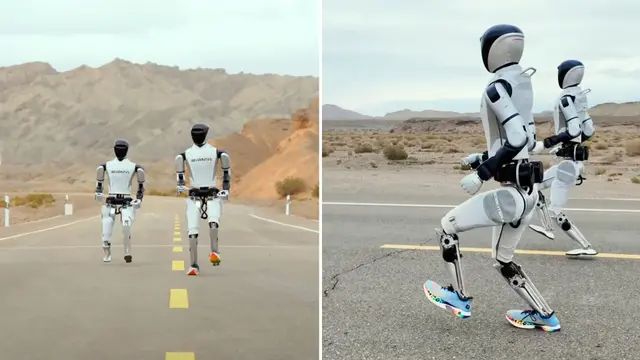
Yes, the future apparently showed up in sneakers.
When a Chinese humanoid robot called STAR1 started tearing across rough ground in running shoes, the internet reacted the way it usually does when a machine does something oddly human: with equal parts amazement, skepticism, and a tiny whisper of, “Well, that’s not unsettling at all.” But beneath the meme-worthy visuals was a real engineering story. The robot did not merely jog for clicks. It demonstrated how small physical changes at ground level, including traction, cushioning, and impact control, can help unlock better performance in humanoid robotics.
That is what makes the headline so compelling. A pair of running shoes sounds like a punchline, but in robotics it points to something serious: the feet matter just as much as the brain. Fancy AI gets the headlines, but the moment a robot starts moving quickly over actual terrain, physics becomes the boss. And physics, unlike social media, does not care how futuristic your promo video looks.
The sprint that turned a gimmick into a serious robotics story
RobotEra’s STAR1 made waves after a 2024 outdoor running demonstration in China showed the humanoid moving at roughly 3.6 meters per second, or a little over 8 miles per hour. That pace pushed it beyond the earlier speed mark associated with Unitree’s H1 and made STAR1 the latest symbol of China’s fast-moving humanoid robot race. On paper, the difference between 3.3 m/s and 3.6 m/s may not sound dramatic. In robotics, however, that jump is meaningful. When you are balancing a full-size machine on two legs, every tenth of a meter per second is a negotiation with gravity, momentum, vibration, and disaster.
The visual hook was even better than the number: STAR1 was wearing running shoes. That detail made the story instantly shareable, but it also raised the right question. Were the shoes just there for show, or did they genuinely help the robot run faster and more steadily?
The smart answer is: probably both. The shoes made the demo easier to understand for a general audience, and they likely offered real mechanical advantages. In other words, the sneakers were not just a costume. They were part of the system.
Why running shoes can help a humanoid robot
Traction is the least glamorous hero in robotics
Fast bipedal locomotion is not only about how forcefully a robot pushes down. It is also about how reliably the ground pushes back. On dirt, gravel, pavement, and mixed surfaces, a little slippage can wreck timing, shorten stride length, and trigger balance corrections that slow everything down. Good running shoes improve grip. Better grip means cleaner contact. Cleaner contact means the robot wastes less energy correcting micro-slips and can put more of its power into forward motion.
Humans take this for granted. Runners change footwear for road races, trails, treadmills, and muddy conditions because outsole design matters. A humanoid robot faces the same basic truth, except it does not have instinct, pain, or a lifetime of movement adaptations to compensate when things get sketchy. A robot depends on repeatable contact conditions. Give it better grip, and you give its control system a more predictable world.
Cushioning acts like a peace treaty between the robot and the ground
Every foot strike creates impact forces that travel upward through the structure. In humans, muscles, tendons, joints, and soft tissue absorb and redistribute a lot of that load. A robot has motors, linkages, joints, controllers, and materials with far less biological forgiveness. Cushioning can reduce harsh impact spikes, soften landings, and help protect hardware from repeated shock. That can improve durability, stability, and confidence at speed.
This does not mean “the squishier, the better.” Too much softness can create instability, reduce precision, and make motion control harder. The sweet spot is controlled compliance: enough give to manage impact, not so much that the machine starts moving like a shopping cart with one bad wheel.
Stiffness and energy transfer matter more than people realize
Running shoe construction can influence bending stiffness, toe-off efficiency, and energy return. In human footwear research, shoe design affects running economy, comfort, and force patterns. For robots, similar principles apply in a more mechanical way. A better interface between foot and ground can improve how efficiently force is transferred during push-off. Think of it as the difference between launching from a springboard and launching from a wet sponge.
That is why the STAR1 demo matters beyond its headline. It suggests that humanoid performance is not just a software problem or a motor problem. It is also a contact problem. The foot is where code meets reality.
How big the speed jump really was
In absolute terms, 8 miles per hour is not superhuman. It is a brisk recreational running pace for many people. But that comparison misses the point. Humanoid robots are not trying to beat trained runners yet; they are trying to run at all with stability, repeatability, and some hope of not face-planting into next Tuesday.
Measured against the state of the field, STAR1’s result was significant because it showed how quickly full-size bipedal robots were improving. Earlier machines often looked impressive in carefully staged lab clips but struggled with uneven terrain, longer runs, and transitions between surfaces. STAR1’s mixed-terrain performance suggested a broader kind of competence, not just a pretty treadmill trick.
That said, anyone covering humanoid robot speed records should keep one eyebrow raised. Different companies test under different conditions. Some use controlled indoor environments. Some use short bursts. Some publish top speed. Others emphasize sustainable speed. Some compare walking, jogging, and true aerial-phase running as if they are interchangeable. They are not. In robotics, a “record” can be meaningful and still require asterisk-sized reading glasses.
Why China keeps making running humanoids
China’s robotics sector has been moving with unusual urgency, and the public demonstrations are part of that strategy. Running humanoids, robot games, half marathons, dance performances, and flashy motion demos are not random acts of tech theater. They are marketing tools, recruitment tools, investor tools, and national capability signals all at once.
There is also a practical reason for this emphasis. Running exposes a robot’s weaknesses quickly. It tests actuator performance, balance recovery, perception, terrain adaptation, thermal behavior, power efficiency, and mechanical robustness. A humanoid that can move dynamically over uneven surfaces is much closer to being useful in warehouses, industrial sites, logistics centers, or disaster zones than a humanoid that can only wave politely and hold a brochure.
So yes, the videos are theatrical. But they are not meaningless. They are stress tests wearing the costume of a viral clip.
The catch: fast robots are not automatically useful robots
This is where the article gets to take off its party hat and put on reading glasses.
Humanoid running demos are impressive, but real-world performance remains uneven. China’s 2025 humanoid half-marathon provided a memorable reality check. The spectacle was historic, but it also revealed how fragile many of these machines still are. Some robots stumbled. Some overheated. Some needed heavy operator support. Battery management became a starring character. The event was less “robot Olympics” and more “engineering thesis under pressure.” Fascinating? Absolutely. Smooth? Not exactly.
That contrast makes STAR1’s shoe-assisted speed story more interesting, not less. It reminds us that robotics progress often arrives in layers. First, a machine proves it can do something in a demo. Then it proves it can do it repeatedly. Then it proves it can do it outside the lab. Then it proves it can do it without a pit crew, duct tape, and a prayer. Humanoid robotics is somewhere in the middle of that ladder.
What the shoes reveal about the future of humanoid design
The obvious lesson is that end-effectors are not limited to hands. Humanoid feet deserve the same level of design obsession as grippers and vision systems. If a robot’s mission involves moving quickly through the human world, foot-ground interaction may become a configurable subsystem rather than a fixed piece of hardware.
That opens interesting possibilities. Future humanoids may use swappable soles for indoor floors, rough outdoor terrain, factory grates, wet surfaces, or stairs. Some may rely on passive materials that improve shock absorption. Others may use semi-active soles that adapt stiffness in real time. Shoe-like attachments could become the robot equivalent of tires, crampons, or cleats. It sounds funny right up until it becomes normal.
There is also a business angle here. A company building humanoids for logistics or industrial inspection may not need a robot that can sprint. It may need a robot that can stay upright for a long shift, carry loads, and move safely across variable flooring. The footwear lesson still applies. Better traction and better impact management mean safer, cheaper, and more reliable operation.
Why this matters beyond a flashy headline
The STAR1 story works because it sits at the intersection of three fast-growing industries: humanoid robotics, artificial intelligence, and performance footwear science. It shows that robotic progress is rarely about one magic ingredient. Not the AI alone. Not the motors alone. Not the battery alone. The breakthrough often comes from stacking many small gains that reinforce each other.
That is how most meaningful technology evolves. A robot gets a little stronger. A controller gets a little smarter. A battery gets a little lighter. A sensor gets a little faster. A shoe gets a little grippier. Suddenly the “little” improvements stop looking little. They add up to a machine that can do something yesterday’s machine could not.
And that is why the running shoes matter. They are not a novelty tacked onto a robot for laughs. They are a clue. They tell us the field is entering a phase where hardware details at the edge of the system can create big differences in real-world performance.
Experience and perspective: what this moment feels like from the sidelines
Watching a humanoid robot run in sneakers creates a very specific kind of amazement. It is not the same feeling as watching a drone, a self-driving car, or a robotic arm on an assembly line. Those machines look like machines doing machine things. A humanoid in running shoes feels different because the visual language is borrowed directly from people. The brain sees the shape of a runner, the rhythm of a stride, the little bounce of motion, and immediately tries to interpret the scene as human. Then it remembers, a split second later, that the figure charging across the landscape is a metal-bodied system full of motors, controllers, and carefully tuned code. That delay between recognition and realization is where the weirdness lives.
There is humor in it, of course. A robot in sneakers sounds like a joke from a writer’s room that got accidentally funded. The image is so oddly relatable that it slips past technical jargon and lands in ordinary conversation. People who could not care less about actuator torque or gait optimization suddenly have an opinion. They laugh, then lean in, then ask a surprisingly smart question: did the shoes actually help? That is a useful cultural moment. It turns a niche engineering topic into something the broader public can understand.
There is also a quiet shift in emotional tone when you keep thinking about it. At first the clip feels playful, almost cartoonish. Then the implications arrive. If a robot can move faster, more stably, and with better terrain handling because its foot interface improved, then progress in humanoids may not come only from giant leaps in artificial intelligence. It may come from humble physical refinements that are easy to miss. The lesson is oddly human. Sometimes the breakthrough is not a bigger brain. Sometimes it is better shoes.
For engineers, that is exciting because it validates a systems view of robotics. For everyone else, it is a glimpse of how normal advanced machines may start to feel. Not through one dramatic sci-fi reveal, but through a series of strangely familiar moments. A robot climbing stairs. A robot carrying boxes. A robot jogging across gravel in athletic footwear like it has somewhere to be. Each scene chips away at the distance between “research project” and “practical machine.”
Still, the experience is not pure awe. There is a healthy skepticism mixed in, and that skepticism is good. Demos are edited. Conditions are chosen. Record claims are often slippery. Anyone who has watched enough tech hype knows that one smooth clip can hide ten failed attempts just outside the frame. That does not make the achievement fake. It just means the real story is broader than the prettiest shot. The real story includes tuning, trial and error, broken parts, thermal limits, battery swaps, and the unglamorous grind required to make a two-legged machine look graceful for even a short stretch of time.
In that sense, the STAR1 moment feels like a preview rather than a finale. It is not the day humanoid robots became finished products. It is the day many people realized the field is becoming mechanically sophisticated in ways that are easy to grasp and hard to dismiss. The sneakers made the story memorable, but the deeper impression comes from what they symbolize: robotics is moving from pure spectacle toward a more mature understanding of how machines actually survive contact with the real world. And real-world performance, unlike buzzwords, always starts at ground level.
Final thoughts
Chinese humanoid robot establishes new running speed courtesy of running shoes is the kind of headline that sounds ridiculous until you read the engineering behind it. Then it becomes something better than a novelty. It becomes a snapshot of where humanoid robotics is headed.
STAR1’s sneaker-assisted run showed that locomotion breakthroughs can come from the ground up, literally. Better grip, smarter impact control, more efficient force transfer, and more stable contact with real terrain all matter. The lesson is bigger than one robot and one demo. In the race to build useful humanoids, intelligence will matter. Power systems will matter. Materials will matter. And yes, sometimes the thing that moves the field forward will be the robotic equivalent of lacing up properly before a run.
The future of humanoid robotics may still involve dazzling AI, dexterous hands, and factory-scale deployment. But every once in a while, progress arrives in the most relatable way possible: one step at a time, in a decent pair of shoes.