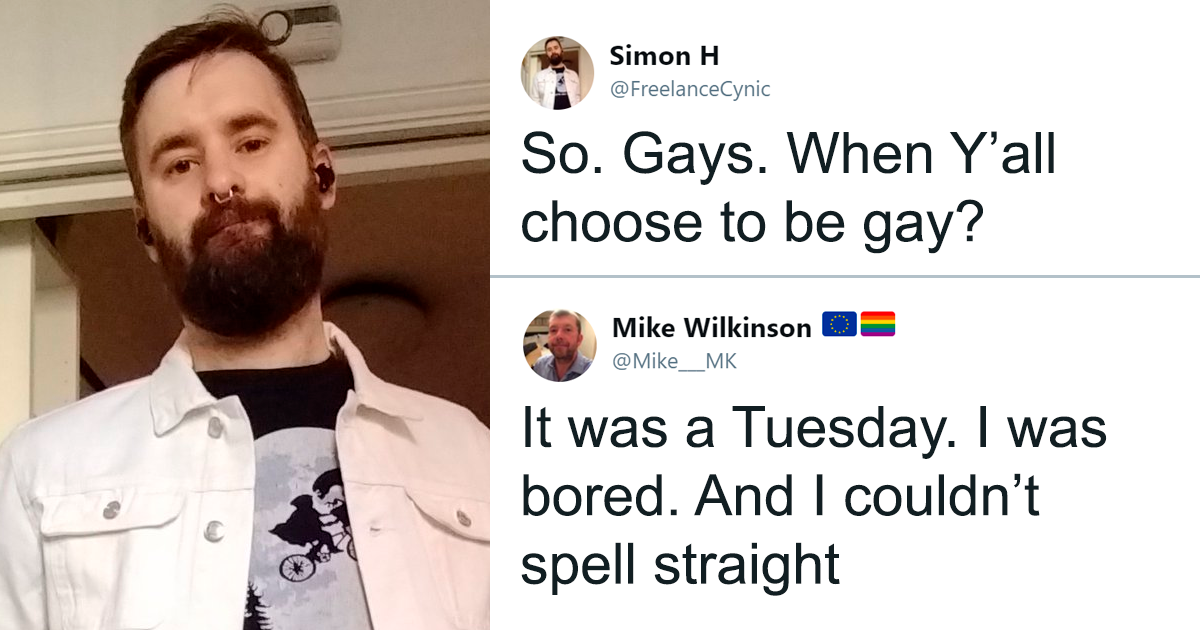
Note: This article uses the phrase “decided to be gay” as irony. Sexual orientation is not a casual lifestyle switch, a weekend hobby, or something a person selects from a menu between “extra fries” and “no pickles.” The point of the viral joke is exactly the opposite: many gay men use humor to expose how absurd it is to claim that being gay is simply a choice.
The Joke That Works Because It Is Not Really A Joke
Every so often, the internet does what the internet does best: takes a tired argument, shakes it by the shoulders, puts a party hat on it, and sends it back into public conversation looking ridiculous. That is exactly what happened when gay men began joking about the “exact moment” they supposedly decided to be gay.
The premise is simple. Some people still argue that homosexuality is a choice. In response, gay men answered with deeply sarcastic “origin stories.” One man might joke that he became gay after seeing a handsome actor on television. Another might claim he made the decision after hearing a dramatic pop song at full volume. Someone else might say it happened when he realized cargo shorts were not emotionally fulfilling. The details vary, but the punchline stays the same: nobody actually sat down with a clipboard and selected their sexual orientation like a gym membership.
That is why the title “25 Guys Are Sharing The Exact Moment They Decided To Be Gay, And It’s Irony At Its Purest” hits such a nerve. The humor is not random. It is a clever response to a serious misconception. Behind the jokes sits a larger truth about identity, self-understanding, social pressure, and the strange way comedy can make a point faster than a thousand angry comment threads.
Why “Decided To Be Gay” Became Such A Perfect Internet Punchline
The phrase “decided to be gay” is funny because it sounds like a business meeting with one agenda item: “New Year, New Me, Same-Sex Attraction.” Of course, real life does not work like that. Sexual orientation refers to patterns of romantic, emotional, and/or sexual attraction. People may discover it, name it, hide it, question it, accept it, or talk about it at different points in life. But discovering something about yourself is not the same as inventing it on purpose.
That distinction matters. A man may decide to come out. He may decide to date openly. He may decide to stop pretending. He may decide to tell his family, change his social circle, move to a more accepting city, or finally delete the “just bros being bros” playlist that fooled absolutely no one. Those are decisions. Being gay itself is not.
The viral posts work because they flip the accusation back on itself. Instead of writing a long academic essay, gay men answer with absurd mini-confessions: “I chose it because I wanted my life to include more awkward family dinners,” or “I became gay for the tax benefits, which, by the way, did not arrive.” The joke points out the obvious: why would anyone choose discrimination, rejection, bullying, legal uncertainty, or social judgment just for fun?
The Real Science: Orientation Is More Complex Than A Button
Major psychological and health organizations describe sexual orientation as a complex part of human identity. Researchers have studied possible genetic, hormonal, developmental, social, and cultural influences, but no single factor explains everyone’s orientation. In plain English: human attraction is not a vending machine. You do not insert a coin and receive “straight,” “gay,” “bisexual,” or “still figuring it out.”
The American Psychological Association has long explained that lesbian, gay, and bisexual orientations are normal expressions of human sexuality, not disorders. GLAAD also advises against language such as “sexual preference” because it can incorrectly suggest that being gay or bisexual is voluntary or curable. Planned Parenthood describes sexual orientation as being about who a person is attracted to and wants relationships with, including gay, lesbian, straight, bisexual, and asexual identities.
So when gay men joke about “choosing” to be gay because they saw a handsome lifeguard, a movie star, or a man with suspiciously perfect forearms, they are not presenting a scientific theory. They are using satire to dismantle a bad one.
Why Humor Can Be So Powerful In LGBTQ+ Conversations
Humor has always been one of the sharpest tools in LGBTQ+ culture. It softens tension, builds community, and turns pain into something people can hold without dropping it on their own feet. A witty post can say, “This stereotype is nonsense,” while making thousands of people laugh, nod, and share it with the cousin who still thinks sexuality is caused by theater camp.
That is why the “exact moment I decided to be gay” format spread so easily. It gave people a safe, funny way to respond to a hurtful claim. Instead of debating someone who refuses to listen, they could exaggerate the idea until it collapsed under its own silliness.
Example: The Pop Culture Awakening
Many gay men describe early moments of recognition through pop culture. A singer, actor, athlete, movie scene, music video, or fictional character may become the first clue that something inside them is different from what people expected. The internet turns that into comedy: “I decided to be gay after watching that one movie scene and realizing I was not paying attention to the plot.”
Of course, the scene did not create the orientation. It simply gave language to something that was already there. Pop culture often works like a mirror. It does not build your face; it helps you see it.
Example: The School Crush That Explained Everything
Another common theme is the school crush. A boy realizes he is more interested in the guy on the soccer team than the girl everyone says he should like. At the time, he may not have the vocabulary to explain it. Years later, he jokes, “I chose to be gay in math class, which explains why I remember nothing about algebra.”
The humor is playful, but the emotional truth is real. Many people look back and recognize patterns they could not understand when they were younger. Coming to terms with identity can feel less like making a sudden decision and more like rereading your own life with better lighting.
Coming Out Is A Choice, But Being Gay Is Not
This is the key difference that often gets lost. Coming out is an action. Sexual orientation is an identity. A person may choose when, how, where, and whether to disclose that identity. Those choices can be shaped by safety, family, religion, culture, school, work, and local laws.
For some people, coming out is joyful. For others, it is complicated, risky, or delayed for decades. Some gay men come out as teenagers. Some come out after marriage, children, military service, religious conflict, or years of trying to live a life that made everyone else comfortable but left them exhausted.
That is why the joke matters. When someone says, “You chose to be gay,” they erase the fear, courage, and self-discovery involved in living honestly. But when gay men respond with irony, they take control of the story. They say, in effect, “Fine, let’s pretend this was a choice. Let’s make that idea so ridiculous nobody can keep a straight face while defending it.”
What The Data Says About LGBTQ+ Visibility
LGBTQ+ visibility in the United States has grown significantly over the past decade. Gallup has reported rising LGBTQ+ identification among U.S. adults, especially among younger generations. Pew Research Center has also studied the experiences of LGBTQ+ Americans, including how many are out to someone and how acceptance varies across different groups.
These numbers do not mean more people are being “turned gay” by social media, rainbow logos, or one dangerously charismatic barista. A more realistic explanation is that more people now have the language and social space to describe themselves honestly. When stigma decreases, visibility increases. The closet gets less crowded because people finally find the door.
The Serious Side: Why The “Choice” Myth Can Cause Harm
The “being gay is a choice” argument is not just inaccurate; it can be harmful. If people believe sexual orientation is a voluntary behavior, they may support pressure, shame, rejection, or so-called conversion efforts. Major health and mental health organizations have rejected approaches that try to change a person’s sexual orientation, especially for minors.
Research and advocacy organizations have repeatedly warned that LGBTQ+ youth face higher risks of bullying, discrimination, poor mental health outcomes, and suicidal thoughts or behaviors when they are rejected or mistreated. The Trevor Project and CDC have reported serious concerns about bullying and mental health among LGBTQ+ youth. Support, acceptance, and affirming environments are not political decorations; they are protective factors.
That is why an ironic meme can do more than entertain. It can challenge a harmful belief in a format people actually read. Sometimes the shortest route to empathy is not a lecture. Sometimes it is a joke that makes a bad argument look exactly as silly as it is.
Why The Viral Thread Resonated With So Many People
The viral “I decided to be gay” responses resonated because they combined three powerful ingredients: shared experience, comedic timing, and righteous exhaustion. Many gay men have heard the same question again and again: “When did you choose this?” The joke answers, “At 8:43 p.m., after careful review of the available options and a presentation from the Council of Fabulousness.”
That exaggeration works because it reveals the absurdity of the original question. Most straight people are never asked when they decided to be straight. Nobody demands a childhood receipt proving heterosexuality. Nobody says, “Was it the first time you saw a woman in a shampoo commercial, or did you file paperwork?” The double standard is obvious once you put it in comic lighting.
What Readers Should Take Away
The best way to understand the joke is this: the “decision” was never about becoming gay. It was about deciding to stop pretending the truth was not there. It was about choosing honesty over performance, self-respect over shame, and joy over the exhausting full-time job of passing as someone else.
For some, that moment is quiet. For others, it is dramatic. For many, it is not one moment at all, but a series of small realizations. A crush here. A song lyric there. A friendship that felt like lightning. A movie scene that suddenly made the room too warm. A conversation that unlocked a door. A joke online that made someone think, “Oh. That sounds like me.”
Extra Experiences Related To The Topic
One of the most relatable experiences behind this topic is the slow-motion realization. Many gay men do not describe their identity as a lightning strike. Instead, they remember a collection of small signs that only made sense later. Maybe they were unusually invested in a male celebrity. Maybe they felt nervous around a friend and could not explain why. Maybe they practiced being “normal” so carefully that normal started to feel like a school play with bad costumes.
Another common experience is the “I thought everyone felt this way” stage. A young man might assume all boys secretly notice other boys but simply do not talk about it. He may think attraction is something people exaggerate for social reasons. Then, slowly, he realizes his friends are not pretending to like girls. They actually do. Meanwhile, he is emotionally preparing an Oscar speech because the quarterback smiled at him in the hallway.
There is also the experience of trying to negotiate with yourself. Some men spend years thinking, “Maybe this will pass,” or “Maybe if I date the right woman, everything will click.” These attempts are often painful because they are not based on honest desire; they are based on fear. The outside world says, “Choose differently,” so they try. But attraction does not respond well to committee meetings.
For others, the turning point arrives through community. Meeting openly gay friends can change everything. Suddenly, being gay is not an abstract label or a scary headline. It is a person laughing at brunch, building a career, loving a partner, calling their mom, paying rent, making bad coffee, and being wonderfully ordinary. Representation matters because it replaces fear with possibility.
Some men also describe their “moment” as the first time they felt peace. Not fireworks. Not drama. Peace. Maybe they said the words “I’m gay” alone in a car. Maybe they wrote it in a journal. Maybe they told one trusted friend and nothing terrible happened. That quiet relief can be more powerful than any grand announcement. It is the sound of a person finally putting down a heavy bag they were never meant to carry forever.
Then there are the funny moments: the childhood obsession with a superhero, the suspiciously passionate interest in men’s Olympic swimming, the “friendship” that involved staring into space for three business days after a compliment, or the realization that the romantic comedy’s male lead was far more interesting than the entire plot. These stories are funny because they are human. They are awkward, sweet, and familiar to anyone who has ever discovered something about themselves before having the words for it.
The irony, then, is not cruel. It is liberating. By joking that they “decided” to be gay, these men are actually saying they finally decided to be honest. They decided to laugh at a myth that once hurt them. They decided to turn a bad-faith question into a community punchline. And honestly, if that is not pure internet poetry, what is?
Conclusion
The viral idea of “25 guys sharing the exact moment they decided to be gay” works because it is satire with a backbone. It uses humor to expose a false belief: that sexual orientation is a simple choice. The jokes are funny, but the message underneath is serious. Being gay is not a phase selected for attention, rebellion, fashion, or better brunch invitations. It is a real part of human identity.
What people can choose is honesty. They can choose self-acceptance. They can choose who deserves access to their truth. They can choose to laugh at ignorance instead of letting it define them. And sometimes, they can choose to turn one of the most exhausting questions into a joke so good that the internet does the educational labor for them.