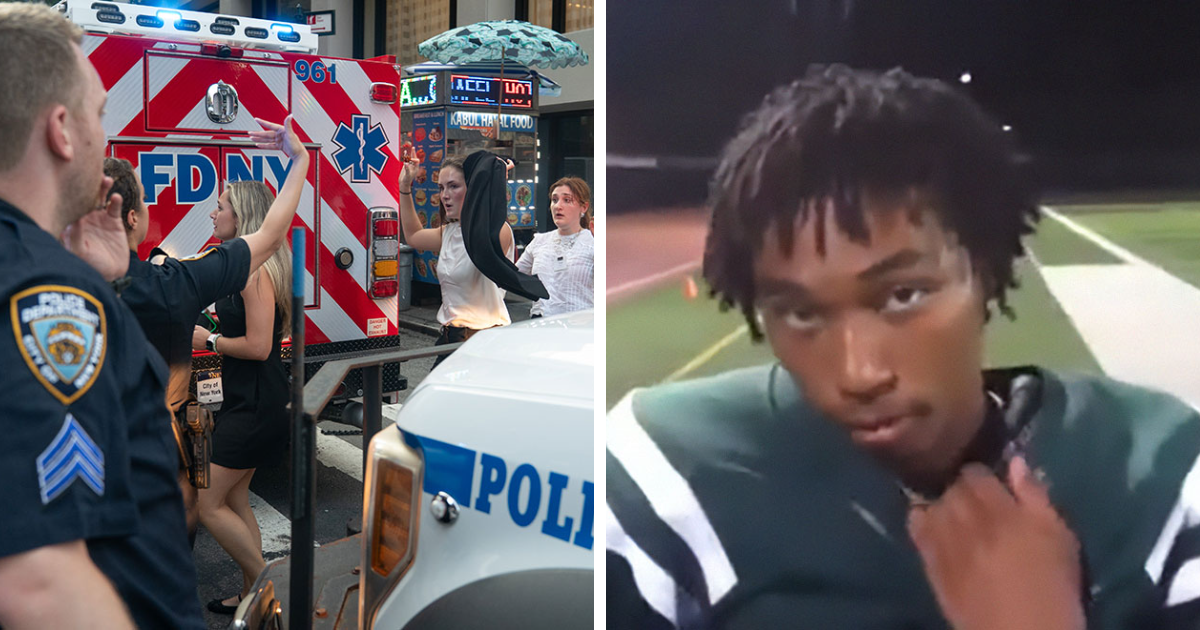
When investigators searched for answers after the deadly shooting at 345 Park Avenue in Midtown Manhattan, one discovery quickly became central to the public conversation: a handwritten note found with the shooter. The note, according to officials and multiple news reports, appeared to point toward a grievance involving the NFL, football-related brain injuries, and chronic traumatic encephalopathy, better known as CTE.
That does not mean the note explains everything. Real life is rarely kind enough to hand investigators a neat little envelope labeled “motive,” preferably color-coded and spell-checked. But it may help clarify why authorities believe Shane Tamura, the 27-year-old suspect from Las Vegas, traveled across the country and entered a Manhattan office tower that housed the NFL’s headquarters.
The attack killed four people and wounded others, leaving New York City shaken and families grieving. The note has since become a key piece of evidence, not because it excuses the violenceit absolutely does notbut because it offers a window into the shooter’s claimed thinking before the tragedy.
What Authorities Say Happened at 345 Park Avenue
The shooting took place on July 28, 2025, inside a Midtown Manhattan skyscraper on Park Avenue. The building is home to several major tenants, including the NFL, Blackstone, KPMG, and Rudin Management. Authorities identified the shooter as Shane Devon Tamura, who had recently been living in Las Vegas and working in a casino security role.
Officials said Tamura appeared to have intended to reach the NFL offices but took the wrong elevator bank. Instead, he ended up on a floor connected to Rudin Management. That detail has become one of the most haunting parts of the case: investigators believe the victims were not the people he had set out to confront, but they became the targets of his violence anyway.
Among those killed were NYPD Officer Didarul Islam, security guard Aland Etienne, Blackstone executive Wesley LePatner, and Rudin Management employee Julia Hyman. An NFL employee was also seriously injured. These names matter. In stories like this, the shooter’s note can become the loudest object in the room, but the victims’ lives should never become footnotes.
The Note and the Possible Motive
According to law enforcement sources cited by major outlets, the note found with Tamura referenced CTE, accused the NFL of concealing the dangers of brain injuries, and asked that his brain be studied. Officials also said he appeared to blame football for his condition.
The note reportedly mentioned the NFL repeatedly. That matters because the league’s offices were located inside the building, and Mayor Eric Adams said investigators believed Tamura was focused on the NFL. In plain English: authorities are not treating the building choice as random.
Still, motive is not a magic key. A note can reveal a grievance, but it cannot fully explain a human being’s path to mass violence. It can show what the attacker wanted others to believe. It can suggest obsession, resentment, or distorted logic. But investigators still have to study travel records, communications, mental health history, work history, weapon acquisition, digital activity, and interviews with people who knew him.
What Is CTE, and Why Did It Become Part of the Story?
Chronic traumatic encephalopathy is a degenerative brain disease associated with repeated head impacts. It has been studied most prominently in contact-sport athletes, including football players, as well as military veterans and others with histories of repetitive brain trauma.
Medical experts emphasize an important point: CTE cannot be definitively diagnosed in a living person using ordinary clinical tools. A confirmed diagnosis requires postmortem examination of brain tissue. That is why Tamura’s request for brain study became such a major part of the investigation.
In September 2025, the New York City Office of Chief Medical Examiner said its neuropathology experts found unambiguous diagnostic evidence of low-stage CTE in Tamura’s brain tissue. That finding confirmed that CTE was present. However, it did not prove that CTE caused the shooting. Brains are complicated. Human behavior is even more complicated. Put the two together and you get a puzzle that does not come with a cheerful instruction manual.
CTE Is Important, But It Is Not a Simple Explanation
The presence of CTE raises serious questions about repeated head impacts, youth football, long-term brain health, and how families recognize neurological or behavioral changes. But it would be irresponsible to say, “CTE made him do it.” Experts generally warn against drawing a straight line from a brain disease to a specific violent act.
CTE has been associated with problems such as mood changes, memory issues, impulsivity, and emotional regulation. But many people with brain injuries or mental health struggles never harm anyone. Most people facing pain, confusion, depression, anger, or neurological decline are far more likely to need help than to pose a threat.
That distinction matters. Otherwise, public discussion can slide into stigma faster than a coffee cup off a crowded Manhattan conference table. The responsible takeaway is not “people with CTE are dangerous.” The responsible takeaway is that brain health, mental health, access to care, crisis intervention, and violence prevention all deserve more serious attention.
The NFL Connection and a Long-Running Brain Injury Debate
The NFL has faced years of scrutiny over concussions and long-term brain disease. Former players, researchers, families, journalists, and public health advocates have pushed the league and the wider football world to confront the risks of repeated head trauma.
The Manhattan shooter had no known professional connection to the NFL. Reports describe him as a former high school football player, not a former NFL athlete. That difference is crucial. His apparent grievance was aimed at the league, but investigators have not reported evidence that the NFL personally caused his medical condition or had any direct relationship with him.
Even so, the case landed inside a national conversation that has been simmering for years: How much risk is acceptable in contact sports? Are young athletes and parents given enough information? Are schools, leagues, and medical systems prepared to track head impacts over time? And when someone begins to struggle after years of collisions, who notices before the crisis becomes catastrophic?
Why the Note Matters to Investigators
In criminal investigations, writings left by an attacker can help establish intent, planning, target selection, and state of mind. A note can show whether a location was chosen symbolically or strategically. It can help investigators determine whether others were involved, whether threats were made earlier, and whether the attack fits a broader pattern.
In this case, the note appears to support the theory that the shooter had a grievance involving the NFL and brain injury concerns. That is why it has been described as a possible clue to motive. But a clue is not the whole case. It is one tile in a very dark mosaic.
Investigators also looked at Tamura’s background, including his travel from Nevada to New York, prior mental health-related incidents reported by authorities, employment history, and the items found in his vehicle. Those details matter because mass violence is usually not caused by one factor. It is more often a convergence of grievance, access to weapons, crisis, planning, isolation, and missed warning signs.
The Victims Should Stay at the Center
Public attention often tilts toward the attacker because people want answers. That is understandable. But it can unintentionally give the perpetrator the spotlight he may have wanted. A more humane approach keeps the victims visible.
Didarul Islam was a New York police officer, an immigrant from Bangladesh, a husband, and a father. Aland Etienne worked security, a job that often demands calm professionalism even when nobody says thank you. Wesley LePatner was a respected executive and colleague. Julia Hyman was a young professional whose life and career were still unfolding.
Their families lost real people, not headlines. Their coworkers lost familiar faces. New York lost four lives in a place where thousands of people simply expected to finish the workday, ride the elevator down, and complain about traffic like normal citizens exercising their constitutional right to be annoyed by Midtown.
How News Readers Should Interpret the Motive
A careful reader should hold two ideas at once. First, the note is significant because it appears to show a grievance aimed at the NFL and connected to CTE. Second, the note should not be treated as a complete explanation or a medical conclusion.
The later CTE finding adds another layer, but not a simple answer. Low-stage CTE was found, yet experts still cannot say that it directly caused the attack. The fairest interpretation is this: the shooter believed brain injury and football were central to his suffering, and investigators believe that belief may have shaped his target selection.
That interpretation is sober, accurate, and much better than turning the case into a cable-news shouting match where everyone brings one fact and a megaphone.
What This Case Says About Warning Signs
Many public tragedies are followed by the same painful question: Could anyone have stopped it? The answer is often unsatisfying. Sometimes warning signs are visible only in hindsight. Sometimes they are scattered across states, agencies, workplaces, and family conversations. Sometimes people notice something is wrong but do not know what action to take.
That does not mean prevention is hopeless. It means systems matter. Employers need clear reporting paths for threatening behavior. Families need crisis resources that do not feel impossible to access. Law enforcement needs tools that balance public safety with civil rights. Schools and sports programs need better education about concussions and repeated head impacts. Medical providers need time, records, and communication channels.
No single policy catches every danger. But layered prevention can reduce risk. Think of it like airport security, except with fewer plastic bins and hopefully less sock exposure.
Experiences and Lessons Related to the Manhattan Shooter Note
One experience many people share after a high-profile tragedy is the uncomfortable urge to search for one clean reason. We want the note to explain the motive. We want the medical finding to explain the note. We want the building choice to explain the violence. That desire is human. It is also incomplete.
For office workers, the Manhattan shooting created a different kind of anxiety. Many people spend their days in towers with lobby guards, badge readers, elevator banks, delivery workers, visitors, and crowded entrances. The system feels ordinary until something breaks it. After an attack like this, workers may look at their own lobby and wonder whether security is truly prepared or simply part of the décor, like a very serious-looking potted plant.
The practical lesson is not to live in fear. It is to know the basics. Employees should understand emergency exits, shelter procedures, internal alert systems, and how to report concerning behavior. Companies should make safety training short, clear, and repeated often enough that people remember it without needing a 96-slide presentation narrated by someone named Brad from Compliance.
For parents and young athletes, the case also reopens the conversation about head injuries. A teenager does not need to be headed for the NFL for brain health to matter. Concussions should be taken seriously. Repeated head impacts should not be brushed off as “just part of the game.” Coaches, trainers, and parents should encourage athletes to report symptoms honestly and should never treat toughness as a substitute for medical judgment.
For readers following the news, another lesson is media hygiene. Do not share unverified claims. Do not turn the attacker into a dark celebrity. Do not treat early reports as final truth. In the first hours after a tragedy, information changes quickly. Responsible reporting often sounds less dramatic because it uses phrases like “authorities said,” “investigators believe,” and “the motive remains under review.” Those phrases are not weakness. They are seatbelts for facts.
Finally, this story is a reminder that grief and analysis can coexist. We can study the note, discuss CTE, examine security failures, and debate policy without forgetting the people who died. The point of understanding motive is not to satisfy curiosity. The point is to reduce the chance that another ordinary workday becomes a national tragedy.
Conclusion
The chilling note found with the Manhattan shooter may shed light on the motive, but it does not offer a complete explanation. It points toward a claimed grievance involving the NFL, football-related brain injury, and CTE. Later medical findings confirmed low-stage CTE, adding weight to part of the shooter’s own claim, while still leaving major questions about responsibility, causation, and prevention.
The clearest truth is also the most important: four innocent people were killed, others were injured, and a city was left searching for answers. The note matters because it helps investigators understand the attacker’s mindset. But the victims matter more because they are the reason the story must be told with care, accuracy, and humanity.
Note: This article is written for responsible web publication and avoids graphic details while summarizing publicly reported facts.