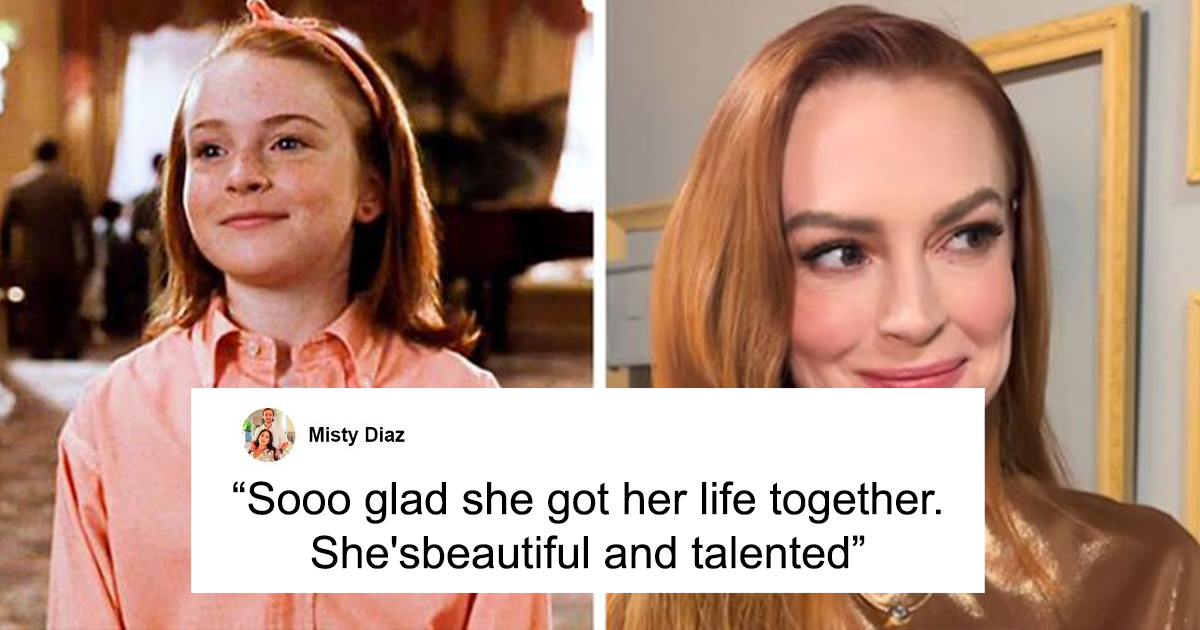
Lindsay Lohan just proved that some movie moments do not age; they simply wait patiently in the pop-culture pantry until someone pulls out the Oreos and peanut butter again. During a nostalgic appearance connected to The Tonight Show Starring Jimmy Fallon, Lohan recreated one of the most beloved scenes from Disney’s 1998 remake of The Parent Trap, and the internet responded exactly as expected: with squeals, childhood flashbacks, and a sudden craving for snacks that absolutely should not work together but somehow do.
The viral recreation brought back Hallie Parker and Annie James, the identical twins Lohan famously played as a child. In the clip, she appears alongside Jimmy Fallon in a playful backstage setup, recreating the moment when the twins realize they both like dipping Oreos in peanut butter. One Lindsay offers the cookie. Another Lindsay appears. Fallon looks like a man who has walked into a Disney Channel multiverse without signing the proper paperwork. And fans? Fans immediately lost it.
That reaction makes sense. The Parent Trap is not just another late-1990s family movie. For millions of viewers, it is a comfort-film landmark: summer camp mischief, secret twin swaps, British accents, Napa vineyards, the legendary Meredith Blake, and a soundtrack of feelings that still knows exactly where the nostalgia button is located. Lohan’s recreation worked because it was not trying too hard. It was simple, funny, and deeply familiarthe entertainment equivalent of finding an old friendship bracelet in a drawer.
Why Lindsay Lohan’s “Parent Trap” Recreation Went Viral
The biggest reason the moment exploded online is obvious: nostalgia travels fast. In the age of TikTok, Instagram Reels, and short-form video, a recognizable movie callback can reach people who watched the film on VHS, DVD, Disney+, or during a random family movie night. The Parent Trap has a rare cross-generational appeal. Millennials remember growing up with it. Gen Z discovered it through streaming. Younger viewers are meeting Hallie and Annie for the first time and wondering, quite reasonably, how one kid managed to play two kids so convincingly.
Lohan’s recreation also arrived during a broader public re-embrace of her career. After becoming one of the defining young stars of the early 2000s, she has stepped back into mainstream entertainment with projects such as Netflix romantic comedies and renewed interest in Disney-era favorites. Her return has been framed by fans less as a comeback and more as a celebration: a talented performer reconnecting with the roles that made audiences root for her in the first place.
The Fallon sketch worked because it played with the exact ingredients fans love: a recognizable setup, a wink to the original, and Lohan effortlessly sliding back into the dual-role energy that made her childhood performance so memorable. The clip did not need a long explanation. The moment she said the Oreo-and-peanut-butter line, the internet collectively remembered Camp Walden.
The Original “Parent Trap” Scene Still Has Magic
In the 1998 film, the Oreo scene takes place after Hallie and Annie have already clashed at summer camp. They begin as rivals, each convinced the other is an annoying mirror image sent by the universe to ruin fencing class and cabin peace. Then comes the moment of discovery. They talk, compare habits, and realize they share more than a face. The snack becomes a clue. Both girls enjoy Oreos with peanut butter, a strange little detail that turns into emotional evidence.
That is why the scene remains famous. It is not only about cookies. It is about recognition. The twins are finding pieces of themselves in each other, and the audience gets to feel the thrill of the secret forming in real time. The scene is sweet without being sticky, funny without breaking the story, and specific enough to become iconic. Peanut butter and Oreos may not be a scientifically necessary pairing, but in The Parent Trap, they are practically DNA testing with dessert.
Director Nancy Meyers, who made her feature directorial debut with the film, helped shape a world full of polished details: the cozy camp cabins, the London elegance, the warm California vineyard, and the kind of interiors that make viewers suddenly want copper pans and fresh flowers. But the Oreo scene stands out because it is charmingly small. It is the kind of childhood habit that feels believable, even when the story itself is deliciously improbable.
Lindsay Lohan’s Dual Performance Made the Movie Work
It is easy to forget how difficult Lohan’s role was because she made it look so natural. She did not simply play “the American twin” and “the British twin.” She created two distinct personalities. Hallie is bold, scrappy, and emotionally direct. Annie is poised, observant, and polished, but not stiff. When the twins switch places, Lohan also had to play each sister pretending to be the other sister, which is a level of acting gymnastics most adults would approach with a helmet and a waiver.
The film used visual effects, careful staging, and body-double work to make the twin illusion convincing, but the emotional trick belonged to Lohan. The audience had to believe Hallie and Annie were separate people with separate wounds, hopes, habits, and comedic timing. The fact that viewers still talk about the performance decades later shows how successfully she pulled it off.
That is why the viral recreation felt so satisfying. It reminded people of what Lohan delivered at such a young age: charisma, timing, and a screen presence strong enough to anchor an entire family comedy opposite herself. Not every actor can share a scene with their own edited double and make the chemistry feel real. Lohan did it before most kids are trusted to keep track of a lunchbox.
A Viral Moment Built for the Social Media Era
Social media loves instantly recognizable references. A clip does not need a full plot summary when it features one of the most quoted and rewatched scenes from a beloved movie. Lohan’s Fallon recreation was short, visual, and emotionally efficient. It gave viewers the pleasure of recognition within seconds.
It also invited interaction. Fans could comment about their favorite Parent Trap scenes, debate whether Oreos and peanut butter are genius or chaos, ask for another remake, or simply announce that their inner child was doing cartwheels. Viral nostalgia works best when it gives people a reason to share their own memories. This clip did exactly that.
Lohan has tapped into this before. In 2022, she delighted fans by joining TikTok and lip-syncing one of the film’s famous lines: “I have class and you don’t.” That earlier moment showed how eager audiences were to see her acknowledge the characters that helped launch her career. The 2024 recreation expanded that nostalgia from a single line into a mini-scene, complete with the visual gag of two Lindsays and one very confused Fallon.
Why “The Parent Trap” Still Connects With Audiences
Part of the film’s staying power comes from its fantasy. The idea that there could be another version of you somewhere in the world is irresistible. Add summer camp, secret plans, stylish parents, and a villainous almost-stepmother with perfect hair, and you have a movie that feels engineered for repeat viewing.
But the emotional center is more grounded. Hallie and Annie are not just trying to pull off a prank; they are trying to rebuild a family. The comedy works because it is attached to longing. The twins want to know the parent they lost. They want answers. They want love to make sense again. Beneath the bright Disney polish, the story understands that children often imagine bold solutions to adult heartbreak.
That mix of humor and vulnerability is why the film remains comforting. It offers an impossible plan and somehow makes it feel emotionally honest. Viewers remember the pranks, the handshake, the redheaded twin reveal, the camping disaster, and Meredith Blake’s wonderfully dramatic downfall. But they also remember the feeling of two girls discovering that their broken family might not be beyond repair.
The Fallon Recreation Was Also Smart Career Storytelling
Celebrity nostalgia can feel forced when it is used only as a marketing tool. Lohan’s Parent Trap callback felt warmer because it connected naturally to where she is now. She is an adult performer, a mother, and an actress returning to major fan conversations with a sense of humor about her own legacy. By revisiting Hallie and Annie, she did not freeze herself in the past. She showed that the past can still be playful.
The moment also linked neatly to renewed excitement around her Disney history. Fans have long associated Lohan with The Parent Trap, Freaky Friday, and Mean Girls. Each title represents a different stage of her pop-cultural identity: child star, teen comedy powerhouse, and early-2000s icon. Recreating a Parent Trap scene reminds audiences where that journey began.
For Fallon’s audience, the sketch provided an easy laugh. For Lohan’s longtime fans, it provided something more sentimental: proof that she understands why these roles matter. She did not have to distance herself from the character that made her famous. She could step back into the joke, smile, and let everyone enjoy seeing double again.
Specific Examples Fans Still Love From “The Parent Trap”
The Oreo and Peanut Butter Scene
This is the scene at the center of the viral recreation. It works because it turns a weird snack habit into a bonding moment. The humor is gentle, the reveal is clever, and the food choice is just strange enough to be unforgettable.
The Camp Walden Rivalry
Before Hallie and Annie become allies, they are enemies in matching faces. Their fencing match, prank war, and cabin punishment create the comic tension that makes their later sisterly bond more rewarding.
The Twin Switch
The makeover and training sequence is one of the film’s most satisfying parts. Hallie learns manners and British polish; Annie learns confidence and California casualness. It is makeover cinema with espionage energy.
Meredith Blake’s Camping Trip
Elaine Hendrix’s Meredith remains one of Disney’s most stylish antagonists. The camping sequence gives viewers comedy, justice, and a strong reminder that marrying into a family with two scheming twins is not for the faint of heart.
What the Viral Clip Says About Nostalgia Today
Nostalgia is no longer limited to anniversary specials or reunion interviews. It now lives in short clips, reaction videos, memes, and celebrity self-references. A single recreation can revive an entire wave of conversation about a film released decades earlier.
That is exactly what happened here. Lohan’s viral Parent Trap moment reminded fans of the original film, introduced younger viewers to the scene, and gave entertainment writers a reason to revisit her career arc. It also proved that some callbacks do not need reinvention. Sometimes the best strategy is to honor the original joke, keep the spirit intact, and let the audience bring the emotional fireworks.
In a media landscape full of reboots, sequels, and remakes, Lohan’s recreation was refreshingly low-pressure. It did not announce a new Parent Trap movie. It did not demand that fans accept a massive franchise expansion. It simply said, “Remember this?” And everyone did.
Fan Experience: Why This Moment Felt Personal
For many fans, watching Lindsay Lohan recreate a Parent Trap scene felt less like seeing a celebrity trend and more like opening a time capsule. The experience was personal because the movie itself is tied to ordinary memories: sleepovers, rainy weekends, family movie nights, summer breaks, and the first time someone tried Oreos with peanut butter just to see if Hallie and Annie were onto something. Some viewers probably discovered the combination and thought, “This is amazing.” Others probably thought, “This is a crime against cookies.” Either way, the movie made them try.
The viral clip also created a shared emotional reaction across age groups. Older fans remembered watching Lohan as a child actor and being amazed that she played both twins. Younger fans, especially those who found the film on streaming platforms, experienced the recreation as a bridge between the original movie and modern celebrity culture. It was the rare internet moment that did not require cynicism. Nobody needed to argue about whether the scene was “deep.” It was simply charming, familiar, and fun.
There is also something touching about seeing an actor revisit a role that shaped so many childhoods. Fans often build strong emotional connections with family films because they watch them during formative years. A character like Hallie or Annie becomes part of how viewers remember being young: curious, dramatic, mischievous, hopeful, and convinced that a sufficiently clever plan can fix almost anything. Lohan returning to that world, even briefly, gave audiences permission to feel that old affection without embarrassment.
The experience was especially powerful because Lohan’s career has been followed so publicly. Many fans who grew up with her have also watched the ups and downs of fame around her. Seeing her relaxed, playful, and warmly received made the recreation feel like more than a sketch. It felt like a little victory lap, but without arrogance. She was not saying, “Look how iconic I am.” She was saying, “Let’s have fun with this thing we all remember.” That difference matters.
From a viewer’s perspective, the best part may have been how quickly the scene transported people. One second, they were scrolling through their feeds; the next, they were back at Camp Walden, hearing British accents, imagining secret handshakes, and wondering whether Meredith Blake deserved better or deserved exactly what she got. That is the strange magic of internet nostalgia: it can compress 25 years into 25 seconds.
Ultimately, the viral recreation worked because it honored the fans’ relationship with the film. It did not mock the original. It did not over-explain the joke. It trusted the audience to remember. And when a movie memory is that beloved, trust is all you need. Add one cookie, one jar of peanut butter, two Lindsays, and one bewildered Jimmy Fallon, and suddenly the internet is a summer camp cabin again.
Conclusion
Lindsay Lohan’s viral recreation of the famous Parent Trap scene succeeded because it blended nostalgia, humor, and genuine affection for a movie that still holds a special place in pop culture. The Oreo-and-peanut-butter callback was small, but its impact was huge because fans did not just see a scene being repeated. They saw a beloved performer reconnecting with a role that helped define a generation’s childhood movie memories.
The moment also highlighted why The Parent Trap continues to endure. Its story is playful, its emotional core is sincere, and Lohan’s dual performance remains impressive decades later. Whether viewers came for Hallie, Annie, Meredith Blake, Camp Walden, or the snack combo that launched a thousand kitchen experiments, the viral clip reminded everyone that some movie magic never really leaves. It just waits for the right celebrity, the right talk show, and the right cookie.