Childhood is basically a tiny research lab run by someone who cannot reach the cereal shelf. Kids observe the world, collect suspicious evidence, ask three questions, ignore two answers, and then publish a bold theory in their own mind: the moon follows the family car, teachers live at school, and turning on the dome light while driving is a federal offense punishable by immediate parental panic.
That is why the question “What’s the most ridiculous thing you believed as a child?” never gets old. It unlocks a beautiful archive of kid logic, where every misunderstanding is both completely wrong and weirdly reasonable. A child does not know how airport luggage systems work, so why wouldn’t a suitcase ride one heroic conveyor belt all the way to Florida? A child sees black-and-white movies, so why wouldn’t they assume the old world had no color? Honestly, adults have believed worse after reading one bad comment section.
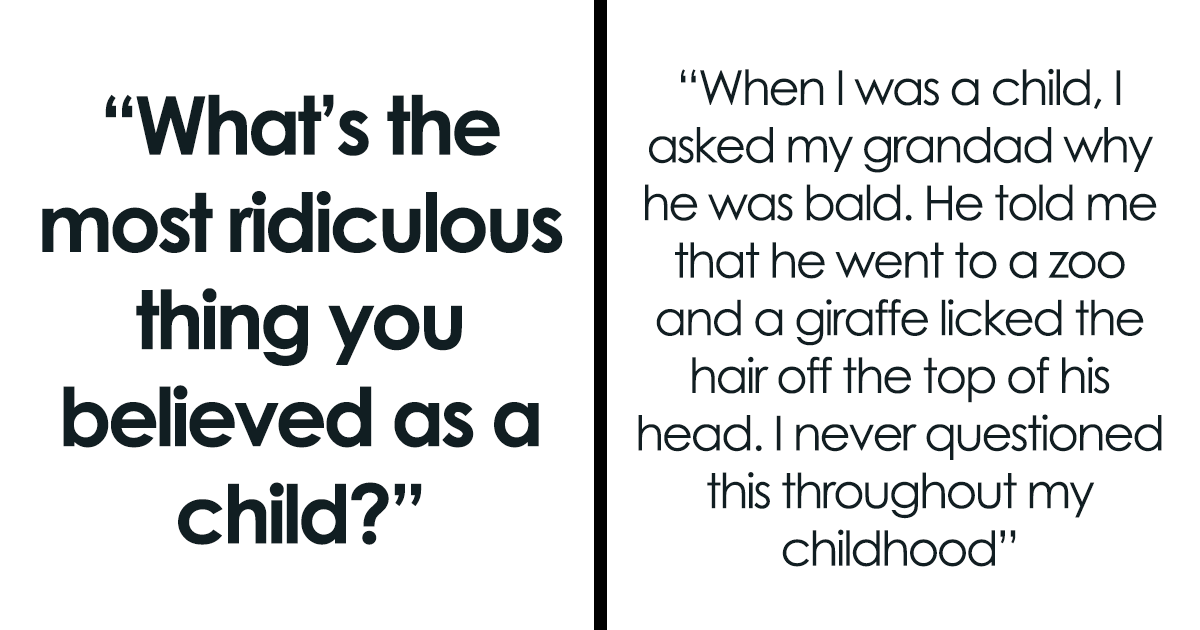
The viral answers to this question are funny because they reveal something universal: children are not stupid. They are simply building a model of reality with limited data, dramatic confidence, and occasional help from adults who say things like “a giraffe licked Grandpa’s hair off” and then act surprised when the child files that under Science.
Why Ridiculous Childhood Beliefs Make Perfect Sense
Funny childhood misconceptions usually come from three places: incomplete information, literal interpretation, and trusted adults. Children do not have decades of experience to compare against, so they connect the dots they can see. Sometimes the dots form a house. Sometimes they form a monster named Fred living in the attic and protecting the family at night.
Psychologists often point out that children gradually learn to separate fantasy from reality. They use context, existing knowledge, and trusted sources, much like adults do. The difference is that adults have more knowledge and have already learned that wrestlers probably do not have to fight each other at the grocery store. Probably.
Childhood beliefs also reveal the power of imagination. Pretend play, fantasy, and silly explanations are not just cute background noise. They help children test possibilities, practice problem-solving, and understand the social world. A child who believes the moon is chasing the car is also practicing observation, cause-and-effect thinking, and storytelling. The science is shaky, but the narrative arc is excellent.
30 Ridiculous Things People Believed As Kids
Here are 30 of the funniest, strangest, and most relatable childhood beliefs people have shared online, rewritten and grouped into a cleaner tour of kid logic at its finest.
- The moon was following the car. Many kids looked out the window and concluded the moon had chosen their family vehicle for a personal escort mission.
- Teachers lived at school. First-grade teachers apparently slept in supply closets, ate chalk for dinner, and waited patiently for Monday.
- Turning on the car light was illegal. Parents said it with such urgency that children imagined police helicopters circling the minivan.
- Quicksand would be a major adult problem. Cartoons and adventure movies made it seem like adulthood involved taxes, jobs, and weekly quicksand emergencies.
- Actors really died in movies. Some kids could not understand why anyone would accept a role if the script clearly ended badly for them.
- Old movies meant the old world had no color. Black-and-white footage looked like evidence that color was invented sometime after hats got smaller.
- Radio singers were inside the radio. The tiny band in the dashboard must have been exhausted after every road trip.
- Airport luggage took one long conveyor belt to the destination. The suitcase simply began its brave underground journey while passengers boarded the plane like amateurs.
- ATMs had a person inside handing out money. Somewhere in the wall, a tiny banker was counting twenties and judging your balance.
- Digging deep enough would reach another country. Many childhood explorers attacked the backyard with a plastic shovel and global ambition.
- The Tooth Fairy was one specific parent. Not “my parent helps the Tooth Fairy,” but “my parent is the Tooth Fairy, making me fairy royalty.”
- Monsters lived under the bed. A blanket was not bedding; it was a legal shield recognized by all creatures of the night.
- Professional wrestlers had to fight anywhere. If two rivals met in a supermarket aisle, the canned beans were going to witness history.
- Waves came from whales slapping the ocean. Incorrect, yes. But as ocean theories go, it has charm and decent visual effects.
- Dogs and cats were the male and female versions of one species. This one is wrong in several biological directions, but the confidence is impressive.
- Planes flew “up” to other countries. Australia was not across the world; it was just on a higher floor of the sky.
- Food traveled all the way to the feet. The digestive system, according to this theory, was basically a waterslide with socks at the end.
- Queen bees wore crowns. Honestly, they should. This misconception is more of a design suggestion.
- Thunderstorms were arguments between the sun and rain. Weather became a domestic dispute, and tomorrow’s forecast depended on who won.
- Santa and God were the same person. Both watched behavior, had mysterious powers, and were discussed in December. The confusion had paperwork.
- Wild animals automatically caused dramatic diseases. Parents trying to prevent raccoon hugs sometimes created lifelong medical cinema.
- Baldness could be caused by zoo animals. If Grandpa said a giraffe licked his hair off, who was a child to question zoological hair removal?
- The Statue of Liberty could be seen from anywhere. One child mistook a distant antenna for the statue, despite being very much not in New York.
- Adults had life automatically figured out. Money, houses, cars, groceriessurely these just arrived when you turned 18. Adulthood has since issued a correction.
- The point of football was to create the biggest human pile. To be fair, some games do not work very hard to disprove this.
- Pregnancy worked through the belly button. A child hears that the belly button once connected baby and parent, then builds an entire food-delivery system from that clue.
- Someone lived inside every machine. Vending machines, ATMs, radios, and elevators were apparently staffed by extremely patient tiny workers.
- The sun and moon were two sides of the same object. Day side, night side, cosmic coin flip. Wrong, but tidy.
- The edge of the bed was monster territory. One exposed foot meant instant danger. The blanket treaty had strict borders.
- Being grown up would be easy. This may be the funniest childhood belief of all, because adults are still waiting for it to become true.
The Main Types of Childhood Misconceptions
1. Literal Kid Logic
Children often take phrases exactly as they hear them. If an adult says, “Don’t drink and drive,” a child may not automatically understand that the phrase refers to alcohol. A parent sipping tea in traffic can suddenly become a criminal mastermind. The child is not being dramatic; they are applying the rule as stated. Adults, meanwhile, are learning the hard way that precision matters.
2. Media Confusion
Television and movies create some of the best childhood myths. A child sees quicksand in cartoons, movie characters dying, superheroes flying, and wrestlers solving conflict with folding chairs. Without enough real-world context, entertainment becomes evidence. This is why so many adults grew up expecting quicksand to appear in parks, parking lots, or possibly the hallway outside math class.
3. Technology Mysteries
Machines are magical until someone explains them. Radios, ATMs, airport baggage systems, vending machines, escalators, and car engines all invite tiny-worker theories. Before children understand circuits, logistics, banking networks, or recorded sound, “a person inside the box” is a perfectly efficient explanation. It is also more charming than most user manuals.
4. Parent-Created Legends
Some misconceptions are not invented by children at all. Adults plant them. Parents say the car light is illegal because they want to drive without glare. Grandparents invent giraffe-related baldness because it is funnier than genetics. Fathers create friendly attic monsters because bedtime apparently needed a horror-comedy subplot. Children trust adults, so these jokes can become official family doctrine.
5. Big Questions With Small Clues
Children ask huge questions about birth, death, weather, money, geography, space, and time. When they receive partial answers, they fill in the rest. That is how you get theories about food traveling to feet, planes flying upward to countries, and waves being generated by whales. The conclusions are wrong, but the impulse is intelligent: a child is trying to make the world coherent.
Why These Stories Feel So Relatable
The charm of ridiculous childhood beliefs is that they expose how learning actually feels from the inside. Nobody is born understanding taxes, pregnancy, film production, astronomy, or why luggage disappears into a rubber curtain at the airport. We learn by guessing, asking, watching, and being corrected. Sometimes the correction happens instantly. Sometimes it happens at age 19, in front of friends, when someone explains that giraffes are not a recognized cause of male-pattern baldness.
These stories also remind us that childhood is full of serious emotions attached to silly ideas. The kid afraid of quicksand was genuinely preparing for danger. The child worried about a parent “drinking and driving” was genuinely concerned. The child who believed a monster would bite an exposed foot was not pretending to be scared; the fear was real. The belief may be funny later, but at the time it shaped bedtime routines, classroom confessions, and the way a child looked at the world.
That is why the best response from adults is usually not mockery. Gentle explanation works better. Laughing with the child, not at the child, preserves curiosity. A ridiculous belief is often the beginning of a better question: How do movies work? Where do waves come from? Why does the moon look like it is moving with us? What does “drinking and driving” actually mean? The funny mistake becomes a doorway into real learning.
What Adults Can Learn From Kid Logic
Adults like to imagine they have outgrown childish assumptions. Then we confidently misread a bill, believe a fake headline for six minutes, or assume the printer is angry at us personally. The difference between child logic and adult logic is not always as large as we think. Adults still build stories from incomplete information. We still trust familiar sources. We still invent explanations when the real answer is hidden inside a machine.
That is why these childhood stories are more than nostalgic comedy. They are tiny case studies in how humans learn. We observe patterns. We assign causes. We trust people we love. We fear things we do not understand. Then, little by little, reality edits the draft.
And sometimes the first draft is better. “Waves come from whales” is scientifically false, but poetically superior. “Queen bees wear crowns” is inaccurate, but culturally appropriate. “Teachers live at school” is wrong, but every teacher grading papers at 8 p.m. may understand how the rumor started.
Extra Experiences: The Childhood Beliefs We Carry, Laugh At, And Secretly Miss
Almost everyone has one childhood belief that still makes them pause and think, “How did I ever accept that?” Maybe it was the fear that swallowing a watermelon seed would grow a fruit in your stomach. Maybe it was the suspicion that clouds were made in factories. Maybe it was the belief that adults knew exactly what they were doing, which is adorable because many adults are currently Googling how long rice lasts in the fridge.
The experience usually begins with a small misunderstanding. A child hears a sentence, sees an image, or witnesses a routine without context. The brain wants an answer, so it builds one. If Dad disappears behind the garage door and the car starts making noise, perhaps Dad is waking the car up. If Mom says money does not grow on trees, perhaps there is a specific tree somewhere that everyone keeps discussing because it used to work. If a teacher leaves the classroom through a side door, perhaps that door leads to the teacher’s bedroom, kitchen, and private chalk museum.
One of the funniest parts of growing up is realizing how confidently we defended these beliefs. Children do not usually say, “My current hypothesis is that the moon has selected our vehicle for surveillance.” They say, “The moon is following us,” with the calm authority of a scientist presenting final results. That confidence is precious. It comes from a time before embarrassment became a full-time hobby.
These experiences also become family folklore. Years later, relatives retell the story at dinners, weddings, and random Tuesdays when someone needs emotional ammunition. “Remember when you thought the ATM had a man inside?” Yes, Brenda, and remember when you printed MapQuest directions, so let us all be humble. The stories survive because they are affectionate proof that a person was once small, curious, and wonderfully wrong.
There is also a softer side to these memories. Childhood misconceptions remind adults of a world that felt more enchanted. Machines had people inside. The moon had intentions. Blankets had protective powers. The attic monster might be friendly. The world was confusing, but it was also alive with personality. Growing up gives us better facts, but it sometimes removes the sparkle. We learn that waves are caused by wind, gravity, and energy moving through water. That is useful and beautiful in its own way. Still, a tiny part of us may miss the whale version.
Parents, teachers, and caregivers can use these moments wisely. When a child shares a strange belief, it is an invitation, not a failure. Ask how they came up with it. Let them explain the evidence. Then offer the real answer in a way that keeps wonder intact. “No, the moon is not following our car, but it looks that way because it is so far away.” That answer gives the child truth without crushing the magic. Better yet, it teaches them that being wrong is not shameful. It is how thinking grows.
In the end, ridiculous childhood beliefs are not just jokes. They are souvenirs from the construction site of the mind. Every silly theory marks a moment when a child tried to understand a giant world using the tools available: imagination, trust, observation, and fearless creativity. The results were messy. The conclusions were often spectacularly incorrect. But the process was deeply human. And if we are honest, adulthood is just the same project with better vocabulary, higher stakes, and fewer acceptable excuses for believing there is a tiny banker inside the ATM.
Conclusion
“What’s the most ridiculous thing you believed as a child?” is a simple question with endless answers because childhood is full of serious little scientists making hilarious errors. From moon-chasing cars to school-dwelling teachers, from quicksand panic to tiny ATM workers, these stories prove that kid logic is not random nonsense. It is curiosity wearing mismatched socks.
The best part is that these beliefs connect people. Different families, countries, generations, and personalities still produce the same kinds of misunderstandings. We all tried to explain the world before we fully understood it. We all trusted someone who was joking. We all mistook a clue for a conclusion. And eventually, we all grew up enough to laughwhile quietly admitting that the blanket still feels safer when it covers both feet.